
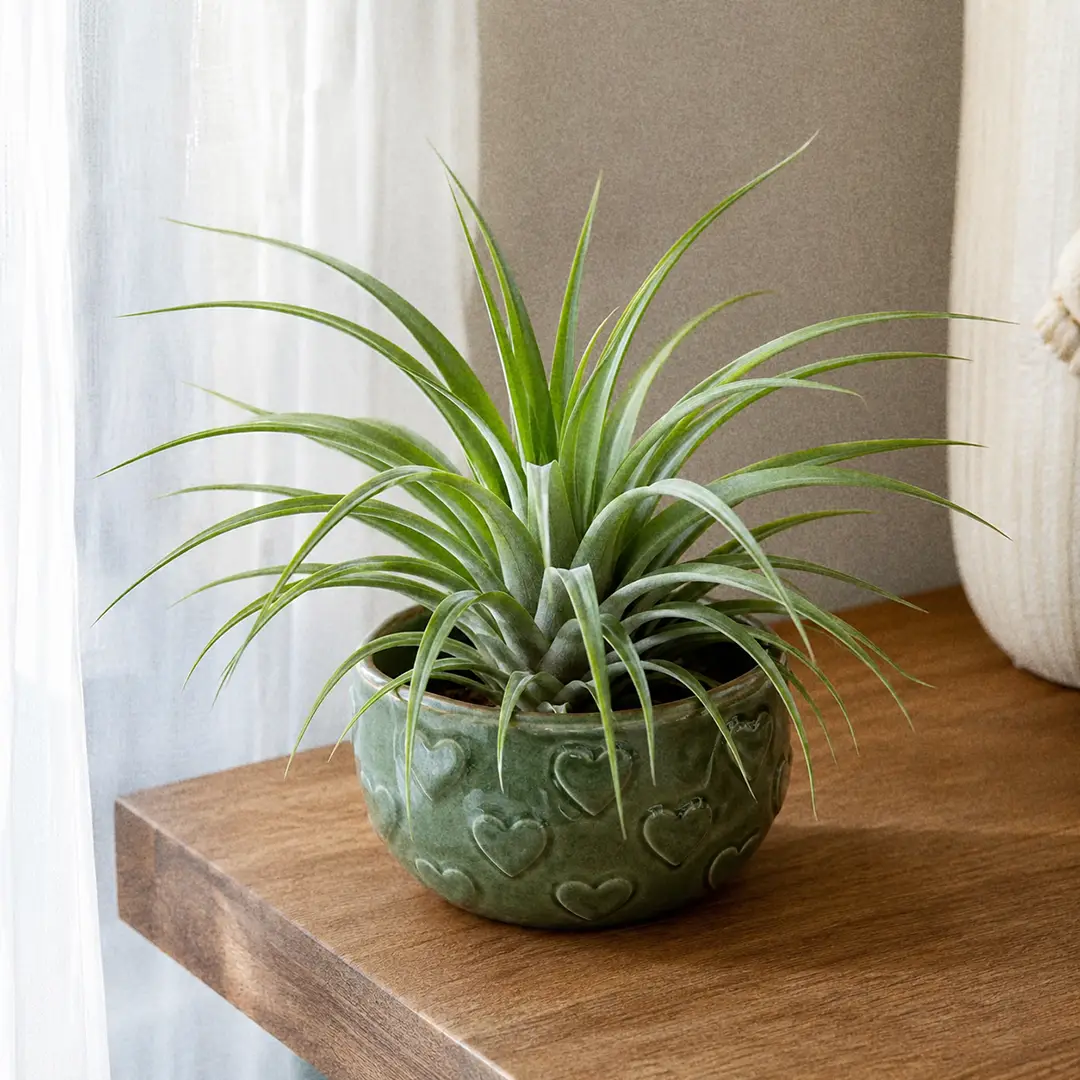
Brachycaulos Air Plant
Tillandsia brachycaulos
Tillandsia brachycaulos, Brachycaulos, Blushing Air Plant, Tillandsia abdita, Short-Stemmed Air Plant


Brachycaulos Air Plant is the Tillandsia that turns scarlet from the center out before it flowers, and it gets there in two or three years instead of ten. Learn how to water this thirsty mesic air plant, trigger the red blush, and raise the pups it leaves behind.
📝 Brachycaulos Air Plant Care Notes
🌿 Care Instructions
⚠️ Common Pests
📊 Growth Information
🪴 In This Guide 🪴

☀️ Brachycaulos Air Plant Light Requirements (Bright Filtered Light)
The Sweet Spot
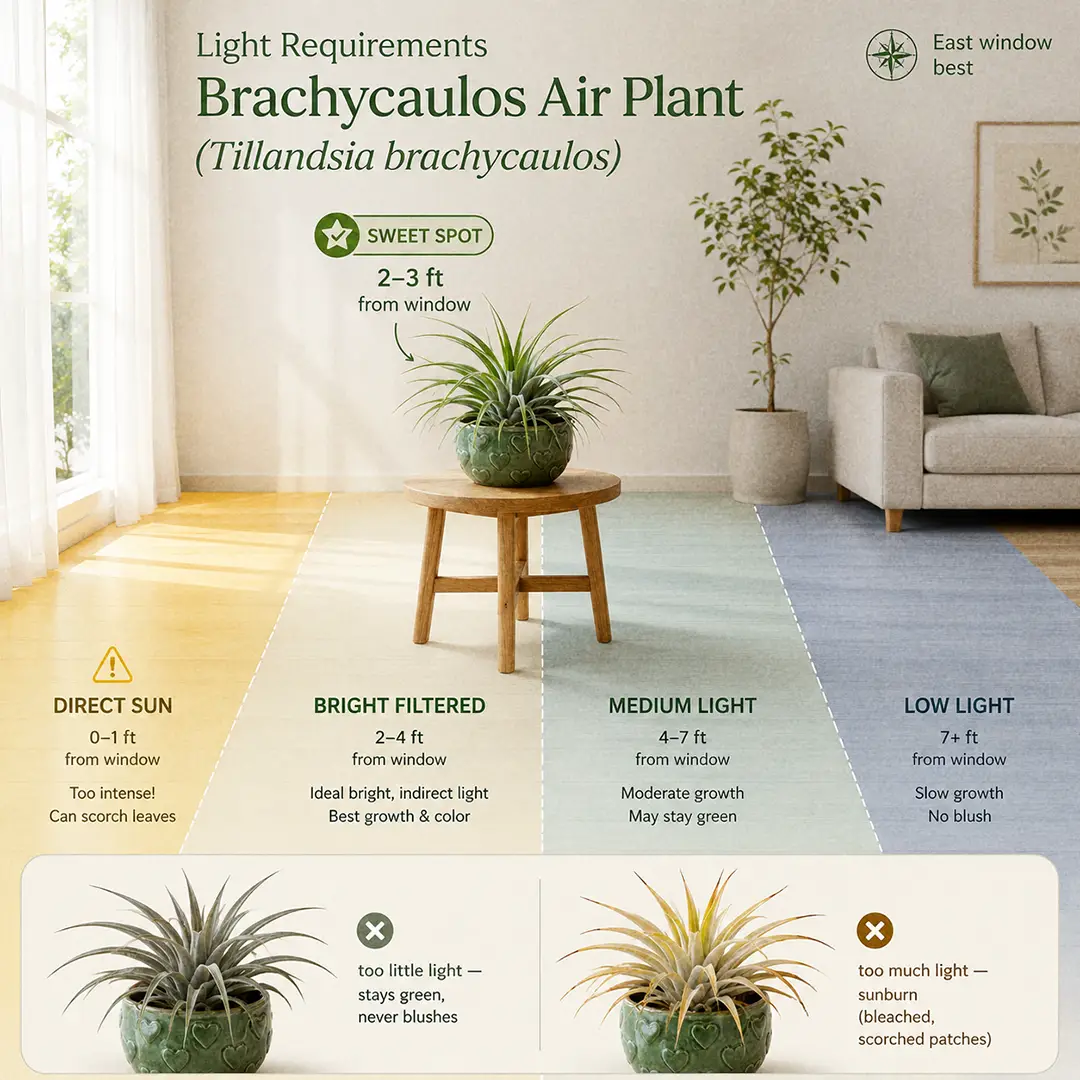
Brachycaulos wants bright but filtered light, roughly two to four feet back from an east-facing window. Morning sun through glass is fine and actually helps drive the red blush. Afternoon sun through a west or south window needs a sheer curtain between the plant and the glass.
This is a mesic Tillandsia, which is the piece of jargon worth learning. Mesic species come from shadier, damper forest branches and have smooth green leaves with relatively few trichomes, the tiny silvery scales that absorb water and also reflect sun. Xeric species like T. tectorum and T. xerographica are fuzzy and pale because they are built for open sun. Brachycaulos is not, so treat it more like a fern's neighbor than a cactus. Our Indoor Lighting Guide helps if you are still judging spots by eye.
Too Little Light
In a dim corner the plant stays flat green forever. The leaves loosen and splay outward instead of arching in a tight rosette, growth crawls, and the color goes dull and slightly grayish, which is pale faded leaves. Worse, it will never blush and never flower, which is most of the reason to own this plant.
Winter is where this bites in northern homes. If your bright spot goes gloomy from November onward, a grow light on a timer for ten hours a day keeps the rosette tight and the blush on schedule.
Too Much Light
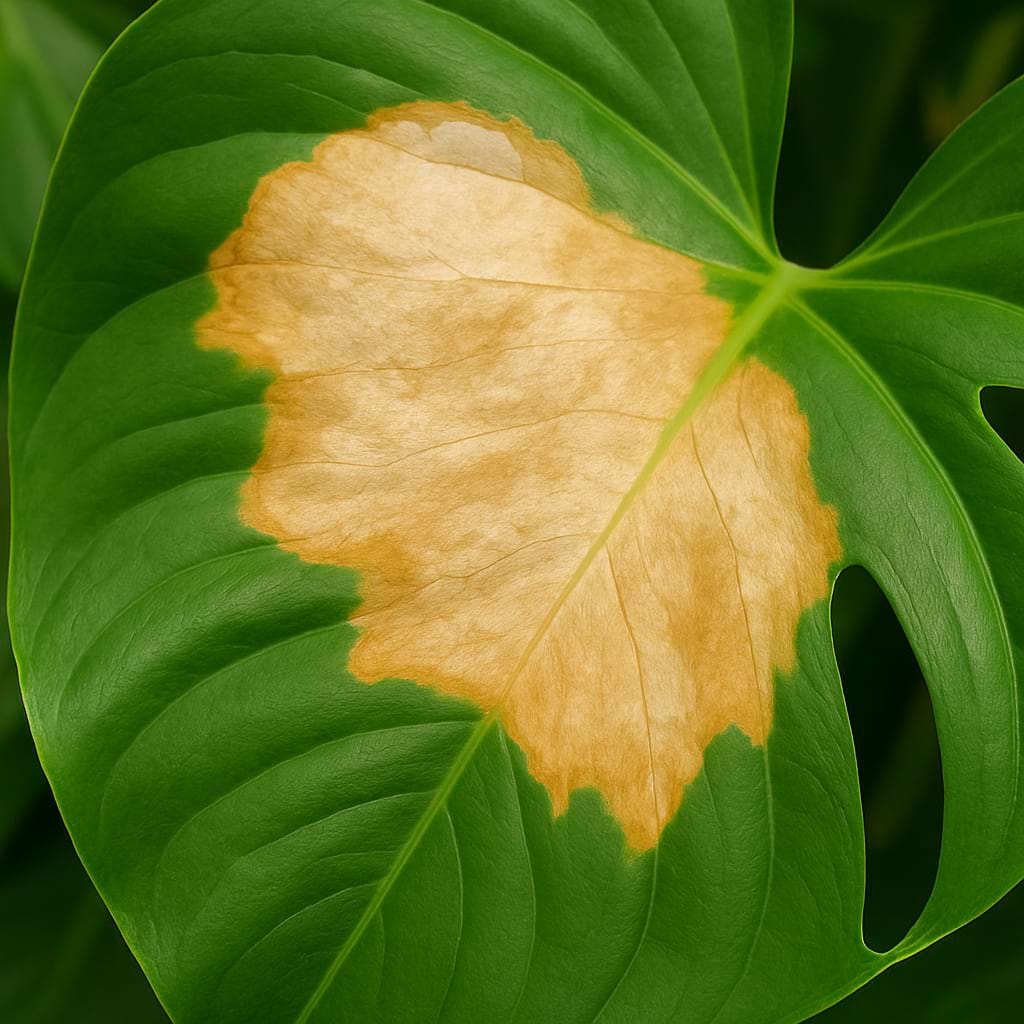
Direct midday sun through glass scorches this species quickly. You get bleached straw-colored patches on the leaves facing the window, and the tips go crispy far faster than watering alone explains. That is sunburn, and the damaged tissue never recovers.
A warm bronze or reddish cast in bright light is different and perfectly welcome. That is the same pigment that produces the full bloom blush, showing up early because the plant is getting plenty of light.
💧 Brachycaulos Air Plant Watering Guide (Soak and Invert)
Watering Frequency
Because it is mesic, Brachycaulos is one of the thirstiest air plants on the shelf. Soak it once a week as a baseline, and twice a week in a heated winter room or a dry summer one. The silvery xeric types get by on half that, so do not copy a care card written for the Xerographica Air Plant.
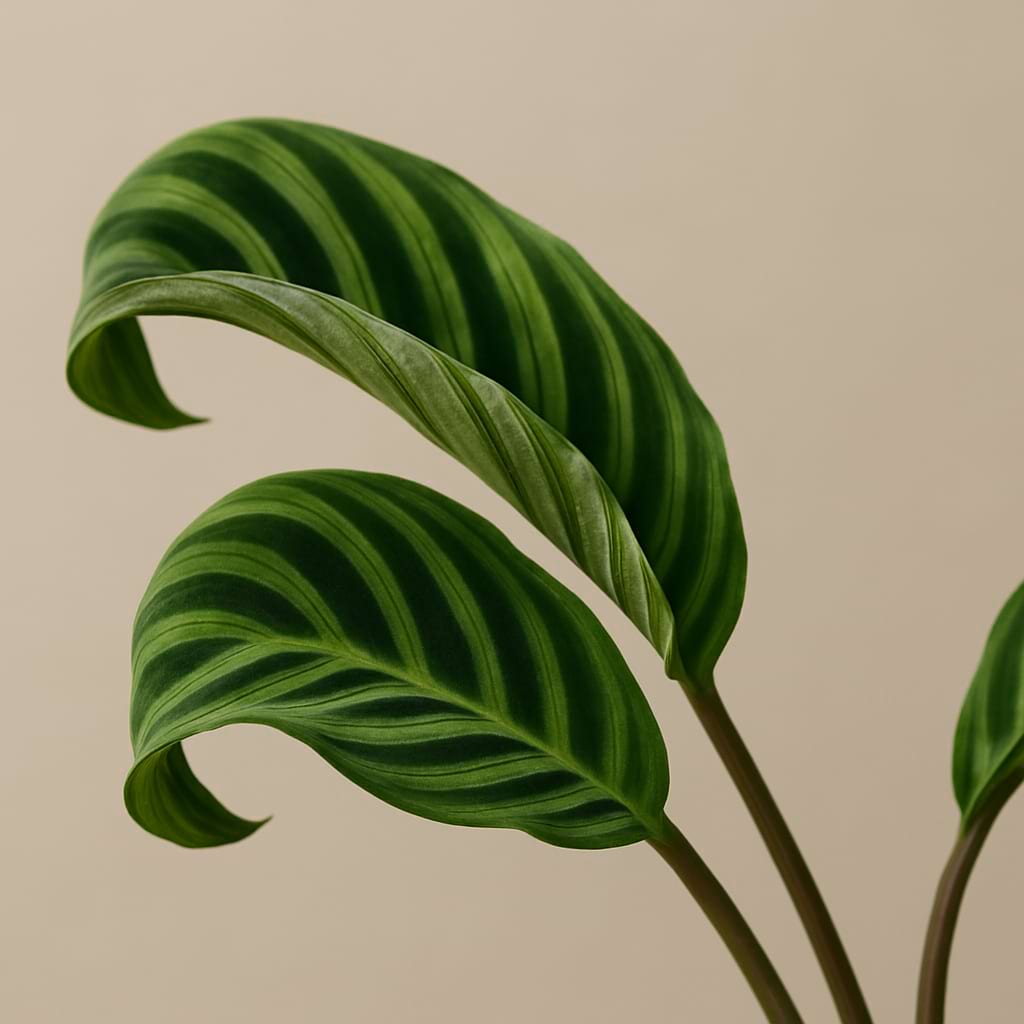
The plant tells you when it is thirsty, which is more reliable than a calendar. Hydrated leaves are relatively flat and arch outward in a loose fountain. A thirsty Brachycaulos rolls its leaves inward along the length, so the rosette looks narrower and more closed. That is curling leaves, and a proper soak reverses it within a few hours.
How to Soak and Dry
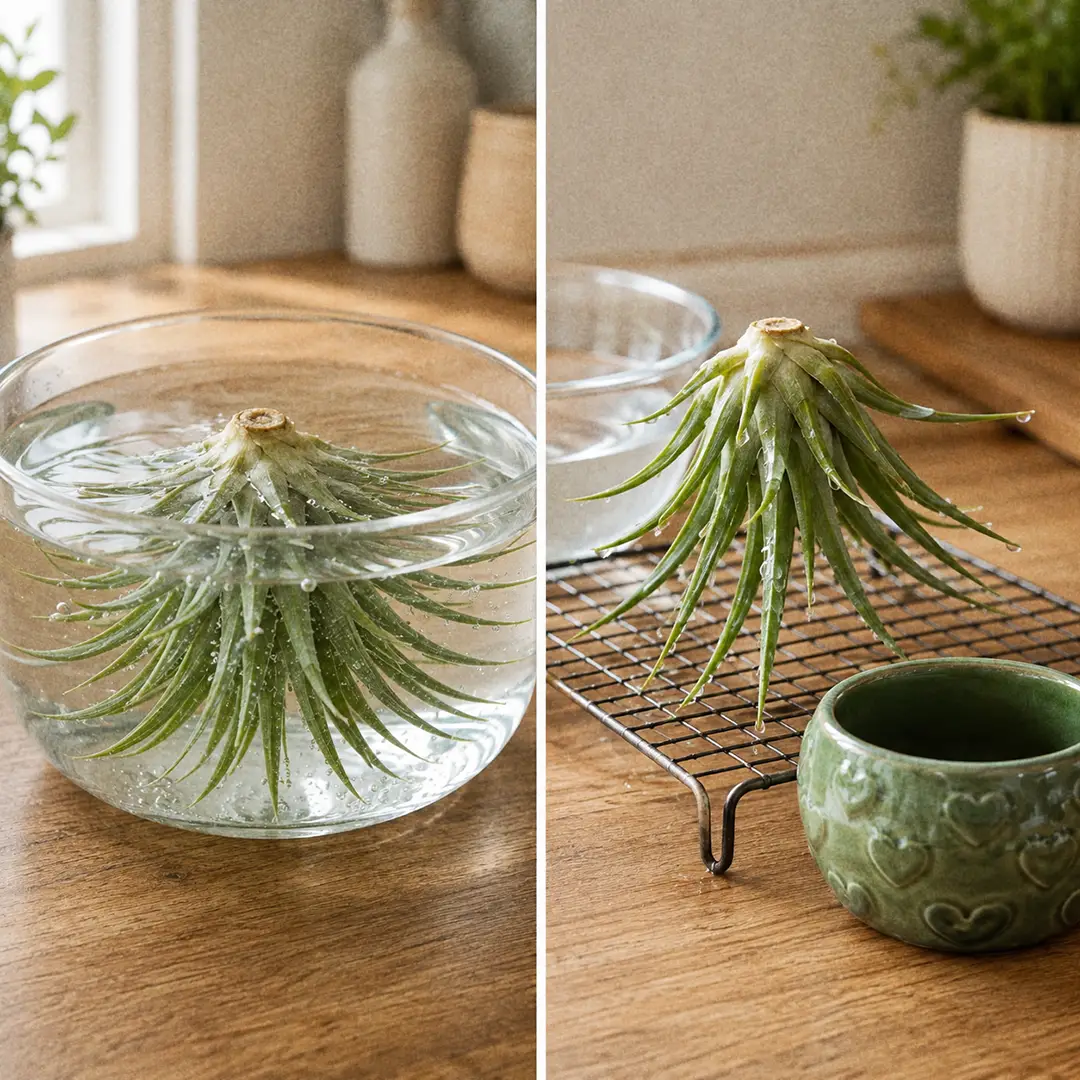
Drop the whole plant upside down into a bowl of room-temperature water and leave it 20 to 30 minutes. Rainwater, filtered water, or aquarium water is best. Avoid water from a softener, which is loaded with salt, and let heavily chlorinated tap water sit out overnight first.
Then comes the step that decides whether this plant lives. Lift it out, shake it hard to fling water out of the leaf axils, and set it upside down on a towel or a wire rack for three or four hours somewhere with moving air. Never return a damp plant to a closed globe, a shell, or a mossy nook. Our watering guide covers the general principles, but for a Tillandsia the drying half matters more than the wetting half.
Signs of Trouble
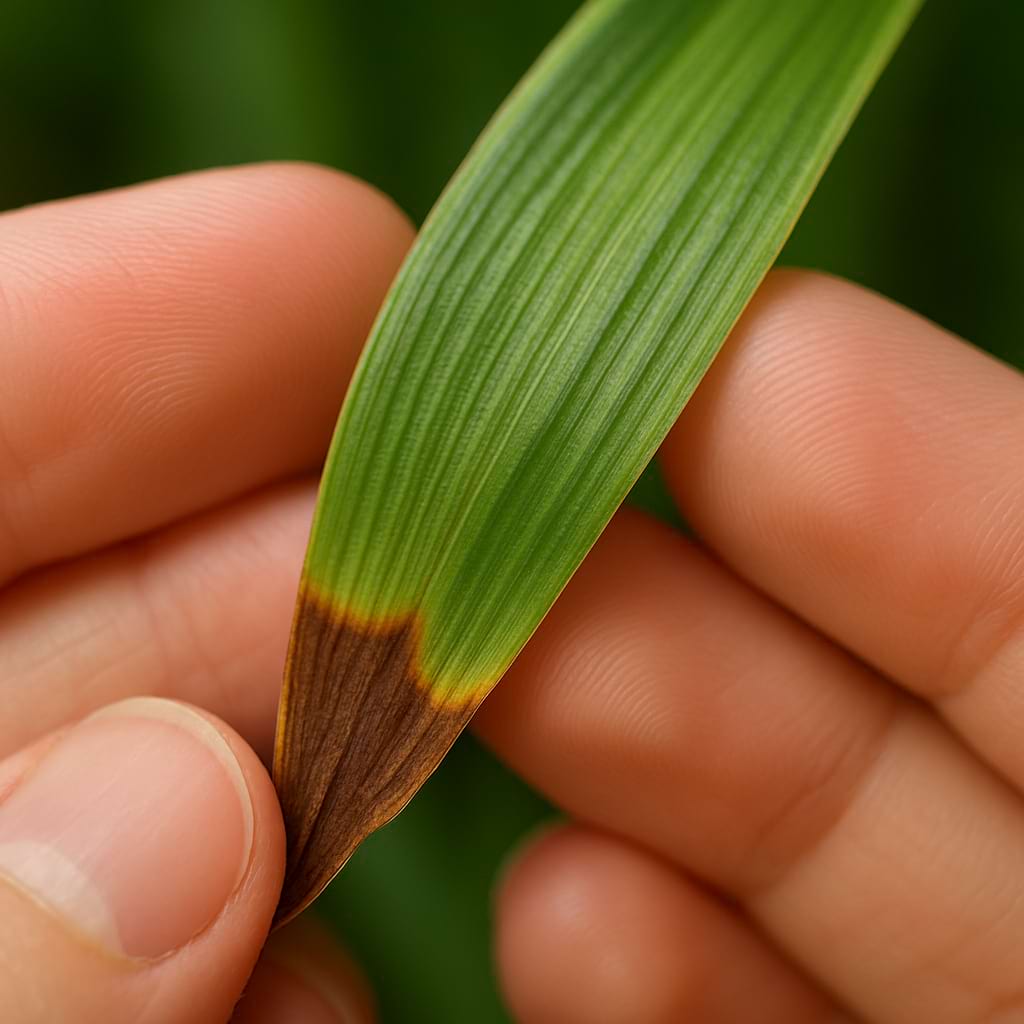
Curled leaves and brittle, papery tips point to thirst, and that is brown crispy edges from a soak schedule that is too thin for your air.
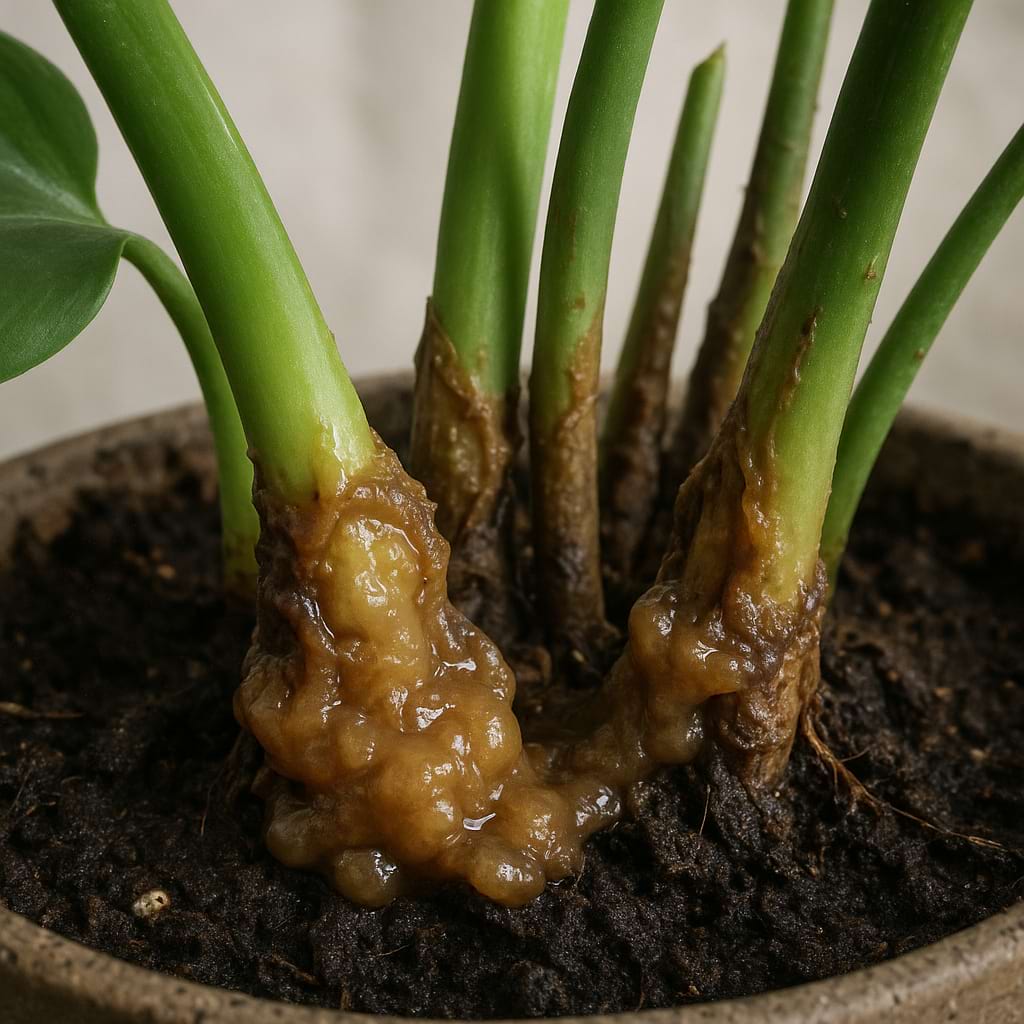
The other direction is the emergency. A base that has gone soft, dark, or slippery, or leaves that slide out with a gentle tug, means rot has started in the center. That reads as mushy stems, it is nearly always fatal once it reaches the growing point, and it comes from water sitting in the crown rather than from soaking too often.
🪴 Best Growing Medium for Brachycaulos Air Plant (Why It Needs No Soil)
There Is No Soil, and That Is the Point
Brachycaulos is an epiphyte. In the wild it clings to tree branches in Mexican and Central American dry forest, and the roots it grows are anchors rather than feeders. Everything it eats and drinks comes in through the trichomes on its leaves. Potting one in soil is the single fastest way to kill it, because the buried base stays wet and rots within weeks. Our Soil Guide is worth reading precisely so you understand why this plant sits outside of it.
What to Mount It On
Good mounts are porous, non-toxic, and dry fast: cork bark, driftwood, grapevine, cholla wood, and lava rock all work. Shells and ceramic holders are fine as long as water drains out rather than pooling.
Two things to avoid. Copper is toxic to bromeliads, so no copper wire and no copper-treated wood. And skip pressure-treated lumber for the same reason. Sphagnum moss packed around the base is another common mistake with this species, since it holds moisture right where you least want it.
If You Want It in a Pot Anyway
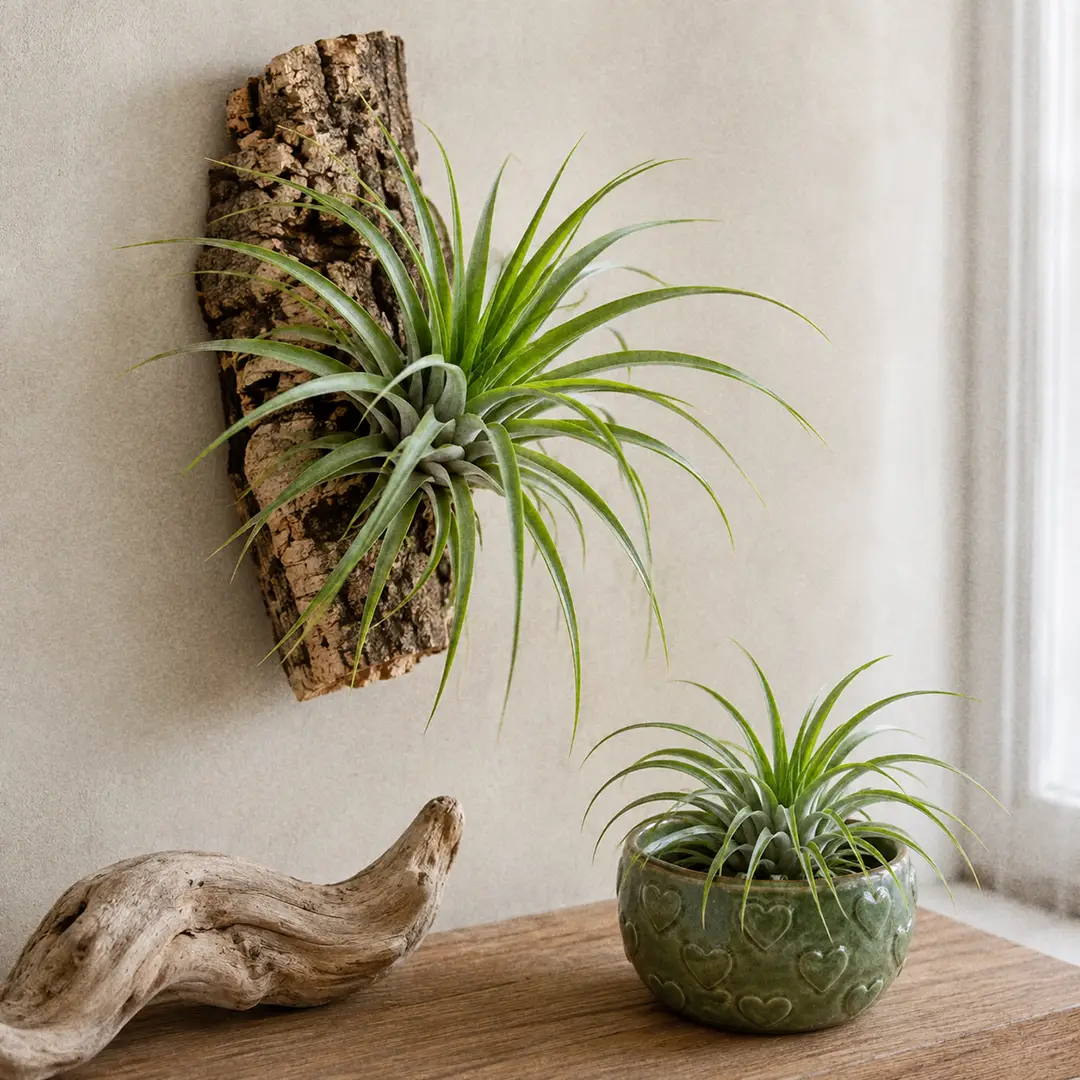
You can absolutely sit a Brachycaulos loose in a green ceramic pot with no soil in it at all, resting on a layer of dry pebbles or a small wire cradle so air moves underneath. Lift it out for its weekly soak and set it back once dry. Our plant pots guide is aimed at rooted plants, but the drainage logic carries over.
🍼 Fertilizing Brachycaulos Air Plant
When and How Often
Feed once a month from spring through summer, and stretch to every six or eight weeks in the darker months. The easiest method by far is to add fertilizer to the soak water rather than treating it as a separate job. Feeding is what pushes a young plant to blushing size faster, so it matters more here than it would on a foliage plant you are happy to keep small.
What to Use
Buy a fertilizer made for bromeliads or air plants, something around a 17-8-22 ratio. Two details on the label are worth checking. The nitrogen must be urea-free, because urea needs soil microbes to convert it into a usable form and there are none on a mounted plant. And the mix must be copper-free, since copper is genuinely toxic to this family. Failing that, a general houseplant feed diluted to a quarter strength works. Our fertilizing guide explains the ratios and the fertilizers guide covers what to buy.
Over-Fertilizing Signs
Scorched brown tips, oddly limp leaves, and a faint white crust on the leaf surface all point to too much. Soak the plant in plain water two weeks running to rinse it, then go back to a lighter dose.
🌡️ Brachycaulos Air Plant Temperature Range
Ideal Range
Ordinary room temperatures suit it well, roughly 60-85°F (15-29°C). It copes from about 50°F up to 90°F without complaint. Below 45°F the tissue starts to suffer, and frost kills it outright, which is why it only grows outdoors year-round in USDA zones 9 to 11.
Heat above 90°F is survivable but changes the routine. The plant transpires faster, dries out sooner, and needs an extra soak that week rather than the same weekly one.
Drafts, Vents, and Summer Outdoors
Radiators, heating vents, and the blast from an air conditioner all dry a Brachycaulos out remarkably fast, since it has no soil reservoir buffering it. Keep it a few feet clear of any of them.
Summering it outdoors is a genuine treat for this species. Hang it in dappled shade under a tree or on a covered porch from late spring, where rain and moving air do most of the work, then bring it back inside before nights drop under 50°F. Expect deeper color and faster growth for the trouble.
💦 Brachycaulos Air Plant Humidity Requirements
Ideal Humidity
Aim for 50-70%. Green mesic species dry out faster than the fuzzy silver ones, because those trichomes double as a moisture-holding coat this plant mostly lacks. Winter heating that drops a room to 30% means going to two soaks a week.
Boosting Humidity Without Causing Rot
A humidifier nearby, a group of plants sharing their moisture, or a bright bathroom all work. Our humidity guide covers the options.
One rule overrides all of them: humidity without airflow rots this plant. Sealed terrariums and closed jars are the wrong home for a Brachycaulos, however good they look.
🌸 Brachycaulos Air Plant Flowers and the Red Blush
The Famous Blush
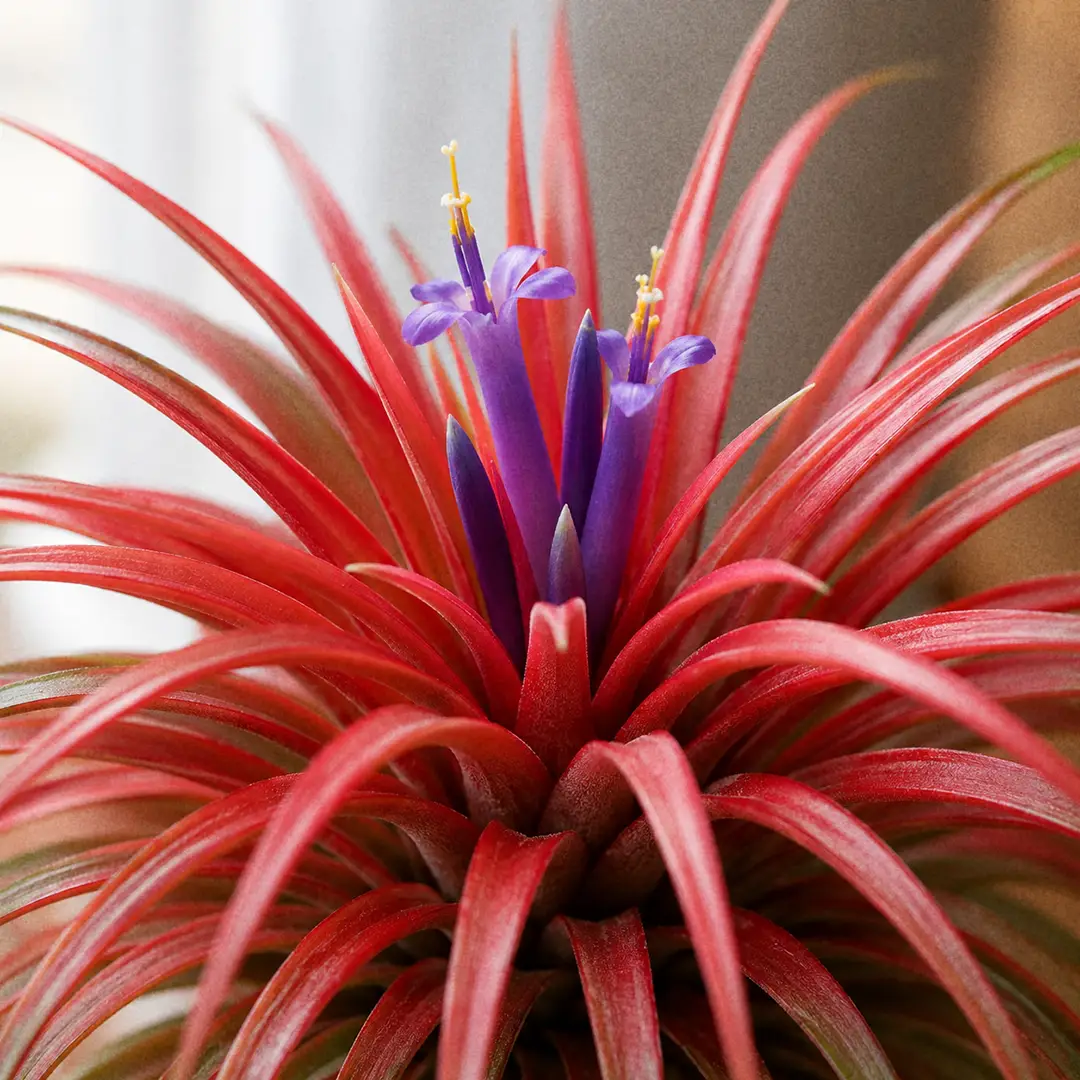
This is the reason to grow it. Several weeks before flowering, the whole rosette shifts from grass green to scarlet, starting at the center and washing outward until the entire plant is red. Many air plants blush a little at the inner leaves. Brachycaulos commits to it completely, and holds the color for anywhere from a few weeks to a couple of months.
The pigment is anthocyanin, the same family of compounds behind red autumn leaves, and it is generally read as a flag for pollinators that goes up long before the small flowers do.
What the Flowers Look Like
The flowers themselves are almost an anticlimax after the blush: slender violet to deep purple tubes, an inch or so long, pushing up from the middle of the rosette a few at a time over two to four weeks. Some plants send them up on a short spike, others open them nestled down in the center. Keep the soaking bowl away from open flowers and rinse under a tap instead.
How to Trigger the Blush
Four things get you there: maturity at two to four years, bright filtered light, monthly feeding, and consistent soaking. Light is the lever people are usually short on. If a mature plant stays stubbornly green, that is failure to bloom, and moving it closer to the window fixes it more often than anything else.
Sealing the plant in a bag with a ripe apple for a few days is the old forcing trick, since the ethylene gas triggers flowering. It works, but it spends the plant's one bloom early.
What Happens Afterward
Each rosette flowers once and then slowly winds down over a year or two while pushing out pups around its base. A mother going brown after blooming is the life cycle running normally, not a care failure. The same pattern shows up in its potted cousin the Pink Quill Plant and on a much bigger scale in the Silver Vase Plant.
🏷️ Brachycaulos Air Plant Types and Varieties
The species is variable across its wide native range, and the labels on shop shelves are inconsistent. Care is identical across every form below, so the differences are about size, color, and how tight the rosette sits.
Tillandsia brachycaulos (the standard form)
The plant described throughout this guide. An open rosette six to fourteen inches across of soft, narrow, arching green leaves that taper to fine points, blushing full scarlet before it flowers. This is what most sellers ship.
Tillandsia brachycaulos 'Abdita'
Sold everywhere as a separate plant, and often labeled T. abdita, though botanists now generally fold it into brachycaulos. It is a touch greener and glossier with maroon speckling near the base, and it blushes to a slightly deeper wine red. It also tends to pup more readily than the type.
Tillandsia brachycaulos var. multiflora
The showier flowering form, producing more flowers over a longer window rather than the handful the standard form opens. The rosette is usually a little more upright.
Tillandsia brachycaulos 'Selecta'
A larger, more symmetrical selection with broader leaves and an unusually saturated blush. If you want maximum red from one plant, this is the form to hunt for.
Tillandsia brachycaulos x concolor
A widely grown hybrid crossing the blush of brachycaulos with the sturdier, stiffer leaves and taller flower spike of T. concolor. It handles brighter light and neglect better than the pure species, which makes it a good second plant.
Tillandsia 'Eric Knobloch'
The other hybrid you will meet often, a brachycaulos crossed with the Streptophylla Air Plant by a New Orleans grower in the 1960s. It grows larger than either parent, around eight inches, with broad lime-green leaves that pick up a loose curl from the streptophylla side and still blush deep red before flowering. Sellers often list it simply as "streptophylla hybrid".
How It Compares to Other Air Plants
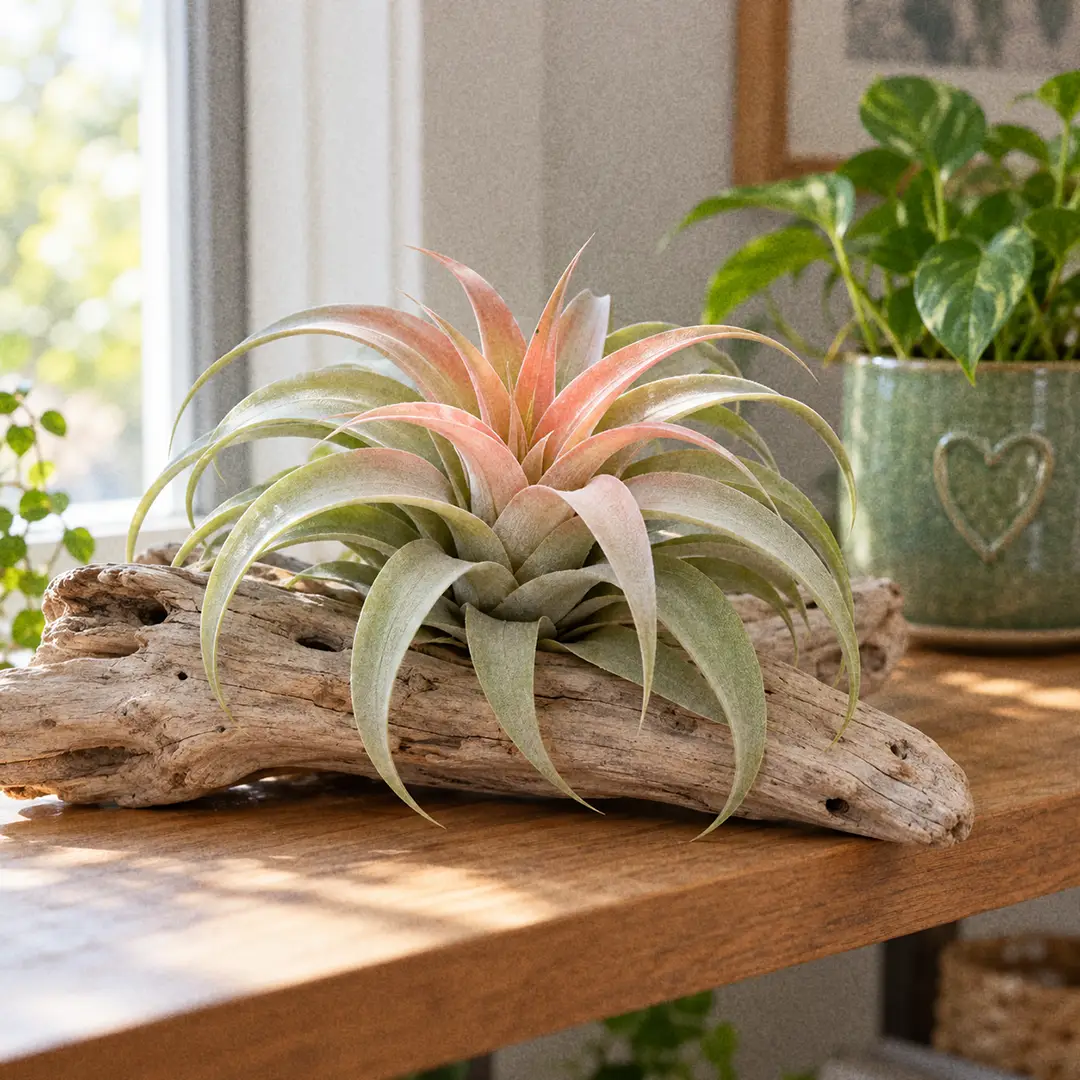
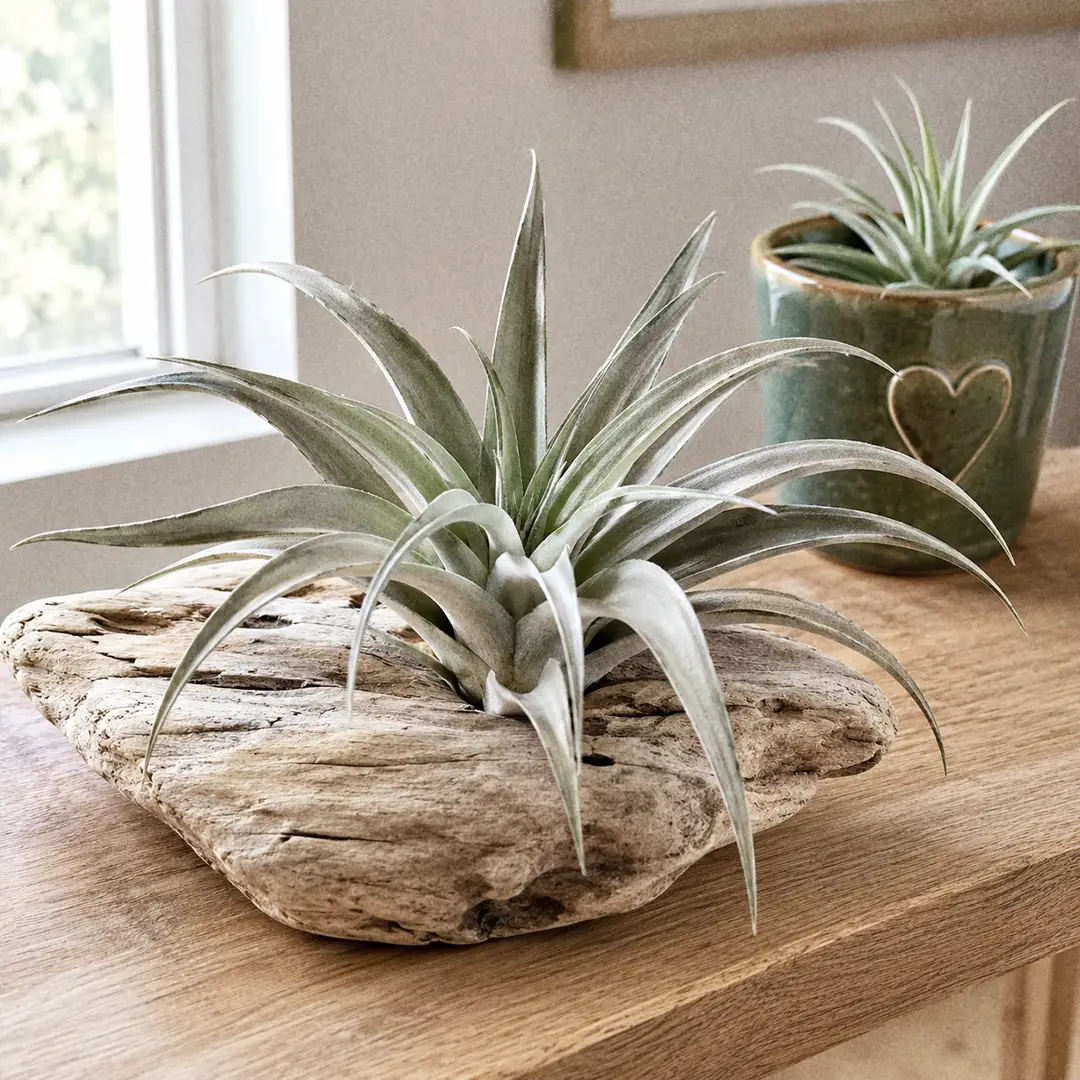
Beside a silvery giant like the Xerographica Air Plant, Brachycaulos looks softer, greener, and altogether more leaf-like, and it wants roughly double the water. The Sky Plant sits between the two: stiff and silvery like a xeric type, but a reliable bloomer that raises a pink bract instead of blushing all over, and hardy enough to winter outdoors in mild climates. Harris's Air Plant is the opposite temperament entirely: thick silver leaves that want a fraction of the water, a tolerance for direct morning sun, and a slow climb to a red-and-violet flower spike instead of an all-over blush. The Ionantha Air Plant does the same all-over scarlet blush trick in miniature, at two inches instead of a foot, and it reaches blooming size sooner, so it is the cheaper way to see the effect on a windowsill. The Capitata Peach Air Plant is the closest match in shape, a soft open rosette of similar size, but silvery and velvety where Brachycaulos is glossy green, and it blushes peach and pink instead of red. The Butzii Air Plant is the other mesic green species worth knowing, drinking about as often as Brachycaulos does, but it trades the rosette for wiry chocolate-speckled tentacles on a hollow bulb that has to be shaken out after every watering. The Tricolor Air Plant is the nearest thing to a taller Brachycaulos: another mesic green species that blushes red and purple in strong light, though it blushes toward the tips rather than all over, and it sits on a near-black bulbous base that has to be shaken dry after every soak. The Tenuifolia Air Plant is another green, thirsty species on the same weekly soak, but with small, stiff, spiky rosettes that pup fast into a dense clump and a pink spike with blue or white petals instead of an all-over blush. The Pink Quill Plant is the odd cousin that grows potted in bark and holds a flat pink paddle for months, while a tank-forming Bromeliad does the same red-then-pup trick with a cup of water at its heart.
🪴 Mounting Brachycaulos Air Plant (No Pot Required)
When to Mount
There is no repotting schedule here, because there is no pot. You mount a Brachycaulos when you want it fixed to a display, and you re-mount only when the wood starts breaking down or a clump of pups outgrows its support. Plenty of people never mount at all and just set the plant in a bowl, which is easier to soak.
Choosing a Mount
Cork bark is the classic, with driftwood and grapevine close behind. All three are porous, dry quickly, and look like the branch this plant evolved on. Lava rock and cholla wood work too. Pick a piece you can carry to the sink, since a mounted plant still needs its weekly soak and the mount goes with it.
How to Attach It
The safest method is fishing line or nylon thread, wrapped around the base of the leaves and the mount, snug but not cutting in. It disappears visually within a season and lets you cut the plant free later. A shaped wire cradle is the other good option, and the most forgiving, because you can lift the plant out for soaking.
If you glue, use a waterproof adhesive like E6000 and apply it only to the underside of the outer leaf bases, never to the center of the rosette. Hot glue and superglue both scorch or seal the tissue. And do not use copper wire, which poisons bromeliads.
Once attached, water as usual. The roots that eventually grip the mount grow only to hold on, so nothing changes about feeding or soaking.
✂️ Pruning Brachycaulos Air Plant
Trimming Brown Tips
Dried tips are normal on a plant this thirsty, especially in winter. Snip them off with clean scissors at a shallow angle that copies the leaf's natural taper, so the cut vanishes instead of leaving a blunt stub. Cut into the dead brown only, not the living green.
Removing Spent Leaves and Flower Stalks
Outer leaves brown and dry over time, particularly on a plant that has flowered. Peel them away with a gentle downward pull once they are fully dry and brittle. If one resists, leave it another week rather than tearing tissue.
Once the flowers have finished and the stalk has dried completely, snip it off near the base so the plant redirects everything into pups.
Never Cut the Center
The growing point sits in the middle of the rosette, and cutting into it ends the plant. Everything you trim on a Brachycaulos is at the tips or the outer edges.
🌱 How to Propagate Brachycaulos Air Plant
Best Method: Pups
Brachycaulos propagates by pups, small clones that appear around the base of the mother after she flowers. A healthy plant produces anywhere from two to eight of them, so one bloom typically turns into a small colony. This is the only practical method at home, and it is close to foolproof. Our propagation hub covers the general ideas.
Step-by-Step
Wait until each pup is at least one third, ideally one half, the size of the mother. Pups pulled early have too little leaf surface to hydrate themselves and usually shrivel.
Hold the mother in one hand and the pup in the other, right where they join. Push the pup gently downward and twist, and a ready one separates with a small clean snap. If it resists, it is not ready. Where the pups are packed tightly, slide a sterilized blade down between the two bases instead of forcing them apart.
Soak the separated pup as usual, dry it upside down, and treat it exactly like an adult. It will bloom in its own time, typically two to three years out.
Growing a Clump Instead
You do not have to separate anything. Leaving the pups attached lets the mother fade quietly in the middle while the ring around her fills in, and you end up with a clump that blooms in waves rather than all at once. Clumps are more forgiving of missed soaks too, since the mass holds moisture longer. The one requirement is airflow through the middle, so a mounted or raised clump beats one sitting flat in a dish.
Tips for Success
Do not bother with seed unless you enjoy waiting. Tillandsia seed germinates readily enough on a bed of damp bark, but plants take five to eight years to reach flowering size.
The one real failure mode with pups is drying. A small pup has less mass than an adult and dehydrates faster, so give it the same weekly soak plus a mist between soaks for its first couple of months.
🐛 Brachycaulos Air Plant Pests and Treatment
Common Pests
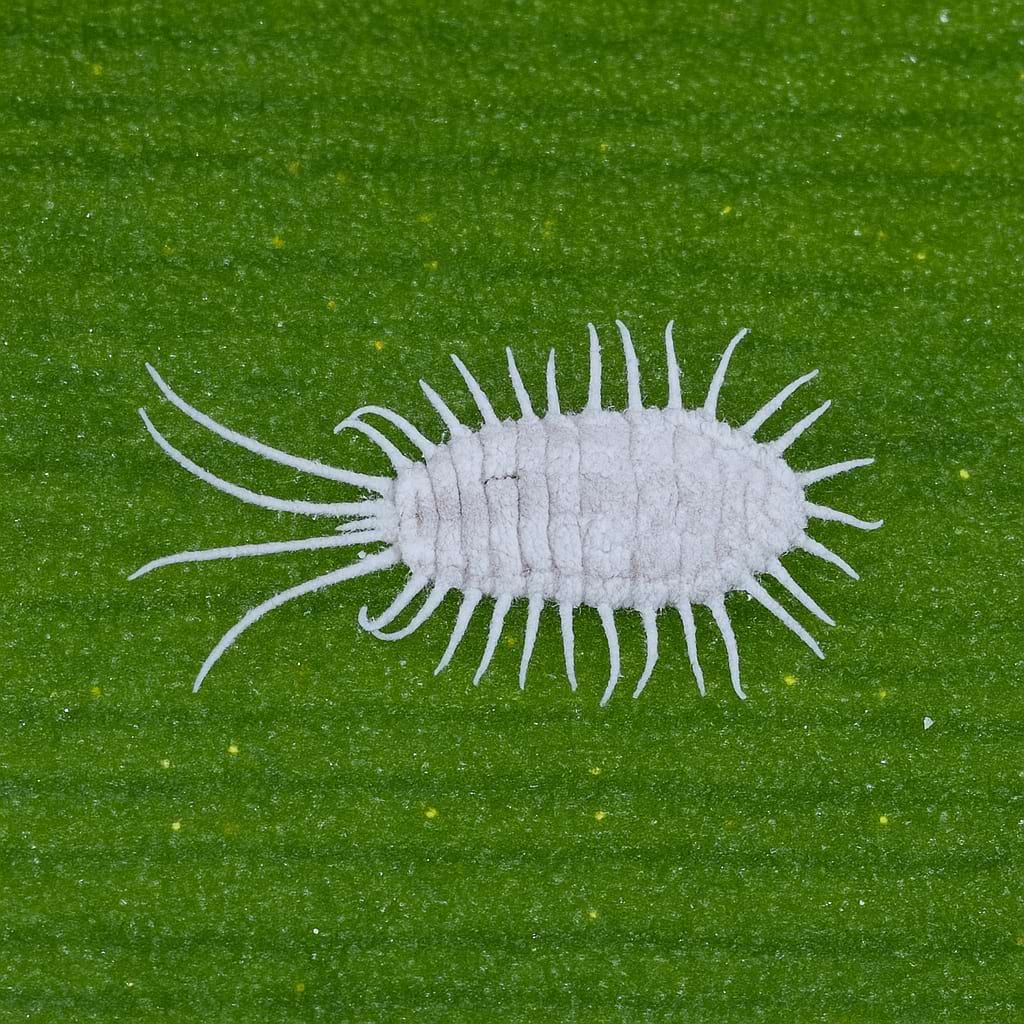
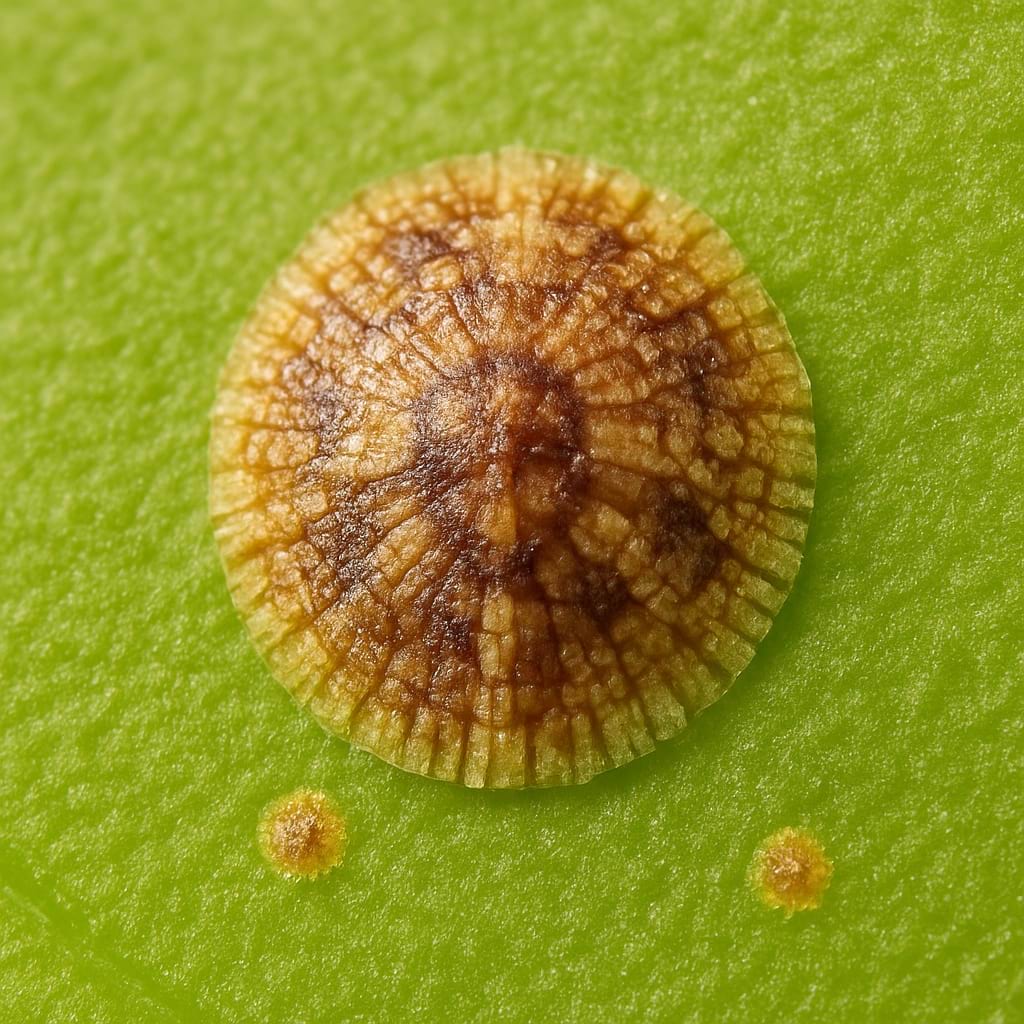
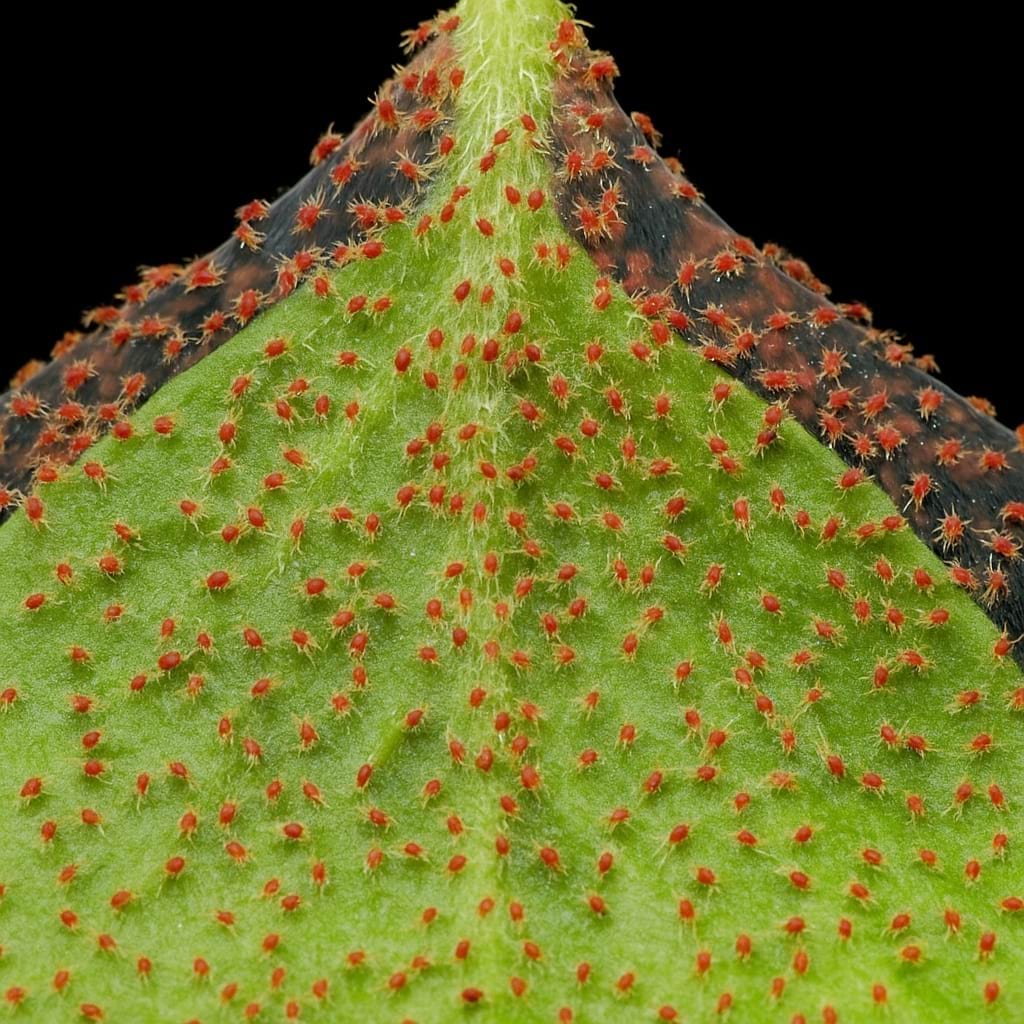
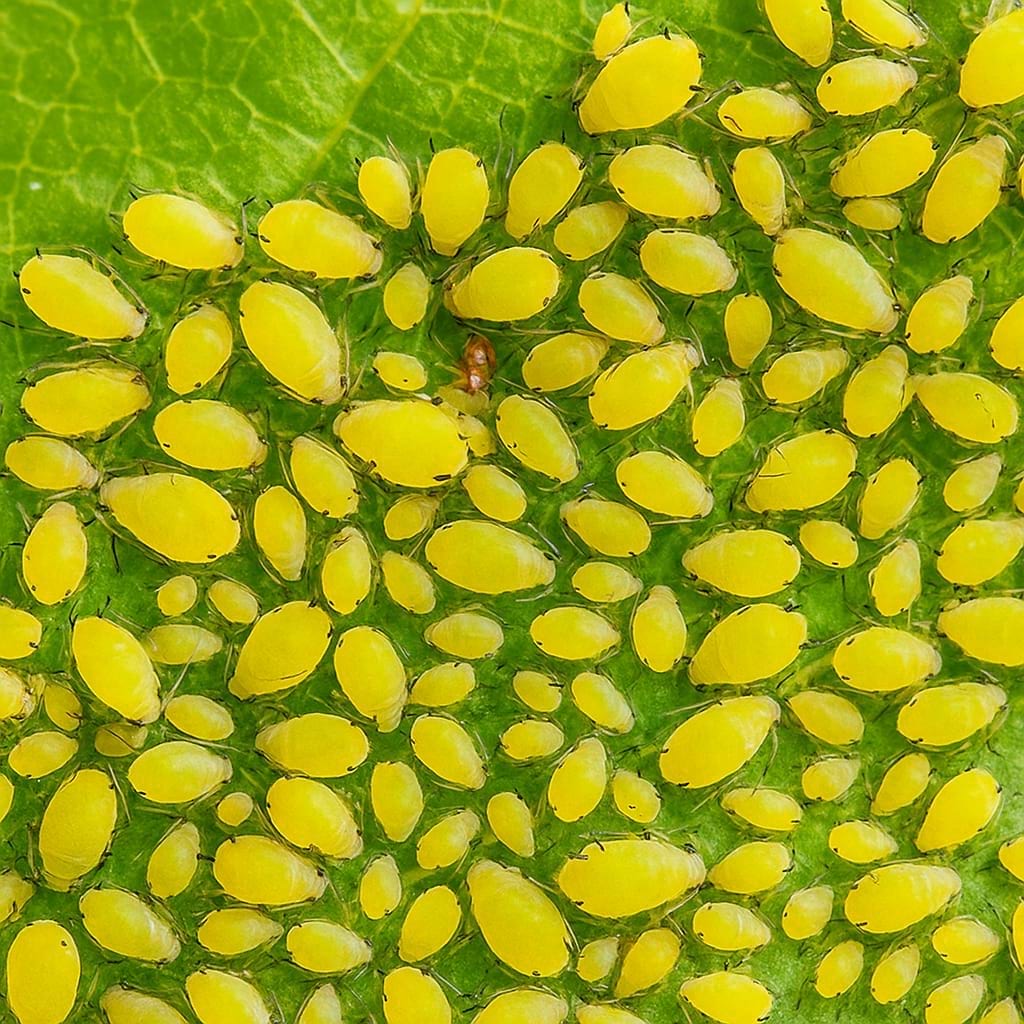
Mealybugs are the usual problem, wedging down into the leaf axils near the base as white cottony specks where they are easy to miss until the colony spreads. Scale insects turn up as small hard brown discs stuck flat to the leaves, and they arrive most often on imported plants, which is why quarantine matters. Spider mites show up in dry heated rooms as fine webbing between leaves and a stippled, dusty look. Aphids occasionally cluster on a developing flower stalk, drawn to the soft new tissue.
Treatment and Prevention
Start with a soak and a soft brush, which physically removes most of a light infestation. For mealybugs and scale, dab each insect with a cotton bud dipped in rubbing alcohol, then rinse the plant thoroughly and dry it upside down.
Here is the part specific to air plants: do not smother a Tillandsia in neem oil. A heavy oil coat clogs the trichomes the plant breathes and drinks through, and it suffocates plants that the pests would not have killed. Use a light insecticidal soap spray, leave it on for a few minutes, then rinse it off completely under a lukewarm tap and invert to dry. Quarantine anything new for three weeks before it joins the shelf.
🩺 Common Brachycaulos Air Plant Problems
Base Rot, the One That Kills
Almost every dead Brachycaulos died of rot. It starts when water sits in the tight center after a soak, and it shows as a base that turns dark and soft, a sour smell, and leaves that pull free with almost no resistance. Read that as mushy stems or leaf drop. There is no cure once it reaches the growing point. Prevention is the whole treatment: shake hard, dry upside down within four hours, and give it moving air.
Curling Leaves and Crispy Tips
Leaves rolling inward along their length mean the plant is thirsty, which is curling leaves. Papery brown tips are the longer-running version, brown crispy edges, and both usually mean weekly soaking is too thin for your air. Go to twice weekly and trim the dead tips at an angle.
Bleaching, Fading, and Sunburn
Straw-colored or bleached patches on the side facing the window are sunburn from unfiltered direct sun, and that tissue does not recover. A whole plant going dull, grayish, and washed out is the opposite problem, pale faded leaves from a spot that is too dark.
A Mother Dying After Bloom
If your plant flowered, blushed, and is now browning from the middle out, nothing has gone wrong. The rosette is monocarpic and this is how it ends. Check around the base for pups and shift your attention to those.
🖼️ Brachycaulos Air Plant Display and Styling Ideas
Mounted Setups
A cork bark or driftwood mount on a wall is where this plant looks most like itself, and it solves airflow at the same time. Angle the mount so you can see down into the center of the rosette, because that is where the blush begins and works outward. A tilted or slightly raised display shows far more than a plant lying flat.
Vessels and Groupings
Open glass globes, shallow ceramic bowls, wire holders, and shells all work as long as nothing traps water underneath. Group three at slightly different heights and the arching leaves read as one loose fountain. Set beside a silvery xeric Air Plant, the green of a Brachycaulos looks twice as lush, and it goes scarlet while the neighbor stays pale. A tall grassy Juncea Air Plant behind the group adds the height that a rosette cannot, and the two blush red at roughly the same time of year.
Where Not to Put It
Skip sealed terrariums and closed jars, which are the classic way to rot one. Skip windowsills in unfiltered afternoon sun. And keep it away from the top of a radiator, where it will dry out between soaks no matter how carefully you water.
🌟 Brachycaulos Air Plant Pro Care Tips
💧 Dry it upside down, every single time. Four hours inverted with moving air prevents the rot that kills most of these plants.
🌿 Treat it as mesic, not xeric. It drinks about twice what a silvery air plant does, so care cards written for T. xerographica will underwater it.
☀️ Light drives the blush. A plant that never turns red is nearly always a plant sitting too far from the window.
🍼 Check the label for urea and copper. Urea nitrogen is useless without soil and copper is toxic to bromeliads.
🚫 No neem oil coatings. Heavy oil clogs the trichomes it drinks through. Use insecticidal soap and rinse it off.
👀 Read the leaves. Rolled inward means thirsty, open and arching means hydrated. Better than any schedule.
🌱 Wait until pups are half the mother's size before separating, or leave them and grow a clump.
🌳 Summer it outdoors in dappled shade. Rain and real airflow produce deeper color than any indoor spot.
❓ Frequently Asked Questions
Is Brachycaulos Air Plant toxic to cats and dogs?
Tillandsia species are non-toxic to cats and dogs, so a Brachycaulos is safe around pets. The bigger risk runs the other way, since a mounted plant at cat height tends to get batted off the wall and chewed apart.
Why is my Brachycaulos turning red?
That is the blush, and it means the plant is about to flower. The whole rosette shifts from green to scarlet several weeks ahead of the violet flowers appearing. It is the healthiest thing this plant does and needs nothing from you except continued soaking and light.
How often should I water a Brachycaulos Air Plant?
Soak it for 20 to 30 minutes once a week as a baseline, and twice a week in dry or heated rooms. This is a mesic species and thirstier than most air plants. Judge by the leaves: rolled inward means it needs water sooner.
Can I grow a Brachycaulos in soil?
No. It is an epiphyte whose roots exist only to grip a branch, and burying the base in soil rots it within weeks. Mount it on bark or wood, or sit it loose in a dry vessel with airflow underneath.
Why did my air plant rot in the middle?
Water sat in the center of the rosette after watering. Brachycaulos packs its leaves tightly at the base, so a soak that is not shaken out and dried upside down leaves a pocket of trapped water where rot starts. Shake hard and invert it for three to four hours every time.
How big does a Brachycaulos Air Plant get?
A single rosette reaches about 6 to 10 inches tall and 8 to 14 inches across. Clumps of attached pups spread wider over the years, and the 'Selecta' form runs a little larger than the standard.
Does my Brachycaulos die after flowering?
The rosette does, slowly, over one to two years. Before it goes it produces two to eight pups around its base, and those carry the plant on. You can separate them once each is half the mother's size or leave them to form a clump.
Is Tillandsia abdita the same as brachycaulos?
Effectively yes. T. abdita is now generally treated as a form of T. brachycaulos, though it is still sold under its own name. It is glossier and greener with maroon speckling at the base, and it wants identical care.
Why won't my Brachycaulos blush or bloom?
The usual cause is not enough light, followed by never being fed. It needs bright filtered light, monthly bromeliad fertilizer in the soak water, and two to four years of age. A plant sitting in a dim corner can live for years without ever coloring up.
ℹ️ Brachycaulos Air Plant Info
Care and Maintenance
🪴 Soil Type and pH: None. Grown mounted or unpotted as an epiphyte.
💧 Humidity and Misting: Wants 50-70% humidity with steady airflow, since it dries faster than the silvery air plants.
✂️ Pruning: Snip brown leaf tips at an angle and remove the spent flower stalk once it has fully dried.
🧼 Cleaning: The weekly soak is the cleaning. Rinse dust off under a lukewarm tap and never wipe the leaves with a cloth, which flattens the trichomes.
🌱 Repotting: Never potted. Re-mount only when the mount rots, or when a clump outgrows its support.
🔄 Repotting Frequency: Not applicable
❄️ Seasonal Changes in Care: Soak weekly and feed monthly from spring through summer, then stretch the interval slightly in winter while watching for heating-dried leaves.
Growing Characteristics
💥 Growth Speed: Moderate for a Tillandsia
🔄 Life Cycle: Monocarpic evergreen epiphyte. Each rosette blooms once, then produces pups and slowly declines.
💥 Bloom Time: Late winter through summer indoors, preceded by several weeks of deep red blush across the whole rosette
🌡️ Hardiness Zones: 9-11
🗺️ Native Area: Mexico, Guatemala, Belize, Honduras, Costa Rica, and northern South America, growing on tree branches in seasonally dry forest
🚘 Hibernation: No true dormancy. Growth slows in low winter light but watering continues.
Propagation and Health
📍 Suitable Locations: East windowsills, bright bathrooms, mounted wall displays, open glass vessels, wire holders, shallow bowls
🪴 Propagation Methods: Twist off the pups that appear around the base after flowering, once each is a third the size of the mother.
🐛 Common Pests: Mealybugs, Scale Insects, Spider Mites, Aphids
🦠 Possible Diseases: Base rot from trapped water, fungal spotting in still humid air
Plant Details
🌿 Plant Type: Epiphytic bromeliad (air plant)
🍃 Foliage Type: Evergreen open rosette of soft, arching, narrow-triangular leaves
🎨 Color of Leaves: Mid to grass green, flushing scarlet to crimson across the whole plant before bloom
🌸 Flower Color: Violet to deep purple tubular flowers
🌼 Blooming: Yes, once per rosette, at roughly 2-4 years old
🍽️ Edibility: Not grown as an edible plant.
📏 Mature Size: 6-10 inches tall
Additional Info
🌻 General Benefits: Pet-safe, needs no soil or pot, blushes brilliant red on schedule, pups freely, and mounts anywhere there is light and airflow
💊 Medical Properties: No documented medicinal uses.
🧿 Feng Shui: A rootless, soil-free plant reads as light and unanchored energy, good for small shelves, desks, and bathrooms where a potted plant would feel heavy.
⭐ Zodiac Sign Compatibility: Aquarius
🌈 Symbolism or Folklore: Independence, adaptability, and a brief brilliant finish
📝 Interesting Facts: The name brachycaulos means short-stemmed in Greek, describing the compressed stem that packs the leaves into a tight rosette. The red blush is anthocyanin pigment produced ahead of flowering, and it is thought to act as a landing flag for pollinators long before the small violet flowers appear.
Buying and Usage
🛒 What to Look for When Buying: Look for a firm plant with leaves that arch outward and a base you cannot squeeze. Skip anything with a soft brown center, leaves that slide out when tugged, or a glued-on base you cannot remove for soaking.
🪴 Other Uses: Mounted wall art, cork bark displays, shell and driftwood arrangements, wedding and terrarium accents, living wreaths.
Decoration and Styling
🖼️ Display Ideas: Cork bark mounts, driftwood, wire cradles, open glass globes, shallow bowls, grouped shelf collections
🧵 Styling Tips: Display it where you can see into the center of the rosette, because the blush starts there and works outward. A slightly raised or tilted mount shows more than a plant sitting flat in a dish.
🪴 See also 🪴
Complete Guide to Capitata Peach Air Plant Care and Growth
Complete Guide to Baileyi Air Plant Care and Growth
Complete Guide to Harris's Air Plant Care and Growth
Complete Guide to Pruinosa Air Plant Care and Growth
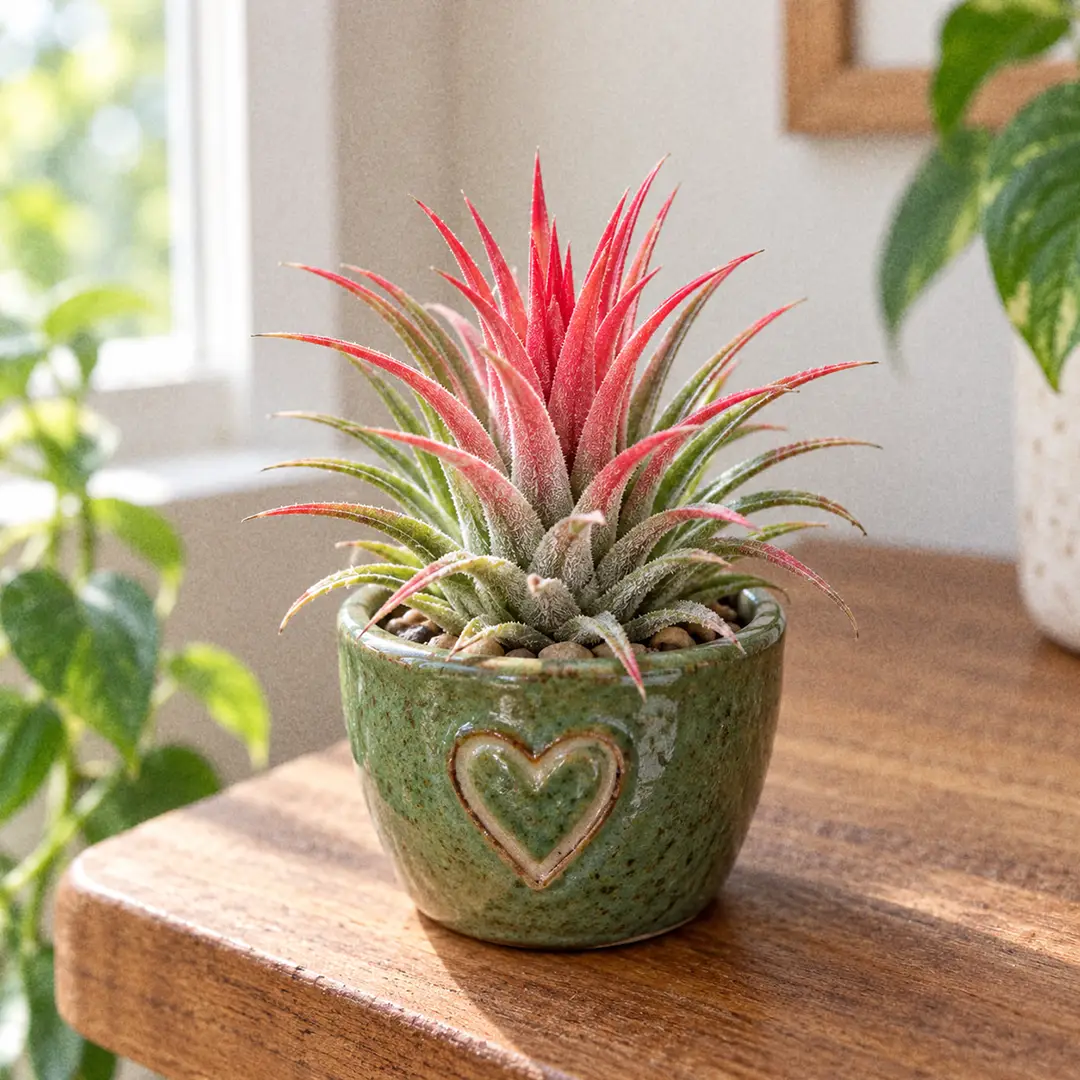
Complete Guide to Ionantha Air Plant Care and Growth
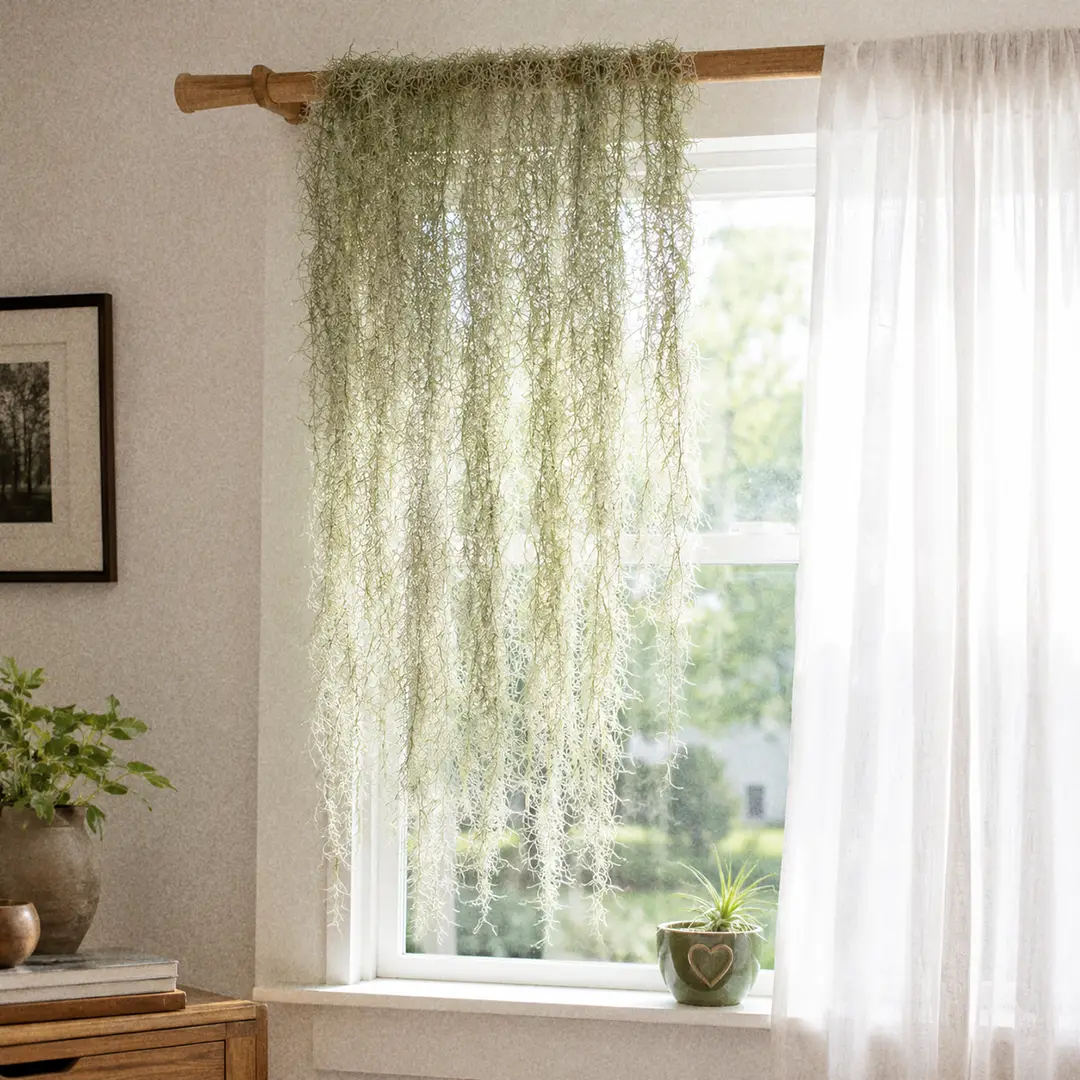
Complete Guide to Spanish Moss Care and Growth
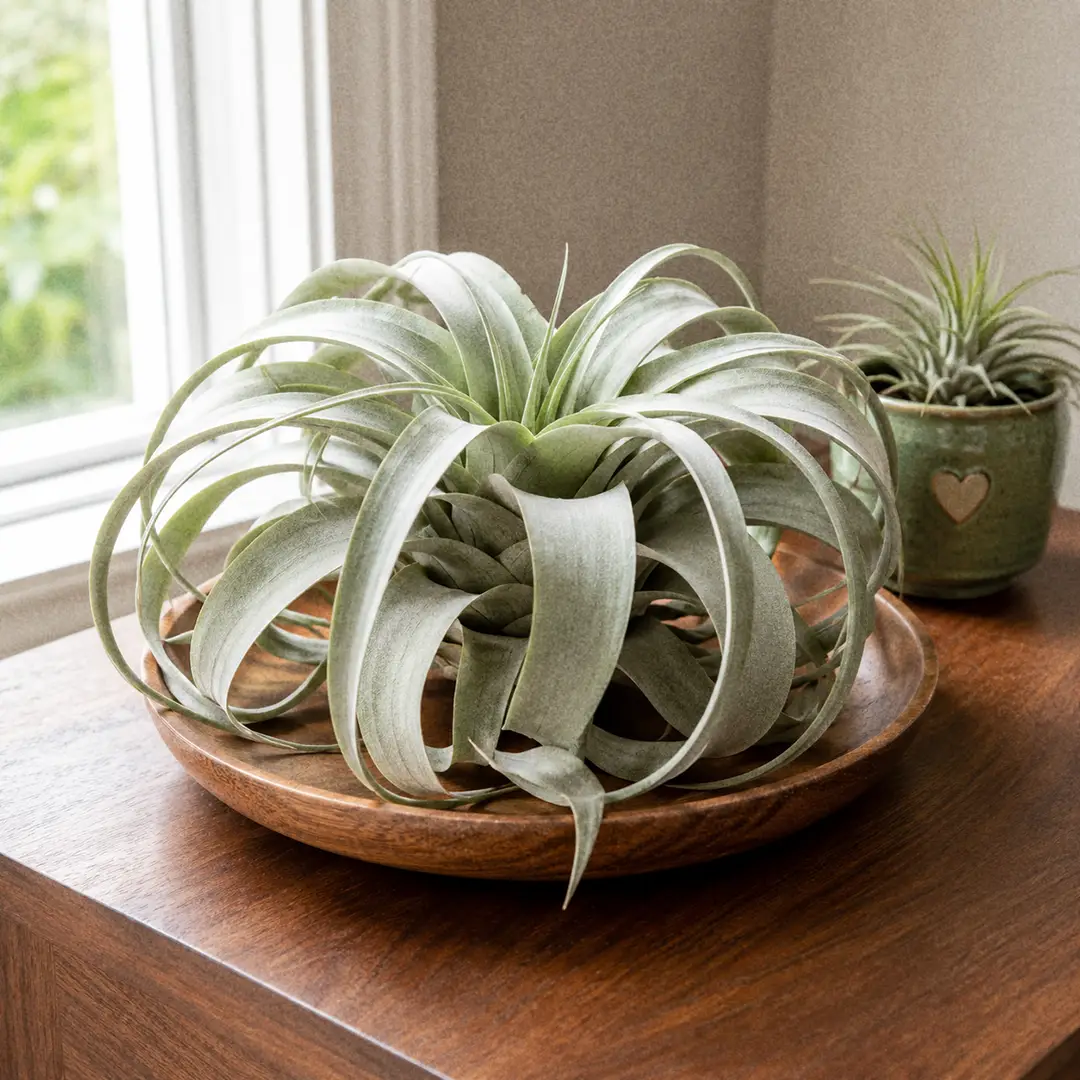
Complete Guide to Xerographica Air Plant Care and Growth
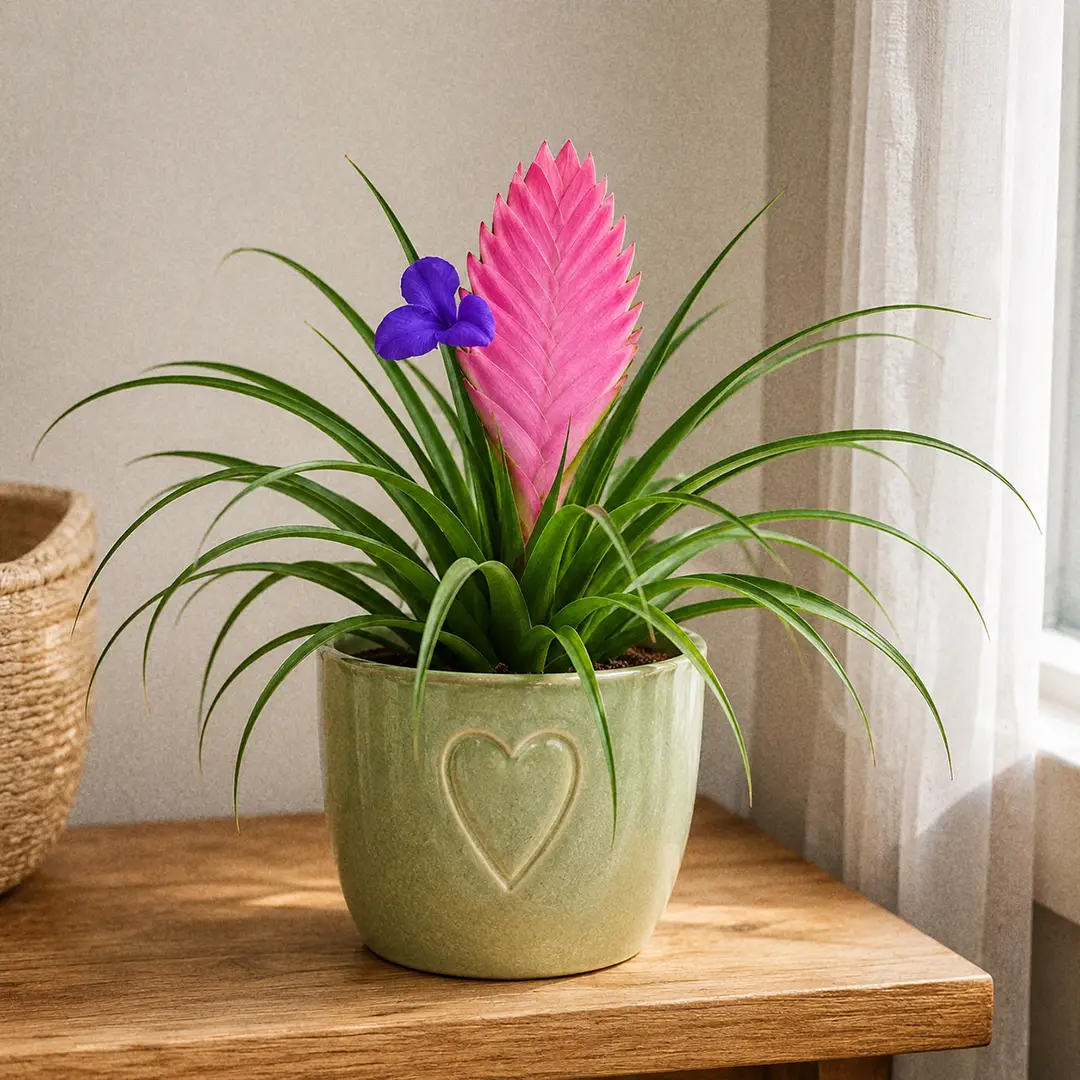
Complete Guide to Pink Quill Plant Care and Growth
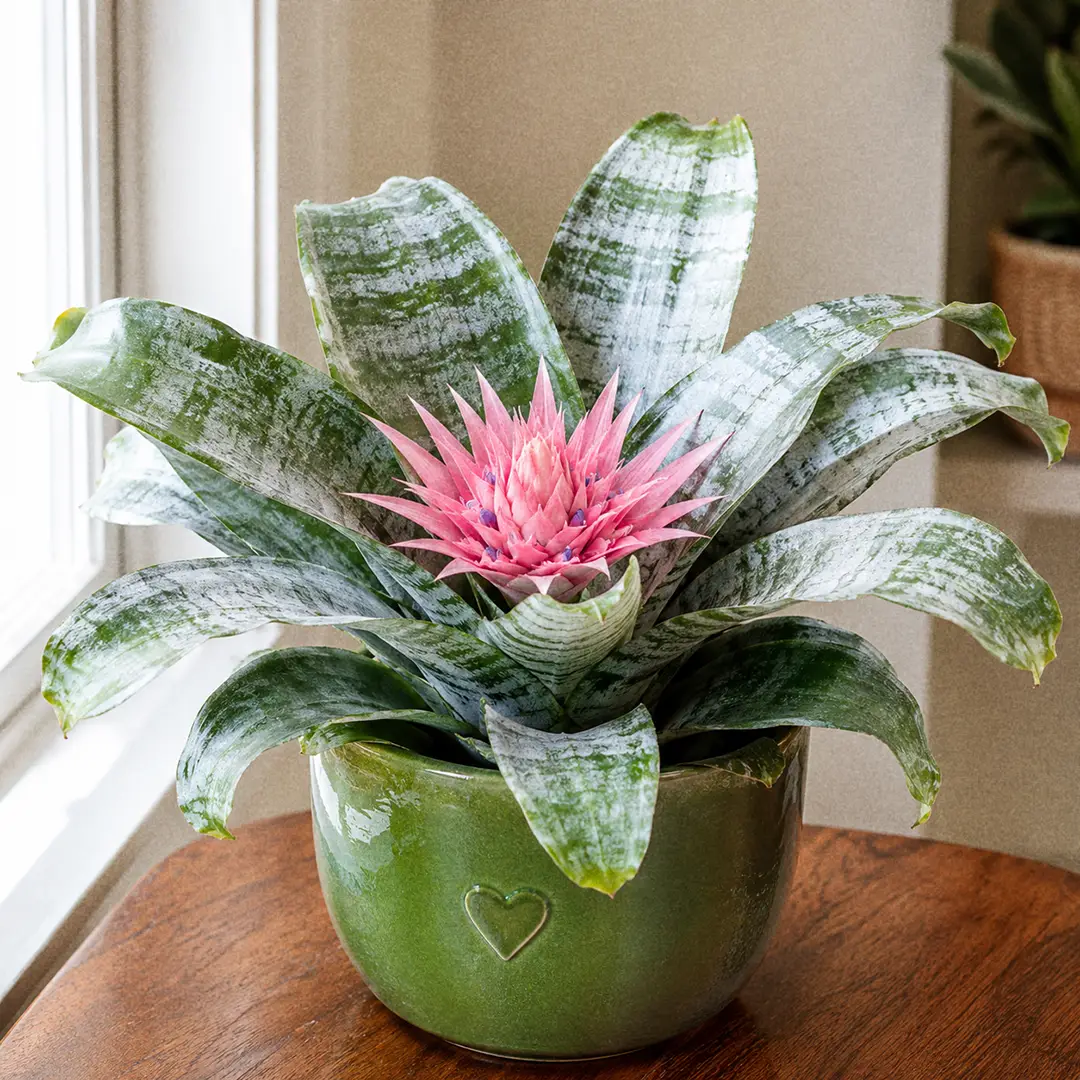
Complete Guide to Silver Vase Plant Care and Growth
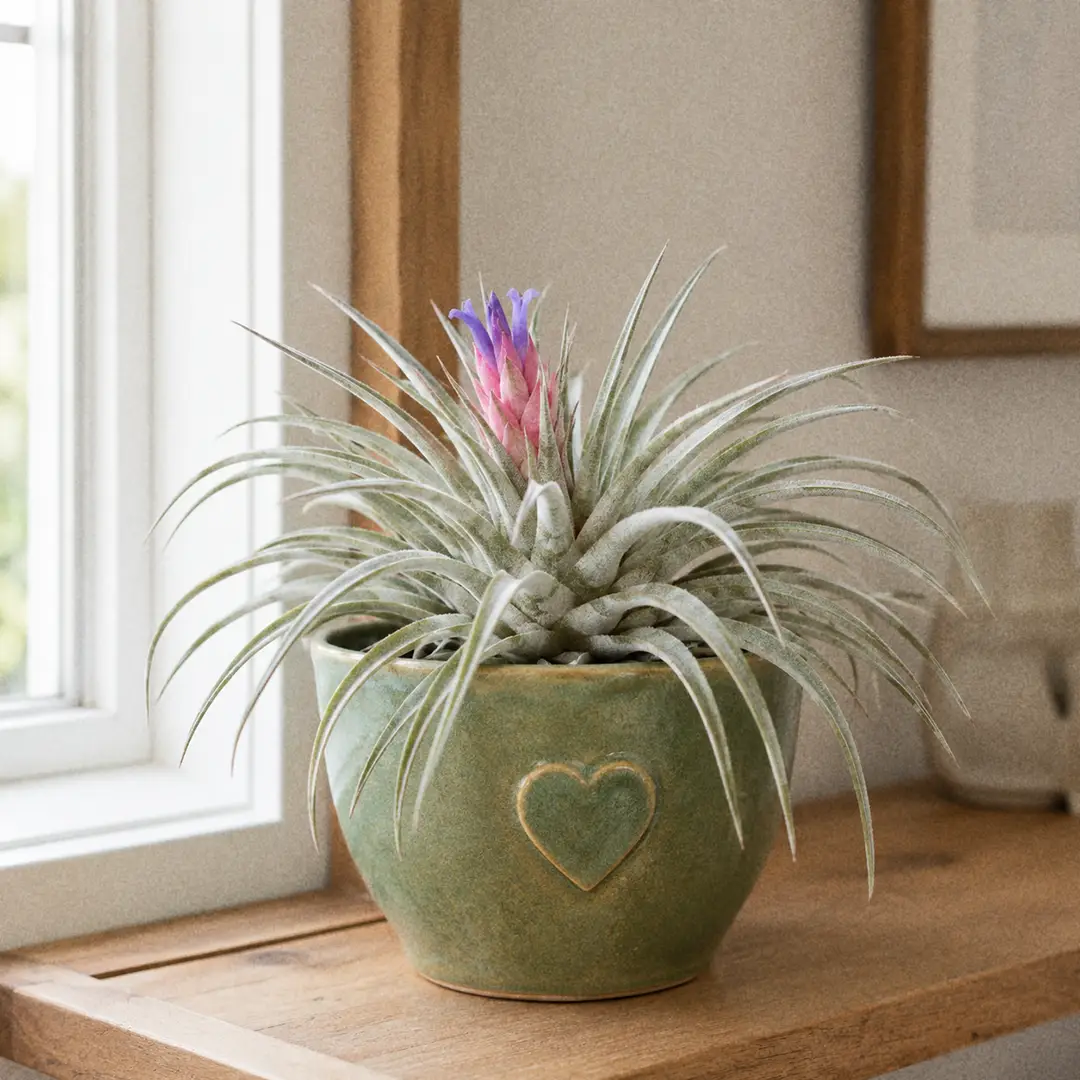
Complete Guide to Sky Plant Care and Growth

Houseplant101 Forum
Questions & Comments
Ask a question, share your plant experience, or help other plant owners.
Comments are temporarily unavailable.
Open the Houseplant101 ForumNo comments yet
Be the first to ask a question or share your experience about this page.
Log in or create an account
Comments use your Houseplant101 Forum account, but you can stay on this page.
Create a new account