
Baileyi Air Plant
Tillandsia baileyi
Bailey's Ball Moss, Reflexed Airplant, Giant Ball Moss


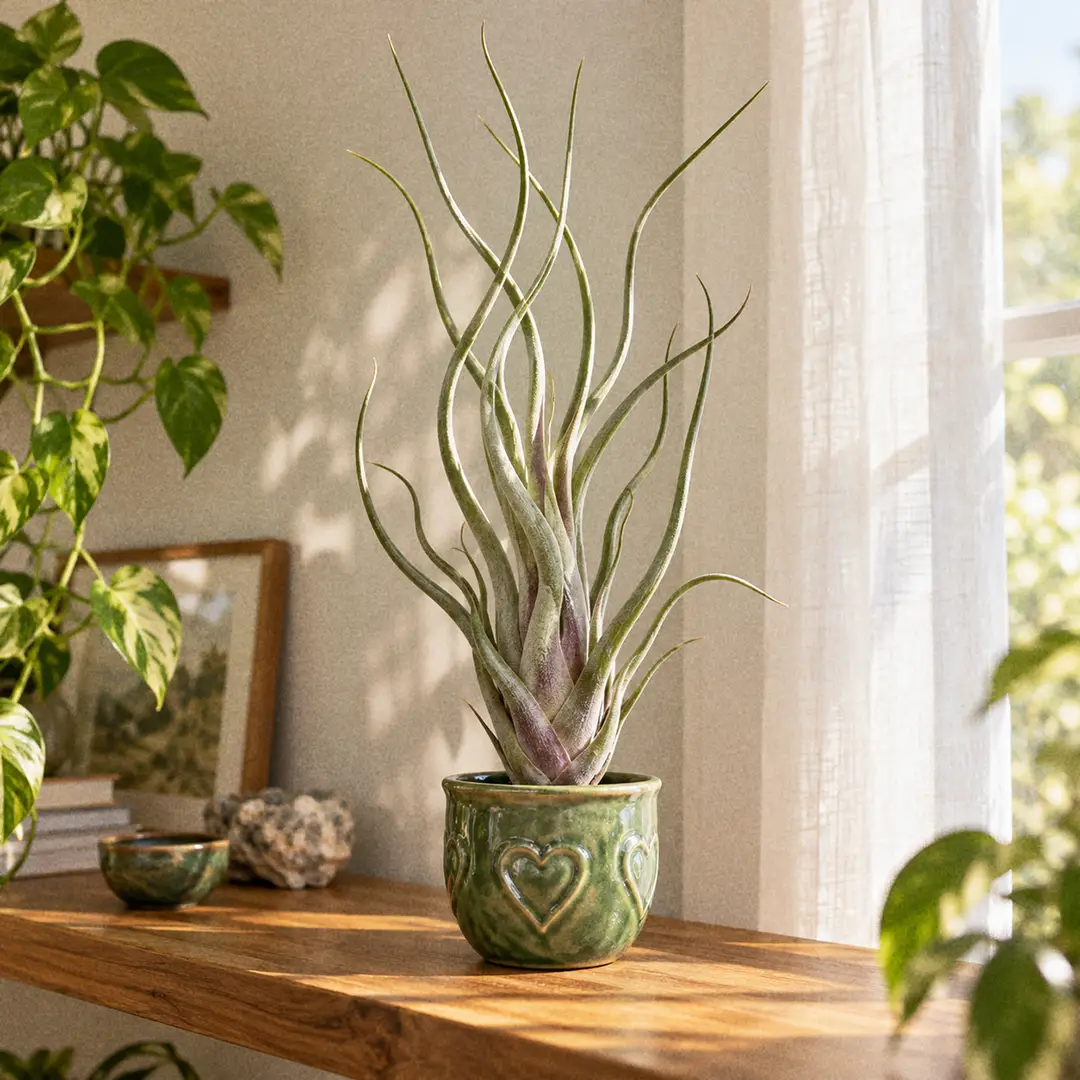
Baileyi Air Plant is the tall, twisting Texas native with tubular silver-green leaves and a rosy flower spike. Learn how to water Tillandsia baileyi without rotting its base, tell a true baileyi from the far more common pseudobaileyi, and grow it into a clump.
📝 Baileyi Air Plant Care Notes
🌿 Care Instructions
⚠️ Common Pests
📊 Growth Information
🪴 In This Guide 🪴

☀️ Baileyi Air Plant Light Requirements (Bright Light, Some Sun)
The Sweet Spot
Baileyi comes from dry oak woods in South Texas, where it hangs in bright, broken sun. Indoors, that means a spot within two to three feet of a south or west window with a sheer curtain, or right in a bright east window. A couple of hours of gentle morning sun is welcome.
It handles more light than the soft, green-leaved air plants. The silvery coat of trichomes on its leaves works like built-in sunscreen, so it can take a little direct light without scorching. Just keep it out of hot afternoon sun pressed against the glass.

Too Little Light
In a dim room, baileyi stalls. The leaves lose their silver sheen and turn a flat, pale green, new growth comes in thin and floppy, and it will never bloom. A north window or a shelf across the room is usually too dark. If that is all you have, a grow light set 12 inches above the plant for 10 to 12 hours a day fixes it.
Too Much Light
Hours of hot, unfiltered sun through glass dry the plant faster than any soak can keep up with. Watch for tips that go crispy and brown, leaves that curl tighter than usual, and bleached, yellowish patches. Pull it back a foot or add a sheer curtain, and soak it a little more often in summer. For the general picture on window directions, see our light guide.
💧 Baileyi Air Plant Watering Guide (Dunk, Then Drain Upside Down)
Watering Frequency
Water baileyi once or twice a week. Twice is right for a bright, warm room in summer or a home with heating running. Once a week is enough in a cool winter room or a humid bathroom. Misting alone is not enough. It wets the surface but never really rehydrates the plant.
A monthly long soak of an hour or two is a nice reset, especially if the leaves are starting to look thin. Skip the long soak if your plant has a noticeably fat bulb, since that shape traps more water.
How to Water Baileyi
Fill a bowl with room-temperature rainwater, filtered water, or tap water that has sat out overnight. Submerge the whole plant for 10 to 20 minutes. Then comes the step that matters most: turn it upside down, give it a few firm shakes, and leave it upside down or on its side on a towel in bright, airy light.
The leaves of baileyi are channeled and wrap tightly at the base. Water runs down those channels and pools where the leaves meet. If it sits there, the center rots. Your plant should be completely dry within about four hours. Only then does it go back on its mount or stand.
Signs of Trouble
An underwatered baileyi rolls its leaves tighter, feels light and papery, and gets crispy brown tips. Soak it for an hour, then return to a regular routine.
Overwatering shows up at the base first. The center goes dark brown or black, and leaves pull out with a gentle tug. That is rot, and it rarely recovers once the core has gone soft. Prevention is all about the upside-down drying step. Our watering guide covers water quality in more detail.
🪴 Best Soil for Baileyi Air Plant (None at All)
Why Baileyi Needs No Soil
Baileyi is an epiphyte. In the wild it grips the bark of live oaks with a few wiry roots and takes in water and nutrients through its leaves. Those fuzzy-looking silver scales, called trichomes, do the job roots do for a potted plant. Soil holds moisture against the base and rots it within weeks, so leave it out entirely.
What to Put It On Instead
Good choices are cork bark, driftwood, grapevine, a wooden stand, or a simple wire holder. Anything that lets air move all around the base works. Avoid copper wire, since copper is toxic to air plants, and skip sealed containers or deep dishes that collect water.
Materials to Avoid
Do not nest baileyi in wet moss, gravel, or sand. Decorative fillers look nice, but they hold moisture right against the most rot-prone part of the plant. If you love a moss look, use dry preserved moss and keep the base sitting on top of it, not buried. And never glue over the base itself. A dab of plant-safe glue on the side of the lowest leaves is fine.
🍼 Fertilizing Baileyi Air Plant (Weak and Monthly)
When and How Often
Feed once a month from spring through late summer, when the plant is actively growing. Skip feeding in winter. A little food before spring helps a mature plant bloom and push out pups afterward.
What to Use
Use a bromeliad or air plant fertilizer, or a regular water-soluble houseplant feed diluted to a quarter of the label strength. Pick one low in urea-based nitrogen, since air plants cannot break urea down without soil microbes. Add it to the soak water instead of a separate spray. Our fertilizer roundup lists options.
Over-Fertilizing Signs
Too much fertilizer burns air plants fast. Look for brown, burnt tips on new leaves or dark spots near the base. If that happens, rinse the plant in plain water and skip feeding for two months.
More food does not mean faster growth here. Baileyi grows slowly by nature, and a plant that gets good light and regular soaks will do fine with no fertilizer at all. Think of feeding as a small bonus, not a fix for a plant that looks unhappy.
🌡️ Baileyi Air Plant Temperature Range
Ideal Range
Baileyi is happiest between 60°F and 85°F (16°C to 29°C). As a Gulf coast native, it tolerates summer heat into the low 90s°F if it gets extra water and air movement. It can take a brief dip to around 50°F (10°C), but anything near freezing damages it. In USDA zones 9b to 11 it can live outdoors on a shaded tree branch year-round.
Drafts and Heat Sources
Keep it away from heating vents, radiators, and the top of the fridge, which dry it out in a day. In winter, move it off cold window glass at night. Baileyi can summer outside on a covered porch once nights stay above 55°F, which it usually loves. Bring it in before the first cold snap.
One warning for summer: a plant outdoors in hot, dry wind loses water fast. Check it every few days and soak it whenever the leaves feel light or start to roll inward.
💦 Baileyi Air Plant Humidity Requirements
Ideal Humidity
Baileyi is one of the more forgiving air plants on humidity. It does well at 40 to 60 percent, and regular soaks carry it through drier homes. Its thick silvery leaves lose water more slowly than the soft green species.
Easy Humidity Boosters
In a very dry winter home, water twice a week instead of once. Grouping air plants together helps a little, and a bright bathroom works too, as long as the plant still dries quickly after a shower. Closed glass terrariums are a bad idea: the air stays wet and the base rots. See our humidity guide for more.
A small humidifier in the room helps if your winter air drops below 30 percent. Aim it at the room, not at the plant, so the leaves never stay damp for long.
🌸 Baileyi Air Plant Flowers (Pink Spike, Purple Tubes)
What the Flowers Look Like
A mature baileyi sends a slim spike up from the center of the rosette. The spike is wrapped in rosy pink bracts, and from it come tubular flowers in violet to lavender, roughly an inch long. The leaves often blush pink or purple in the weeks before and during bloom. Each flower lasts only a few days, but the pink bracts stay colorful for weeks.
How to Encourage Blooming
A baileyi blooms when it is mature, usually as a plant of six inches or more, most often in spring or summer. The main triggers are bright light and steady care. Give it the brightest filtered spot you have, water regularly, and feed monthly through the growing season. A few hours of morning sun often brings on the blush that comes before a bloom.
After It Blooms and If It Won't
Each rosette blooms only once. That is normal. After flowering, the plant sends out pups from its base and then slowly declines over several months while they grow. Keep caring for the mother until the pups are established.
If yours has never bloomed, the cause is almost always light or age. A young plant simply needs time. A mature plant sitting in medium light needs a brighter spot. More on this in our failure to bloom guide.
🏷️ Baileyi Air Plant Types and Varieties
True Tillandsia baileyi
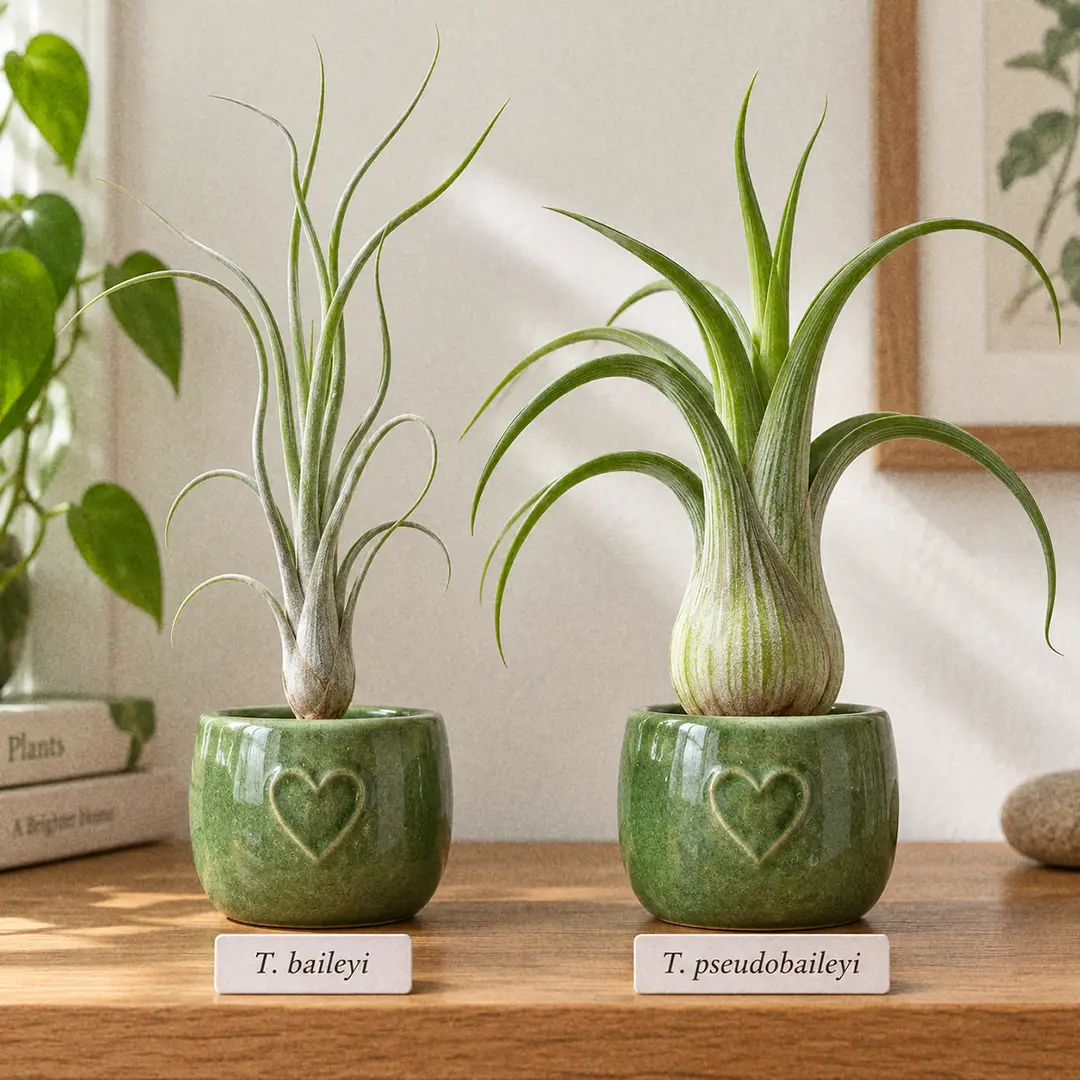
The real species is slimmer than most people expect. It has a narrow base that is only slightly swollen, and long, channeled, silver-green leaves that twist and curve upward. Over the years it grows into a dense, impressive clump. It is sold by specialist nurseries in small, medium, and large sizes, including established clumps.
Tillandsia pseudobaileyi
This is the plant most shoppers actually own. Pseudobaileyi comes from Mexico and Central America, and for many years it was sold as baileyi, which is why the two names are still mixed up. It has a fat, onion-shaped bulb at the base, thicker and stiffer leaves, and fine vertical stripes along each leaf. It grows a little faster and likes to hang sideways or upside down. Some sellers now list it as "Baileyi Pseudobaileyi," which is a clue.
How to Tell Them Apart
Look at the base. A plump, clearly bulbous base with stiff, striped arms is pseudobaileyi. A slim base with softer, smoother, more silvery leaves is true baileyi. Care is the same for both, so either label is fine for keeping it alive. The bulbous form just needs more care with draining.
Hybrids and Lookalikes
Baileyi has several named hybrids. The most common in shops is 'Califano' (baileyi x ionantha), a sturdy plant that blushes red and blooms reliably. If you like the bulb-and-tentacles shape, the speckled Butzii Air Plant and the curly Streptophylla Air Plant are close cousins with the same watering rules.
🪴 Mounting a Baileyi Air Plant
Choosing a Mount
Baileyi does not need a pot, but it does need somewhere to stand. Its upright arms look best on a wooden block, a piece of driftwood, or a cork slab set at an angle. A wide, shallow holder with drainage also works. Pick something you can lift off easily, because the plant has to come off for every soak.
How to Attach It
For a removable setup, wedge the base into a crevice in driftwood or a hole drilled in a wood block. For a permanent mount, use plant-safe glue or fishing line on the lower leaves, never on the base itself, and water by misting heavily and dunking the whole mount briefly. Plants on permanent mounts dry faster, so they may need water more often.
Moving to a Bigger Mount
A healthy baileyi eventually becomes a clump of several rosettes. When the clump outgrows its perch, gently lift it free and set it on a larger piece of wood. Do this in spring or summer, when the plant can put out new roots to grip the new surface.
✂️ Pruning a Baileyi Air Plant
When to Prune
Baileyi needs very little pruning. Trim when a leaf tip dries out, when a lower leaf turns brown and papery, or when a flower spike has faded completely. Healthy growth needs no cutting.
How to Prune
Use clean, sharp scissors. For brown tips, cut at a slight angle so the leaf still looks natural. Dry outer leaves at the base can usually be pulled away gently with your fingers. If a leaf resists, leave it. For a spent flower spike, wait until it is fully brown and dry, then cut it close to the base.
Clearing Out an Old Mother Plant
Once a mother plant has bloomed and her pups are growing, she slowly dries out. When she is mostly brown, you can pull her away from the clump, or leave her in place if she is still holding the pups together.
🌱 How to Propagate Baileyi Air Plant
Best Method: Pups
The easiest way to get more baileyi is to wait for pups. After blooming, the mother sends out one to several small offsets from her base. They grow fastest while still attached, feeding from the mother. Seed is possible but very slow, taking years to reach a decent size, so pups are the practical route at home.
Step-by-Step Pup Removal
- Wait until the pup is about a third the size of the mother. Smaller pups struggle on their own.
- Soak the plant first. Wet leaves bend instead of snapping.
- Hold the mother near her base in one hand and the pup at its base in the other.
- Gently twist and pull the pup downward and away. It should come free cleanly. If it resists, wait a few more weeks.
- If needed, use clean scissors to cut the pup off as close to the mother as possible.
- Let the pup dry upside down, then care for it exactly like an adult.
Letting It Clump Instead
You do not have to separate pups at all. Leaving them attached builds a full, round clump of baileyi that looks spectacular on driftwood. A clump holds more water between rosettes, so shake it extra well and give it longer to dry after each soak. Our propagation guide covers other methods for different plants.
🐛 Baileyi Air Plant Pests and Treatment
Baileyi rarely has pest trouble, especially when it gets good air flow. When bugs do show up, they hide in the tight base where leaves overlap.
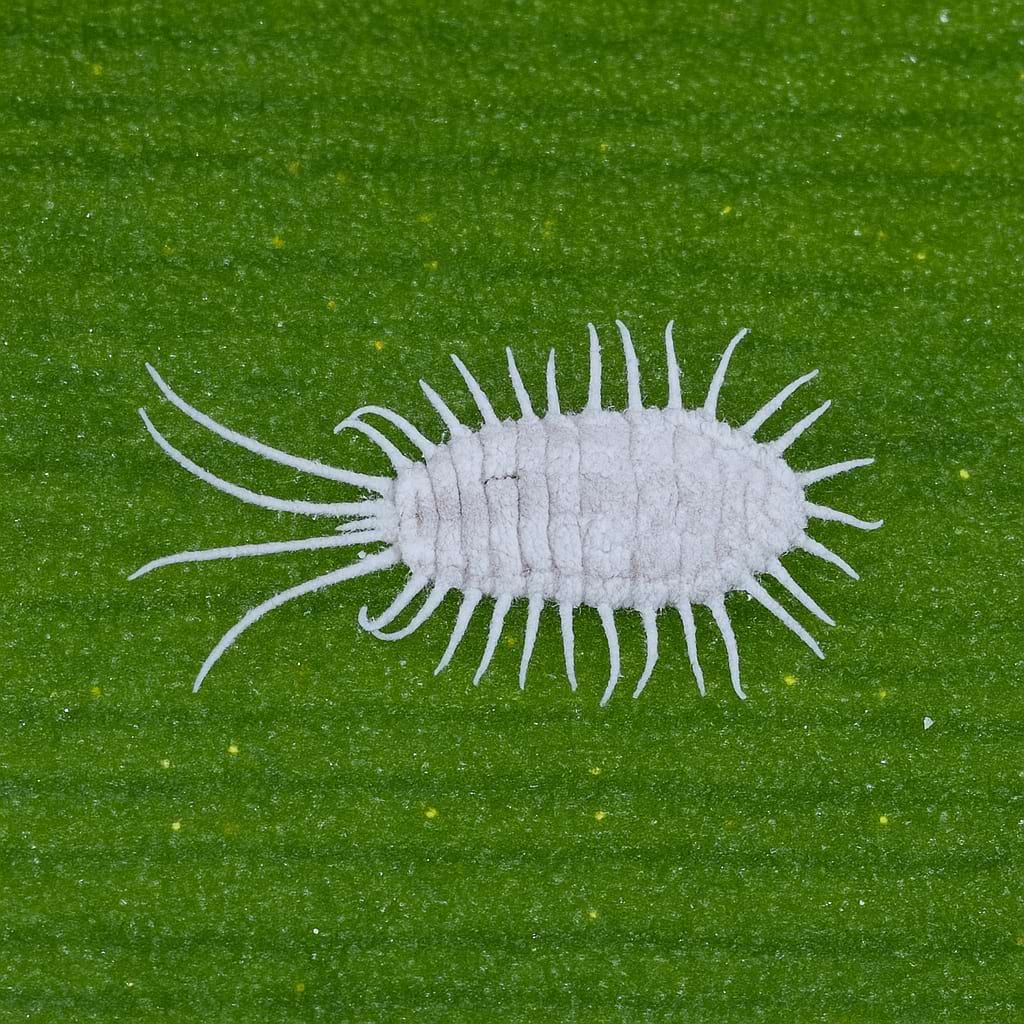
- Mealybugs leave white, cottony tufts between the leaves. Dab them with a cotton swab dipped in rubbing alcohol, then rinse and dry the plant well.
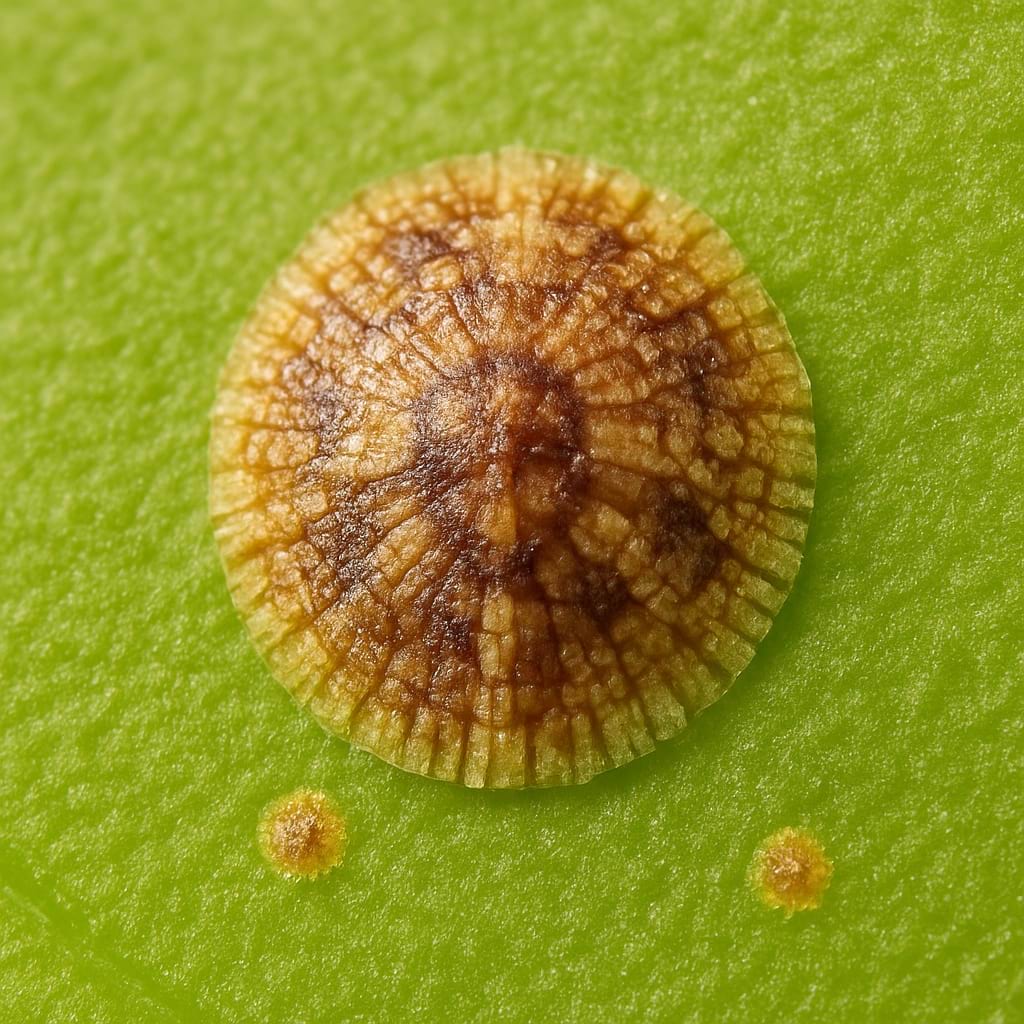
- Scale insects look like small tan or brown bumps stuck to the leaves. Scrape them off gently with a fingernail and rinse. Do not scrub, since that strips trichomes.
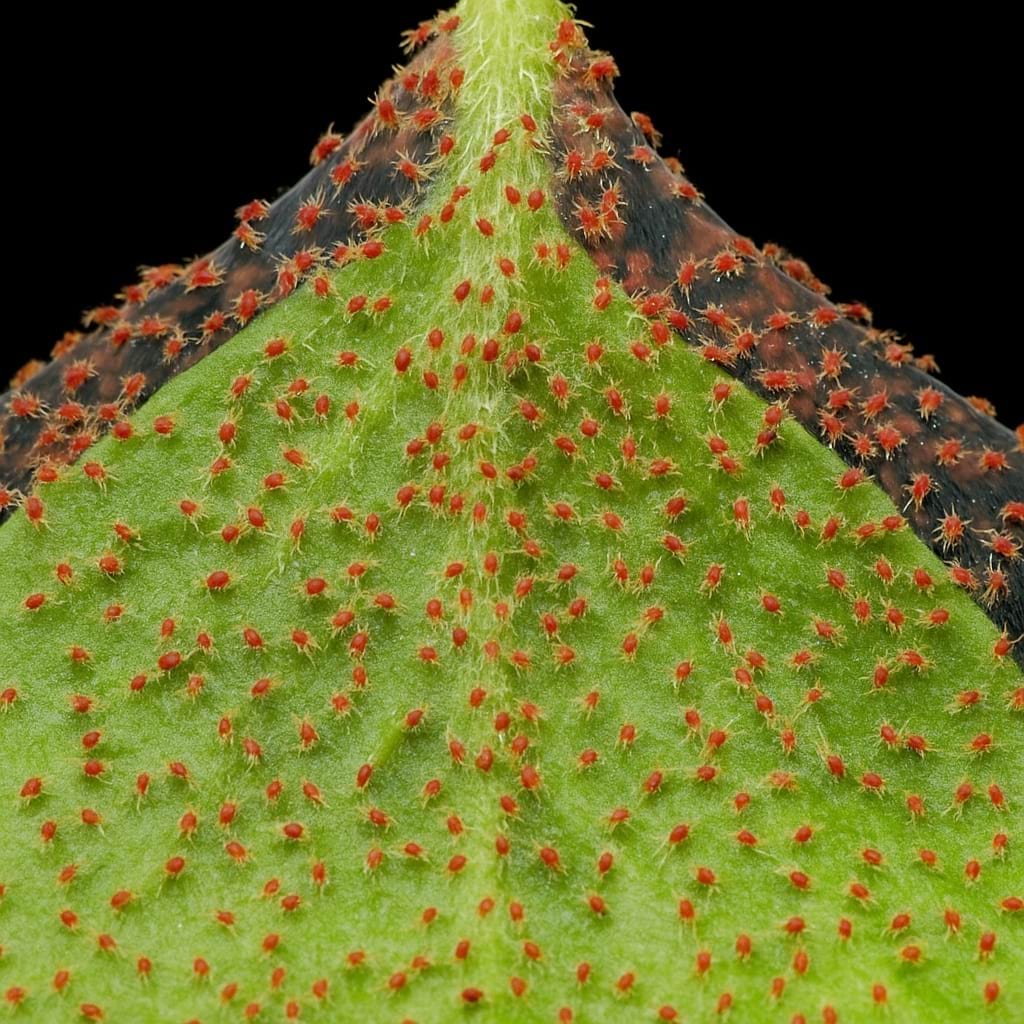
- Spider mites cause fine speckling and faint webbing in hot, dry, still air. Rinse the plant thoroughly and increase watering and air movement.
Avoid oil-based sprays and most insecticidal soaps. They clog the trichomes the plant uses to drink. A rinse and a cotton swab solve most cases.
🩺 Common Baileyi Air Plant Problems
Most baileyi problems come down to water, either too much held in the base or too little overall.
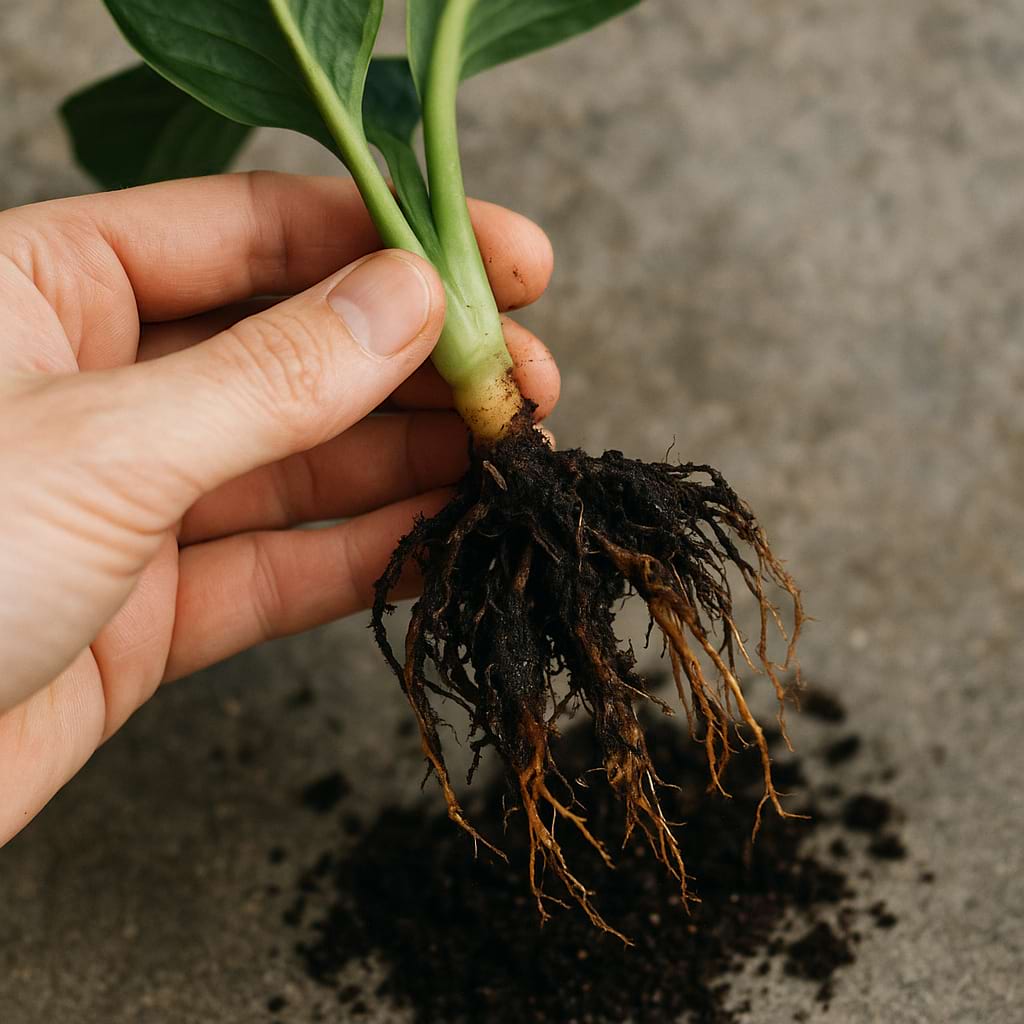
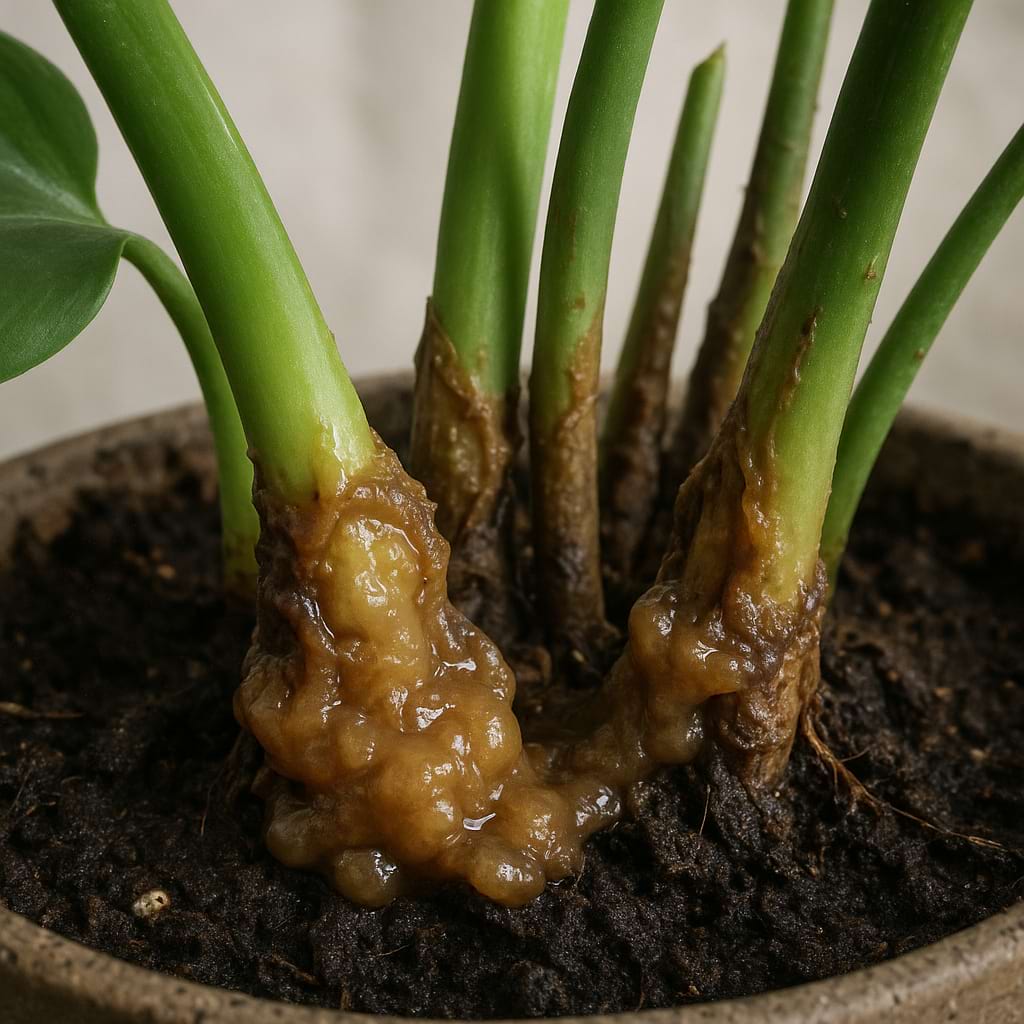
- Rotting base. A dark, mushy center and leaves that fall out mean rot from trapped water. Remove loose leaves and let the plant dry completely, but a soft core rarely recovers. Prevent it by always drying upside down.
- Mushy stems. A soft, darkening base is the early stage of rot. Stop soaking, shorten dunks to a few minutes, and give the plant brighter light and more air.
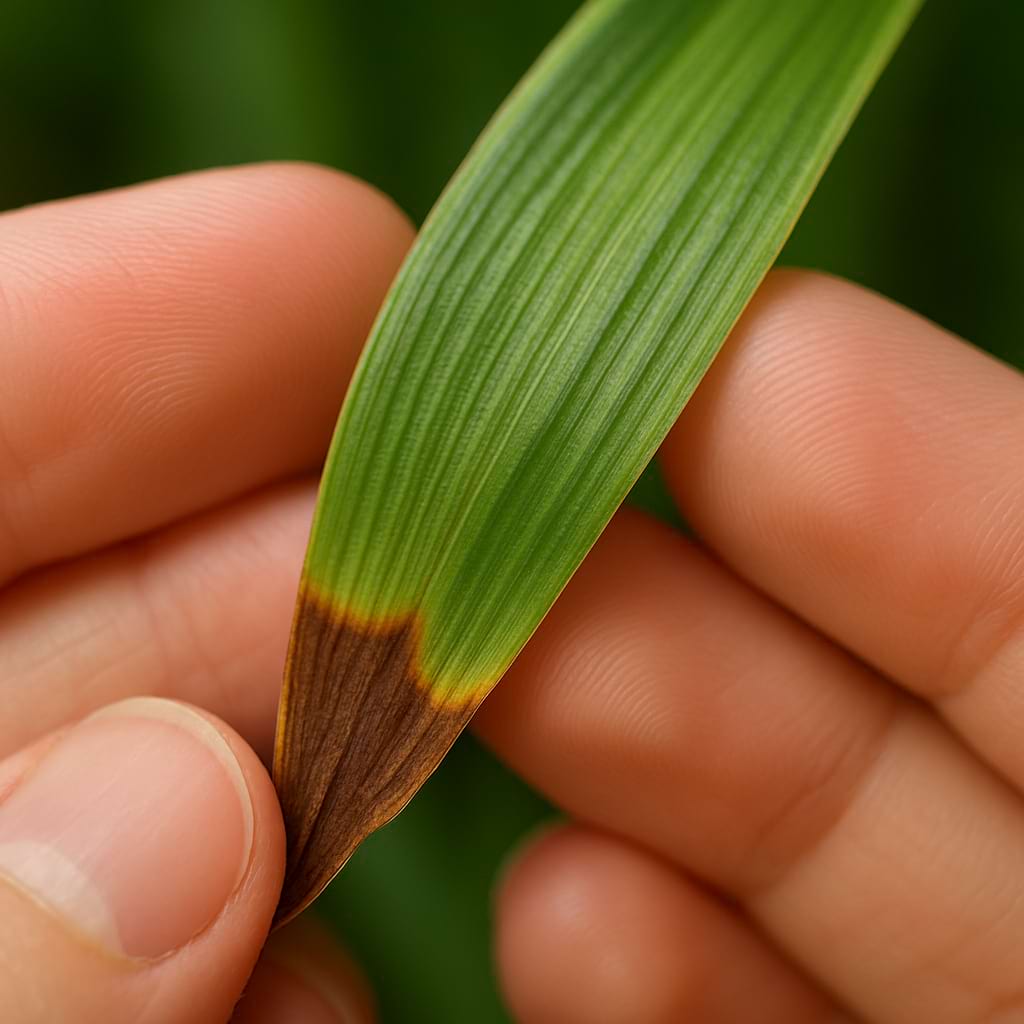
- Brown crispy tips. Usually thirst or low humidity. Water more often and trim the tips at an angle.
- Curling leaves. Baileyi twists naturally, but leaves that roll tight and feel papery mean it is dehydrated. A one-hour soak usually fixes it.
- Pale, faded leaves. Too little light. Move it closer to a bright window.
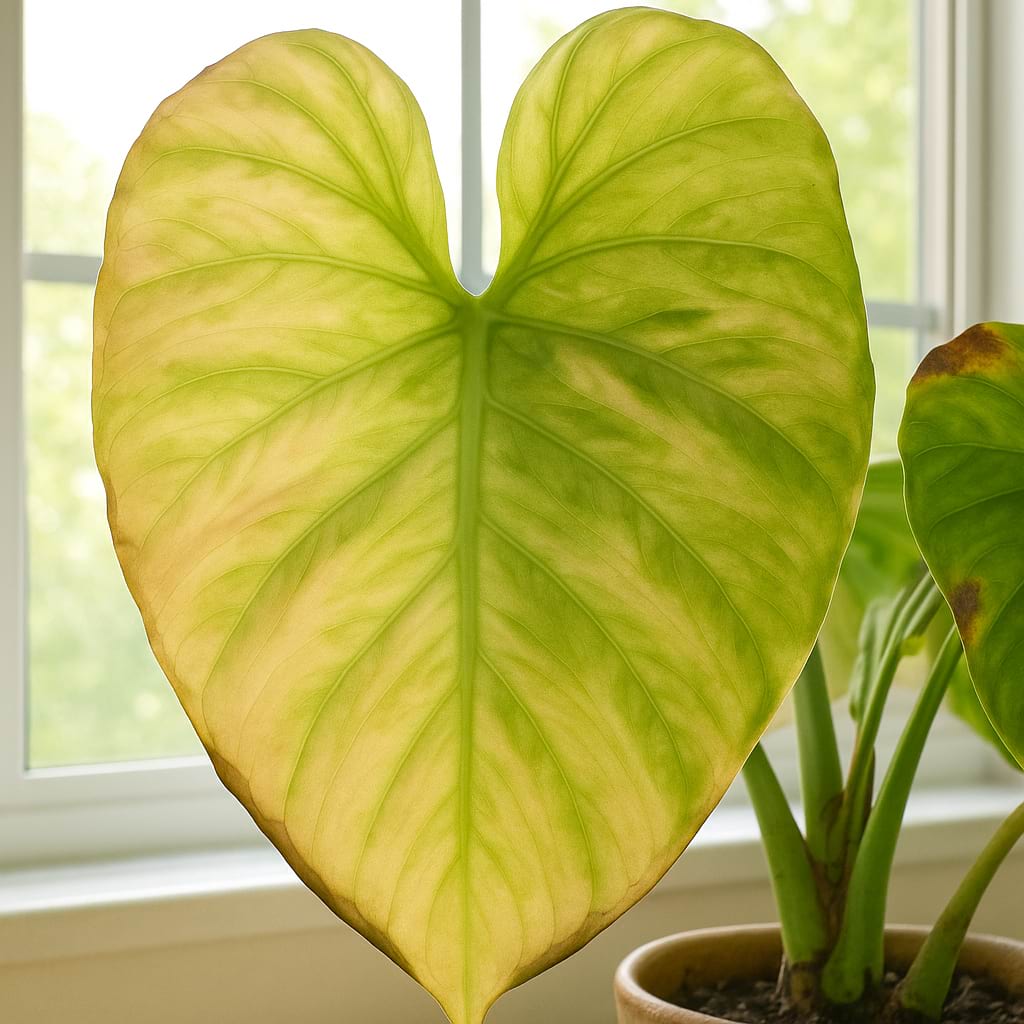
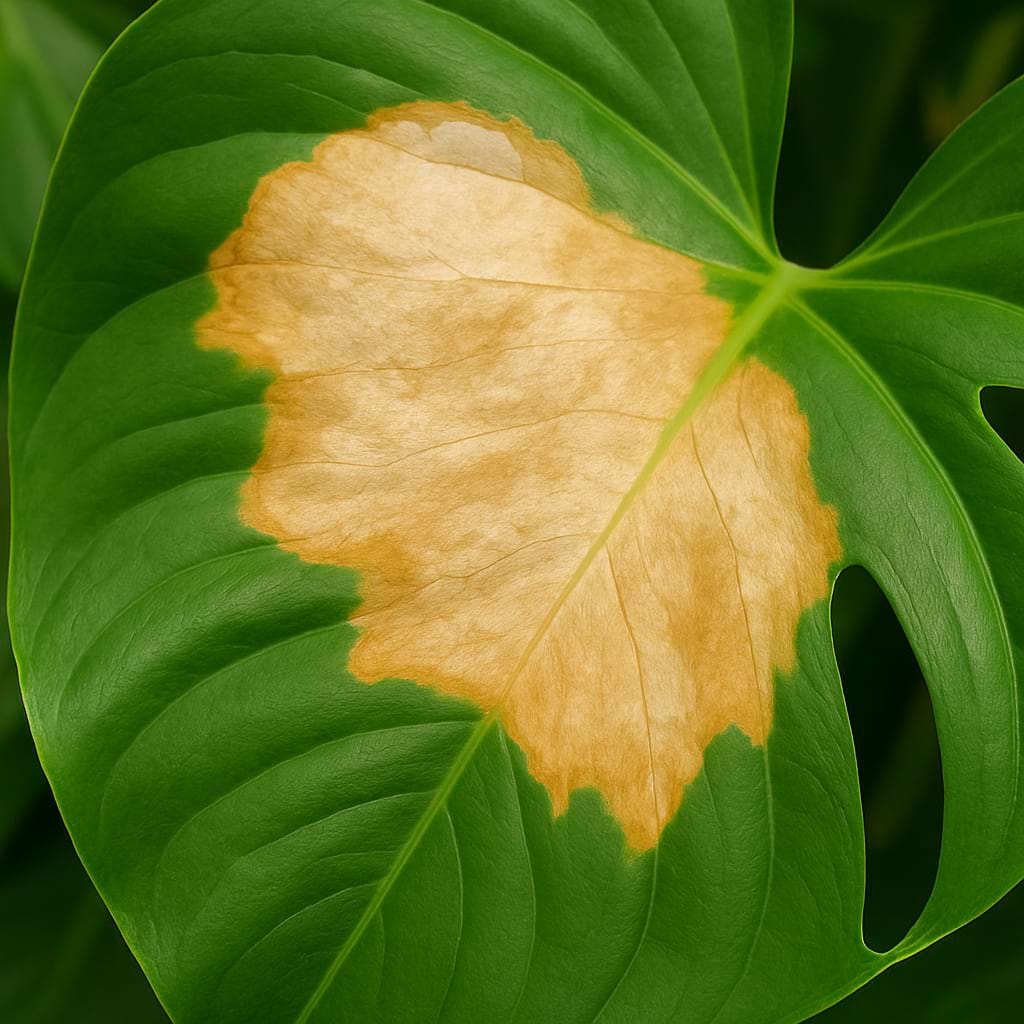
- Sunburn. Bleached or brown patches after a move into strong sun. Add a sheer curtain.
- No blooms. Either the plant is young or the light is too weak.

🖼️ Baileyi Air Plant Display and Styling Ideas
Solo Setups
Baileyi's long, flame-like arms look best standing tall. Wedge a single plant into a block of reclaimed wood or a chunky piece of driftwood so it rises straight up. A slim wire stand works too, and it keeps the base completely dry. A bright desk or windowsill gives it the light and gives you a front-row view of the twisting leaves.
Grouped Arrangements
Group baileyi with air plants of different shapes for contrast. The round, fuzzy Xerographica Air Plant and the tiny, colorful Ionantha Air Plant make good partners. A large driftwood branch with three or four species tucked into its crevices makes a striking wall or shelf display. An established baileyi clump on its own mount also works as a centerpiece.
Where Not to Put It
Skip closed glass globes, deep bowls, and shelves far from a window. Keep it away from heating vents and radiators, and do not set it in a bathroom that never gets direct light or fresh air.
Also avoid spots you walk past constantly, like the edge of a narrow hallway shelf. The long arms catch on sleeves and bags, and a leaf pulled out at the base leaves an open wound where water can collect.
🌟 Baileyi Air Plant Pro Care Tips
- Always dry it upside down. This one habit prevents almost every death.
- Check the base, not the tips. A firm, pale base is healthy. A dark or soft base is the first sign of trouble.
- Use rainwater if you can. Soft water keeps the silvery trichomes clean and working well.
- Give it more light than you think. Baileyi handles bright spots better than most air plants.
- Water in the morning. The plant dries faster in daylight, and many air plants absorb carbon dioxide at night, so it needs to be dry by evening.
- Let pups grow big. A pup a third the size of the mother survives far better than a tiny one.
- Buy nursery-grown plants. Wild baileyi is imperiled in Texas, so avoid wild-collected plants.
- Compare the base when you buy. It tells you whether you have true baileyi or pseudobaileyi.
❓ Frequently Asked Questions
Is Tillandsia baileyi the same as pseudobaileyi?
No. They are separate species that are often mixed up in shops. True baileyi has a slim base and softer silver-green leaves, while pseudobaileyi has a fat onion-shaped bulb and stiff, striped leaves. Care is the same for both.
How often should I water a Baileyi Air Plant?
Once or twice a week, by dunking or soaking for 10 to 20 minutes. Water twice a week in warm, bright, or dry homes and once a week in cool winter rooms. Always shake it out and dry it upside down within four hours.
Why is my Baileyi Air Plant turning brown at the base?
A brown or black base almost always means rot from water trapped between the leaves. Let the plant dry fully and check whether leaves pull out easily. If the core is soft, it usually cannot be saved, though pups may still survive.
Is Baileyi Air Plant safe for cats and dogs?
Yes. Air plants are considered non-toxic to cats and dogs. Keep it out of reach anyway, since pets love to chew the long, crunchy leaves, which damages the plant.
Does a Baileyi Air Plant die after flowering?
Each rosette blooms once and then slowly declines over several months. Before it goes, it makes pups that grow into new plants. Keep watering the mother so the pups get a strong start.
Can I grow Baileyi Air Plant in a terrarium?
Only in an open container with plenty of air flow and a bright spot. Take it out to soak, and let it dry fully before putting it back. Closed terrariums trap moisture and rot the base.
How big does a Baileyi Air Plant get?
Most plants sold are 6 to 9 inches tall, with larger ones reaching about 12 inches. Over several years, left to pup, it forms a clump that can be much wider than a single plant.
Can Baileyi Air Plant grow outdoors?
Yes, in frost-free climates like USDA zones 9b to 11. It is native to South Texas, where it grows on live oaks. Elsewhere, it can spend summer outside in bright shade and come in before nights drop below 50°F.
How can I tell if my Baileyi Air Plant is dead?
Gently tug a center leaf. If it holds firm and the base is pale and solid, the plant is alive, even if the outer leaves look rough. If leaves fall out and the base is black or mushy, the plant has rotted and cannot recover.
Should I mist my Baileyi Air Plant?
Misting between soaks is fine in very dry homes, but it cannot replace soaking. A light mist wets only the surface and dries in minutes. Use it as an extra, and keep the weekly dunk as the main routine.
Why are the leaves of my baileyi curling so much?
Some twisting is natural for baileyi. If the leaves curl tighter than usual and feel dry or papery, the plant is thirsty. Give it an hour-long soak, then water more often.
ℹ️ Baileyi Air Plant Info
Care and Maintenance
🪴 Soil Type and pH: No soil. Mounted on driftwood, cork, or grapevine, or displayed in an open stand.
💧 Humidity and Misting: Handles average room humidity well as long as it gets regular soaks.
✂️ Pruning: Trim dry leaf tips at an angle and pull away the flower spike once it turns brown.
🧼 Cleaning: Rinse under the tap or dunk to remove dust. Do not rub the leaves, which strips the silvery trichomes.
🌱 Repotting: Not applicable. Re-mount when a clump outgrows its perch.
🔄 Repotting Frequency: Not required
❄️ Seasonal Changes in Care: Water twice weekly and feed monthly in warm months, drop to weekly watering in winter, and keep it away from heaters and cold glass.
Growing Characteristics
💥 Growth Speed: Slow to Moderate
🔄 Life Cycle: Evergreen epiphytic perennial. Each rosette flowers once, produces pups, then dries away over several months.
💥 Bloom Time: Spring into summer
🌡️ Hardiness Zones: 9b-11
🗺️ Native Area: The Gulf coast of southern Texas and Tamaulipas, Mexico, growing on live oak and Texas ebony in dry woods
🚘 Hibernation: No true dormancy, though growth slows in cool, dim winters.
Propagation and Health
📍 Suitable Locations: South or west windows with a sheer curtain, bright east windows, sunrooms, covered patios in summer
🪴 Propagation Methods: Remove pups when they reach a third of the mother's size, or leave them on to build a clump.
🐛 Common Pests: Mealybugs, Scale Insects, Spider Mites
🦠 Possible Diseases: Base rot from water trapped between the leaves.
Plant Details
🌿 Plant Type: Epiphytic bromeliad (air plant)
🍃 Foliage Type: Stiff, tubular, channeled leaves that twist and curve
🎨 Color of Leaves: Silvery gray-green, blushing purple or rosy before bloom
🌸 Flower Color: Rosy pink bracts with violet to lavender tubular flowers
🌼 Blooming: Blooms once per plant when mature, sending up a pink spike with purple tubular flowers
🍽️ Edibility: Not edible.
📏 Mature Size: 6-12 inches
Additional Info
🌻 General Benefits: Pet-safe, soil-free, tough on heat and bright light, and a native plant for Texas gardeners
💊 Medical Properties: No documented medicinal uses.
🧿 Feng Shui: Its upward, flame-like leaves suit bright entryways and desks where you want a lively, rising shape.
⭐ Zodiac Sign Compatibility: Sagittarius
🌈 Symbolism or Folklore: Resilience, independence, toughness
📝 Interesting Facts: Tillandsia baileyi is one of the few air plants native to the United States outside Florida. In the wild it grows along a narrow strip of the Gulf coast from Kingsville, Texas, to Tampico, Mexico, and NatureServe ranks it as imperiled. For years the bulbous Tillandsia pseudobaileyi was sold under its name, and the mix-up is still common today.
Buying and Usage
🛒 What to Look for When Buying: Buy nursery-grown plants only. Look for firm, stiff leaves and a base that does not wobble or darken when pressed. Check the shape too: a slim base with softer arms points to true baileyi, a fat onion bulb with stiff striped leaves points to pseudobaileyi.
🪴 Other Uses: Driftwood and cork mounts, wall displays, air plant wreaths, native plant collections in South Texas.
Decoration and Styling
🖼️ Display Ideas: Upright wood stands, angled driftwood mounts, grouped clumps, wire wall grids
🧵 Styling Tips: Give it height. The long twisting arms look best standing tall or leaning out from a mount, not lying flat in a dish.
🪴 See also 🪴
Complete Guide to Harris's Air Plant Care and Growth
Complete Guide to Pruinosa Air Plant Care and Growth
Complete Guide to Ionantha Air Plant Care and Growth
Complete Guide to Spanish Moss Care and Growth
Complete Guide to Xerographica Air Plant Care and Growth
Complete Guide to Pink Quill Plant Care and Growth
Complete Guide to Silver Vase Plant Care and Growth
Complete Guide to Sky Plant Care and Growth
Complete Guide to Brachycaulos Air Plant Care and Growth

Houseplant101 Forum
Questions & Comments
Ask a question, share your plant experience, or help other plant owners.
Comments are temporarily unavailable.
Open the Houseplant101 ForumNo comments yet
Be the first to ask a question or share your experience about this page.
Log in or create an account
Comments use your Houseplant101 Forum account, but you can stay on this page.
Create a new account