
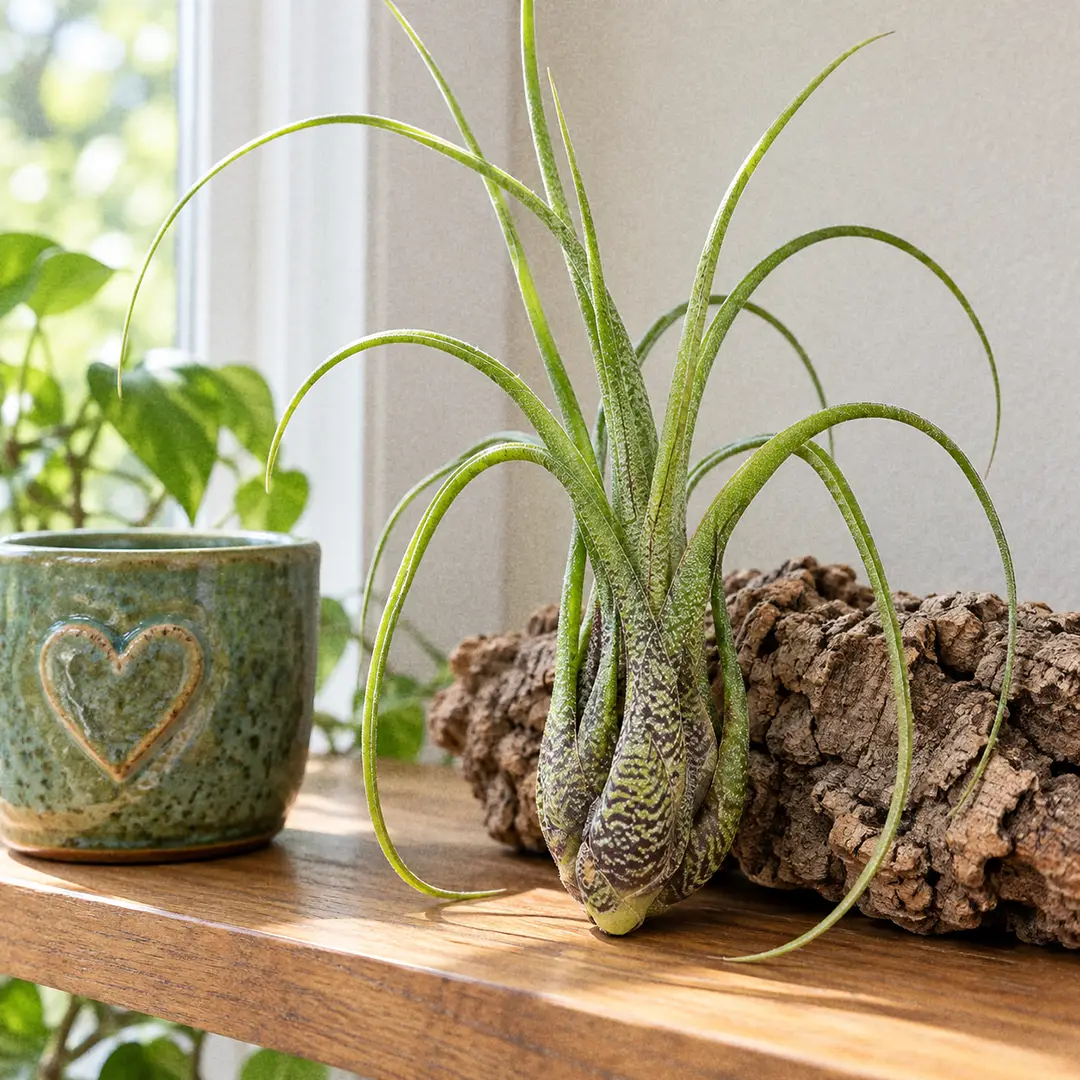
Butzii Air Plant
Tillandsia butzii
Tillandsia butzii, Butzii, Speckled Air Plant, Snake Air Plant, Medusa Air Plant


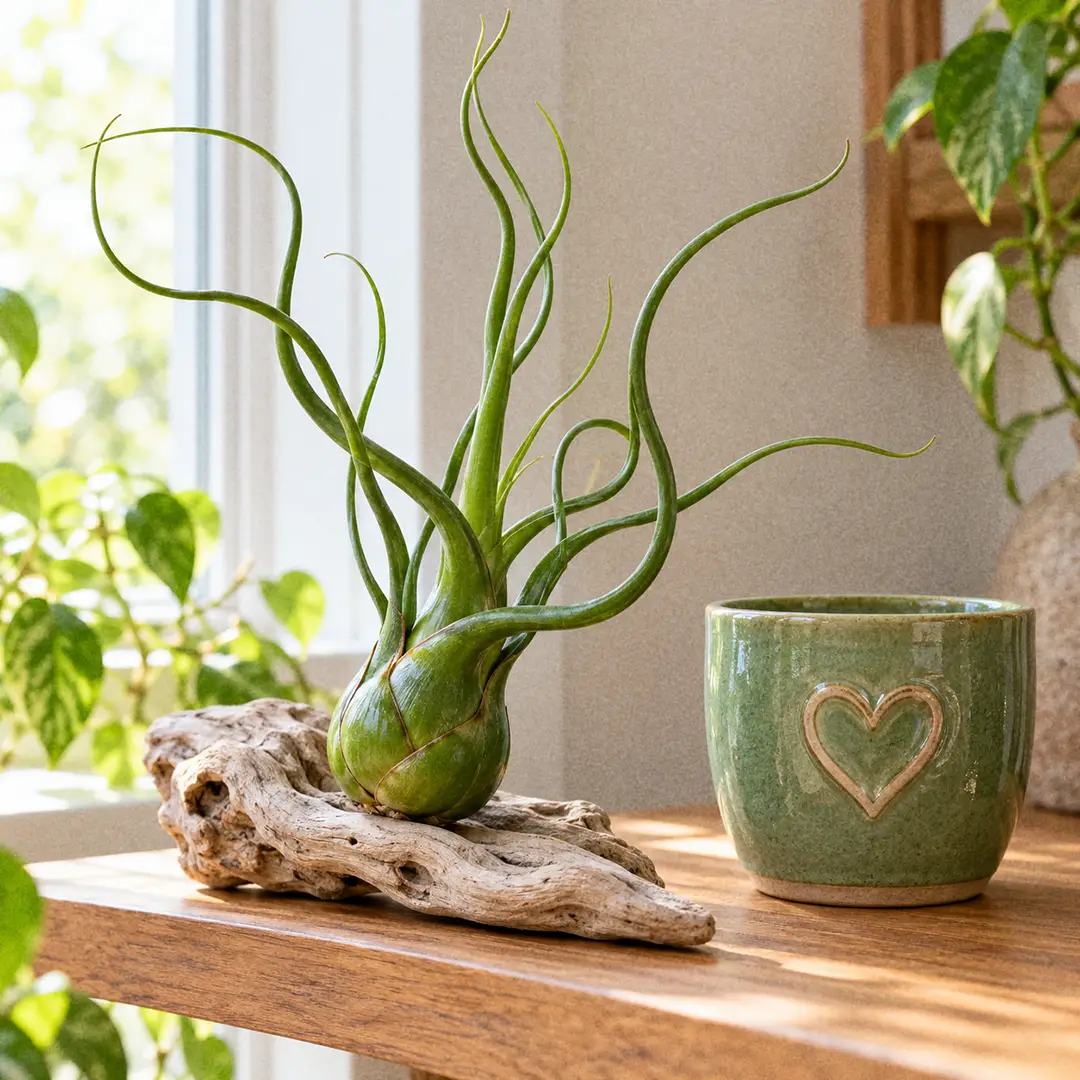
Butzii Air Plant is the leopard-spotted Tillandsia with wiry tentacle leaves rising out of a hollow bulb that wild ants move into. Learn how to water Tillandsia butzii without rotting that bulb, read its chocolate speckling, and grow it on to a purple bloom and a clump of pups.
📝 Butzii Air Plant Care Notes
🌿 Care Instructions
⚠️ Common Pests
📊 Growth Information
🪴 In This Guide 🪴

☀️ Butzii Air Plant Light Requirements (Bright Indirect Light)
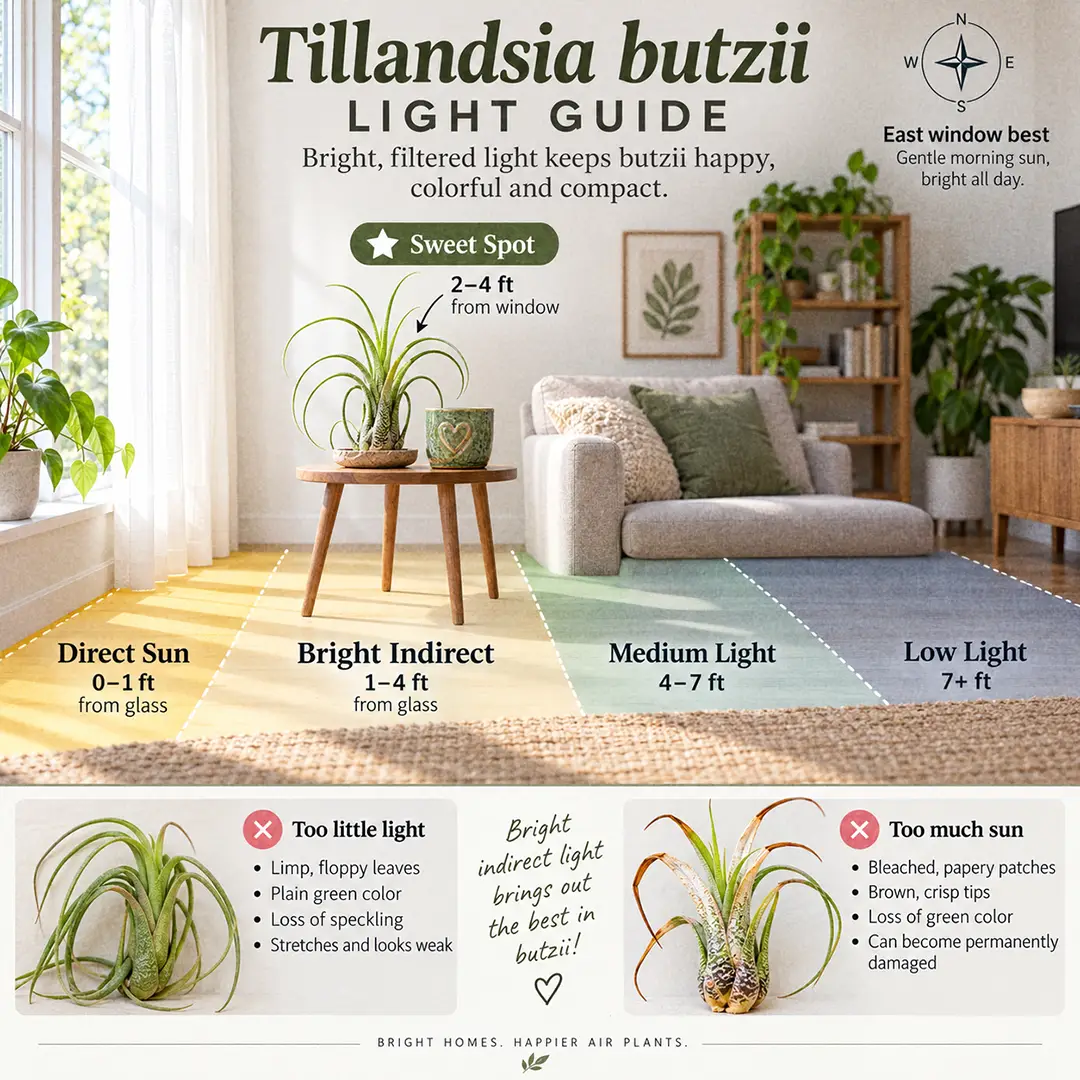
The Sweet Spot
Butzii wants bright indirect light, and it wants slightly less of it than the silver Tillandsias people usually compare it to. It comes from cloud forest, growing high on branches under a layer of canopy and mist, not from an exposed rock face in full Guatemalan sun.
An east window, two to four feet back from the glass, is close to perfect. A south or west window works with a sheer curtain in between. If you already grow Harris's Air Plant on a hot sill, move Butzii a foot or two further into the room and it will be happier.
Too Little Light
The failure here is quiet. A dim Butzii keeps its leaves, keeps looking alive, and does nothing at all for a year. The speckling fades toward plain green, the leaves lose their springy curl and go limp, and the plant will never flower or produce pups.
Air plants have no soil to fall back on, so light is most of their diet. If your brightest spot is genuinely dark, a small grow light about a foot above the plant for ten hours a day solves it outright. Our indoor light guide helps if you are still learning to judge a window by eye.
Too Much Light
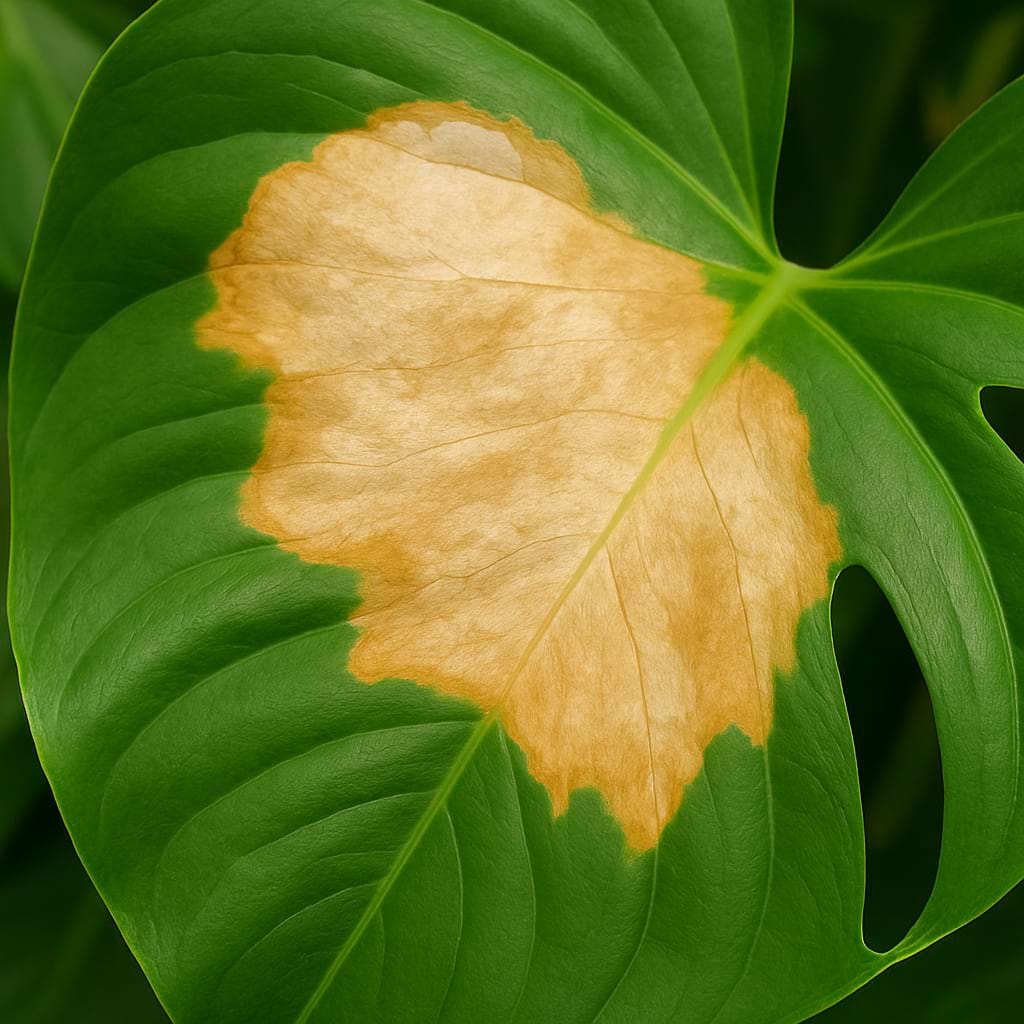
Hours of unfiltered midday sun through glass will bleach pale papery patches on the upward-facing leaves and crisp the fine tips to brown. That is leaf scorch and it does not heal, so the damaged tissue stays damaged.
A gentle silvering across the whole plant is different and perfectly fine. The trichomes that absorb water reflect more light when the plant is dry, so a Butzii in good light simply looks frostier than one sitting in shade.
💧 Butzii Air Plant Watering Guide (Skip the Long Soak)
Watering Frequency
Butzii is a mesic species, which is a botanist's way of saying it grew up somewhere damp. It drinks more often than the chunky silver Tillandsias, and it sulks if you treat it like a desert plant.
Two to three waterings a week in spring and summer, dropping to once or twice a week in winter. Warm bright rooms push that toward the higher number, cool dim winter rooms toward the lower. The plant tells you when it is thirsty: the leaves roll inward more tightly and go a shade paler and stiffer.
How to Water Without Rotting the Bulb
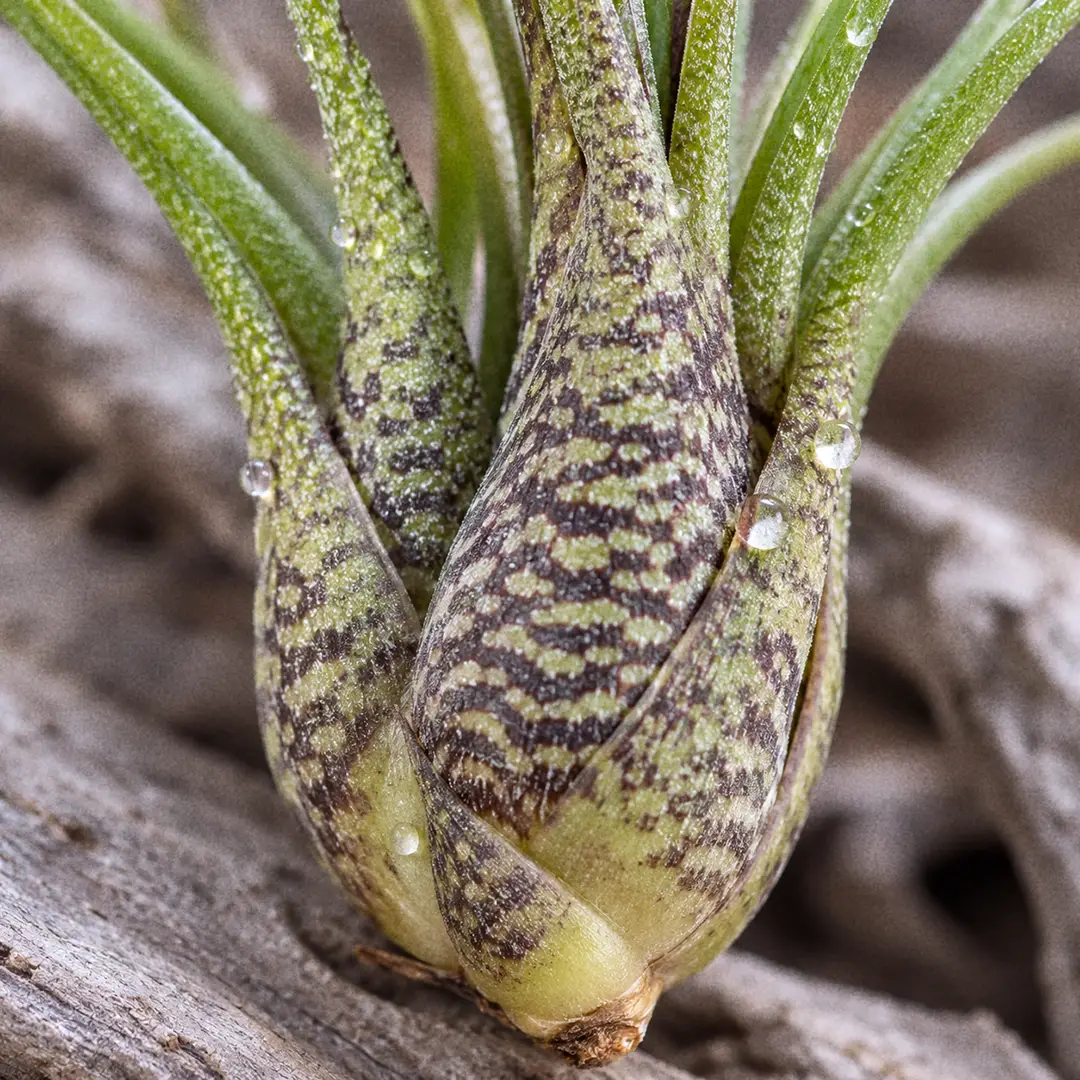
Here is the part that matters, and it is where most Butzii deaths come from. The bulb at the base is a chamber built from overlapping leaf sheaths, and it fills with water and holds it.
Skip the hour-long soak that generic air plant advice recommends. Instead, dunk the plant in room-temperature water for two or three minutes, or mist it heavily until it drips. Then take the single most important step: turn it upside down and shake it firmly, two or three sharp flicks, until no more water runs out of the base. Rest it upside down or on its side somewhere with moving air until it is completely dry, which should take under four hours.
Rainwater, distilled water, or old aquarium water all beat hard tap water, which leaves white mineral crust on the trichomes. If tap is all you have, let it stand overnight first. Our watering guide covers water quality in more detail.
Signs of Trouble
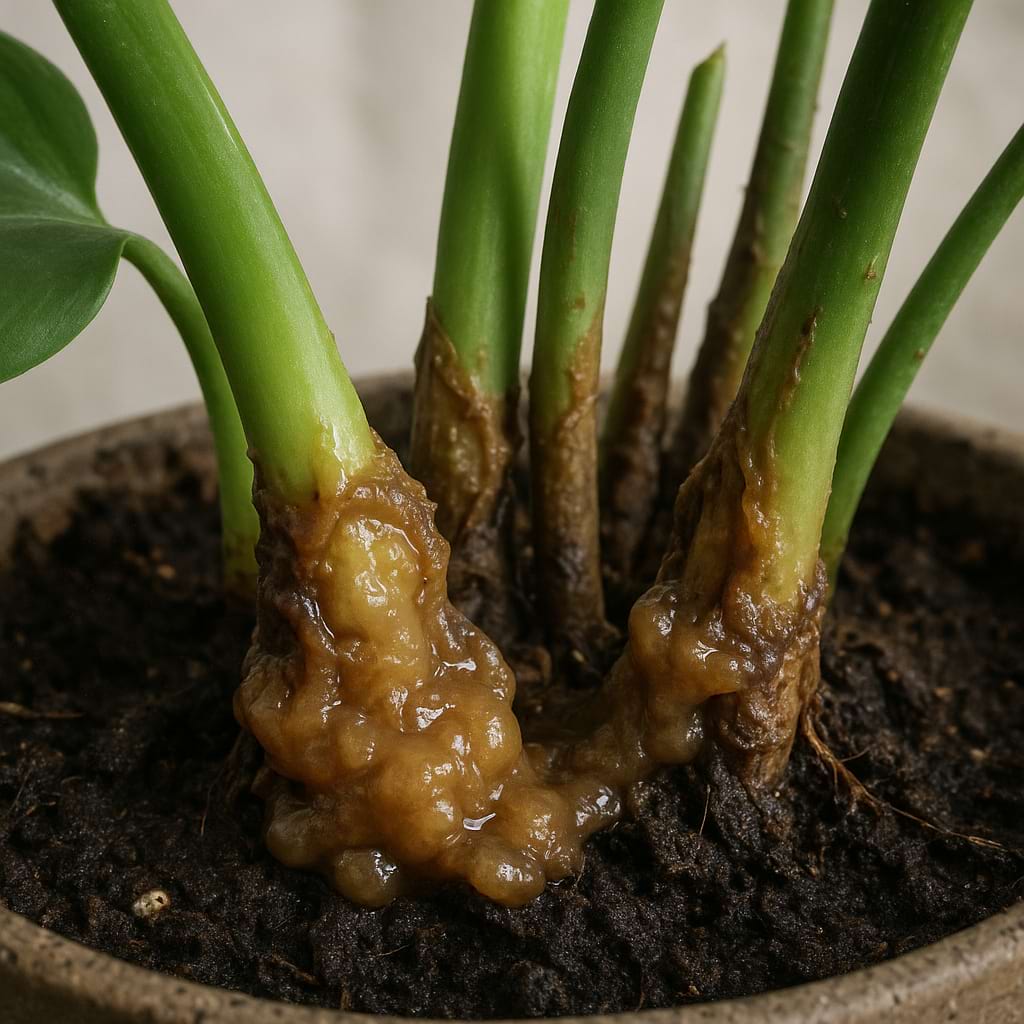
Overwatering shows at the base, not the tips. The bulb goes soft, the innermost leaves pull out with no resistance, and there is a faint sour smell. That is base rot, and a plant that far gone rarely comes back.
Underwatering shows at the tips: browning, crisping, and leaves that curl hard and stay curled after a drink. A thirsty plant recovers fully within a day of a good dunk. A rotting one does not recover at all.
🪴 Best Soil for Butzii Air Plant (There Isn't Any)
Why It Needs No Soil
Butzii has no use for potting mix. In the wild it clings to bark high in a cloud forest canopy, and the few roots it grows are anchors, not feeding organs. Every drop of water and every nutrient it takes in comes through the trichomes on its leaves.
Plant one in soil and the bulb stays wet against damp compost, which is a direct route to root rot. This is the biggest single difference between caring for an air plant and caring for anything else on your shelf.
What to Grow It On Instead
Cork bark is the classic choice and holds up well to years of dunking. Driftwood, grapewood, a slab of tree fern, or a flat piece of manzanita all work. Attach the plant with fishing line, thin florist wire, or a dab of waterproof E6000 glue at the base of the bulb only.
Loose display works just as well. Set the plant in an open glass vessel, a shell, a wire holder, or a shallow dish with nothing under it. Just make sure whatever holds it lets air reach the bulb from underneath.
What to Avoid
No moss packed around the base, no closed jars, no sealed terrariums. Sphagnum against a pseudobulb stays wet for days and will rot the plant even when the room feels dry. If you want the terrarium look, use an open-fronted vessel and mount the plant high where air moves.
🍼 Fertilizing Butzii Air Plant
When and How Often
Feed twice a month from spring through early autumn, and stop entirely from late autumn to late winter. Fertilizer on an air plant is a growth accelerator rather than a rescue, so a plant sitting in poor light gains nothing from being fed more.
The easiest routine is to keep a jug of pre-mixed feed water and use it for one of the week's dunks, then plain water for the others.
What to Use
Use a urea-free bromeliad or air plant fertilizer at a quarter of the label strength. The urea-free part matters. Urea has to be broken down by soil microbes before a plant can take it up, and there are no soil microbes on a piece of cork, so a urea-based feed does nothing except leave residue on the leaves.
An orchid fertilizer at quarter strength is a workable substitute. Our fertilizer guide and the wider feeding article cover the label reading.
Over-Fertilizing Signs
Too much feed burns the tips brown and can leave a chalky film on the leaves that dulls the speckling. Flush the plant with two or three plain water dunks and skip feeding for a month. Under-strength and infrequent is always the safer error with this genus.
🌡️ Butzii Air Plant Temperature Range
Ideal Range
Butzii is comfortable anywhere between 50°F and 90°F (10°C to 32°C), which covers almost every heated home. The cloud forests it comes from sit at four to seven thousand feet, so nights there are genuinely cool and the plant appreciates a similar drop indoors.
A ten degree difference between day and night helps mature plants set flower buds. A windowsill provides that for free most of the year.
Drafts and Heat Sources
Cold is survivable when the plant is dry and dangerous when it is wet. Brief dips toward freezing on a dry plant do little harm, but a soaked plant in a cold draught will develop mushy patches within days. Water in the morning so the plant is bone dry by nightfall.
Heat itself is not the problem, but the dry moving air near a radiator or a forced-air vent pulls moisture out faster than the plant can replace it. Keep it a few feet clear of both, and remember that a plant in a warm spot needs watering more often than the calendar suggests.
💦 Butzii Air Plant Humidity Requirements
Ideal Humidity
Aim for 50 to 70 percent. Butzii handles ordinary household air better than its cloud forest origins suggest, but the difference between a plant that survives and one that thickens up and blooms is often just humidity.
Easy Humidity Boosters
A bright bathroom is the easiest win, since the shower does the work daily. Grouping several air plants together raises the local humidity a little. A small humidifier nearby is the reliable fix in a dry winter room.
What you must not do is trade humidity for airflow. Damp still air rots a pseudobulb faster than dry air ever dries one out. A slow-turning fan in the room is worth more than a pebble tray. Our humidity guide goes further on measuring it.
🌸 Butzii Air Plant Flowers (Purple Tubes on Red Bracts)
What the Flowers Look Like
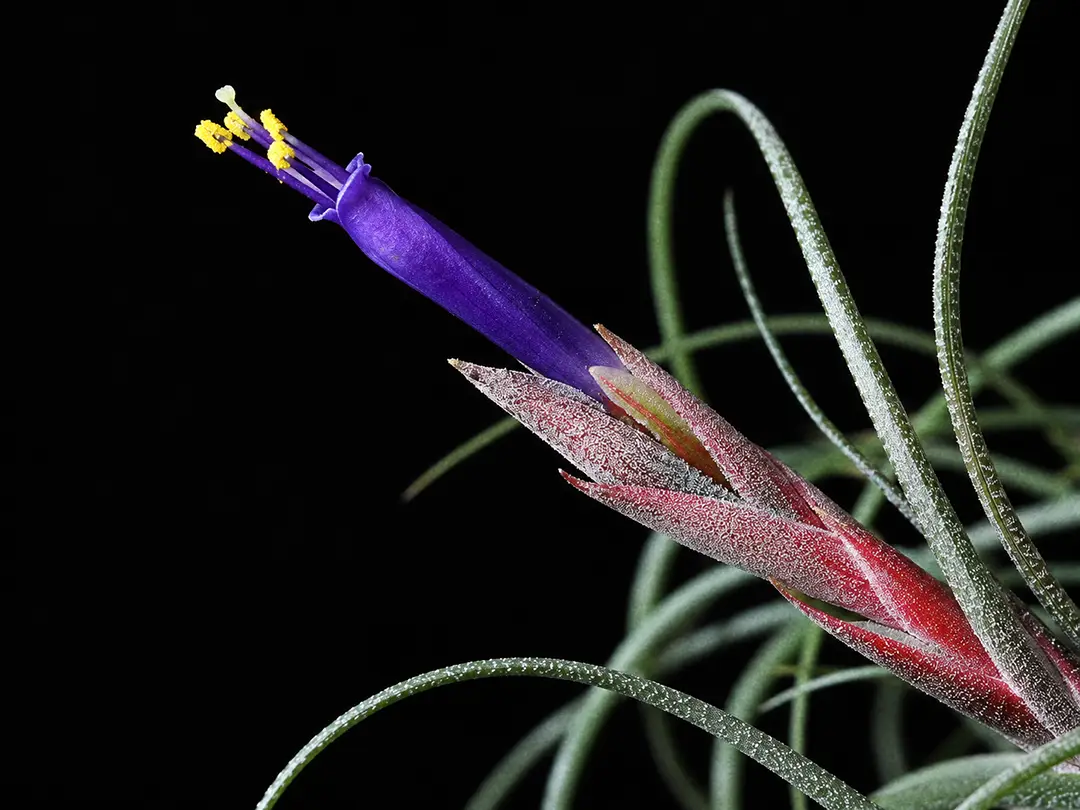
The bloom is worth the wait. A mature Butzii sends up a branched flower spike, sometimes six or eight inches long, made of flattened finger-like sections. The bracts are green flushed pink and tipped in red, and from between them slide narrow violet-purple tubular flowers about an inch long.
Each individual flower lasts a few days, but the coloured bracts hold for weeks, so the whole display runs a month or more.
How to Trigger Bloom
There is no trick, only conditions. A Butzii blooms when it reaches full size, which takes a few years from a small starter plant. Good light is the main lever, followed by consistent watering and regular feeding through the growing season.
Some growers push a stubborn mature plant with the apple trick: seal it in a bag with a ripe apple for three or four days, since the ethylene gas the fruit gives off can nudge bromeliads into flower. Take the plant out afterwards and let it dry fully.
If It Won't Bloom
The usual answer is that the plant is too young or the light is too weak. A Butzii that has been in a dim corner will not flower no matter how carefully you water it, and failure to bloom here is almost always a light problem in disguise.
One thing to understand before you get attached: each rosette flowers once. After blooming, that rosette slowly declines over a year or two while pushing out pups from the base. Losing the parent is not a failure, it is the plant reproducing.
🏷️ Butzii Air Plant Types and Varieties
The Standard Form
There are no named cultivars of Tillandsia butzii in general trade, so what you buy is the species. Plants vary in size and intensity depending on where the grower sourced them: some forms stay compact at five or six inches with tight dark banding, others stretch toward ten inches with looser, more scattered speckling. Both are the same plant.
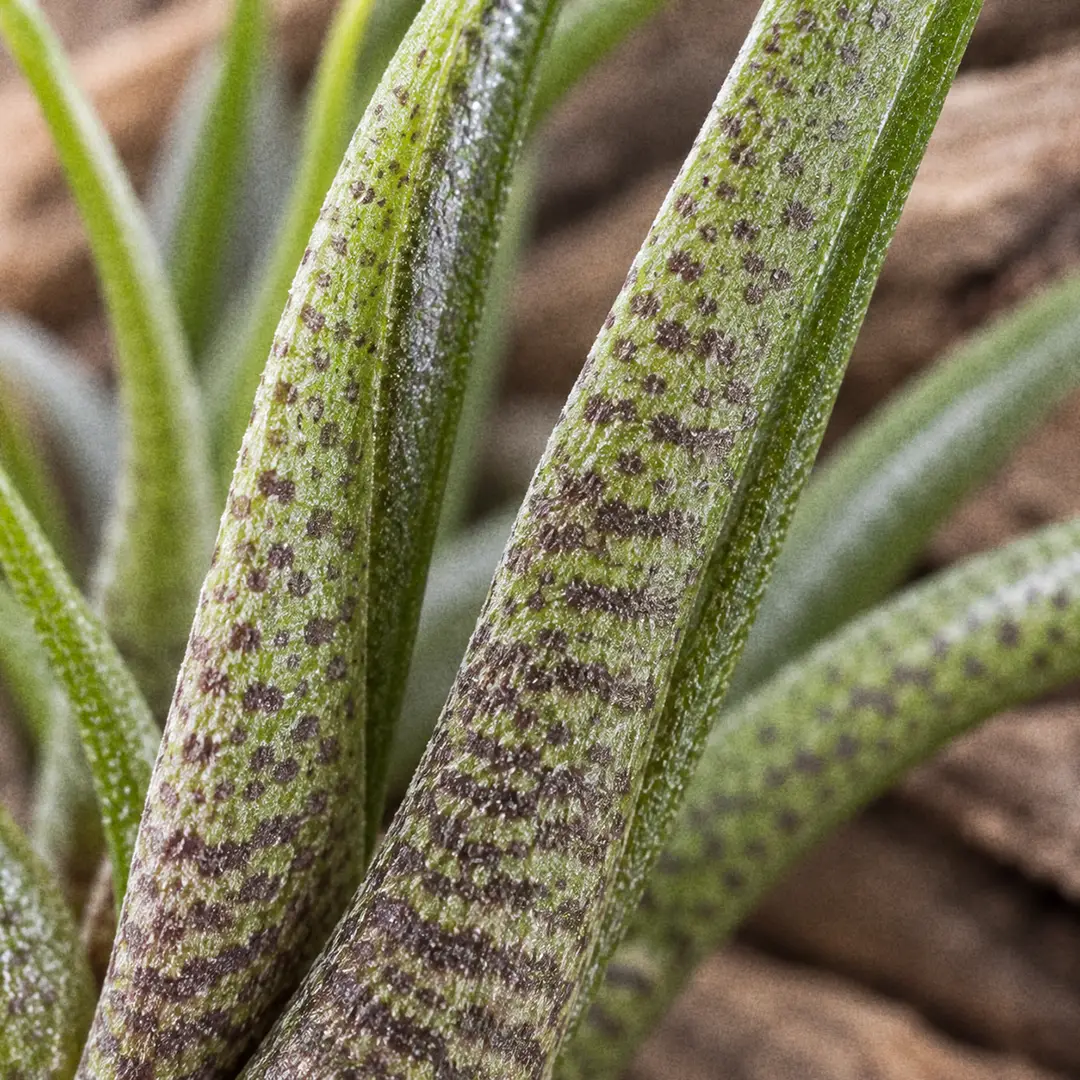
The one visible variation worth knowing is hydration state. A dry Butzii looks silvery and its markings soften. Ten minutes after a dunk the same plant turns deep glossy green and the chocolate spotting jumps out. Photos online swing wildly between the two, which is why the plant that arrives rarely matches the listing.
The Bulbous Cousins
Butzii belongs to an informal group of Tillandsias that build a swollen hollow base, and telling them apart at a shop is a genuinely useful skill.
T. bulbosa has a smaller, smoother, plain green bulb and thicker, fleshier, snakelike leaves with no speckling. The Medusa's Head Air Plant (T. caput-medusae) is chunkier and silver-grey, with stiff leaves that twist like a nest of tentacles. T. seleriana has the fattest, longest bulb of the group and is covered in dense white fuzz. The Pruinosa Air Plant looks like a pocket-sized seleriana, with a small frosty bulb and soft, fuzzy, purple-tinged arms. The Baileyi Air Plant is often sold as a bulbous plant too, though a fat bulb with stiff striped leaves usually means pseudobaileyi, while true baileyi has a slim base. Butzii is the only one of the group with fine chocolate spotting on a slim green leaf.
Butzii Versus the Rosette Air Plants
If you already grow rosette species, Butzii behaves differently enough to be worth flagging. Ionantha and Brachycaulos are compact rosettes that take a full soak without complaint. Xerographica is a giant silver curl that wants far more sun and far less water than Butzii. The grassy Juncea goes the other way again, standing upright on packed leaf sheaths that hold water just as stubbornly as a hollow bulb does. So does the Tricolor Air Plant, whose near-black base is the same trap in a different shape, and if you have learned to shake out a Butzii you already know how to keep one alive. Butzii sits in the middle: more water, less sun, and a base you must never leave wet.
🪴 Mounting and Displaying Butzii Air Plant
Why There Is No Repotting
Butzii is never potted, so the whole business of repotting simply does not apply. What replaces it is mounting, and once a plant is mounted it can stay there for years. The only reason to move it is a clump that has outgrown its perch.
Choosing a Mount
Cork bark is the standard for good reason: it is light, it never rots, and the texture gives the plant's anchor roots something to grip. Driftwood, grapewood, and tree fern slabs are all good. Avoid pressure-treated or painted wood, and avoid anything that stays damp, like a solid block of moss.
Mount the plant so the bulb sits proud of the surface with air underneath. Never bury the base in a hollow that traps water.
How to Attach It
Wrap fishing line or thin coated wire two or three times around the bulb and through a hole in the mount, snug but not biting into the leaves. Within a year the plant grows anchor roots into the bark and you can cut the line away.
Waterproof E6000 glue is the alternative: a small dab on the very bottom of the bulb, held for a minute. Never use hot glue, which cooks the tissue, and never glue over the sides of the bulb where water needs to escape.
✂️ Pruning Butzii Air Plant
When to Prune
Almost never. Butzii needs no shaping, no pinching, and no size control. Pruning here is tidying: removing the dry brown outer leaves that a healthy plant sheds naturally as it grows, and cutting away a spent flower spike once it has gone papery.
How to Prune
Use clean sharp scissors. Pull dead outer leaves off with a gentle downward tug and only cut if they resist. Trim a browned leaf tip on an angle, following the natural taper so the cut is invisible from a step away.
Cut the finished flower spike back to about half an inch from where it emerges. Leaving a short stub is better than cutting flush into the rosette.
What Not to Cut
Do not trim the wiry leaf tips back to make the plant look neater. The taper is the whole look, and a blunt-cut Butzii reads as damaged. Do not remove pups to tidy the shape either. Those are the plant's next generation and they need parental support for months.
🌱 How to Propagate Butzii Air Plant
The Only Method That Works
Butzii propagates from pups, which are offsets that emerge from the base of a rosette that has bloomed. Seed is technically possible and takes several years to reach a plant worth looking at, so nobody does it at home. There are no cuttings, and a single rosette cannot be divided.
Around the time a plant flowers, or shortly after, one to three pups appear at the base. They start as small green nubs tucked between the outer leaves and grow slowly into miniature versions of the parent, complete with their own little bulbs.
Step-by-Step Separation
- Wait until the pup is at least one third the size of the parent. This is the rule that separates growers who end up with clumps from growers who end up with dead pups. Smaller pups have no reserves of their own.
- Water the plant the day before so the tissue is flexible rather than brittle.
- Hold the parent bulb in one hand and the pup in the other, then twist and pull gently downward. A ready pup separates with a soft snap. If it fights you, it is not ready, so leave it.
- Check the break. A clean pup has a small pale scar at its base. If it tore and left a wound on the parent, let both dry in open air for a day before watering again.
- Treat the pup as a full-size plant from that moment: same light, same dunk-and-shake routine, same feeding.
Or Just Leave Them On
The better option, honestly, is to do nothing. Leave the pups attached and the plant builds itself into a clump, several bulbs fused at the base with tentacles going in every direction. A mature Butzii clump on a piece of driftwood is far more striking than three separate plants, and it is less work. Our propagation guide covers the general principles across other houseplants.
🐛 Butzii Air Plant Pests and Treatment
Air plants are not pest magnets, but the sheltered crevices where the leaves meet the bulb are exactly the kind of hiding spot a few species look for. Inspect the base whenever you water and problems stay small.
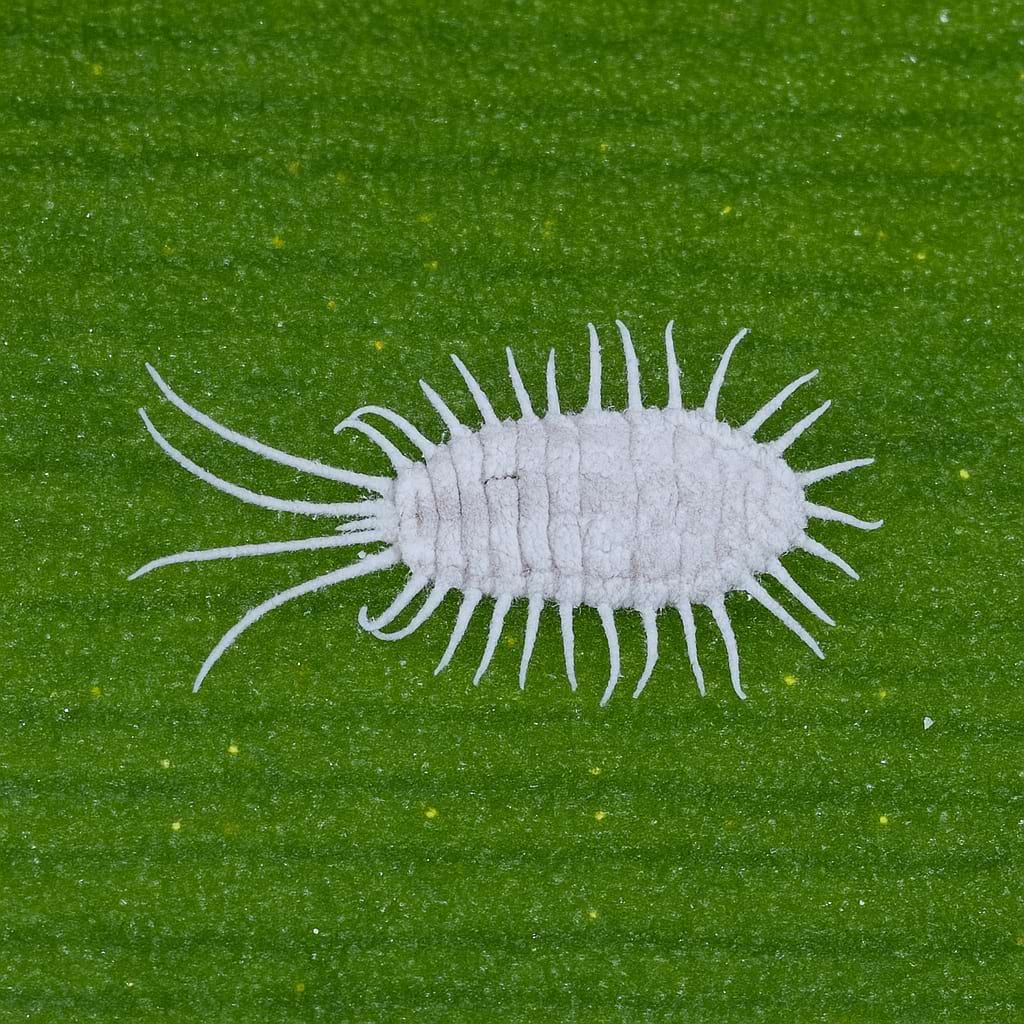
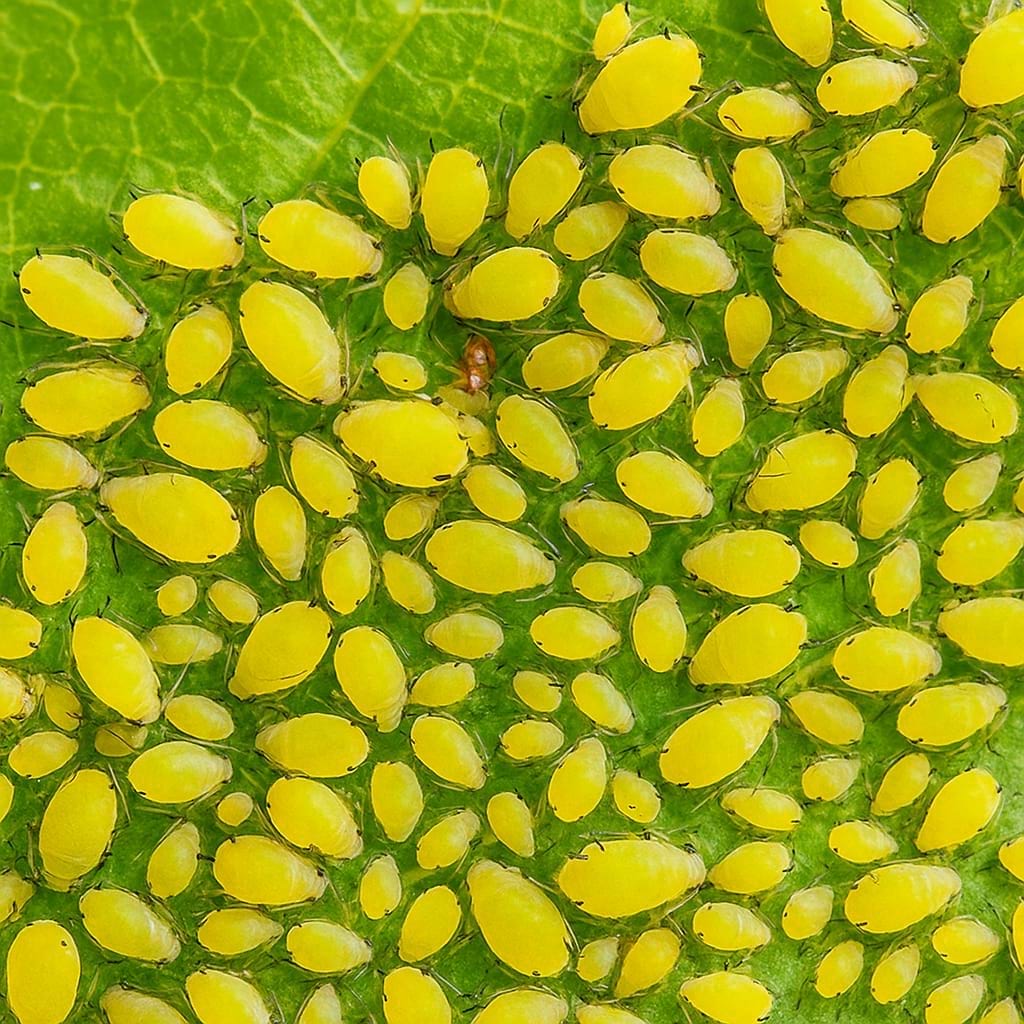
- Mealybugs are the most likely offender: white cottony specks wedged deep in the leaf sheaths. Pick them off with a cotton swab dipped in 70 percent isopropyl alcohol, then dunk the plant to rinse. Repeat weekly for a month, because eggs hatch in waves.
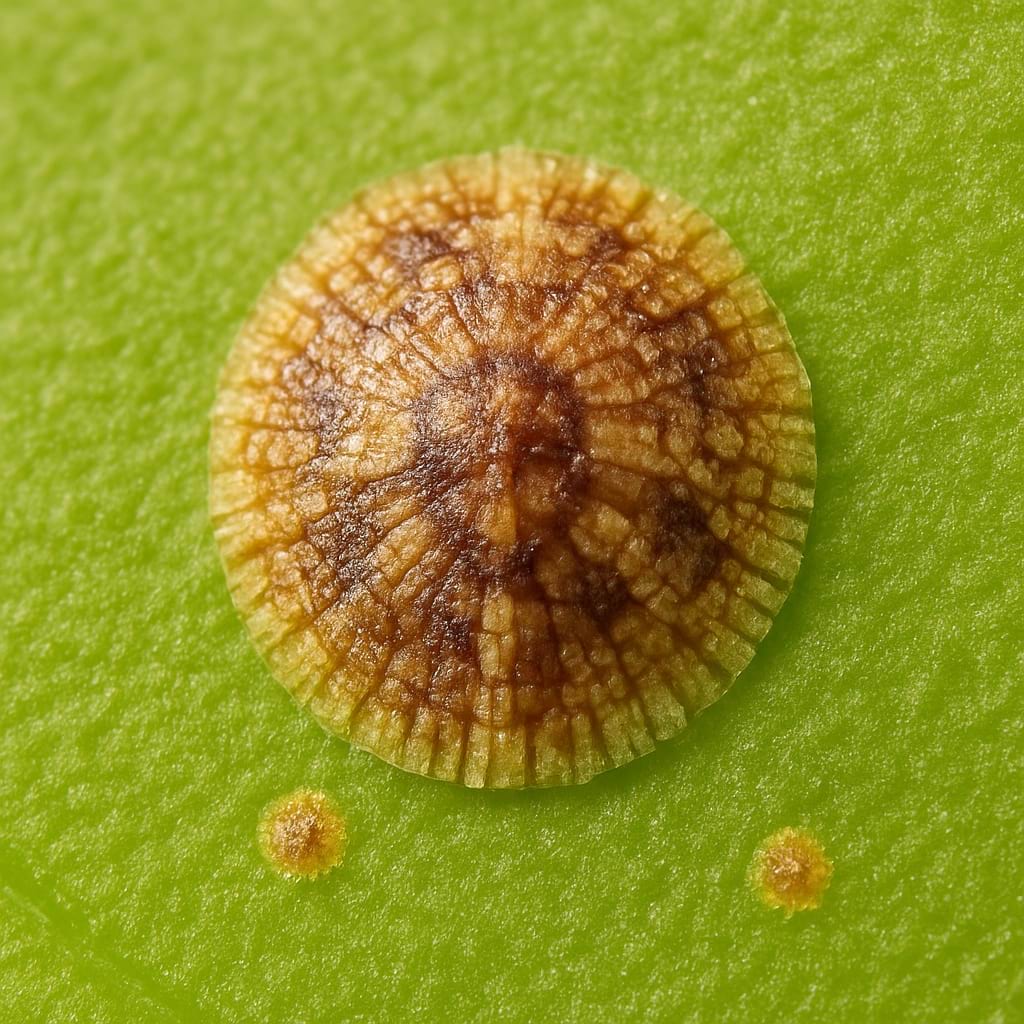
- Scale insects show as small brown limpet-like bumps on the leaves that do not brush off. Scrape them away with a fingernail or a soft toothbrush and treat the same way as mealybugs.
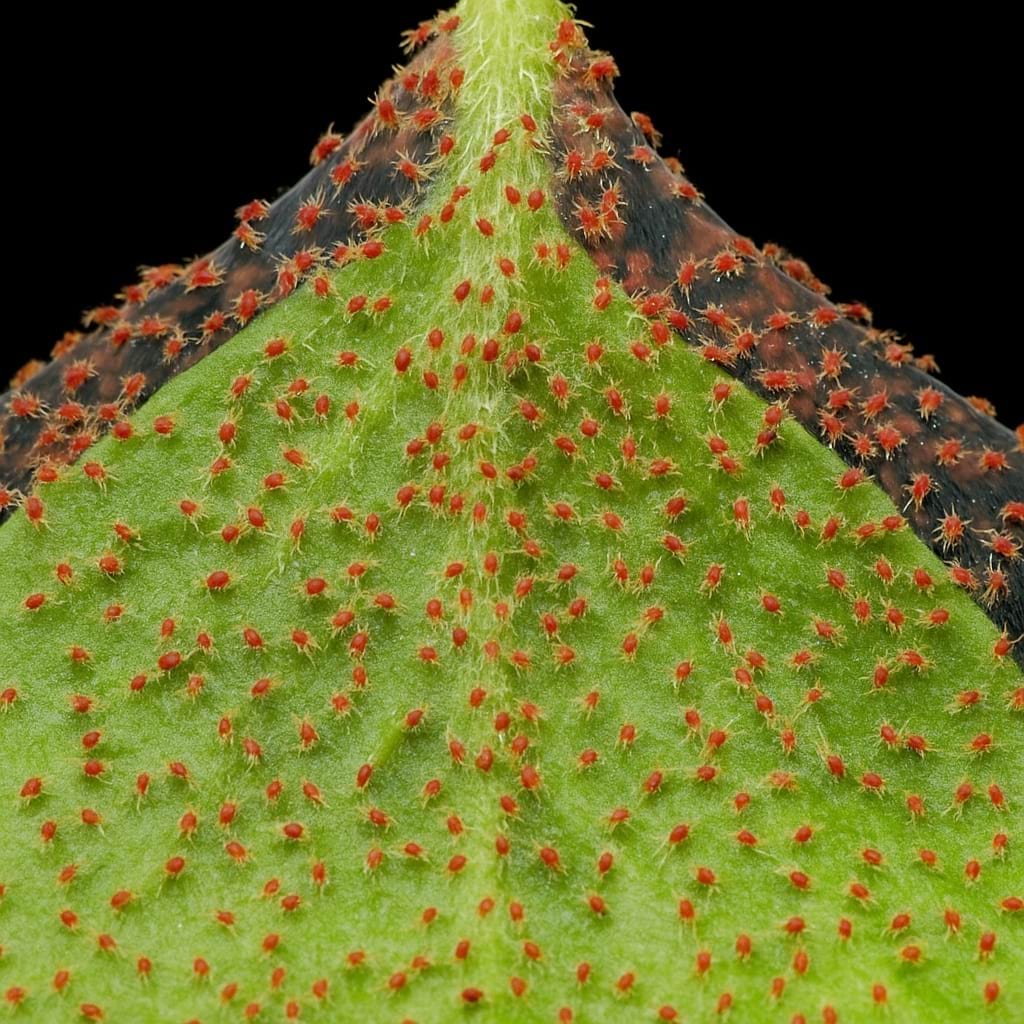
- Spider mites turn up in dry stagnant air, leaving fine webbing between the leaves and a dull stippled look. Raising humidity and rinsing the plant thoroughly usually ends an infestation without any chemicals.
- Aphids occasionally cluster on a developing flower spike. Rinse them off under a tap and check again in a few days.
A note on treatment: never use an oil-based spray on a Tillandsia. Neem oil and horticultural oil coat the trichomes and block the plant's ability to absorb water. Manual removal, alcohol on a swab, and a thorough rinse are the safe tools here.
🩺 Common Butzii Air Plant Problems
Most trouble with this plant is a water problem in one direction or the other, and the base tells you which.
- Base rot is the big one. The bulb goes soft, the centre leaves pull free with no resistance, and there is a sour smell. It is caused by water left standing in the bulb. There is no reliable cure once it reaches the core, so the fix is preventative: shake hard, dry upside down, keep air moving.
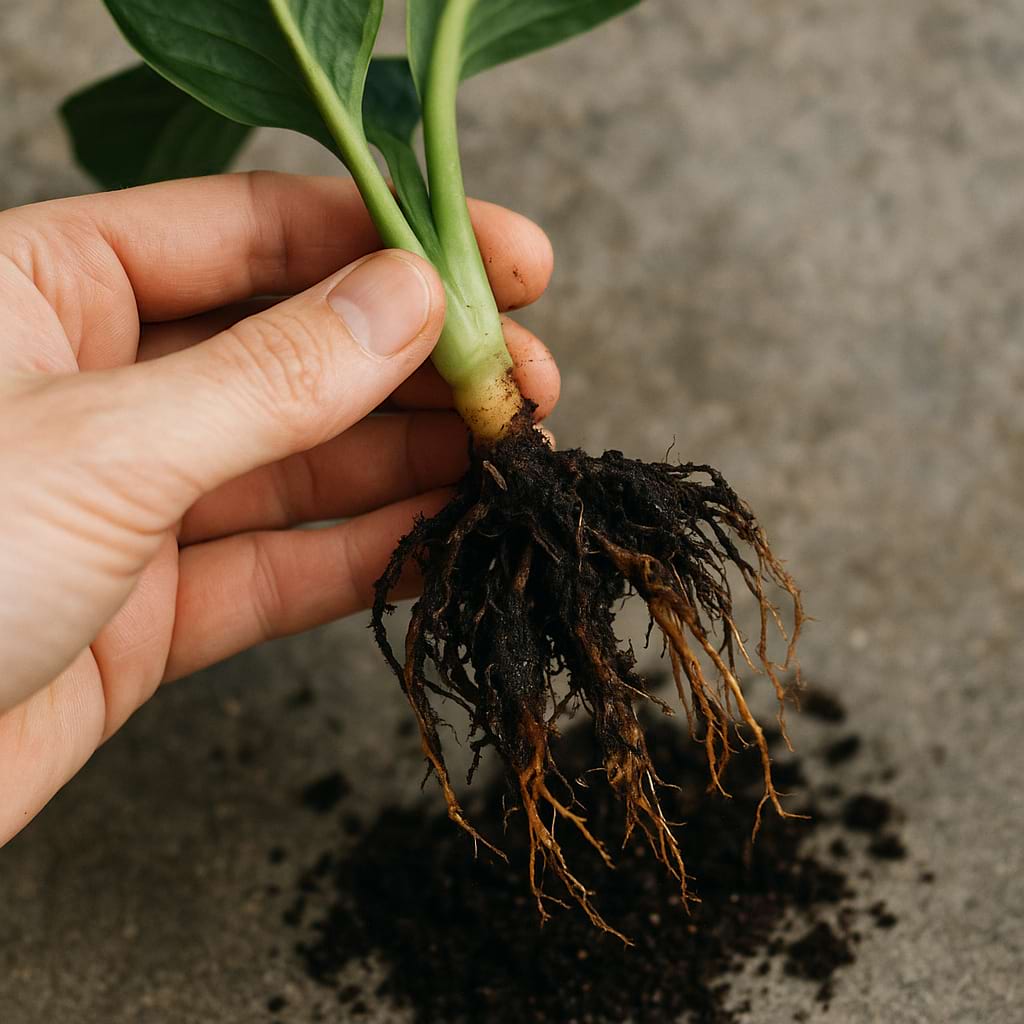
- Root rot happens when a plant is potted in soil or packed in wet moss. Remove it from the medium immediately, dry it out fully, and mount it on bark instead.
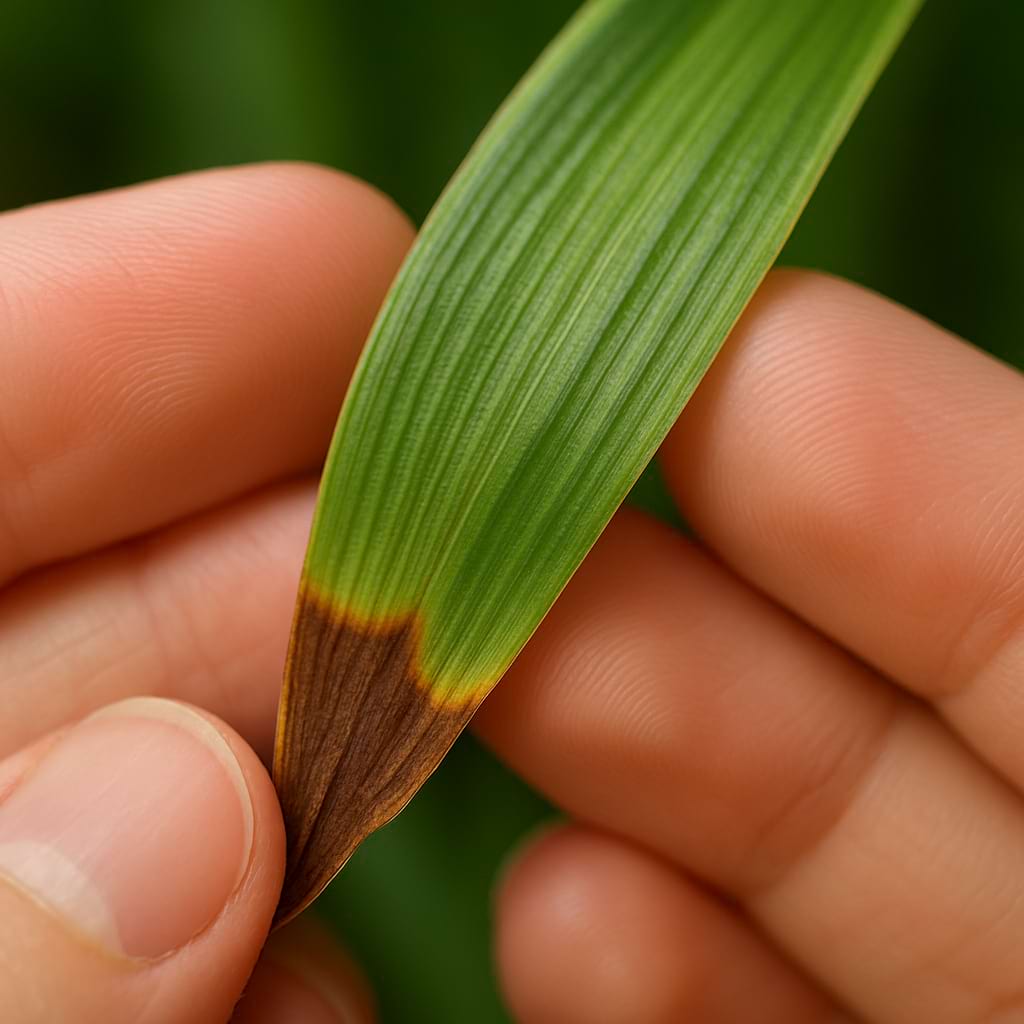
- Brown crispy tips mean too little water, air that is too dry, or mineral buildup from hard tap water. Increase watering frequency and switch to rainwater or distilled.
- Curling, limp leaves that stay curled after a drink point to a plant that has been dry too long. A twenty minute dunk usually revives it, but check the base afterwards.
- Faded speckling and pale leaves almost always mean insufficient light. Move the plant closer to a window over a week or two.
- Sun scorch appears as bleached papery patches on the sun-facing side. Filter the light and accept that the marked tissue will not recover.
🖼️ Butzii Air Plant Display and Styling Ideas
Mounted Displays
The wiry recurved leaves are the whole point, so give them air. A single Butzii wired to a slim piece of cork and hung on a wall lets the tentacles arch outward the way they do on a branch. Mounting the plant upside down is a favourite trick with this species: the leaves fall and curl in a way that makes the plant look like a small green sea creature, and the bulb drains itself every time you water.
Loose and Grouped
In an open glass vessel or a wide shallow bowl, Butzii carries a display on its own without a pot. Grouped, it works best as the tall spiky element beside rounder shapes: a compact Ionantha rosette, a trailing strand of Spanish Moss, or a silver Xerographica as the anchor piece.
Set it at or above eye level. On a low table you look down at a green tangle and lose the shape entirely.
Where Not to Put It
Not in a sealed terrarium, not in a moss-lined jar, and not in a windowless bathroom. Those are the three setups that look right in a photo and kill the plant within a season. Any display you choose needs light and moving air, in that order.
🌟 Butzii Air Plant Pro Care Tips
- Shake, then shake again. Two firm flicks upside down after every watering prevent almost every problem this plant can have.
- Water in the morning. A plant that goes into a cool night still damp is a plant asking for rot.
- Squeeze the bulb when buying. Firm means healthy. Any give at all means it is already rotting from the inside and no care will fix it.
- Judge thirst by leaf curl. Tighter curl and paler colour means dunk it. This beats any watering schedule.
- Skip the neem. Oil sprays clog the trichomes. Use alcohol on a swab for pests instead.
- Leave the pups on. A clump is easier to care for and far better looking than separated plants.
- Give it less sun than your silver Tillandsias. Butzii comes from shaded cloud forest and burns at light levels a Harris's Air Plant would enjoy.
- A fan is not optional in a humid room. Airflow is what makes high humidity safe for a pseudobulb.
❓ Frequently Asked Questions
Why is my Butzii Air Plant turning brown at the base?
A browning, softening base is rot from water trapped in the bulb, and it is the most common way this plant dies. Pull gently on a centre leaf: if it slides out with no resistance and smells sour, the core is gone. If the base is still firm and only the outer leaves have browned, that is normal shedding and nothing to worry about.
Can I soak a Butzii Air Plant like other air plants?
Better not to. The standard twenty to sixty minute soak is written for rosette species that drain freely, and Butzii's hollow bulb holds water instead. A two to three minute dunk or a heavy misting gives it everything it needs. If you do soak it, keep it short and shake the base out thoroughly afterwards.
How often should I water my Butzii Air Plant?
Two to three times a week in spring and summer, once or twice a week in winter. Warm bright rooms need the higher end, cool dim rooms the lower. Read the plant rather than the calendar: tightly curled, paler leaves mean it is thirsty.
Is Tillandsia butzii toxic to cats and dogs?
No. Tillandsias are listed as non-toxic to cats, dogs, and horses by the ASPCA. A nibbled leaf might cause brief stomach upset simply because the tissue is fibrous, and the plant will look worse afterwards than your pet does, so hang it out of reach for its own sake.
Why is my Butzii Air Plant not flowering?
Usually because it is too young or the light is too weak. A Butzii blooms once it reaches full size, which takes a few years from a small starter plant, and only in genuinely bright light. Feeding twice a month through the growing season helps it get there faster.
Does the plant die after it flowers?
The rosette does, but slowly, and it hands you replacements first. After blooming it pushes out one to three pups from the base and then declines over the following year or two. Leave the pups attached and you end up with a bigger plant than you started with.
Do ants really live inside the bulb?
In the wild, yes. In Central American cloud forests, ants chew an entrance into the hollow base of Tillandsia butzii and nest inside, and the debris they leave behind feeds the plant. Houseplants stay empty, and the hollow chamber is simply the reason you must shake the water out.
Can I glue my Butzii Air Plant to a mount?
Yes, with the right glue. Use a small dab of waterproof E6000 on the very bottom of the bulb only. Never use hot glue, which burns the tissue, and never seal the sides of the bulb, because water needs a way out. Fishing line wrapped around the base is the reversible alternative.
Why are the spots on my Butzii fading?
Faded speckling means the plant is not getting enough light, and the markings come back over a few months once it moves somewhere brighter. Colour also shifts with hydration: a dry plant looks silvery and washed out, and the same plant ten minutes after a dunk looks deep green with sharp chocolate spotting.
ℹ️ Butzii Air Plant Info
Care and Maintenance
🪴 Soil Type and pH: No soil. Grown mounted or loose as an epiphyte.
💧 Humidity and Misting: Likes 50 to 70 percent humidity with real airflow, which matters more than the number on the hygrometer.
✂️ Pruning: Trim dead outer leaves and the spent flower spike at the base with clean scissors. Nothing else needs cutting.
🧼 Cleaning: Rinse dust off during a normal dunk. Never wipe the leaves, since the fine trichomes that absorb water sit on the surface.
🌱 Repotting: Never potted. Re-mount onto a larger piece of cork or driftwood once the clump outgrows its perch.
🔄 Repotting Frequency: Only when the clump outgrows its mount, roughly every 3-4 years
❄️ Seasonal Changes in Care: Water more often and feed through spring and summer, then cut watering back and let the plant coast through a cooler, drier winter.
Growing Characteristics
💥 Growth Speed: Slow
🔄 Life Cycle: Evergreen epiphytic perennial that clumps by offsets
💥 Bloom Time: Late spring into summer, once the rosette is mature
🌡️ Hardiness Zones: 9-11
🗺️ Native Area: Cloud forests from southern Mexico through Guatemala to Panama, at roughly 4,000 to 7,000 feet elevation
🚘 Hibernation: No true dormancy. Growth slows in winter and watering should slow with it.
Propagation and Health
📍 Suitable Locations: East windowsills, bright bathrooms, cork mounts, driftwood displays, open glass vessels, terrarium edges with airflow
🪴 Propagation Methods: Leave the pups attached until they reach a third of the parent size, then twist them free or grow the whole clump on.
🐛 Common Pests: Mealybugs, Scale Insects, Spider Mites, Aphids
🦠 Possible Diseases: Bulb rot, base rot, fungal spotting in still damp air
Plant Details
🌿 Plant Type: Pseudobulbous epiphytic bromeliad
🍃 Foliage Type: Evergreen wiry recurved leaves from a swollen leaf-sheath bulb
🎨 Color of Leaves: Deep green banded and speckled with chocolate purple; silvery when dry
🌸 Flower Color: Violet-purple tubular flowers on red-tipped green bracts
🌼 Blooming: Yes, once per rosette, on plants that have had a few years of good light
🍽️ Edibility: Not edible.
📏 Mature Size: 6-10 inches tall
Additional Info
🌻 General Benefits: Pet-safe, needs no soil, survives on air and water, and offers one of the most unusual leaf patterns in the genus
💊 Medical Properties: No documented medicinal uses.
🧿 Feng Shui: A soilless, upward-curling plant that suits small awkward spaces and reads as light, mobile energy rather than grounded weight.
⭐ Zodiac Sign Compatibility: Aquarius
🌈 Symbolism or Folklore: Independence, adaptability, shelter offered freely
📝 Interesting Facts: The swollen base of a Butzii Air Plant is hollow. In the cloud forests of Central America, ants chew an entrance into it and nest inside, and the debris they leave behind feeds the plant. Botanists call plants like this myrmecophytes, or ant-house plants, and Tillandsia butzii shares the habit with its bulbous relatives bulbosa, caput-medusae and seleriana.
Buying and Usage
🛒 What to Look for When Buying: Pick a plant with a firm bulb, crisp visible speckling, and leaves that feel springy rather than limp. Squeeze the base gently. Any softness or sour smell means rot has already started and the plant will not recover.
🪴 Other Uses: Cork and driftwood mounts, hanging displays, wreaths, shell and geode holders, open terrariums, living wall panels
Decoration and Styling
🖼️ Display Ideas: Mounted upside down on cork so the leaves cascade, wired to driftwood, grouped with smaller rosette Tillandsias, or set in an open glass vessel
🧵 Styling Tips: The leaves curl outward and downward, so this plant reads best at or above eye level where the tentacles have room to hang rather than press flat.
🪴 See also 🪴
Complete Guide to Bulbosa Air Plant Care and Growth

Houseplant101 Forum
Questions & Comments
Ask a question, share your plant experience, or help other plant owners.
Comments are temporarily unavailable.
Open the Houseplant101 ForumNo comments yet
Be the first to ask a question or share your experience about this page.
Log in or create an account
Comments use your Houseplant101 Forum account, but you can stay on this page.
Create a new account