
Juncea Air Plant
Tillandsia juncea
Rush-Like Air Plant, Grass Air Plant, Tillandsia juncifolia


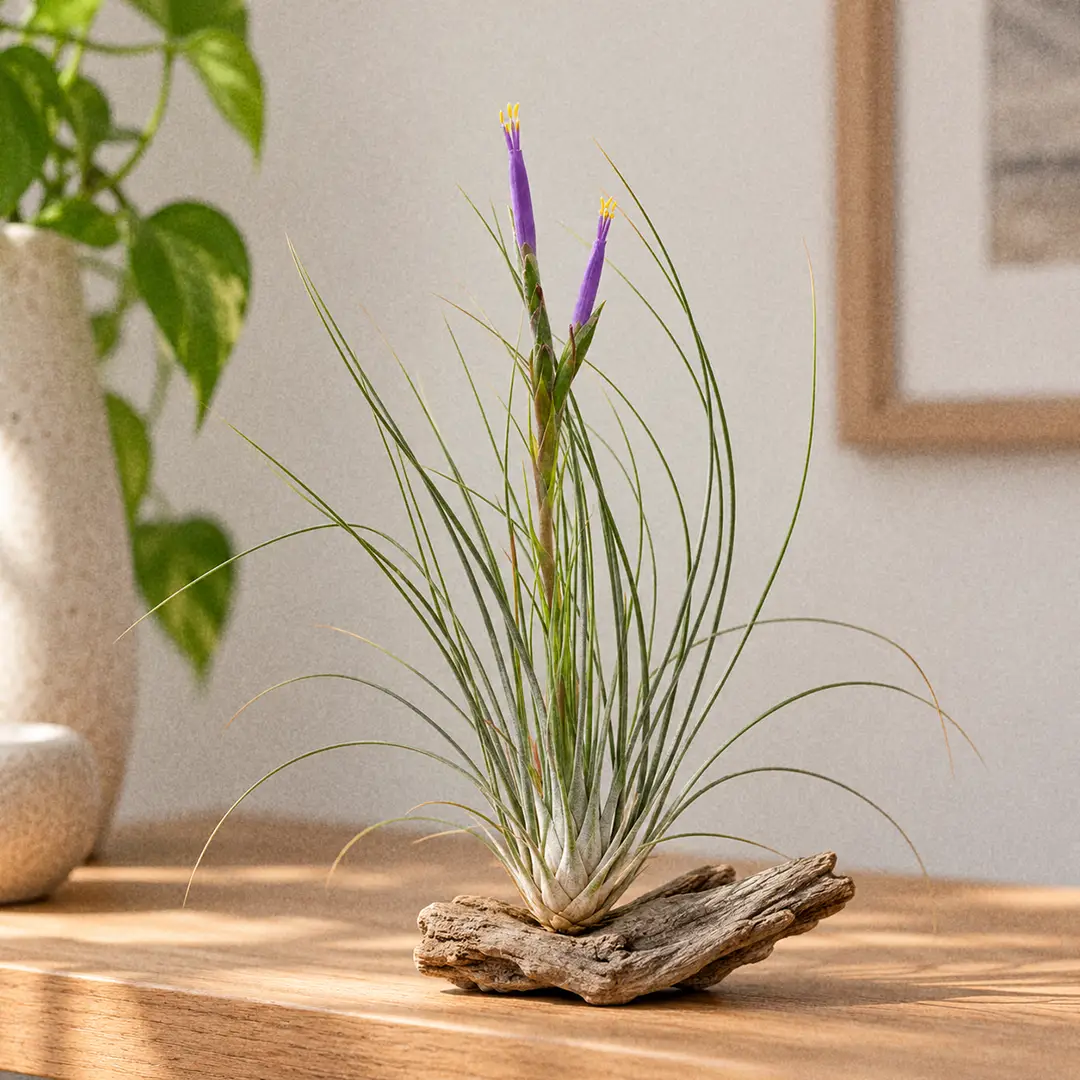
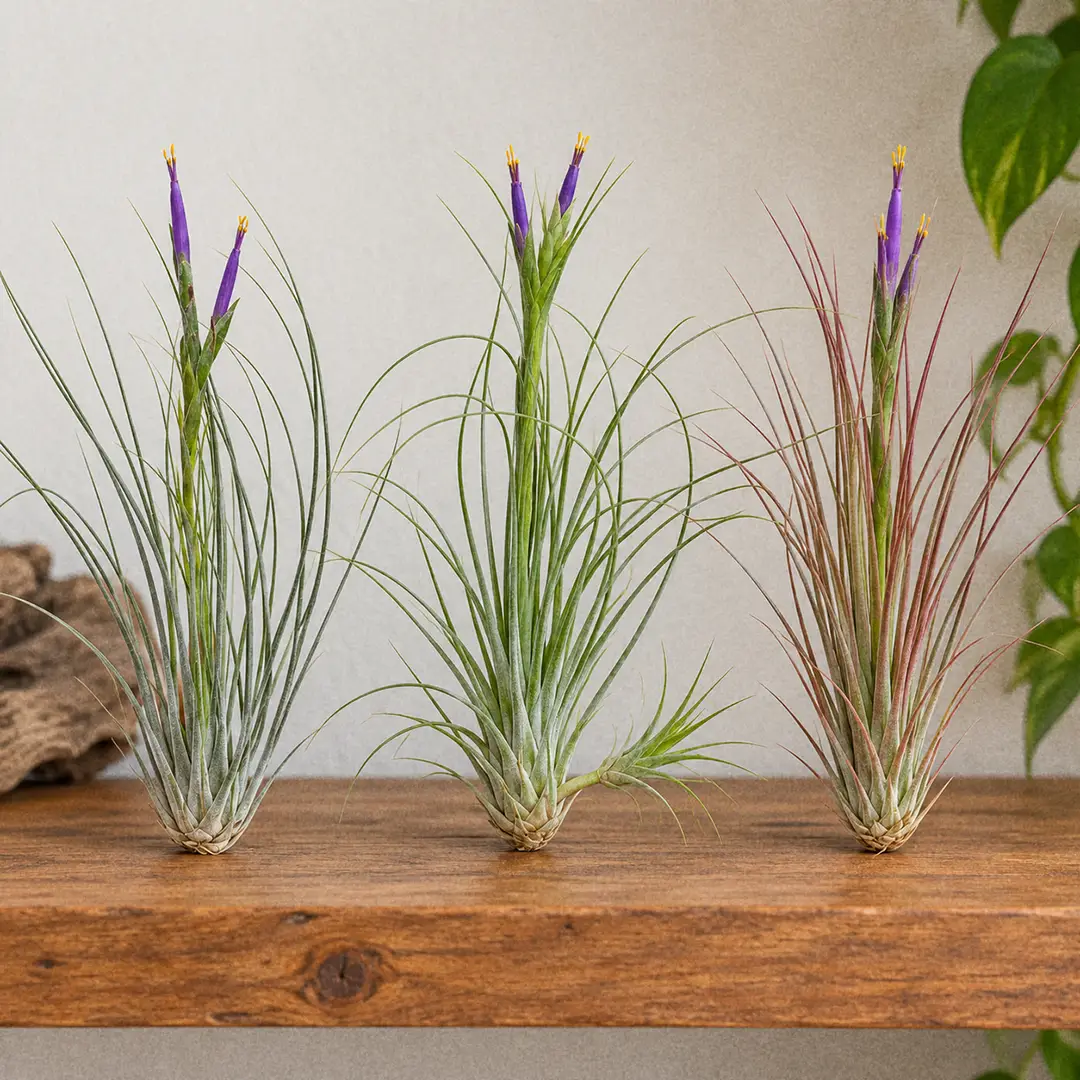
The Juncea Air Plant grows like a fountain of fine silver grass, tall and upright instead of squat like most Tillandsias, and it blushes bronze to red in strong light. Learn how to water Tillandsia juncea without rotting the packed sheaths at its base.
📝 Juncea Air Plant Care Notes
🌿 Care Instructions
⚠️ Common Pests
📊 Growth Information
🪴 In This Guide 🪴

☀️ Juncea Air Plant Light Requirements (Bright, Some Direct Sun)
The Sweet Spot
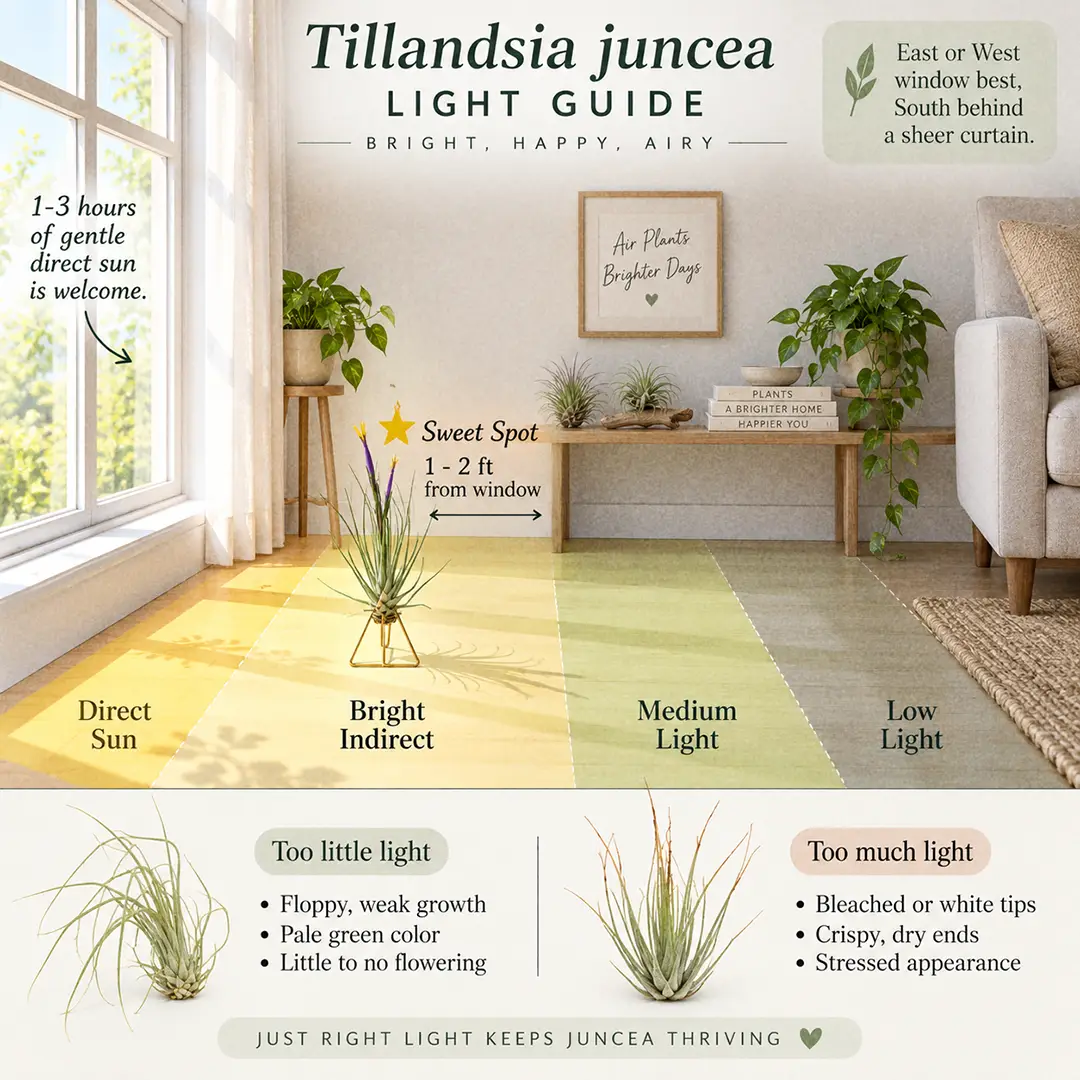
Juncea comes from exposed trees and rock faces across Mexico, Central America and northern South America, at elevations that run all the way up to 2,400 metres. That is bright, open, windy country, and the plant grew a coat of silver scales to cope with it. Indoors it wants bright light all day plus one to three hours of gentle direct sun, which usually means sitting one to two feet from an east or west window.
A south window works too, behind a sheer curtain. Those silver scales are trichomes, and the rule across the whole genus holds here: the furrier and more silver a Tillandsia looks, the more light it is asking for. Our Indoor Lighting Guide walks through judging a window by eye if you are not sure what you have.
Too Little Light
In a dim spot the leaves go soft, flop outward instead of arching up, and lose the silver cast for a flat green. The fountain shape collapses into something closer to a spider plant that has given up.
The bigger problem is drying time. A shaded juncea stays damp for hours after watering, and damp plus still air is exactly how the base rots. Low light also means it will almost certainly never flower. If a north window is your only option, add a grow light on a timer and treat the window as decoration.
Too Much Light
Behind hot unfiltered south or west glass in midsummer, the fine leaf tips bleach and crisp. That is leaf scorch, and scorched tissue does not recover, though the plant usually survives the mistake.
A bronze, coppery or red flush over the whole plant is something different and something good. Juncea genuinely colours up in strong light, and a plant that is blushing evenly is often a plant getting ready to bloom. Increase light over two or three weeks rather than moving it from a corner to a sunny sill in one jump.
💧 Juncea Air Plant Watering Guide (Soak, Then Dry Upside Down)
Watering Frequency
Soak for 20 to 30 minutes every 7 to 10 days in spring and summer, stretching to every 10 to 14 days through a cool, dim winter. Misting alone does not work on this one. There is a lot of leaf here, all of it thin, and a light spray evaporates before the plant has taken anything in.
Adjust to your room rather than the calendar. A juncea in a bright airy kitchen drinks faster than the same plant in a shaded bedroom. Thirst shows in the leaves: they roll inward along their length, the arch tightens, and the fine tips start to brown. A well-watered plant feels slightly cool and pliable, while a thirsty one feels papery.
How to Water Without Rotting the Base
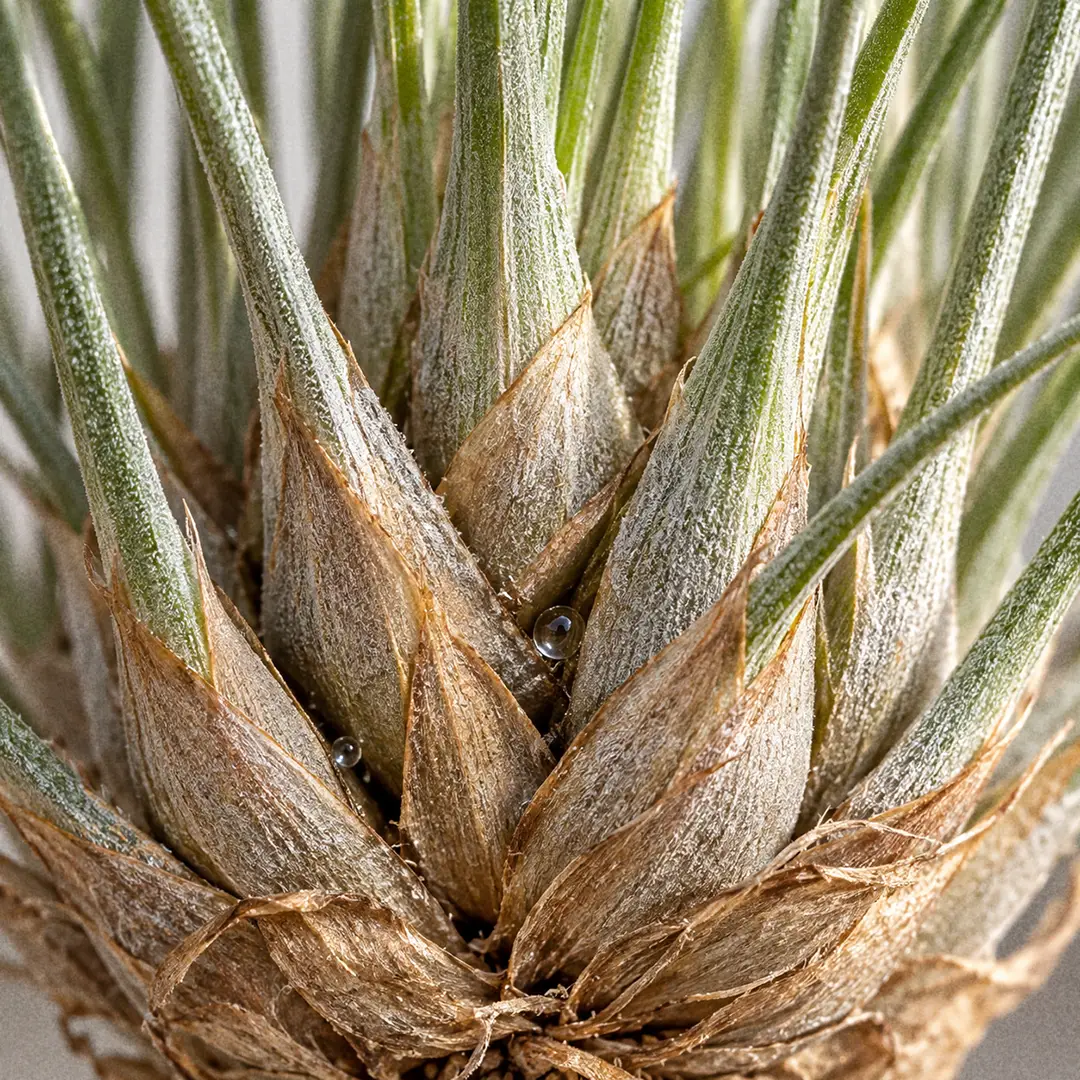
Fill a bowl with room-temperature tap water, rainwater or aquarium water, and lay the whole plant in it upside down so the leaf tips are submerged too. After 20 to 30 minutes, lift it out and shake it hard, the way you would shake water off your hand. You are trying to clear the crevices between those packed brown sheaths at the base, because that is where the danger is.
Then stand or hang it upside down somewhere with moving air until it is completely dry, which should take no more than about four hours. A dish rack, a hook, or a wire loop all work. Never leave it to dry sitting upright in a container, because the water runs straight down into the base and sits there. The watering basics guide covers water quality, and softened water is the one to avoid.
Signs of Trouble
Brown crisp tips on otherwise firm leaves mean it is too dry, too often. Add a soak or extend it by ten minutes.
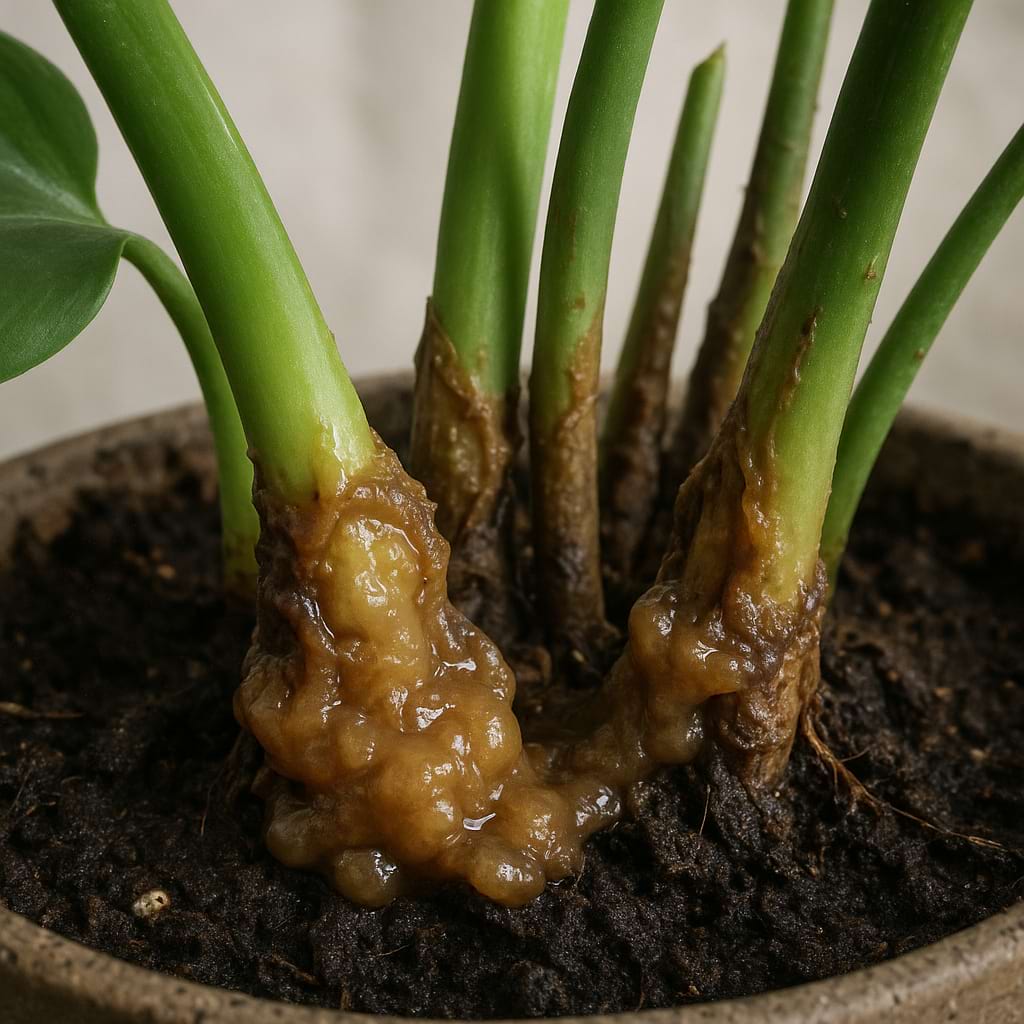
A dark, soft or sour-smelling base is the opposite problem and it is urgent. If individual leaves pull out of the centre with no resistance, the core has already rotted and the plant will not come back. Anything still firm can be saved by drying it out completely and cutting the watering right back for a few weeks.
🪴 Best Soil for Juncea Air Plant (None at All)
Why It Needs No Soil
Juncea has no working root system in the way a potted plant does. The few wiry roots it grows are anchors, nothing more. Every drop of water and every scrap of nutrient enters through the trichomes on the leaves, which is why the whole plant goes in the bowl rather than just the bottom of it.
Put it in potting mix and the base stays damp permanently, which rots it within weeks. This is the one houseplant where a bag of potting soil is actively the wrong answer.
What to Grow It On Instead
Anything that holds the plant and holds no water. Cork bark, driftwood, grapewood, a chunk of lava rock, a slate tile, a wire frame, or a shell all work well. Because juncea is tall and top-heavy, a mount with some weight to it stops the whole arrangement tipping over.
You can also skip mounting entirely. It will sit happily in the neck of a narrow bottle or a tall glass with nothing in it, held by its own sheaths, which makes watering day easy: lift, soak, shake, return.
What to Avoid
Sphagnum moss packed around the base is the classic mistake. It looks finished and it holds moisture against the exact spot that must dry, so skip it.
Also skip closed terrariums, sealed jars, and gravel or sand that the base sits down inside. Hot glue and craft glue directly on living tissue will burn it. If you must glue, use a small dab of waterproof adhesive on the dead outer sheaths only, never on green leaf bases.
🍼 Fertilizing Juncea Air Plant (Weak and Monthly)
When and How Often
Once a month from spring through early autumn is plenty. Skip it entirely in winter, when the plant is barely growing and cannot use what you give it.
The easy method is to add the feed straight to the soak water once a month, so one watering in four is a feeding watering. Nothing extra to remember.
What to Use
A bromeliad or air plant fertilizer at quarter strength is ideal. If you are using a general houseplant feed instead, look for one that is low in copper and free of urea nitrogen, because copper is toxic to Tillandsias and urea needs soil bacteria to break down. Our fertilizer guide explains the label numbers if they are new to you.
Over-Fertilizing Signs
Too much feed burns the leaf tips brown and can leave a whitish crust in the leaf crevices. Full-strength fertilizer on an air plant does real damage, so when in doubt, dilute further.
A plant that is fed hard also grows loose and soft rather than tight and silver, which makes it more likely to rot. Less is genuinely better here. Many growers never fertilize their air plants at all and lose nothing but a little flowering size.
🌡️ Juncea Air Plant Temperature Range
Ideal Range
Juncea is comfortable between roughly 50 and 90°F (10 to 32°C), which covers almost any ordinary home. It handles summer heat better than most houseplants as long as air keeps moving over it.
Outdoors it is hardy to about zone 9 to 11. A dry plant tolerates a brief dip close to freezing, but a wet plant at the same temperature is likely to collapse, so if yours summers on a porch, bring it in before the first cold snap and bring it in dry.
Drafts and Heat Sources
Moving air is a feature, not a hazard. This is one of the few houseplants that actually benefits from sitting near an open window or a ceiling fan, because airflow is what gets it dry after watering.
What to avoid is dry heat blasting on it continuously. A spot directly above a radiator or in front of a heating vent pushes the plant past drying and into shrivelling, and you will see it in crisp tips within a couple of weeks.
💦 Juncea Air Plant Humidity Requirements
Ideal Humidity
Normal household humidity, around 40 to 50 percent, suits it fine. Juncea is well scaled and well adapted to dry air, so nobody needs to buy anything for this plant.
Higher humidity around 60 percent lets you water less often, but only if air is still moving. High humidity plus stagnant air is worse for a juncea than dry air ever is.
Easy Humidity Boosters
If your winter air is very dry and the tips keep crisping, a quick rinse under the tap between soaks helps more than any tray of pebbles. Grouping air plants together also lifts the air around them slightly.
A humidifier is optional, and if you run one, keep the plant out of the direct mist stream so it is not permanently damp. Our humidity guide has more on reading a hygrometer.
🌸 Juncea Air Plant Flowers (Red Bracts, Purple Tubes)
What the Flowers Look Like
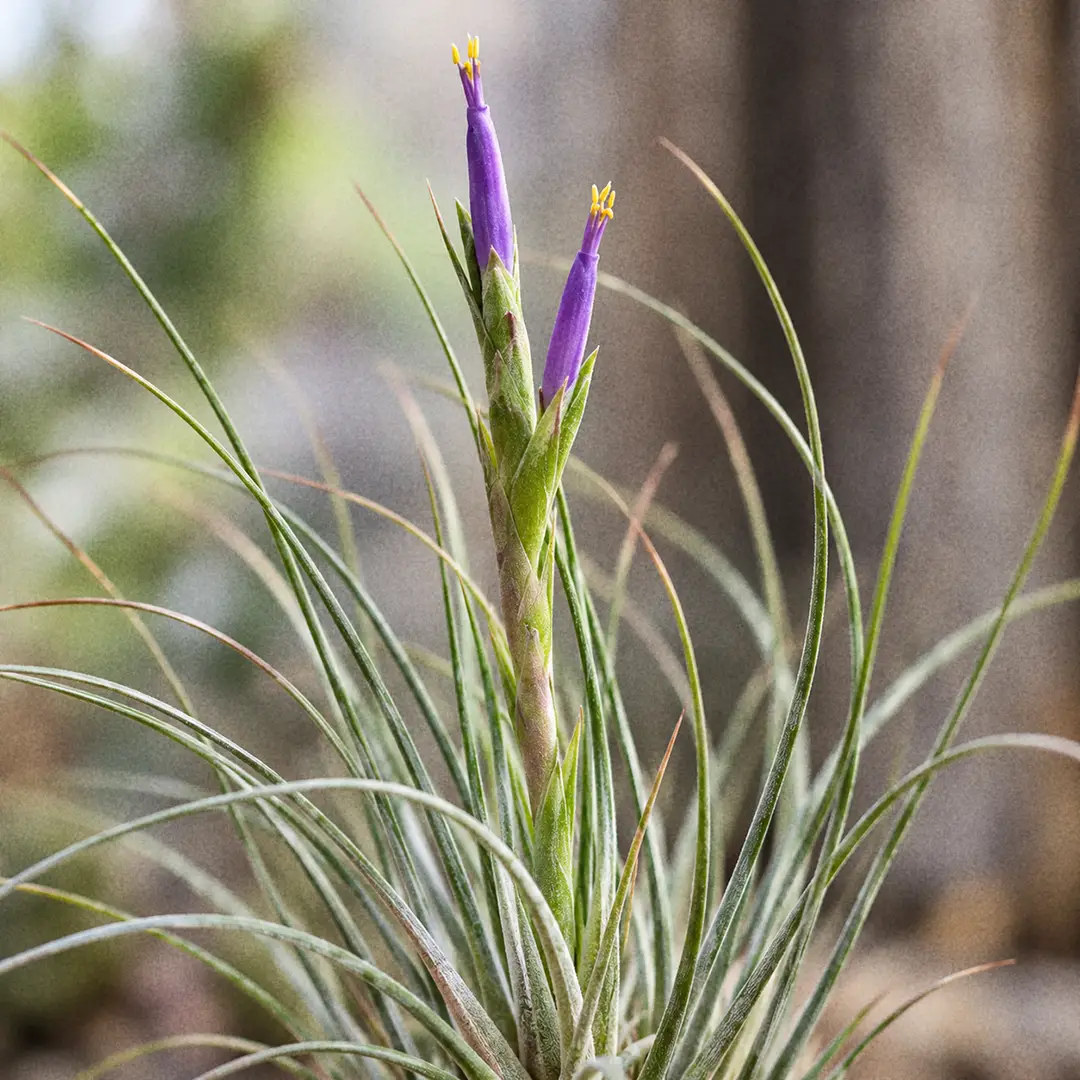
The bloom is worth waiting for. A mature juncea pushes up a short, stiff inflorescence from the centre, made of several flattened spikes gathered like fingers on a hand. The bracts on those spikes flush carmine red through to a green-tipped pink, and they hold that colour for weeks.
Out of the bracts come the actual flowers: slim tubes about an inch and a half long, in violet through to deep purple, opening a few at a time over the flowering period. The whole plant usually blushes bronze or red at the same time, which is the real show.
How to Trigger Bloom
Light does most of the work. A plant in strong light with a monthly weak feed will flower when it reaches full size, which typically takes a few years from a small offset. Nobody makes a juncea bloom early.
You can nudge a mature plant that is stalling with a spell of brighter light and a slightly cooler autumn, both of which signal a season change. The ripe apple trick that forces bromeliads with ethylene works on Tillandsias too, though results are hit and miss.
If It Won't Bloom
The usual reasons are that the plant is too young, or the light is too weak. A juncea sitting in a dim corner will live for years and never flower, which shows up in our failure to bloom guide as the most common air plant complaint.
Worth knowing before you push too hard: this plant is monocarpic. It flowers once in its life and then slowly declines while its pups take over. Flowering is the beginning of the next generation, not a yearly event.
🏷️ Juncea Air Plant Types and Varieties
The Standard Green Form
Most juncea sold is the plain species: silver-green, fine leaved, upright. It is offered by size rather than by name, usually somewhere between 6 and 8 inches for a young plant and 14 to 20 inches for a mature one. The larger sizes are years older, which is why they cost several times as much.
The Juncifolia Form
You will see plants labelled Tillandsia juncifolia, often described as a separate species. Botanically it is treated as a synonym of juncea, so what you are buying is a form rather than a distinct plant. Growers who separate the two point to greener, slightly broader leaves and noticeably longer stolons when it pups, meaning the offsets appear on visible stalks rather than tucked in against the mother.
Red Juncea and Painted Plants
Here is the one to watch. A lot of the brilliant red juncea online has been coloured with floral paint rather than grown that way. Reputable sellers label it clearly, and the dye is plant-safe, but plenty of listings do not mention it at all.
Spot it by looking at the undersides of the leaves, which stay green on a painted plant, and by checking for streaks, hard edges and unpainted green lines where the spray missed. Painted colour washes out over a few months of soaking. Natural blush, by contrast, runs through the whole leaf and deepens with light.
How It Compares to the Rosette Air Plants
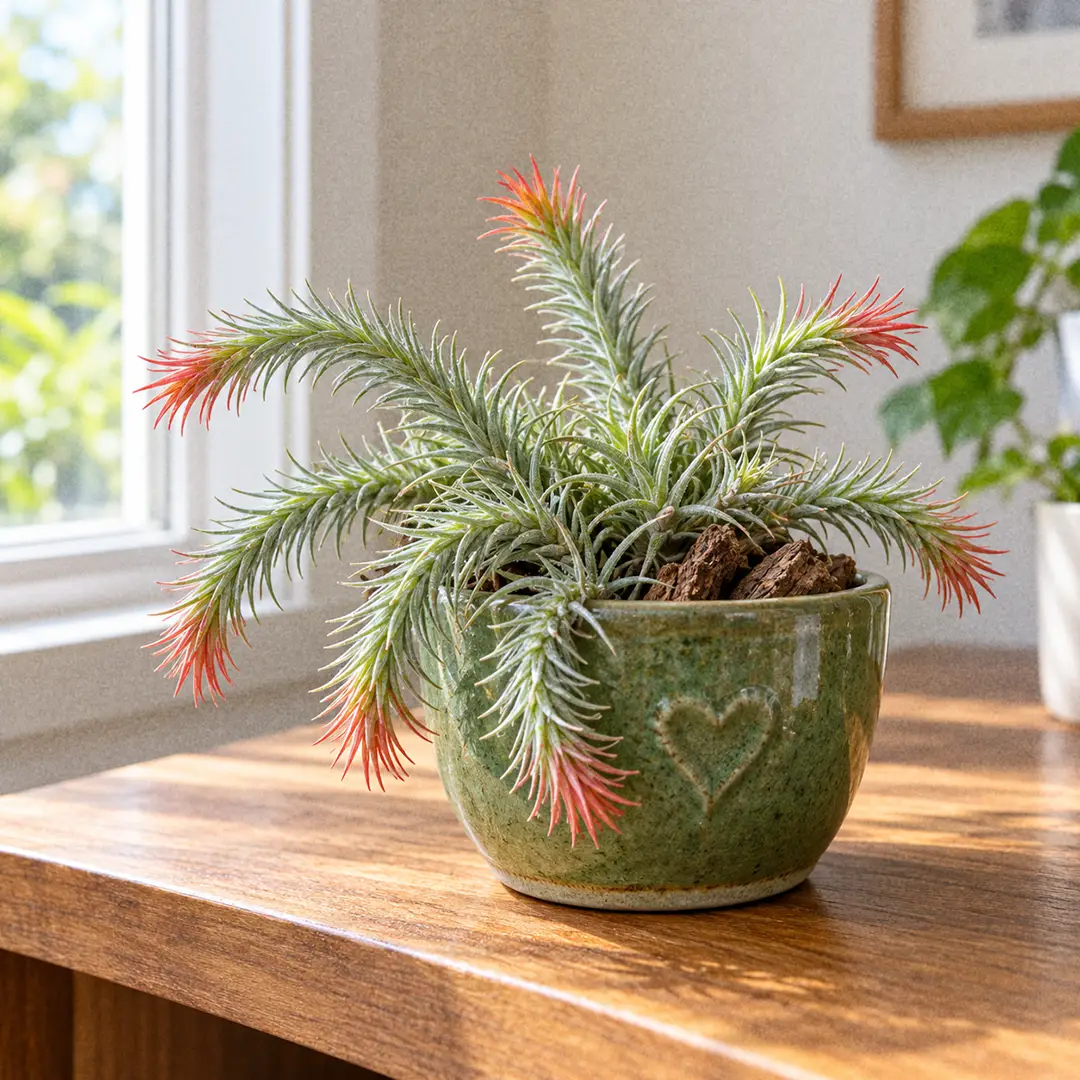
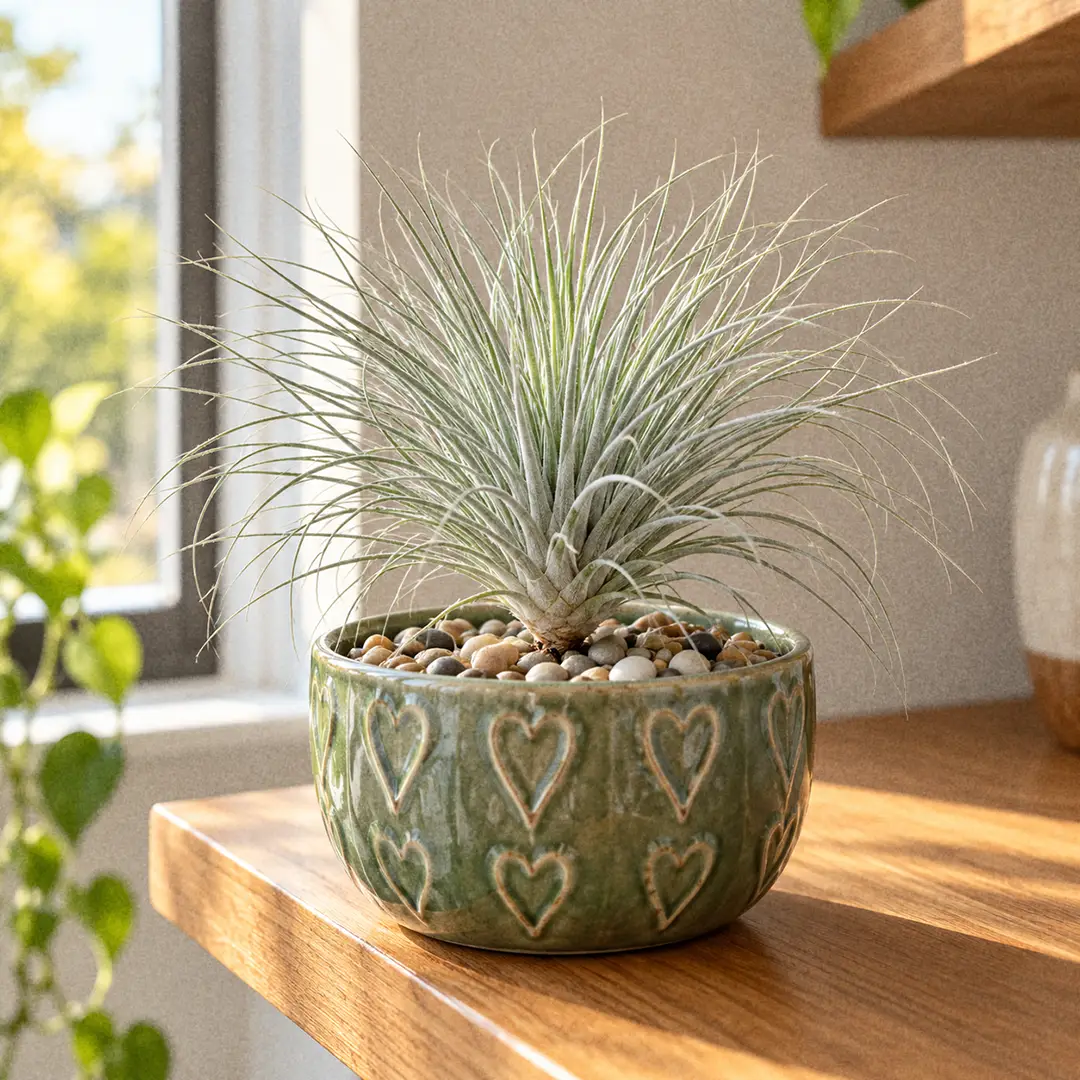
Juncea is the vertical option in a genus full of squat ones. Next to a Ionantha or a Brachycaulos it reads as a different kind of plant entirely, and the contrast is why the three look so good grouped. It is thirstier than the bulbous Butzii and much easier to dry out than a Xerographica. The closest match for habit is the Tricolor Air Plant, which shares the same packed water-trapping base but carries broad glossy green leaves instead of fine silver ones, so the two make a good pair on one shelf. For a low, dense filler at their feet, the spiky green clumps of the Tenuifolia Air Plant work well and drink on a similar weekly schedule. At the other end of the scale, the Fuchsii Air Plant packs the same needle-fine silver leaves into a ball no bigger than a golf ball. The Funkiana Air Plant spreads short needle leaves along curving stems instead, so it trails where juncea stands upright.
🪴 Mounting a Juncea Air Plant
Why There Is No Repotting
Nothing to repot, which removes a whole category of work. There is no root ball, no soil to refresh, and no pot to size up. A juncea simply gets bigger where it sits, and the only reason to touch its mount is if the mount itself starts to break down.
Choosing a Mount
Pick something that gives the plant height and gives itself weight. Vertical driftwood, a slab of cork bark leaning against a wall, or a piece of lava rock in a shallow dish all suit the upright habit. Because the leaves fan out wide at the top, a mount that is too small looks precarious and often is.
Leave the base of the plant standing clear of any flat surface. If it sits down in a saucer or a groove, water pools there after every soak, and back to rot we go.
How to Attach It
Fishing line, thin coated wire, or a loop of nylon thread around the dead outer sheaths is the safest method, and it lets you unclip the plant for soaking. Wrap once around the base and twist, snug enough to hold and loose enough not to cut in.
If you want it permanent, use a small dab of waterproof adhesive such as E6000 on the papery sheaths only. Never glue green tissue, and never use hot glue, which cooks the leaf on contact.
✂️ Pruning a Juncea Air Plant
When to Prune
There is no routine pruning. You tidy it when something has visibly finished: brown outer leaves, crisp tips, or a bloom spike that has faded past looking good.
How to Prune
For crisp tips, cut at a steep angle with sharp scissors so the cut follows the natural taper of the leaf. A straight blunt cut across a needle-fine leaf looks obviously trimmed and stays that way. Take a little less than you think you need.
Dead outer leaves should come away with a gentle downward pull once they are truly dead. If a leaf resists, leave it. Tearing at the base tears the sheaths, and every wound down there is an entry point for rot.
What Not to Cut
Never cut into the centre of the plant, where new leaves come from. Never trim a green leaf back to make the shape neater, because it will not branch or regrow from the cut. After flowering, wait until the spike is fully brown and dry before snipping it off at the base, and leave any pups well alone.
🌱 How to Propagate Juncea Air Plant
The Only Method Worth Using
Pups. After a juncea flowers, it produces offsets from around its base, sometimes tucked in tight and sometimes out on a short stolon depending on the form you have. Each one is a clone of the mother and grows into a full plant.
Seed is technically possible if you have two flowering plants and a steady hand, but it takes five years or more to reach a saleable size. For a home grower it is not a realistic route, and that is true across the genus.
Step-by-Step Separation
- Wait for size. Let each pup reach at least a third, ideally half, of the mother's height. Separated early, pups sulk for a year or fail outright.
- Water first. Soak the whole clump the day before, because hydrated tissue flexes instead of snapping.
- Find the join. Hold the mother firmly and follow the pup down to where it meets her base.
- Twist and pull. Gentle sideways pressure with a slow downward pull usually pops it free cleanly. If it will not budge, slide a clean blade down the join rather than forcing it.
- Dry, do not water. Leave the separated pup somewhere bright and airy for a couple of days before its first soak, so the wound seals.
Or Just Leave Them On
Honestly, this is what I do. Left alone, a juncea builds itself into a dense clump of three, five, ten heads at staggered heights while the old mother dries up quietly in the middle. A clump flowers more heavily than single plants, and there is no separation shock to recover from. Our propagation basics guide covers division on plants that actually need it.
🐛 Juncea Air Plant Pests and Treatment
What Shows Up
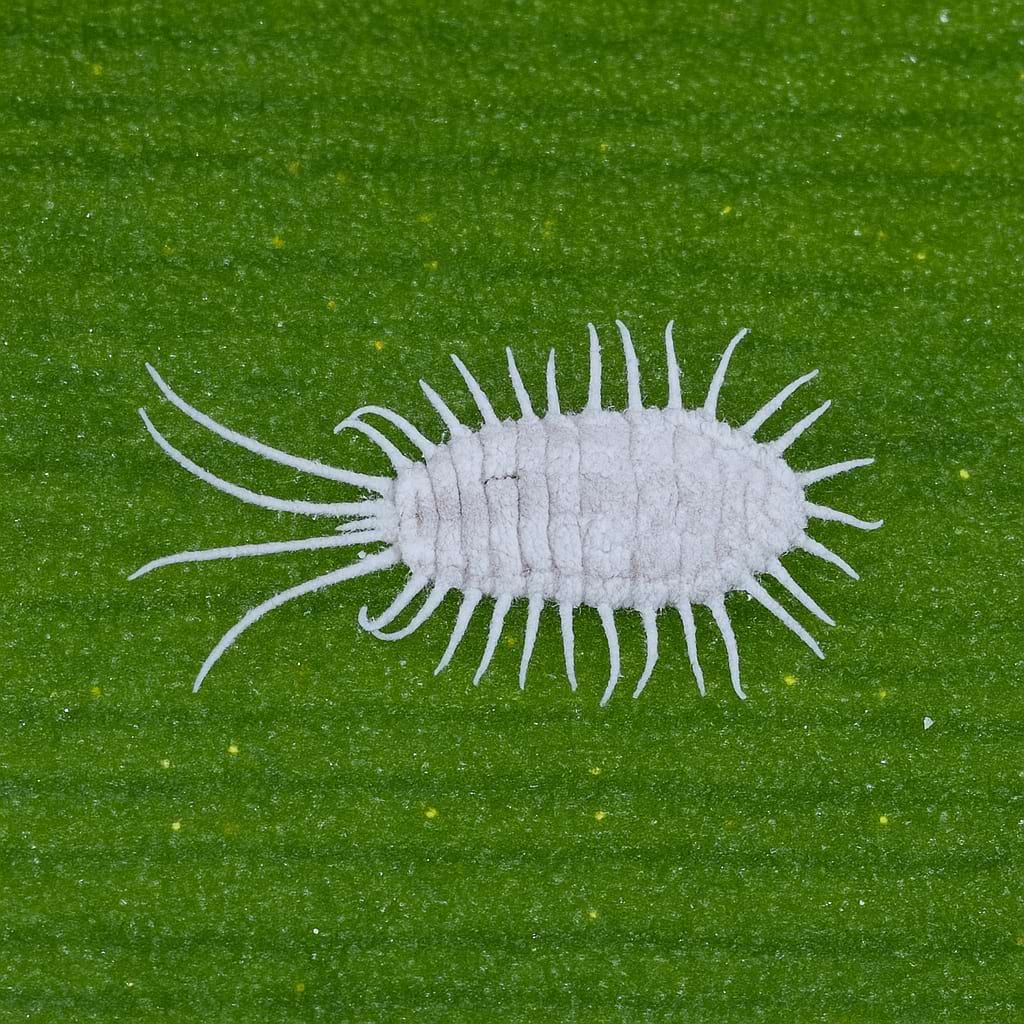
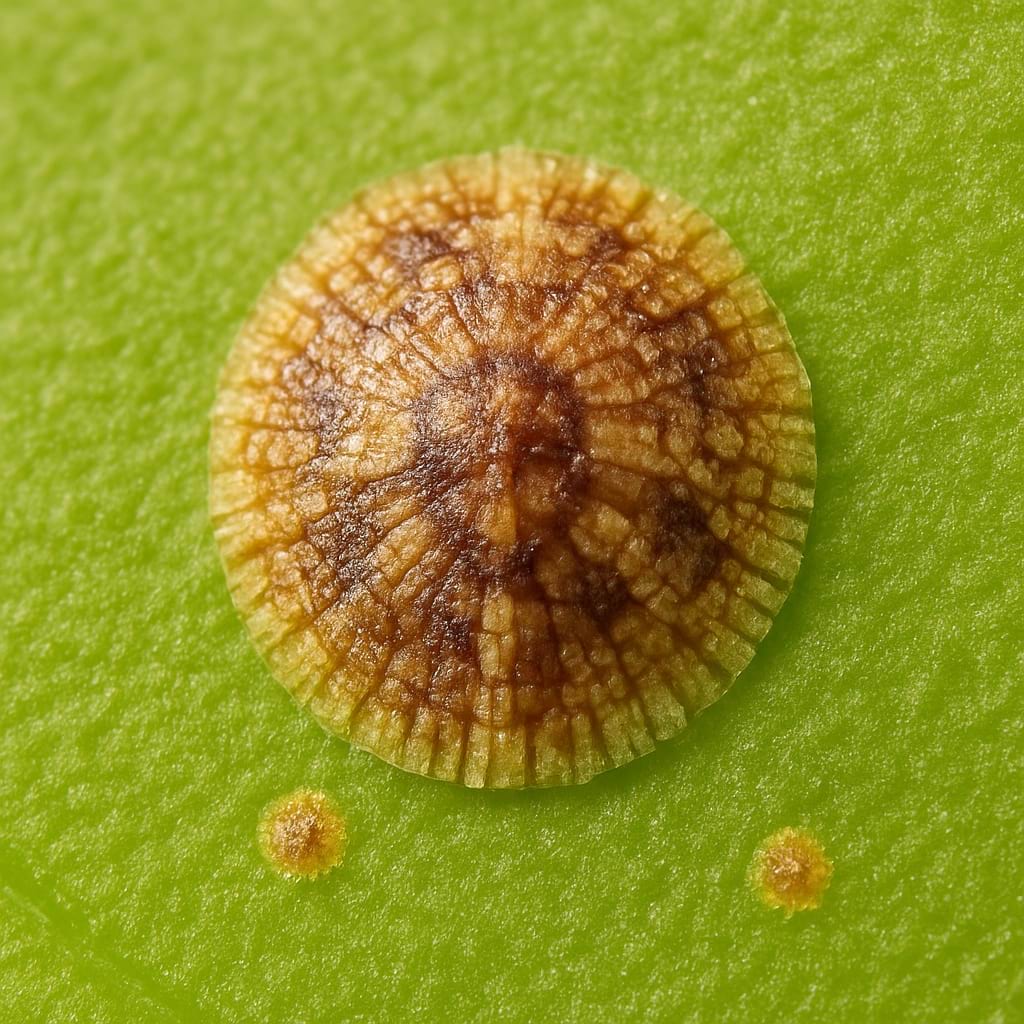
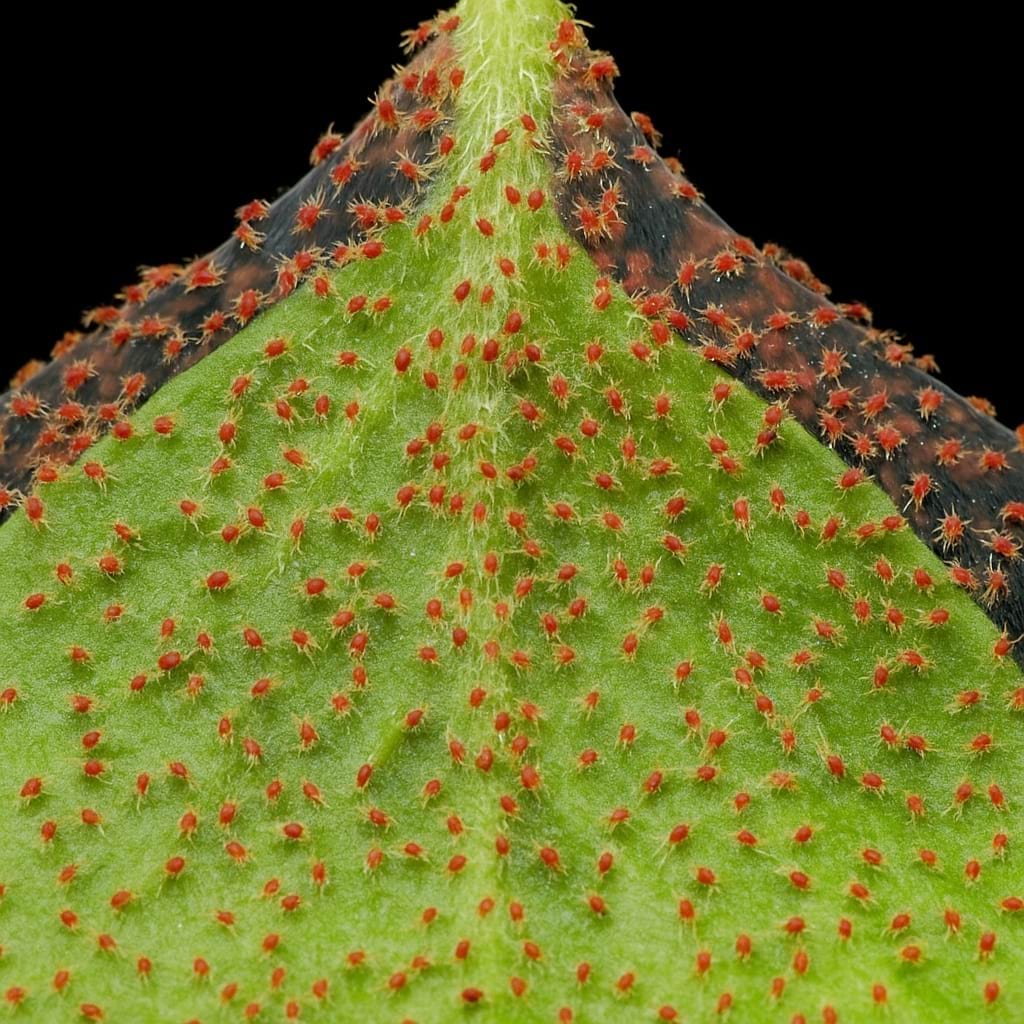
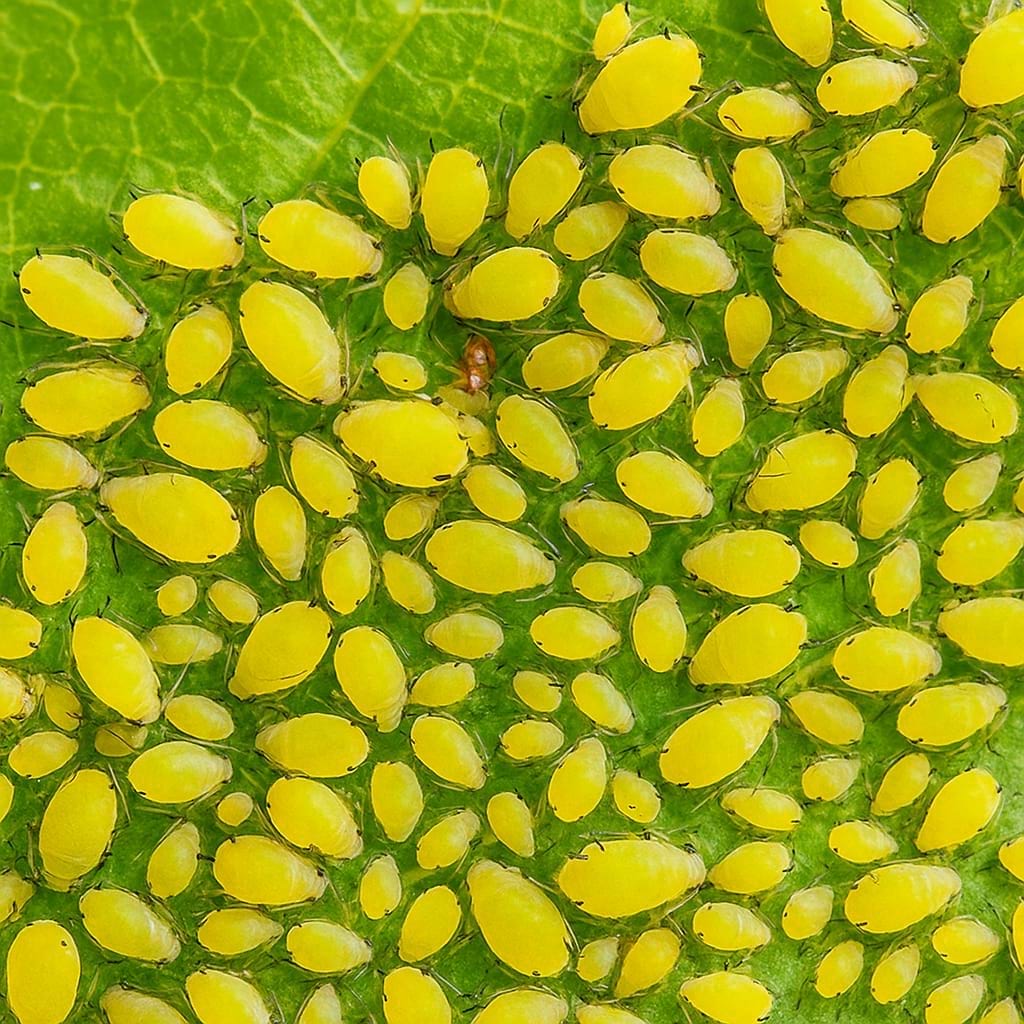
The pest to watch for is mealybugs, which hide in the packed leaf sheaths at the base where you cannot easily see them. Look for white cottony fluff deep in the crevices and a sticky feel to the leaves. Scale insects turn up as small brown limpets along the leaf blades, and aphids cluster on a fresh bloom spike, which is soft enough for them to pierce. Spider mites are uncommon but possible on a plant kept hot, dry and completely still.
How to Treat Them
You cannot use a soil drench here, so treatment is physical. Start with a strong rinse under the tap, aimed into the base, then dry the plant upside down fast. For a light infestation, dab each insect with a cotton bud dipped in rubbing alcohol.
For anything worse, use a dilute insecticidal soap spray, rinse it off after an hour, and dry thoroughly. Go easy on oil-based sprays including heavy neem: a film of oil coats the trichomes, and those scales are how the plant drinks. Quarantine any new air plant for a couple of weeks, because mealybugs travel in the base and turn up later.
🩺 Common Juncea Air Plant Problems
Base Rot Is the Killer
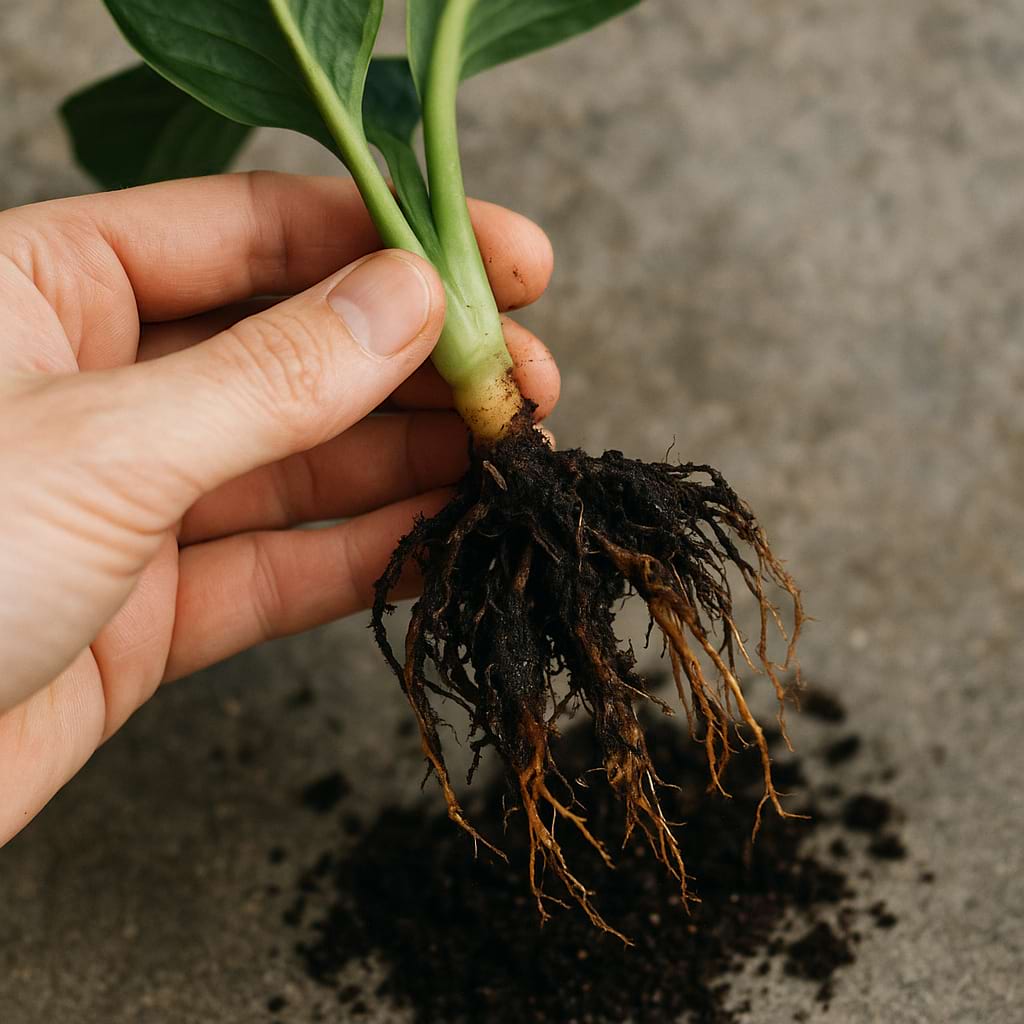
Nearly every dead juncea died of rot in the base, and nearly every case traces back to water sitting in the sheaths after a soak. Signs are a darkened, soft, sometimes sour-smelling base and leaves that slide out of the centre with no resistance. Once the core goes, the plant is finished, so this is a problem to prevent rather than treat. Shake hard, dry upside down, keep air moving.
Brown Crispy Tips
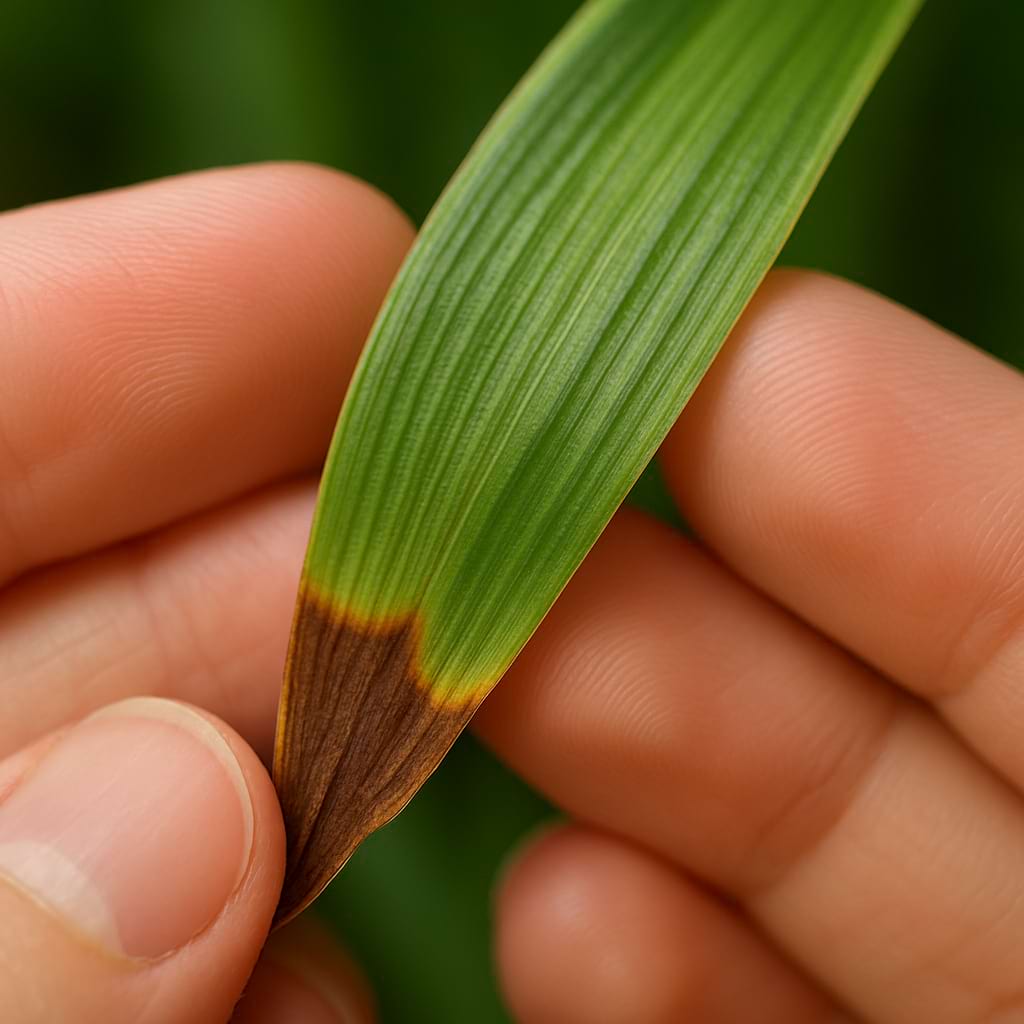
Fine leaf tips brown easily, and a little of it is normal on a plant this delicate. Widespread crisping means it is going too long between soaks or sitting in dry moving heat. Trim at an angle and water a little more often.
Floppy, Pale, Splayed Growth
A juncea that has lost its silver colour and its upward arch is telling you the light is too low, which shows up as pale, faded leaves and a plant that never firms up. Move it closer to a bright window over a couple of weeks.
Bleached Patches
Hard white or tan patches on the sun-facing side are scorch from unfiltered hot glass. The damage is permanent but not dangerous. Add a sheer curtain or shift the plant a foot further back.
🖼️ Juncea Air Plant Display and Styling Ideas
Vertical Setups
Height is the point of this plant, so use it. A single juncea standing in the neck of a tall narrow bottle looks deliberate, and the glass holds the base clear of any water. Wired to a length of standing driftwood, it reads almost like a miniature palm.
Grouped Arrangements
Three juncea at staggered heights, hung from a branch or a wire frame, make a better display than one. Or pair the fine vertical leaves with a flat rosette like a Ionantha at the base for contrast in both shape and scale. Backlighting is the free trick here: put it where morning or evening sun comes through the leaves and the whole silhouette lights up.
Where Not to Put It
Not in a closed terrarium or a sealed jar, however good it looks in one. Without airflow it rots, usually within a couple of months.
Also avoid a bathroom with no window or fan, a shelf directly above a radiator, and any spot where the base sits in a puddle after watering. Anywhere you would be comfortable drying a wet towel is a good home for a juncea.
🌟 Juncea Air Plant Pro Care Tips
- Dry it upside down, every time. This one habit prevents the only problem that actually kills juncea.
- Give it more light than you think. A silver, furry Tillandsia in a shaded corner is a slow decline, not a compromise.
- Skip the mist bottle. There is too much leaf here for misting to hydrate. Soak it properly instead.
- Feed a quarter strength, once a month, growing season only. Then forget about it.
- Check the base, not the leaves, when something looks wrong. Firm and papery is healthy; soft or dark is an emergency.
- Buy the biggest plant you can afford if you want flowers soon, because size is age in this genus.
- Let the pups build a clump. More heads, better bloom, no separation setback.
- Look at leaf undersides before you buy anything bright red. Green underneath means it was painted.
❓ Frequently Asked Questions
How often should I water a Juncea Air Plant?
Soak it for 20 to 30 minutes every 7 to 10 days in spring and summer, and every 10 to 14 days in winter. Adjust for your room rather than following a schedule: a bright, airy, warm spot means more frequent soaks, and a cool dim one means fewer.
Why is my Juncea Air Plant turning brown at the base?
Water is sitting in the packed leaf sheaths after watering. Check whether the base feels soft or smells sour, which means rot has set in and the plant cannot be saved. Firm brown sheaths are just the normal dead outer layer and nothing to worry about.
Can I mist my Juncea instead of soaking it?
Not as its main watering. The leaves are so numerous and so fine that a mist evaporates before much gets absorbed, leaving the plant slowly dehydrating. A rinse or a mist between soaks is a useful top-up in very dry air, but it does not replace the soak.
Is Tillandsia juncea toxic to cats and dogs?
Tillandsias are not listed among toxic plants and juncea is sold as pet safe, so a curious nibble is not a poisoning risk. The plant itself will not survive being chewed or batted around the floor, and the fine leaves are a temptation, so keep it up high for its own sake.
How big does a Juncea Air Plant get?
A mature plant stands roughly 10 to 20 inches tall and spreads 6 to 12 inches across, which makes it one of the taller air plants in common cultivation. Growth is slow, so a 6 inch plant takes a few years to reach full size.
Why is my Juncea Air Plant not flowering?
Almost always because it is too young or the light is too weak. Juncea flowers when it reaches full size, which takes several years from a pup, and it needs strong light to get there. Remember that it blooms once in its life, then lives on through its pups.
Does my Juncea die after it flowers?
Yes, slowly. Like the rest of the genus it is monocarpic: it flowers once, produces offsets, and gradually declines over the following year or two while the pups grow. You are not losing the plant, you are getting several back.
Is the red Juncea sold online natural?
Sometimes, often not. Juncea genuinely blushes bronze to red in strong light, but much of the intensely red juncea on the market has been coloured with floral paint. Look at the leaf undersides: green underneath with red on top means paint, and it will wash out over a few months of soaking.
What is the difference between Tillandsia juncea and Tillandsia juncifolia?
Botanically, none worth arguing over, since juncifolia is treated as a synonym of juncea. In the trade, plants sold as juncifolia tend to have greener, slightly broader leaves and produce their pups on longer visible stolons. Care is identical either way.
ℹ️ Juncea Air Plant Info
Care and Maintenance
🪴 Soil Type and pH: None. Epiphytic, grown mounted or standing free without any medium.
💧 Humidity and Misting: Fine in ordinary household air around 40 to 50 percent, as long as it gets real air movement.
✂️ Pruning: Trim crisp tips at a steep angle so the cut follows the natural taper, and pull away brown outer leaves once they release easily.
🧼 Cleaning: Never wipe the leaves. The silver bloom is living trichomes, and rubbing it off costs the plant the surface it drinks with. Rinse under the tap instead.
🌱 Repotting: Never potted in soil. Remount only when the mount rots or a clump outgrows its base.
🔄 Repotting Frequency: Only when the mount fails
❄️ Seasonal Changes in Care: Strong light and weekly soaks from spring through autumn, then longer gaps between waterings and more airflow through a cool winter.
Growing Characteristics
💥 Growth Speed: Slow
🔄 Life Cycle: Evergreen epiphytic bromeliad that flowers once and then offsets
💥 Bloom Time: Late spring into summer on mature plants; the coloured bracts hold for several weeks
🌡️ Hardiness Zones: 9-11
🗺️ Native Area: Mexico through Central America, the West Indies and much of tropical South America, growing on trees and rocks from the lowlands up to around 2,400 m
🚘 Hibernation: No true dormancy, though growth almost stops in winter and watering should drop back with it.
Propagation and Health
📍 Suitable Locations: East and west windowsills, south windows behind a sheer curtain, bright bathrooms with airflow, driftwood mounts, tall narrow vessels, wire stands
🪴 Propagation Methods: Separate the pups that appear on short stolons after flowering, once each one is about a third the size of the mother.
🐛 Common Pests: Mealybugs, Scale Insects, Spider Mites, Aphids
🦠 Possible Diseases: Base rot, crown rot, fungal leaf spotting in still damp air
Plant Details
🌿 Plant Type: Epiphytic bromeliad with a grass-like upright habit
🍃 Foliage Type: Evergreen, needle-fine, silver-scaled, tapering to hair points
🎨 Color of Leaves: Silvery green, turning bronze to red in strong light
🌸 Flower Color: Violet to deep purple tubular flowers from carmine red bracts
🌼 Blooming: Yes, once at maturity, and the bracts stay colourful for weeks
🍽️ Edibility: Not edible.
📏 Mature Size: 10-20 inches tall
Additional Info
🌻 General Benefits: Needs no soil or pot, adds real height to a shelf without a trunk or a stake, shrugs off dry indoor air, is safe around cats and dogs, and replaces itself with pups after flowering
💊 Medical Properties: No documented medicinal uses.
🧿 Feng Shui: Tall, upward, soilless growth suits a narrow shelf or an entry where a potted plant would sit too heavy.
⭐ Zodiac Sign Compatibility: Aquarius
🌈 Symbolism or Folklore: Resilience, independence, growing upward without roots
📝 Interesting Facts: The name juncea means rush-like, and the resemblance is close enough that people regularly mistake it for a clump of ornamental grass until it flowers. Each leaf tapers from a broad brown sheath at the base to a point finer than a pine needle, which is how the plant stands 20 inches tall on no stem at all.
Buying and Usage
🛒 What to Look for When Buying: Squeeze the base gently. It should feel firm and papery, never soft or dark. Be careful with bright red plants: much of the red juncea on the market has been painted with floral colourant, which you can spot by the green undersides of the leaves, streaky edges, and colour that washes out over a few months of watering.
🪴 Other Uses: Driftwood and cork mounts, hanging bundles, wreaths, open terrariums, living wall panels, wedding and event arrangements.
Decoration and Styling
🖼️ Display Ideas: Standing upright in a narrow bottleneck vase, wired to vertical driftwood, hung in a bundle of three at staggered heights, or grouped with low rosette Tillandsias for contrast
🧵 Styling Tips: Give it height and a plain background. The fine leaf silhouette reads best backlit, and the base should sit clear of any surface so it can drain and dry.
🪴 See also 🪴
Complete Guide to Funkiana Air Plant Care and Growth
Complete Guide to Fuchsii Air Plant Care and Growth
Complete Guide to Tectorum Air Plant Care and Growth
Complete Guide to Stricta Air Plant Care and Growth
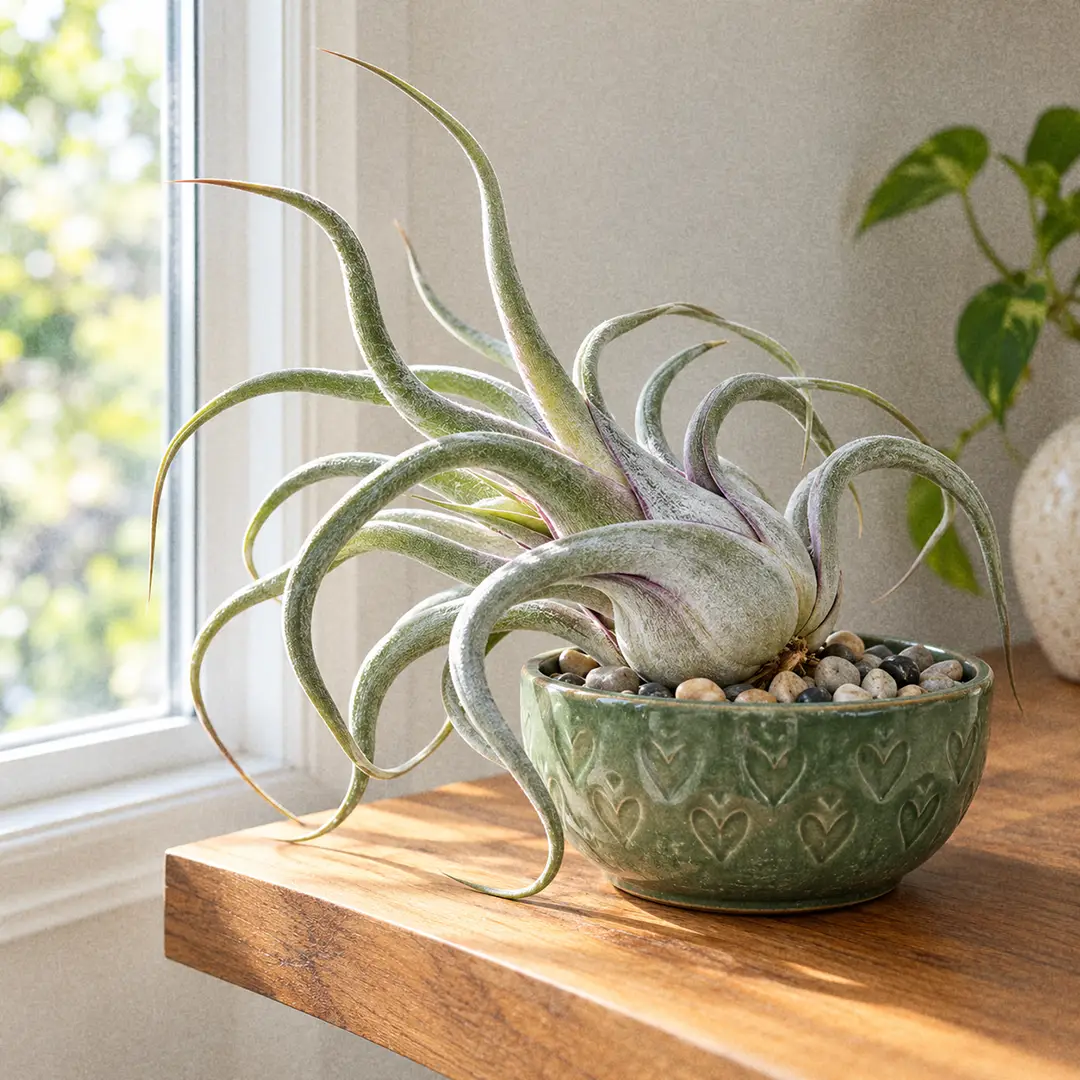
Complete Guide to Medusa's Head Air Plant Care and Growth
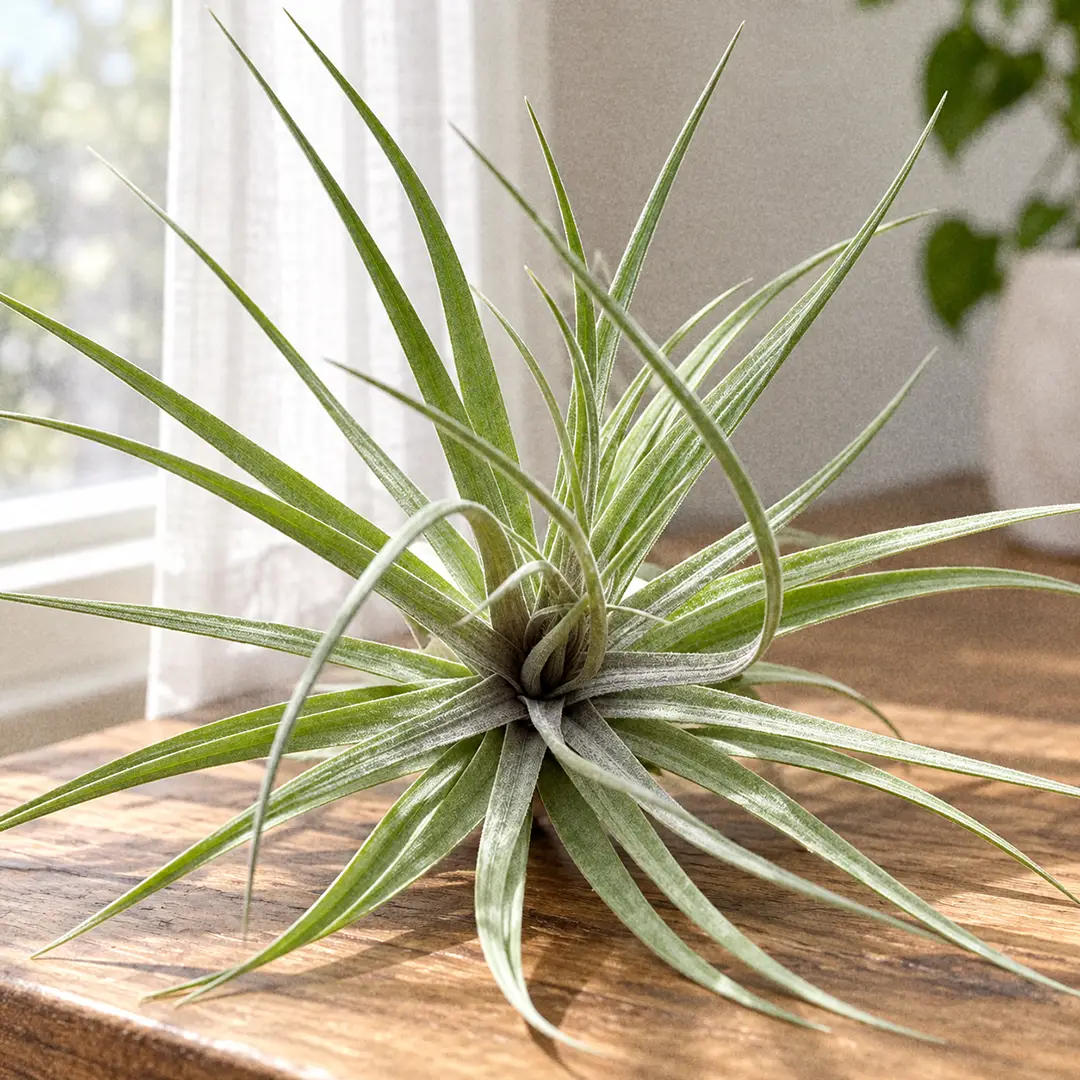
Complete Guide to Tenuifolia Air Plant Care and Growth

Houseplant101 Forum
Questions & Comments
Ask a question, share your plant experience, or help other plant owners.
Comments are temporarily unavailable.
Open the Houseplant101 ForumNo comments yet
Be the first to ask a question or share your experience about this page.
Log in or create an account
Comments use your Houseplant101 Forum account, but you can stay on this page.
Create a new account