
Bulbosa Air Plant
Tillandsia bulbosa
Tillandsia bulbosa, Bulbous Air Plant, Bulbosa, Dancing Bulb Air Plant


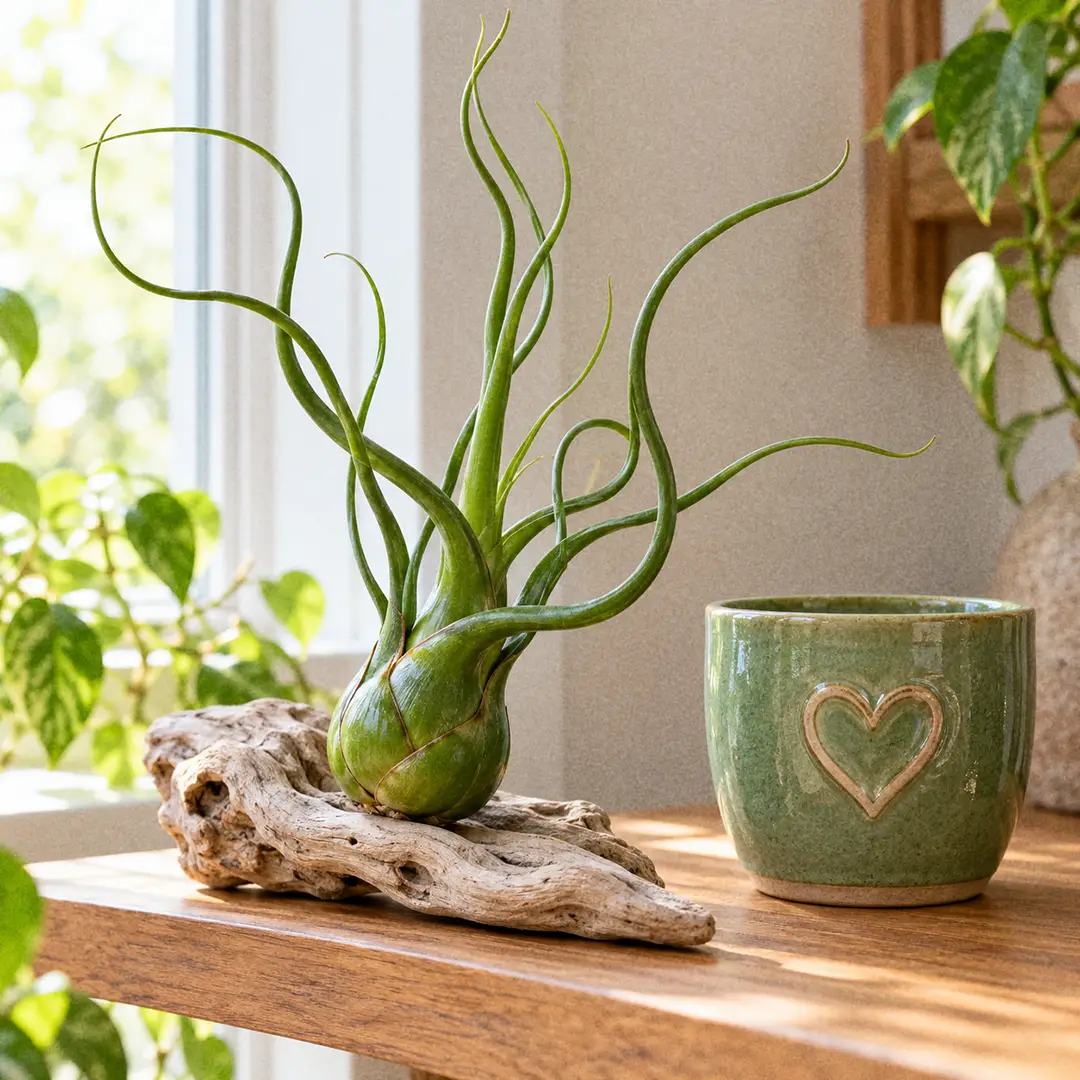
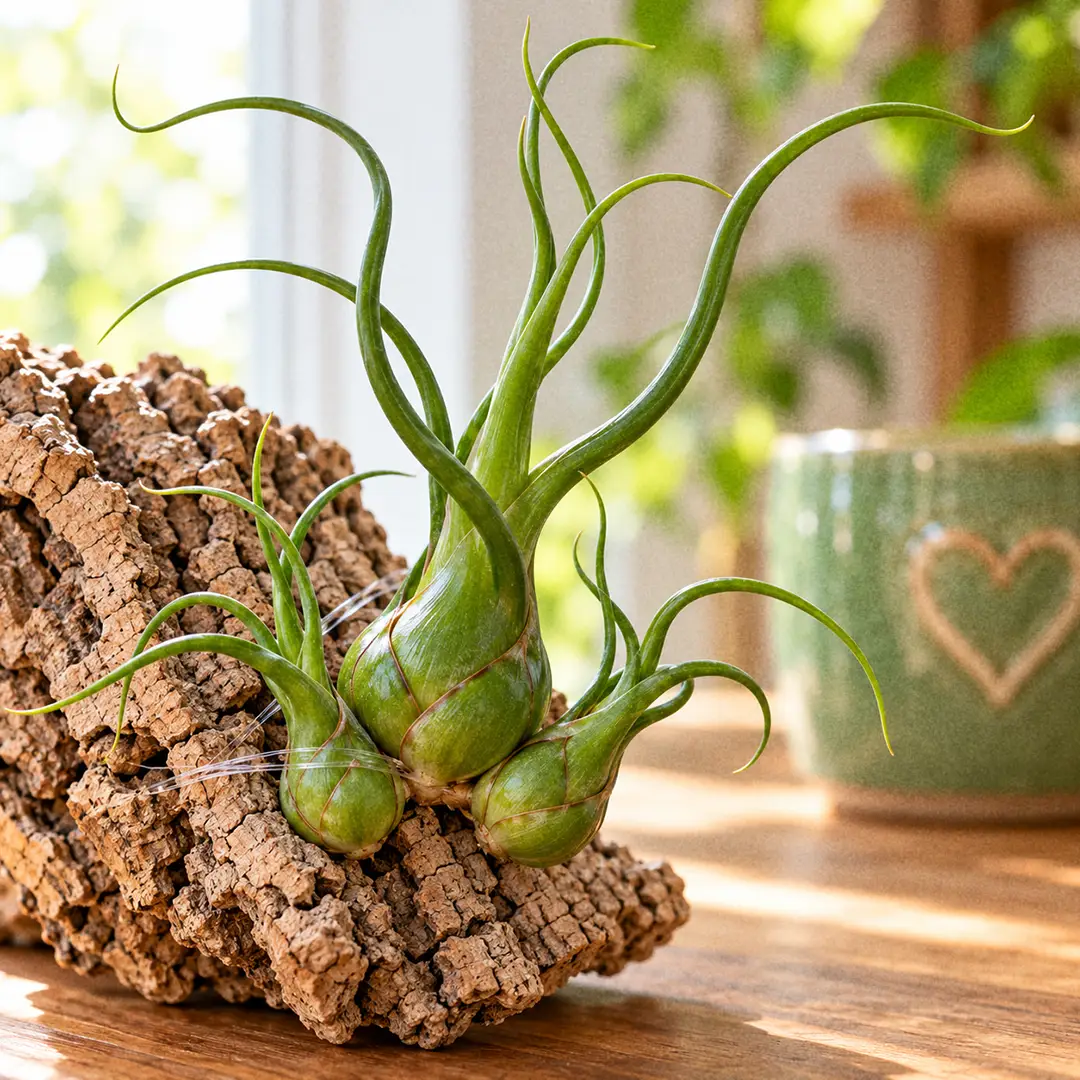
Bulbosa Air Plant is the glossy green Tillandsia with a round hollow bulb and smooth, twisting tentacle leaves. It loves humidity and frequent water, as long as the bulb is shaken out and dried upside down every time.
📝 Bulbosa Air Plant Care Notes
🌿 Care Instructions
⚠️ Common Pests
📊 Growth Information
🪴 In This Guide 🪴

☀️ Bulbosa Air Plant Light Requirements (Bright Indirect Light)
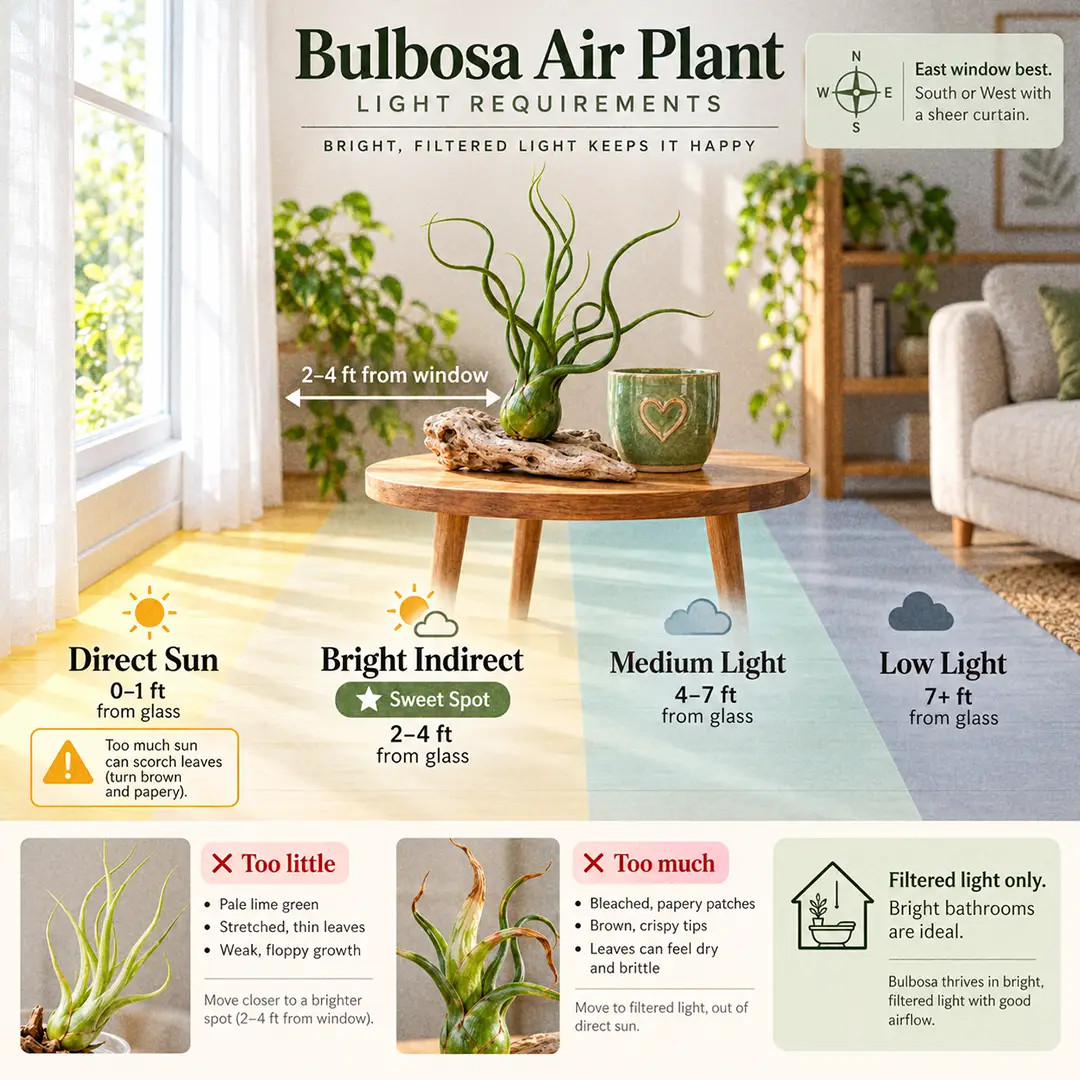
The Sweet Spot for Bulbosa
Bulbosa wants bright indirect light, and it is one of the more shade-tolerant air plants you can buy. The clue is the leaf. Silver, fuzzy Tillandsias wear a thick coat of scales that reflects harsh sun. Bulbosa is smooth and dark green because it grows under tree cover in humid lowland forest, where the light is filtered all day.
Indoors, that means an east window, or a spot two to four feet back from a south or west window. A bright bathroom or kitchen window is close to ideal, since the light and the humidity arrive together. An hour of gentle early morning sun is fine.
Too Little Light
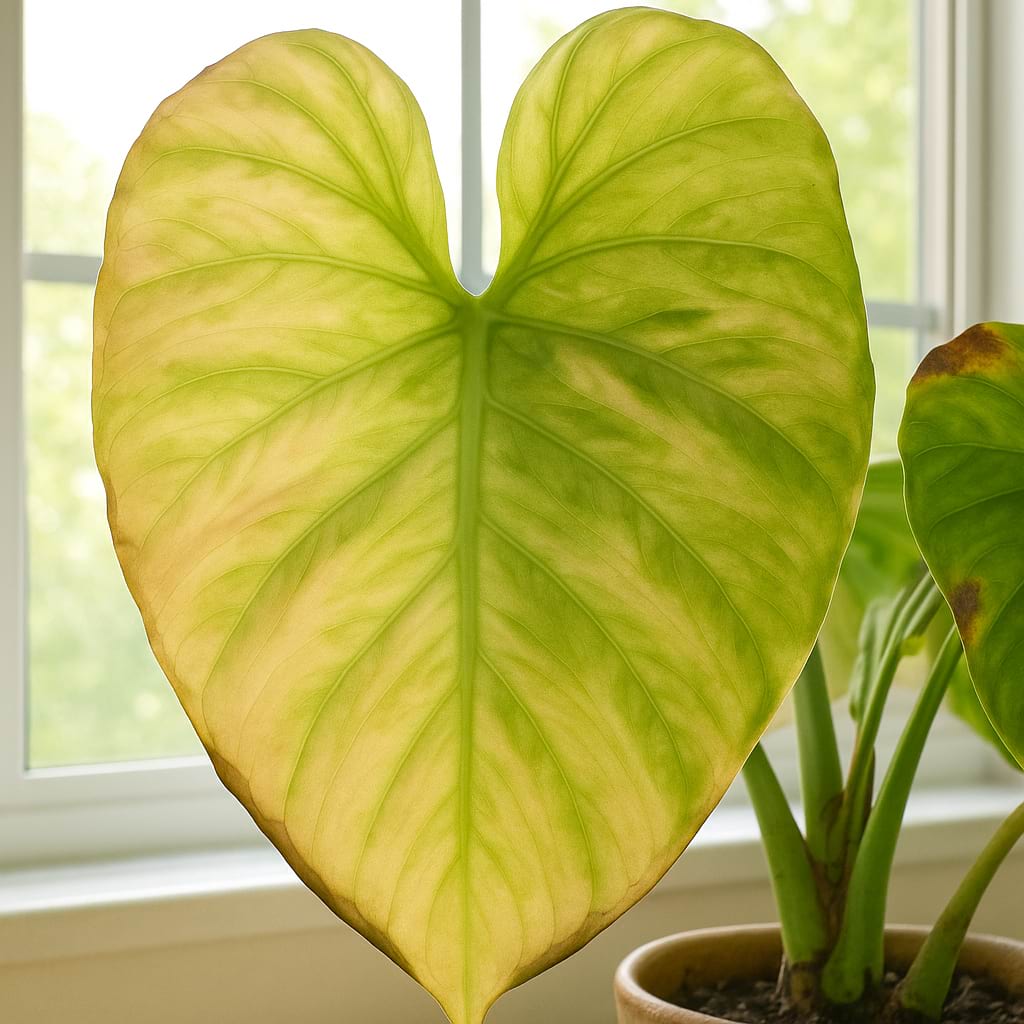
A Bulbosa in a dim room does not collapse. It stalls. The leaves grow longer, thinner and paler, the deep green fades toward a washed-out lime, and the plant never flowers or makes pups. Dim spots also slow drying, which matters a lot for a plant with a hollow base.
If no window is bright enough, a small grow light about a foot above the plant for ten to twelve hours a day does the job. Our indoor light guide explains how to judge a window if you are unsure.
Too Much Light
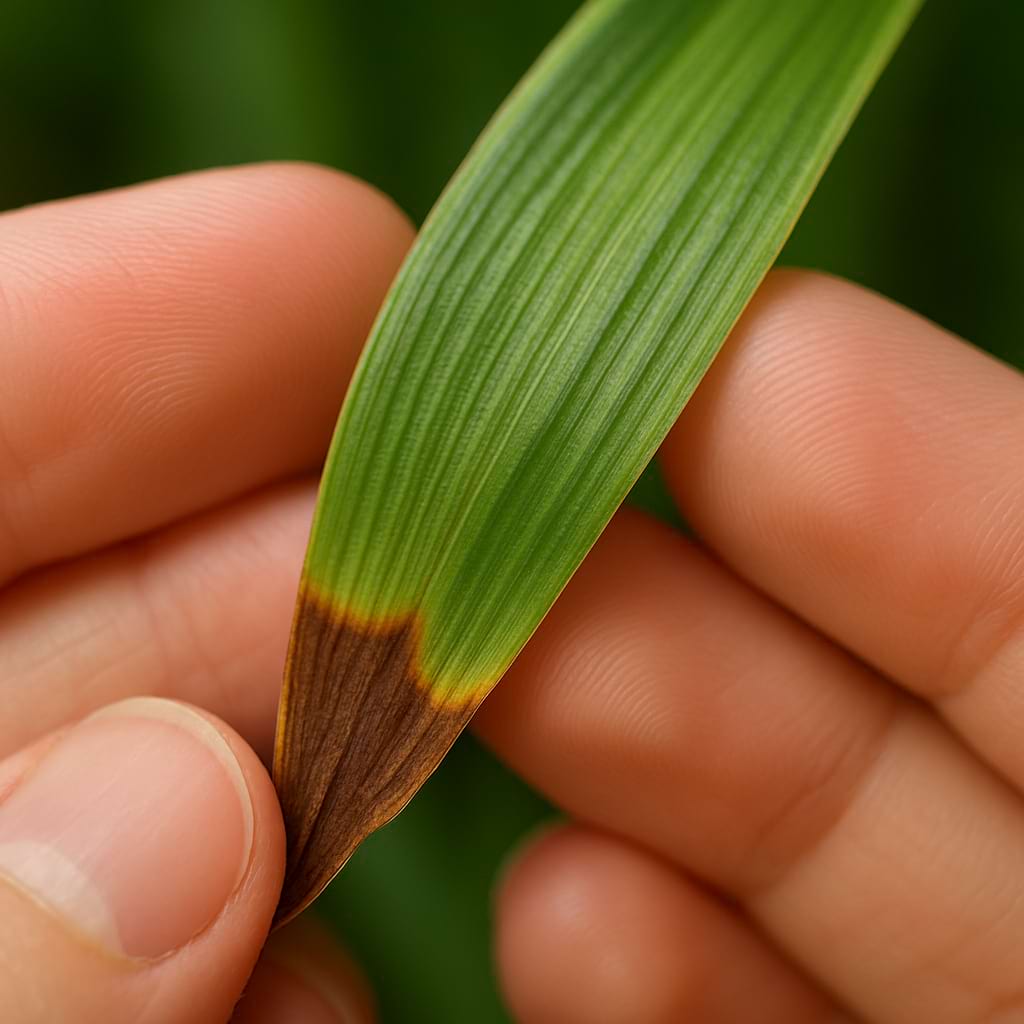
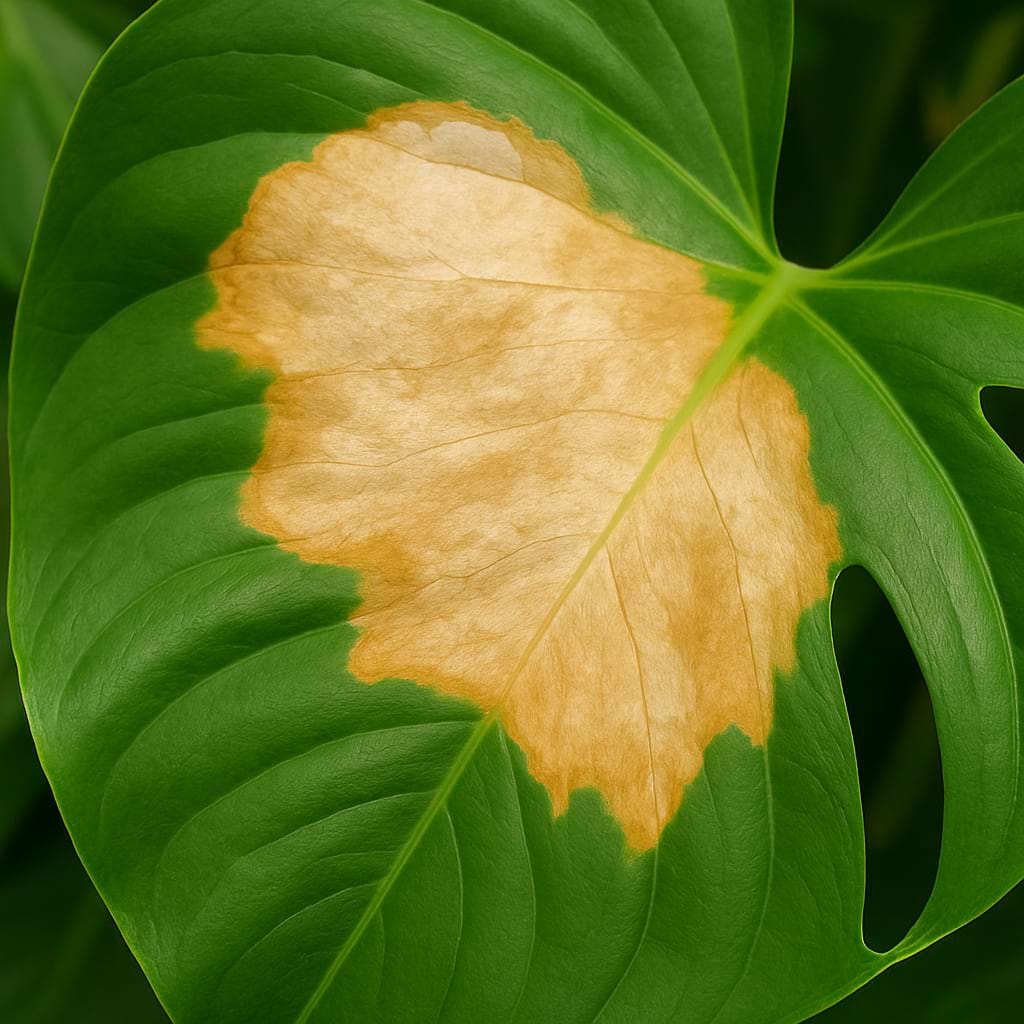
Smooth green leaves burn faster than silver ones. Midday sun through glass leaves pale, dry, papery patches on the side facing the window, and the thin leaf tips crisp to brown. That is leaf scorch, and the marks are permanent.
Do not confuse scorch with a red or purple flush across the upper leaves. A blush that spreads evenly over a healthy, firm plant is the first sign of flowering.
💧 Bulbosa Air Plant Watering Guide (Dunk, Shake, Dry Upside Down)
Watering Frequency
Bulbosa is a mesic air plant, meaning it comes from a wet climate. It has fewer water-catching scales than a silver species, so it dries out faster and needs watering more often.
Water two to three times a week in spring and summer, and once or twice a week in winter. In a steamy bathroom the lower number is enough. In a dry, heated living room, add a light misting on the days between. A thirsty Bulbosa tells you: the leaves roll into tighter tubes, lose their gloss, and the bulb feels slightly less firm.
How to Water Bulbosa Without Trapping Water
The bulb is made of wide, cupped leaf bases that overlap like the layers of an onion, with empty chambers between them. Water that runs down the leaves ends up in those chambers and stays there.
So skip the long soak that most air plant advice recommends. Hold the plant by the bulb, dunk the leaves in room-temperature water for a minute or two, or rinse it under a gentle tap with the leaf tips pointing down. The leaves will turn a darker, wetter green almost at once. Rainwater or filtered water is best. Softened water is the one to avoid, because the salt in it damages the leaves. Our watering guide covers water quality in more depth.
Drying Bulbosa Upside Down
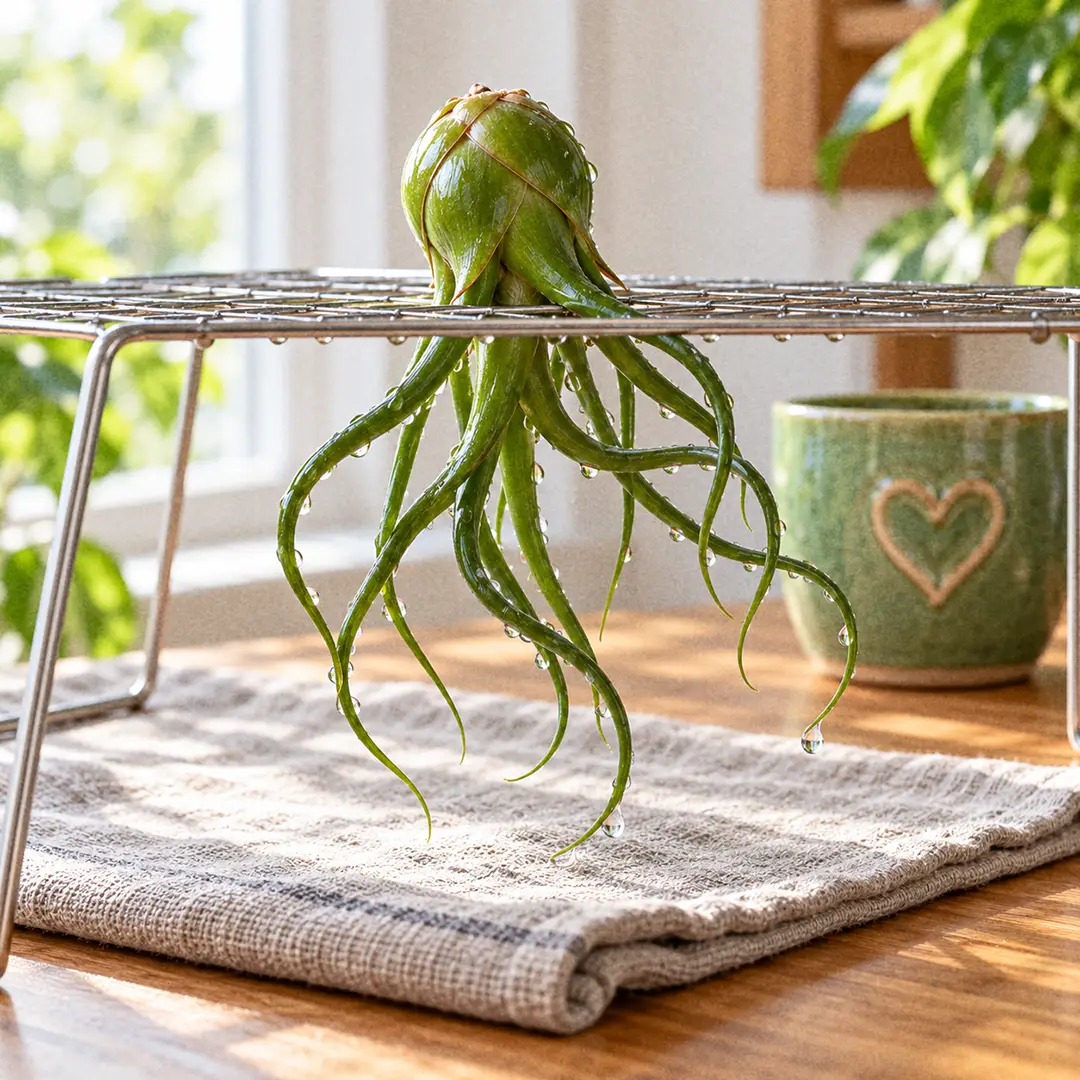
This step decides whether the plant lives. Right after watering, turn the plant upside down and give it three or four firm shakes over the sink until nothing more drips out. Then leave it upside down or on its side on a towel or a wire rack, somewhere bright with moving air.
It should be completely dry within four hours. If it takes longer, the spot is too still or too dim, so move it nearer an open window or a small fan. Water in the morning so the plant never goes into the night damp, and only return it to a holder that sits the bulb upright once it is dry.
Signs of Trouble
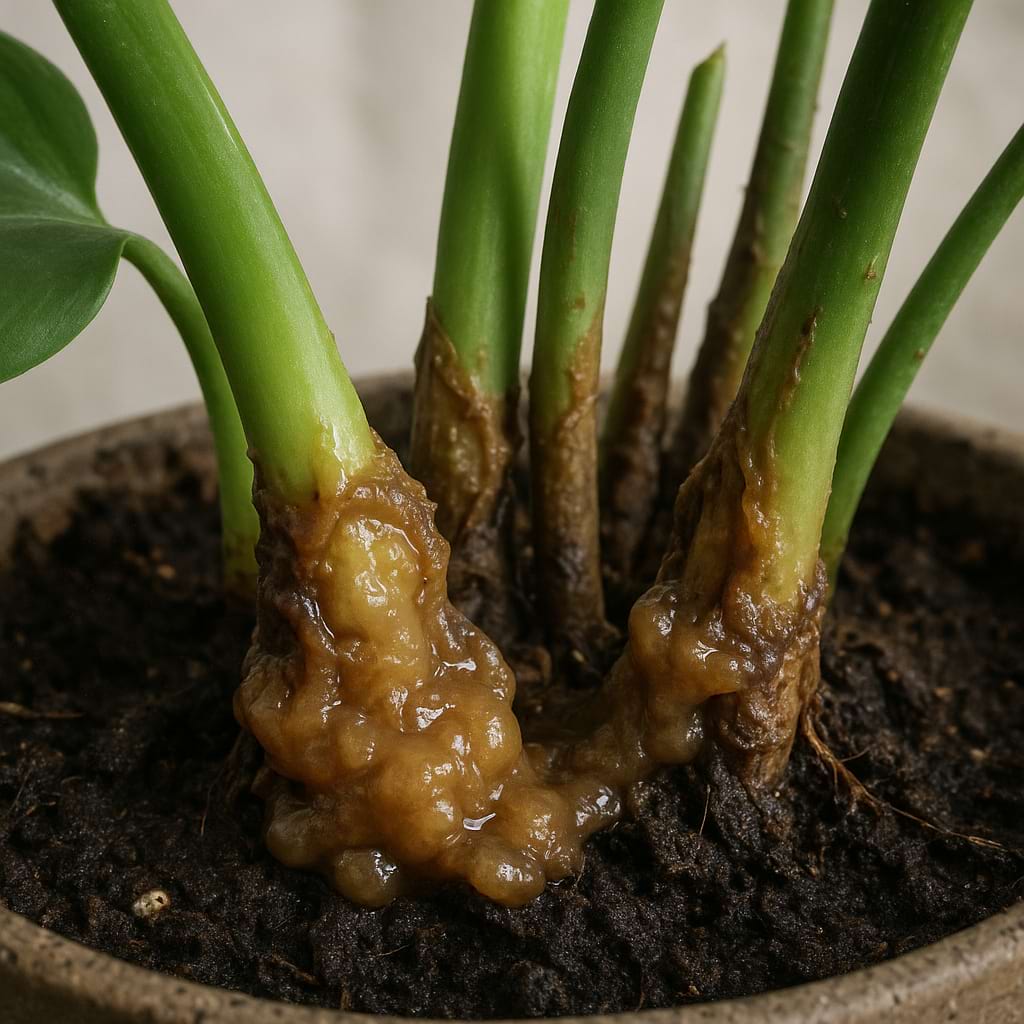
Too much water shows at the base. The bulb darkens to brown or black, feels soft, and the center leaves pull out with a light tug. That is base rot, and it is rarely reversible.
Too little water shows at the tips. They brown and crisp, and the leaves stay tightly rolled. A dry plant bounces back within a day or two of a good dunk.
🪴 Best Soil for Bulbosa Air Plant (None at All)
Why Bulbosa Needs No Soil
Bulbosa is an epiphyte. In the wild it clings to branches and mangrove twigs, and its few thin roots work as anchors. Water and nutrients come in through tiny scales on the leaves, called trichomes.
Potting mix is harmful, not helpful. A bulb pressed into damp compost never dries, and root rot follows within weeks. If your plant arrived in a pot of soil or moss, take it out.
What to Grow Bulbosa On Instead
Anything that holds the plant in open air works. Cork bark, driftwood, grapevine, a wire holder, a shell, or a shallow dish are all fine. Because the bulb is round and heavy, a holder that cradles the plant at an angle is more stable than one that stands it straight up.
Sideways or tilted is also how Bulbosa often grows in nature, and that position lets the bulb drain on its own.
Materials to Avoid
Skip wet sphagnum packed around the bulb, deep narrow vases, and sealed glass globes. All three keep the base damp and the air still. Copper wire is also a problem for Tillandsias, so use aluminum wire, coated wire or fishing line for mounting.
🍼 Fertilizing Bulbosa Air Plant
When and How Often
Feed twice a month from spring through early autumn, then stop for winter. Bulbosa grows slowly, and feeding speeds up growth and pup production only when light and water are already right. Fertilizer will not rescue a plant that sits in a dark corner.
What Fertilizer to Use
Use a urea-free air plant or bromeliad fertilizer at a quarter of the label strength, mixed into the dunk water. Urea needs soil bacteria to break it down before a plant can use it, and a plant on a piece of cork has none. An orchid fertilizer at quarter strength also works.
Our fertilizer roundup and the feeding guide explain how to read the label.
Over-Fertilizing Signs
Brown, burnt leaf tips a week or two after feeding, or a dull chalky film on the glossy leaves, mean the mix was too strong. Rinse the plant with plain water for the next three or four waterings and skip a month of feeding. With air plants, weak and occasional beats strong and regular.
🌡️ Bulbosa Air Plant Temperature Range
Ideal Range
Bulbosa is a lowland tropical plant, and it prefers the same temperatures you do. Keep it between 60°F and 90°F (16°C to 32°C). It can handle short dips to about 50°F (10°C) when dry, but it has no frost tolerance and sulks in a cold room far sooner than highland species such as the Butzii Air Plant.
Drafts and Heat Sources
Cold and wet together cause the damage. A freshly watered plant on a chilly winter windowsill can develop soft, dark patches at the base within days. In winter, move it a foot back from the glass at night and water early in the day.
Radiators and heating vents create the opposite problem. The air around them is hot and dry, and a smooth-leaved plant loses water quickly there. Keep Bulbosa a few feet away, or mist it more often.
💦 Bulbosa Air Plant Humidity Requirements
Ideal Humidity
Aim for 60 to 80 percent. Bulbosa copes at 40 to 50 percent if you water more often, but humidity is the difference between a plant with fat, glossy leaves and one with dry brown tips. This is the air plant that suits a bathroom with a window.
Easy Humidity Boosters
A bright bathroom or a spot near the kitchen sink is the simplest fix. In a dry room, mist the leaves on non-watering days or run a small humidifier nearby. Our humidity guide shows how to measure what your room has.
Keep the air moving, though. Humid air that sits still stops the bulb from drying, so an open door, a cracked window or a slow fan matters as much as the moisture.
🌸 Bulbosa Air Plant Flowers (Red Blush, Violet Blooms)
What the Flowers Look Like
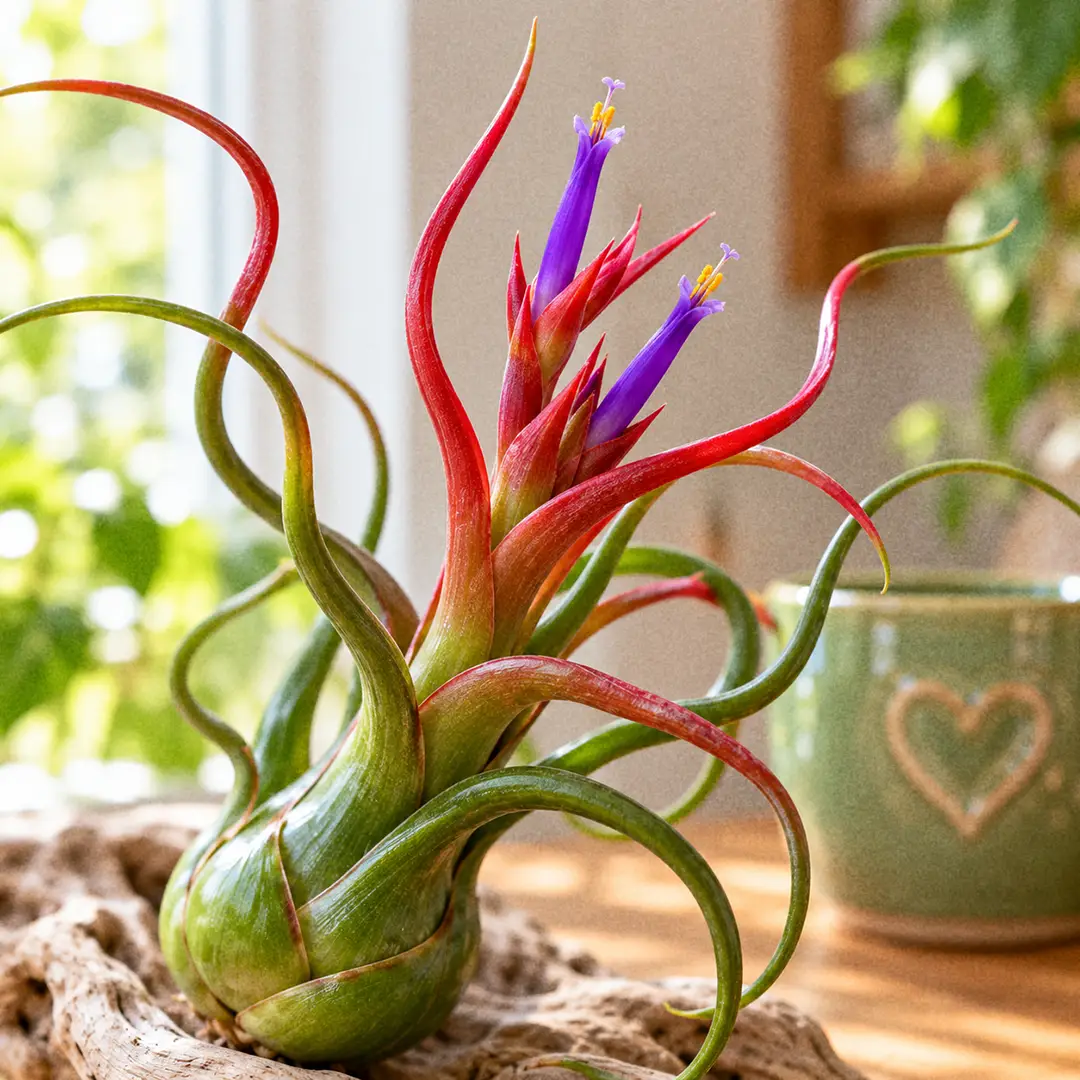
The show starts with the leaves. Before a mature Bulbosa flowers, its upper leaves flush red, sometimes shading to purple, and that color can last for weeks. A short spike then pushes out from the center, with a few small branches covered in red bracts. Narrow violet tubular flowers open from the bracts one or two at a time.
Each flower lasts a few days. The red bracts and blushing leaves hold much longer, so the display runs for a month or more.
How to Trigger Bloom
Maturity comes first, and a small plant from a shop may need two or three years to get there. After that, the levers are the ordinary ones: bright filtered light, regular water, and feeding through the warm months.
Some growers nudge a full-size plant that refuses to flower by sealing it in a clear bag with a ripe apple for a few days. The fruit gives off ethylene gas, which can start flowering in bromeliads. Make sure the plant is dry before it goes in the bag.
If It Won't Bloom
Weak light is the usual cause, followed by a plant that is still too young. Failure to bloom in an air plant is rarely about fertilizer.
Each Bulbosa flowers once. Afterward the parent slowly fades over a year or two while it grows pups at its base. That is the plant's normal life cycle, not a care mistake.
🏷️ Bulbosa Air Plant Types and Varieties
Bulbosa 'Guatemala' (The Standard Form)
Most Bulbosa sold as houseplants is the Guatemala form, and many shops drop the label entirely. It stays small, usually four to eight inches tall, with a bulb about the size of a large grape or a walnut and thin, tightly twisting leaves. This is the one that fits in a shell or a small wire holder.
Bulbosa 'Belize' (The Giant Form)
The Belize form is the same species at a larger scale. It can reach 10 to 14 inches, with a bulb several inches long and leaves that wave more than they twist. Sellers also list it as Giant Bulbosa. It often flushes a deeper red at bloom, and it costs more because it takes longer to grow. Care is identical, but a bigger bulb holds more water, so shake it longer.
Bulbosa vs Butzii and Medusa's Head
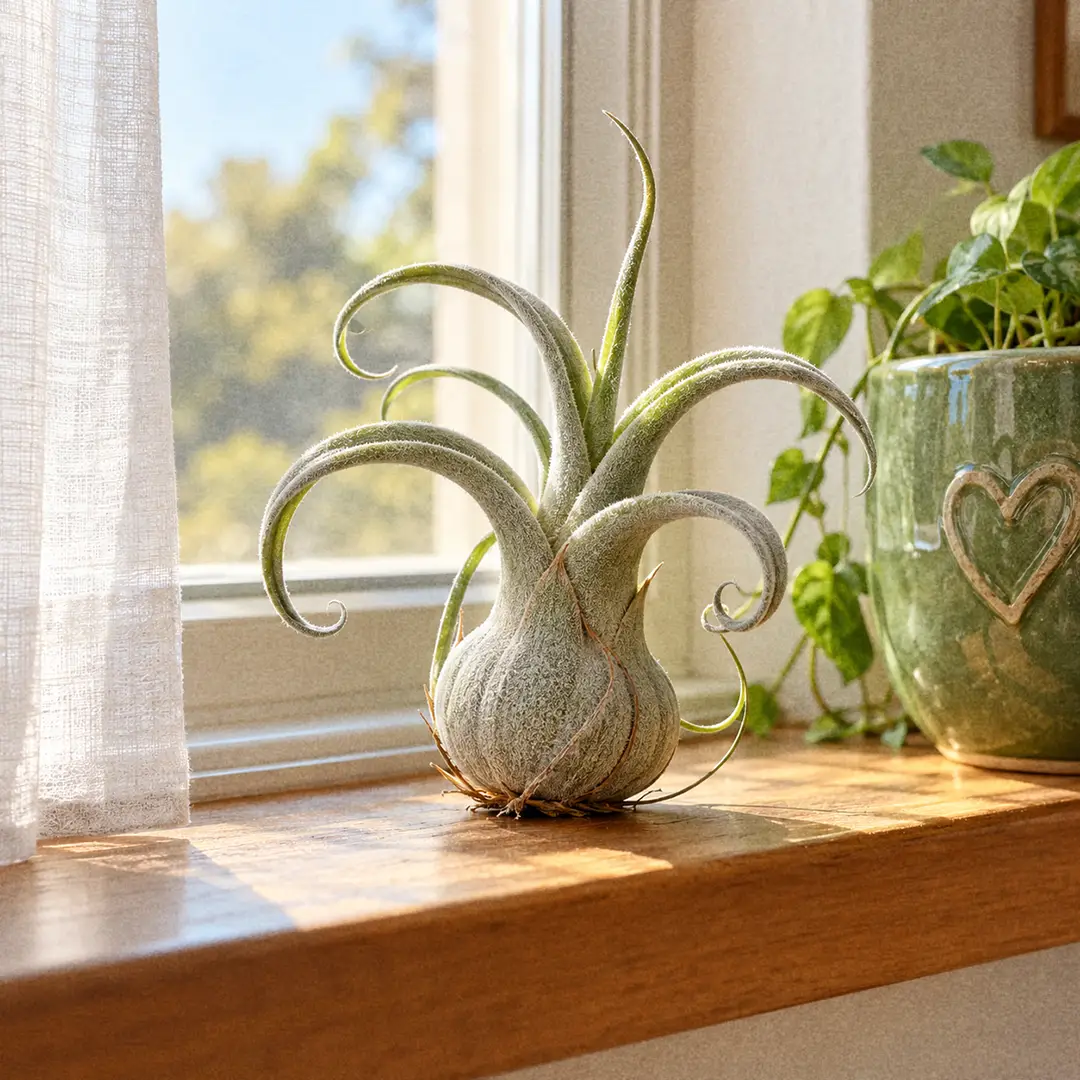
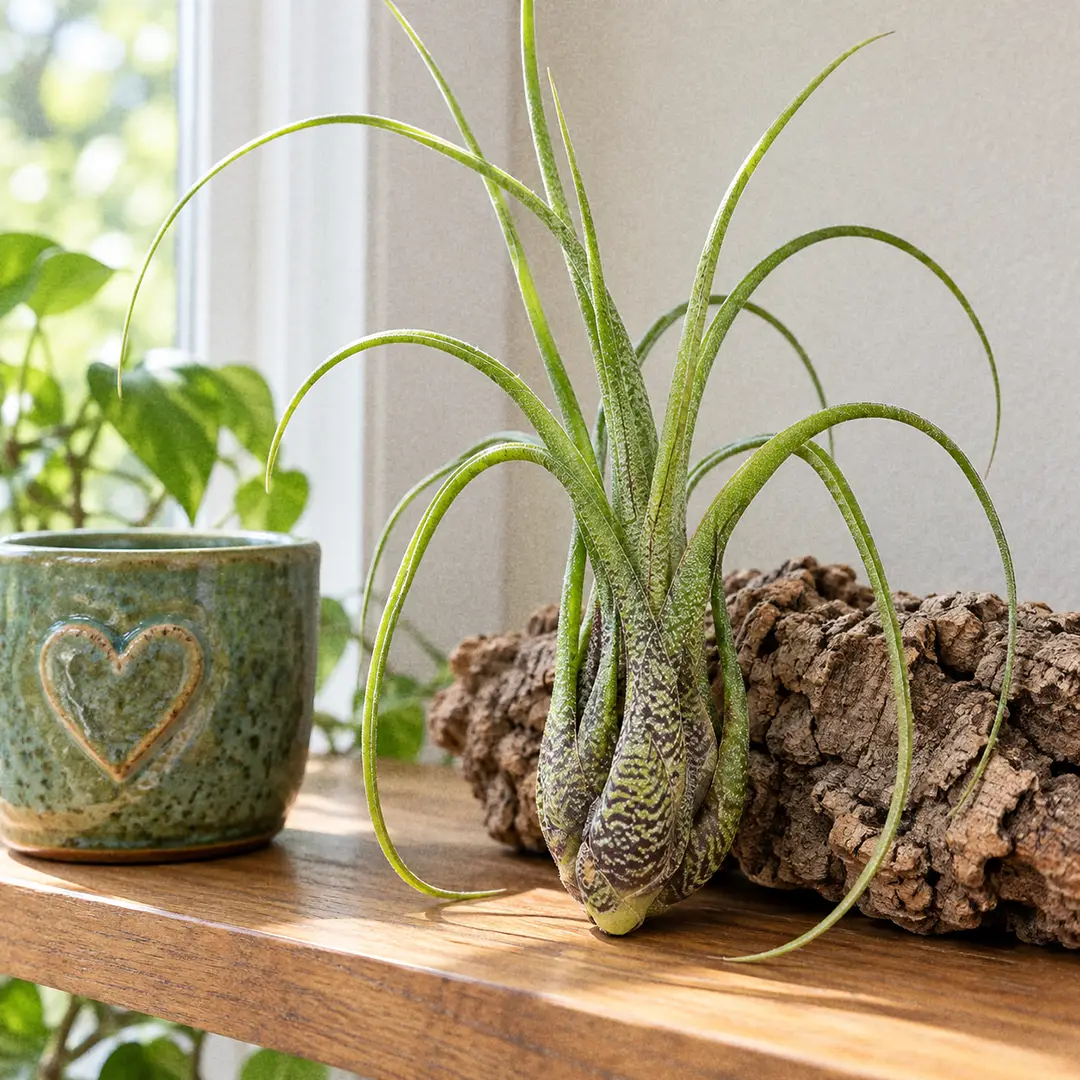
Several bulbous air plants are sold side by side and often mislabeled. The Butzii Air Plant has a slimmer bulb and wiry leaves covered in fine chocolate speckles. The Medusa's Head Air Plant is silver-grey and fuzzy, with thicker leaves, and wants more sun and less water. The Pruinosa Air Plant is small and frosted white, while the Seleriana Air Plant is the giant of the group, with a fat, velvety grey bulb. The Potbelly Air Plant, often tagged circinata, is another silver lookalike with a squat, round base and only a few curling leaves.
Bulbosa is the plain glossy green one, with no spots and no fuzz. That smooth surface is also your care cue: of the group, it wants the most humidity and the least direct sun.
🪴 Mounting Bulbosa Air Plant (No Potting Needed)
Choosing a Mount
Bulbosa never goes in a pot, so mounting replaces repotting. Cork bark is the easiest choice because it is light, does not rot, and gives the anchor roots a rough surface to grip. Driftwood and grapevine work too. Avoid painted or pressure-treated wood.
How to Attach It
Mount the plant sideways or with the leaves pointing down. Water then runs out of the bulb instead of into it, which copies how the plant hangs in the wild. Tie it on with fishing line or coated wire, snug around the lowest part of the bulb.
A small dab of waterproof glue such as E6000 on the underside of the bulb also works. Hot glue can burn the tissue, and glue up the sides blocks drainage.
When to Re-Mount
Only when a clump has outgrown its perch, which takes several years. A mounted plant can be watered in place: hold the whole mount under the tap, then hang it back up to dry.
✂️ Pruning Bulbosa Air Plant
When to Prune
Rarely. Bulbosa needs no shaping. The only jobs are removing outer leaves that have dried to brown and cutting off the flower spike once it turns dry and papery.
How to Prune
Use clean, sharp scissors. Peel dead outer leaves away from the bulb with a gentle downward pull, and cut them only if they resist. Trim a brown tip at an angle so the leaf keeps its pointed shape. Cut the spent spike about half an inch above where it emerges.
Do not shorten healthy leaves to make the plant tidier, and leave the pups alone.
🌱 How to Propagate Bulbosa Air Plant
Best Method: Pups
Bulbosa multiplies by pups, small offsets that grow from the base of a plant after it flowers. Most plants make one to three. Each starts as a green nub between the outer leaf bases and grows into a miniature plant with its own tiny bulb.
Seed is possible but takes years to produce a plant of any size, so home growers stick to pups. You cannot take cuttings from an air plant.
Step-by-Step Pup Separation
- Wait until the pup is at least one third the size of the parent. Smaller pups have too little stored energy to survive alone.
- Water the plant the day before, so the tissue is flexible.
- Hold the parent's bulb in one hand and the base of the pup in the other. Twist gently and pull downward. A ready pup comes away with little effort. If it resists, give it another month.
- Let both plants dry in open air for a day before the next watering, so the small wound seals.
- Care for the pup like an adult, with the same light and the same dunk, shake and upside-down drying.
Growing a Bulbosa Clump
You can also leave the pups where they are. Over a few years the plant turns into a cluster of bulbs with leaves reaching in every direction, and a clump blooms more often because the plants mature at different times.
Clumps need extra care when drying, since water hides between the bulbs. Shake the whole cluster and hang it so every bulb points down. Our propagation guide covers methods for other houseplants.
🐛 Bulbosa Air Plant Pests and Treatment
Air plants attract few pests, and the ants that live in wild Bulbosa do not move into houseplants. Check the creases where the leaves meet the bulb each time you water.
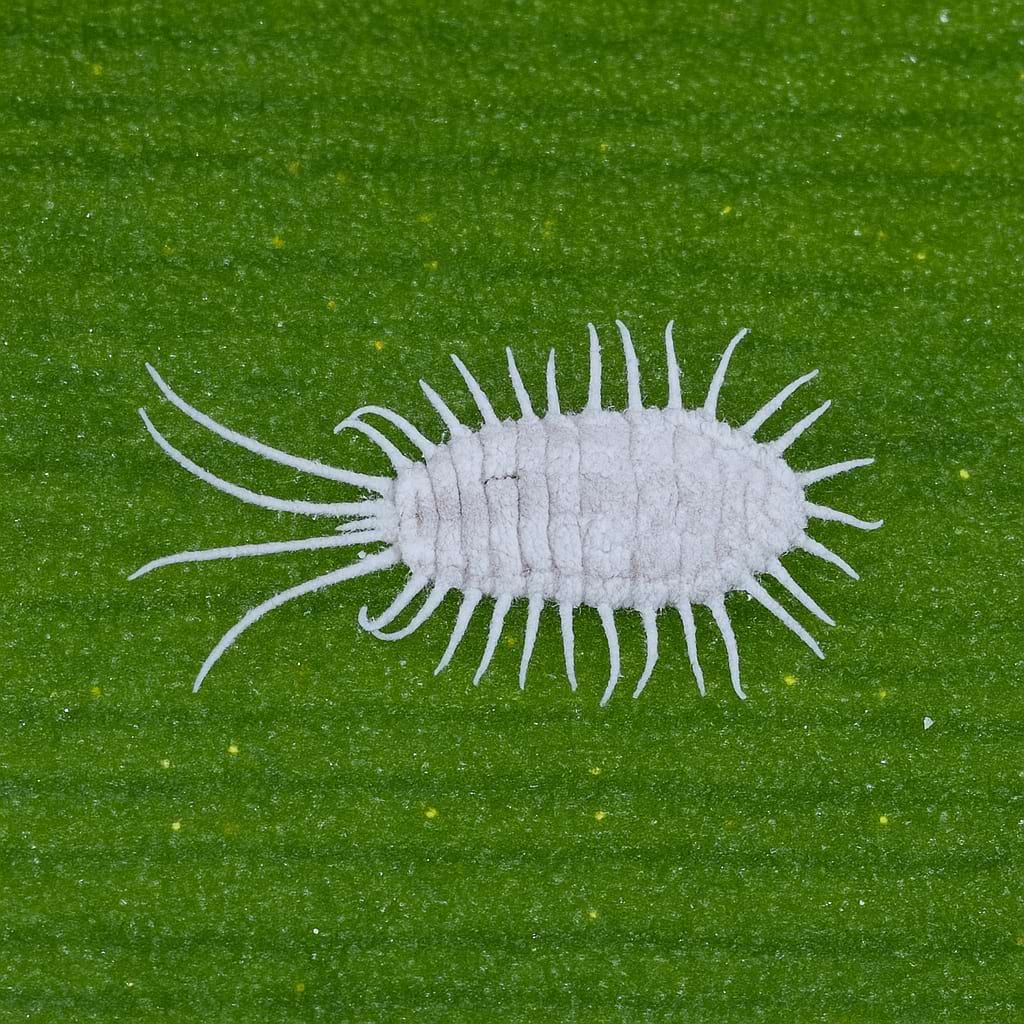
- Mealybugs are the most common. They look like bits of white cotton tucked between the leaf bases. Dab each one with a cotton swab dipped in 70 percent rubbing alcohol, rinse the plant, and repeat weekly for a month.
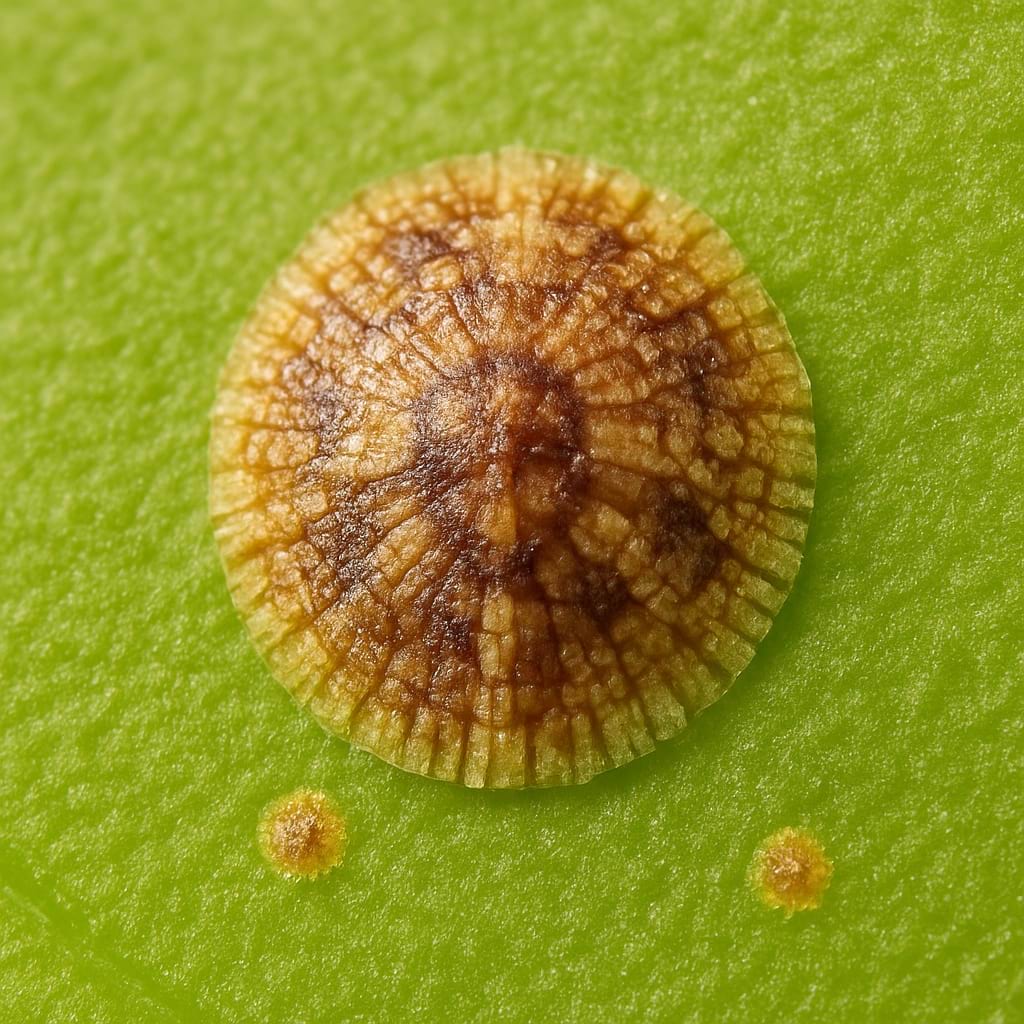
- Scale insects appear as small brown bumps stuck to the leaves. Scrape them off with a fingernail or a soft toothbrush, then treat with alcohol the same way.
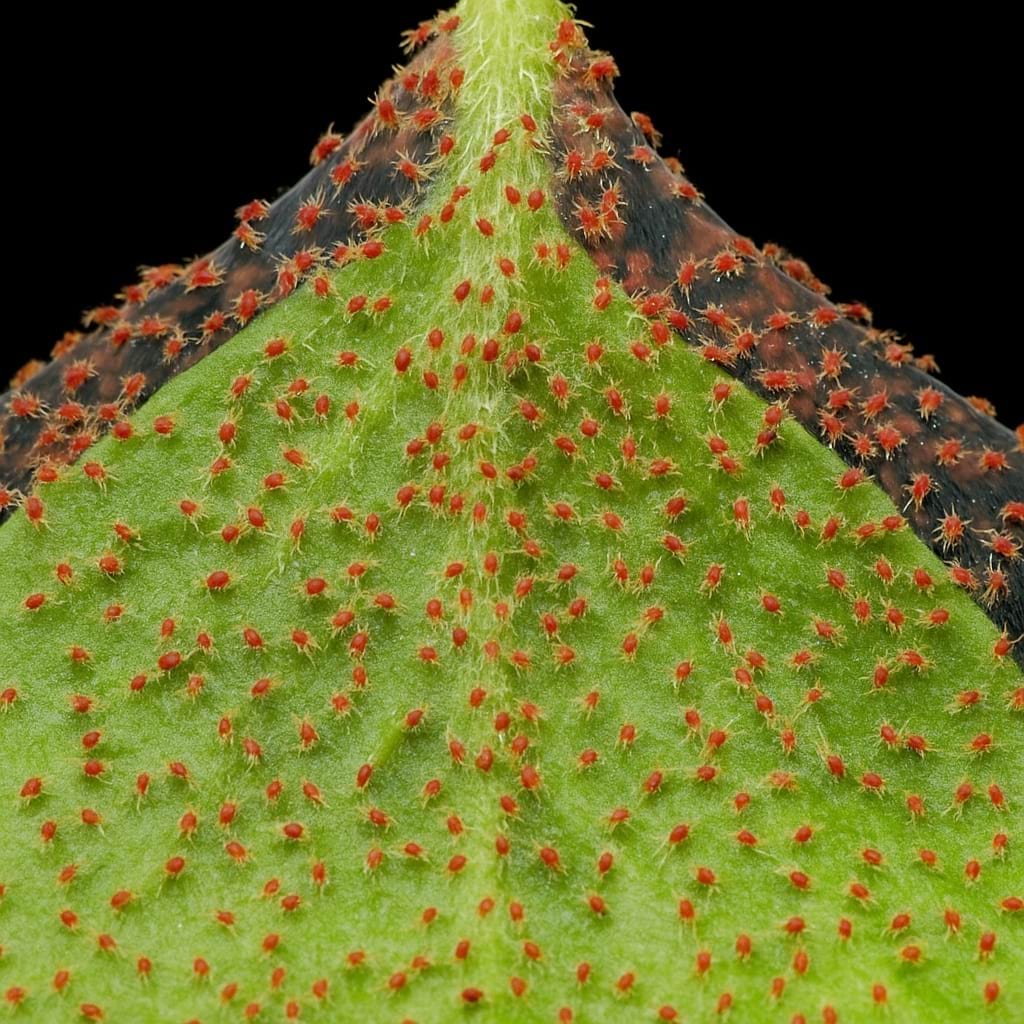
- Spider mites show up in dry, still air as fine webbing and dull, speckled leaves. A thorough rinse and higher humidity usually clear them.
Do not spray neem oil or horticultural oil on a Tillandsia. Oil coats the trichomes and stops the plant from taking in water.
🩺 Common Bulbosa Air Plant Problems
Nearly every Bulbosa problem traces back to water: too much left in the bulb, or too little reaching the leaves.
- Bulb rot is the main killer. The base turns dark and soft, smells sour, and the center leaves slide out. It comes from water sitting in the bulb, and there is no dependable cure once the core is affected. If only one side is soft, peel off the damaged outer leaves, dry the plant upside down for several days, and hope.
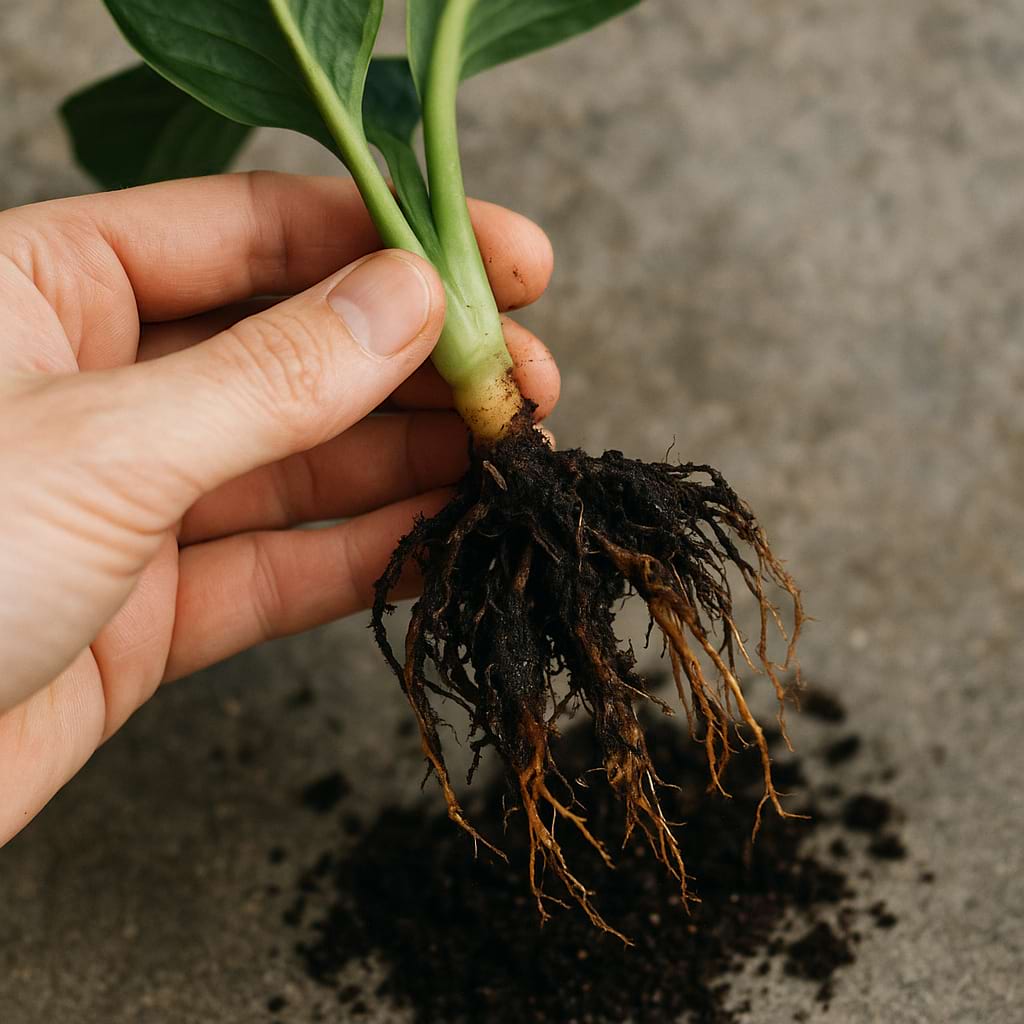
- Root rot affects plants kept in soil or wet moss. Remove the plant, let it dry, and mount it in open air.
- Brown crispy tips mean dry air, too few waterings, or mineral build-up. Water more often and add misting.
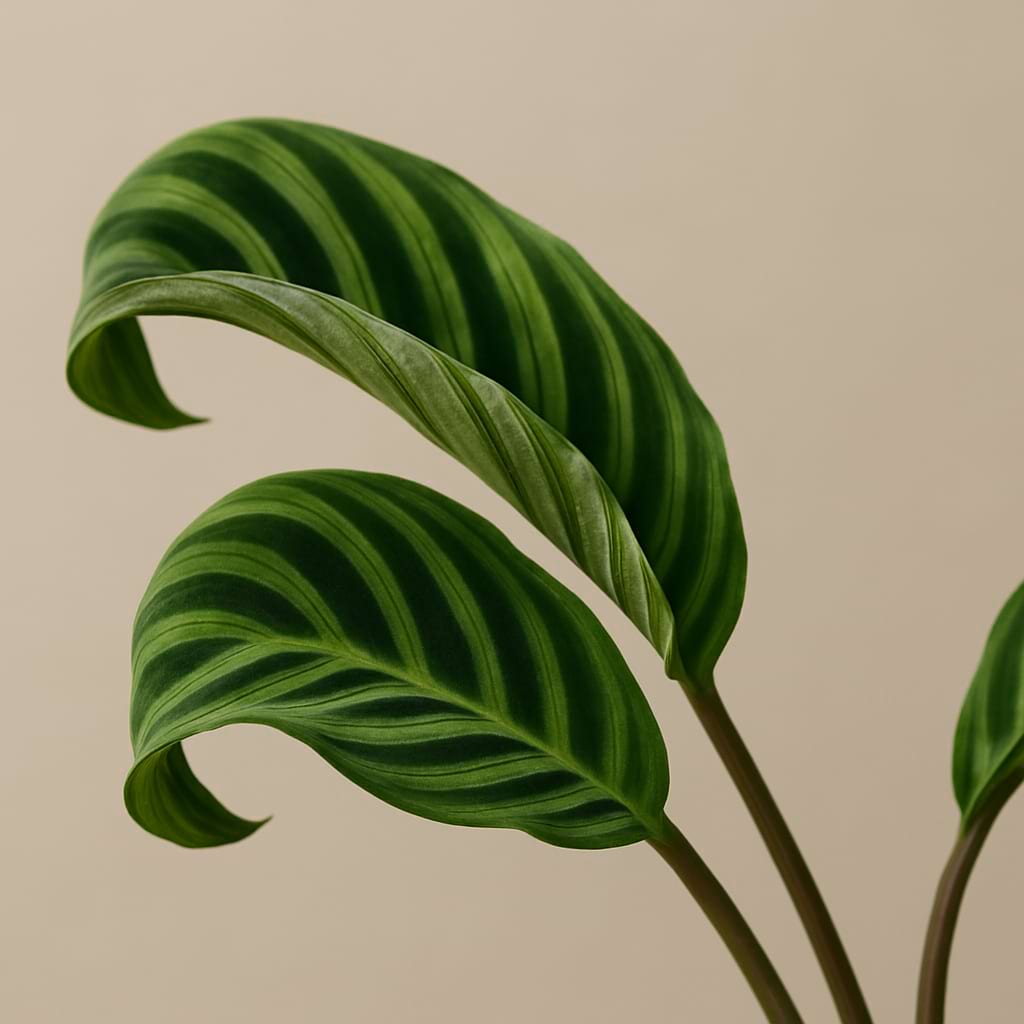
- Tightly curled leaves that have lost their gloss mean thirst. Dunk the plant for ten minutes, shake it out, and return to a regular schedule.
- Pale, stretched leaves point to low light. Move the plant closer to a window over a week or two.
- Sun scorch shows as bleached, papery patches. Shift the plant out of direct sun.
🖼️ Bulbosa Air Plant Display and Styling Ideas
Mounted and Hanging Displays
Bulbosa looks best where its leaves have room to wander. A single plant tied sideways to a strip of cork, or held in a hanging wire spiral, shows off the round bulb and drains well at the same time. Hanging it upside down from a hook makes it look like a small green jellyfish.
Grouped Arrangements
The smooth dark green of Bulbosa contrasts well with silver air plants. Try it beside a compact Ionantha Air Plant, a broad Xerographica, the needle-leaved silver ball of a Fuchsii Air Plant, or a strand of Spanish Moss. Remember that the silver plants want less water, so keep them loose and water each on its own schedule.
Where Not to Put Bulbosa
Avoid closed terrariums, narrow-necked bottles, and deep cups that hold the bulb upright in still air. A windowless bathroom fails too, however humid it is. If the plant sits upright in a holder, lift it out for every watering and put it back dry.
🌟 Bulbosa Air Plant Pro Care Tips
- Shake first, then hang. Three firm shakes and a few hours upside down prevent most Bulbosa deaths.
- Water in the morning. A plant that is dry by evening does not rot overnight.
- Squeeze the bulb once a week. Firm is healthy. Soft, dark or smelly means trouble at the core.
- Watch the leaf roll. Tight tubes and a dull surface mean the plant wants water today.
- Treat it as the thirsty one. If you grow several air plants, Bulbosa needs water before any silver species does.
- Mount it on its side. A tilted bulb drains itself.
- Use a fan in humid rooms. Humidity is safe for the bulb only when the air moves.
- Keep pups attached. A clump is hardier and better looking than single plants.
❓ Frequently Asked Questions
Why is my Bulbosa Air Plant turning brown or black at the base?
A dark, soft base is rot from water trapped inside the hollow bulb. Tug a center leaf gently. If it slides out and smells sour, the core has rotted and the plant will not recover. A firm bulb with one or two dry, tan outer leaves is normal aging.
Can I soak a Bulbosa Air Plant?
A short dunk of a minute or two is safer than the long soak used for other air plants. The bulb fills with water during a soak and is slow to empty. If the plant is badly dried out, a ten-minute soak is fine as a one-off, followed by a thorough shake and upside-down drying.
How often should I water a Bulbosa Air Plant?
Two to three times a week in the warm months and once or twice a week in winter, with misting in between if your air is dry. It needs more water than silver air plants because its smooth leaves have fewer scales to catch and hold moisture.
Why do I have to dry Bulbosa upside down?
Because the bulb is a set of hollow chambers that hold water like a cup when the plant sits upright. Turning it over lets gravity empty them. Wild plants often grow sideways or hanging down for the same reason.
Is Tillandsia bulbosa safe for cats and dogs?
Yes. Air plants are considered non-toxic to cats and dogs. A pet that chews the leaves may get a mild upset stomach from the tough fibers, and the plant will be badly damaged, so hang it out of reach.
Do ants live inside a Bulbosa Air Plant at home?
No. In its native forests, ants nest in the dry spaces inside the bulb and the plant absorbs nutrients from what they leave behind. Nursery-grown plants are empty, and nothing about the plant attracts household ants.
Why are my Bulbosa's leaves turning red?
An even red or purple flush on the upper leaves of a firm, healthy plant means it is about to flower. Strong light can deepen the color. Red leaves combined with crispy patches point to too much direct sun instead.
How big does a Bulbosa Air Plant get?
The common Guatemala form reaches four to eight inches tall. The Belize or giant form grows to 10 to 14 inches with a much larger bulb. Both grow slowly and take a few years to reach full size.
Can a Bulbosa Air Plant live in a terrarium?
Only in an open one. Bulbosa enjoys the humidity, but a closed globe has no airflow, so the bulb stays damp and rots. Choose a wide-mouthed vessel, rest the plant on dry material such as bark or pebbles, and take it out for every watering.
Does Bulbosa die after flowering?
The plant that flowered slowly declines over a year or two, but it produces one to three pups first. Leave them attached and they replace the parent, so the clump keeps growing.
ℹ️ Bulbosa Air Plant Info
Care and Maintenance
🪴 Soil Type and pH: No soil. Grown mounted or loose as an epiphyte.
💧 Humidity and Misting: Happiest at 60 to 80 percent humidity with moving air, and noticeably thirstier than silver air plants in a dry room.
✂️ Pruning: Remove dry outer leaves and the spent flower spike with clean scissors. Nothing else needs cutting.
🧼 Cleaning: Rinse dust off during a normal watering. Skip leaf shine and oils, which block the scales the plant drinks through.
🌱 Repotting: Never potted. Re-mount onto a larger piece of cork or driftwood once the clump outgrows its perch.
🔄 Repotting Frequency: Only when the clump outgrows its mount, roughly every 3-4 years
❄️ Seasonal Changes in Care: Water and feed more through spring and summer. In winter, water a little less often, keep it above 55°F, and mist between dunks if the heating is on.
Growing Characteristics
💥 Growth Speed: Slow
🔄 Life Cycle: Evergreen epiphytic perennial that clumps by offsets
💥 Bloom Time: Usually spring or summer, once the plant is mature
🌡️ Hardiness Zones: 10-11
🗺️ Native Area: Humid lowland forests and mangroves from southern Mexico through Central America and the Caribbean to Colombia, Ecuador and northern Brazil
🚘 Hibernation: No true dormancy. Growth slows in winter and watering should slow with it.
Propagation and Health
📍 Suitable Locations: East windowsills, bright bathrooms and kitchens, cork mounts, driftwood, hanging wire holders, open glass vessels
🪴 Propagation Methods: Leave pups attached until they reach a third of the parent's size, then twist them free or let the clump grow on.
🐛 Common Pests: Mealybugs, Scale Insects, Spider Mites
🦠 Possible Diseases: Bulb rot, base rot, fungal spotting in still damp air
Plant Details
🌿 Plant Type: Bulbous epiphytic bromeliad
🍃 Foliage Type: Evergreen smooth, rolled, twisting leaves from a swollen hollow base
🎨 Color of Leaves: Glossy deep green, flushing red to purple at the top before bloom
🌸 Flower Color: Violet tubular flowers on short red bracts
🌼 Blooming: Yes, once per plant, after a few years of good light
🍽️ Edibility: Not edible.
📏 Mature Size: 4-8 inches for the common form, 10-14 inches for the Belize form
Additional Info
🌻 General Benefits: Pet-safe, needs no soil, tolerates more humidity than most air plants, and has one of the most recognizable shapes in the genus
💊 Medical Properties: No documented medicinal uses.
🧿 Feng Shui: A soilless plant with upward, wandering lines that suits small bright corners and humid rooms where a pot would be in the way.
⭐ Zodiac Sign Compatibility: Pisces
🌈 Symbolism or Folklore: Independence, adaptability, shelter
📝 Interesting Facts: The bulb of a Bulbosa Air Plant is hollow. In the wild, ants nest in the dry chambers between its swollen leaf bases, and the plant feeds on the debris they leave behind. Wild plants often hang sideways or upside down, which keeps rain from pooling inside.
Buying and Usage
🛒 What to Look for When Buying: Squeeze the bulb gently before buying. It should feel firm like a small onion, with glossy leaves and no dark, soft or sour-smelling patches at the base.
🪴 Other Uses: Cork and driftwood mounts, hanging displays, wire holders, shell and urchin-shell holders, open terrariums
Decoration and Styling
🖼️ Display Ideas: Mounted sideways or upside down on cork, hung in a wire spiral, or grouped with rounder silver air plants for contrast
🧵 Styling Tips: The leaves wander in every direction, so give the plant open space around it and keep it at eye level or higher.
🪴 See also 🪴
Complete Guide to Seleriana Air Plant Care and Growth
Complete Guide to Potbelly Air Plant Care and Growth
Complete Guide to Butzii Air Plant Care and Growth

Houseplant101 Forum
Questions & Comments
Ask a question, share your plant experience, or help other plant owners.
Comments are temporarily unavailable.
Open the Houseplant101 ForumNo comments yet
Be the first to ask a question or share your experience about this page.
Log in or create an account
Comments use your Houseplant101 Forum account, but you can stay on this page.
Create a new account