
 AI Overview
 🪴 In This Guide 🪴

A Note From Our Plant Expert
Anastasia here. Philodendron is the genus I hand to people who are convinced they cannot keep anything alive, because the whole group forgives a missed watering and still pushes out a new leaf. One thing is worth knowing before you buy: some climb and some do not, and that single fact decides whether you need a moss pole or just a shelf. Get it right and the rest of the care is nearly identical across all twenty-two plants below.
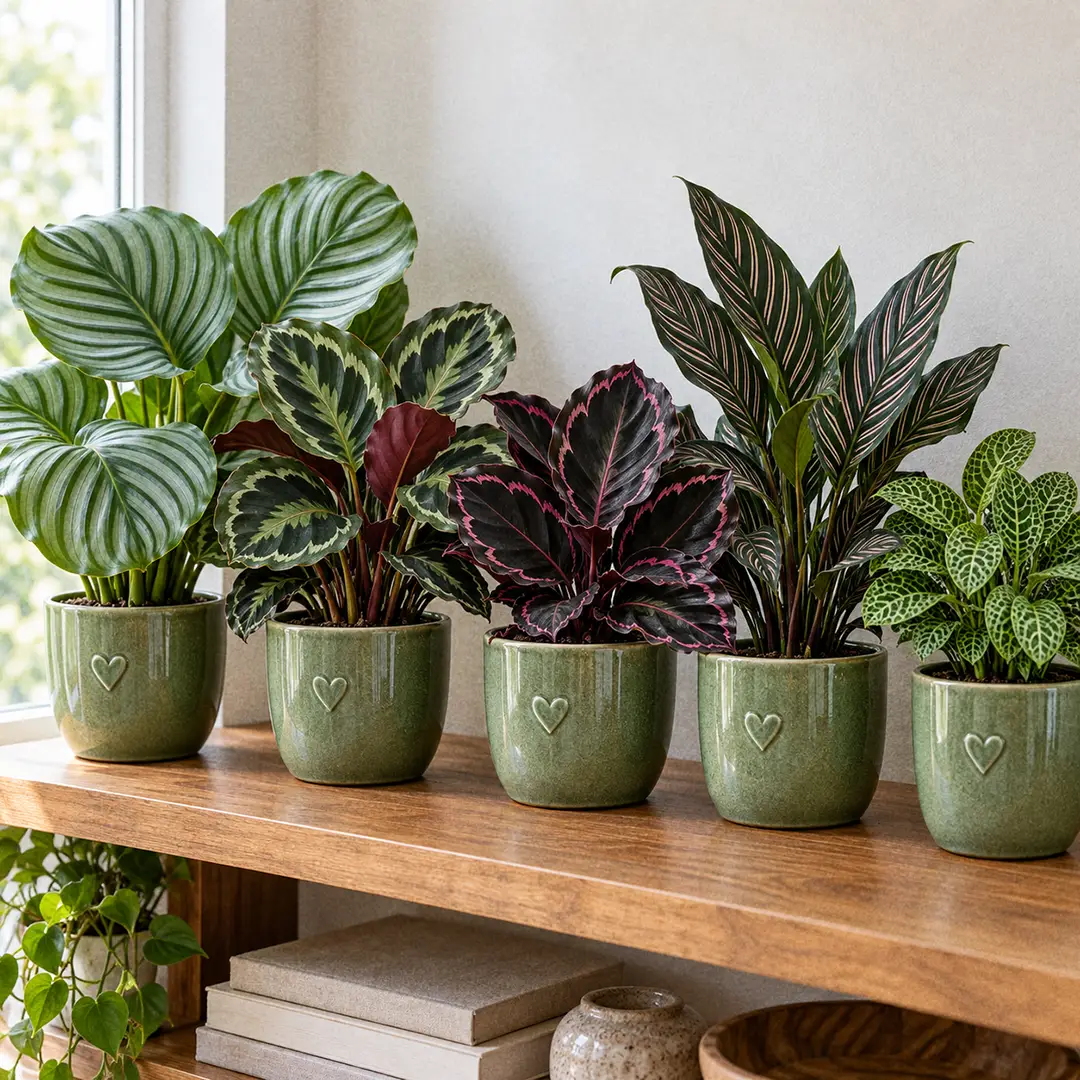
🧭 Climbing vs Self-Heading Philodendrons
Every philodendron sold as a houseplant falls into one of two camps, and nurseries almost never label which one you are holding. Learning to read the stem takes about ten seconds and saves you a year of wondering why your plant looks wrong.
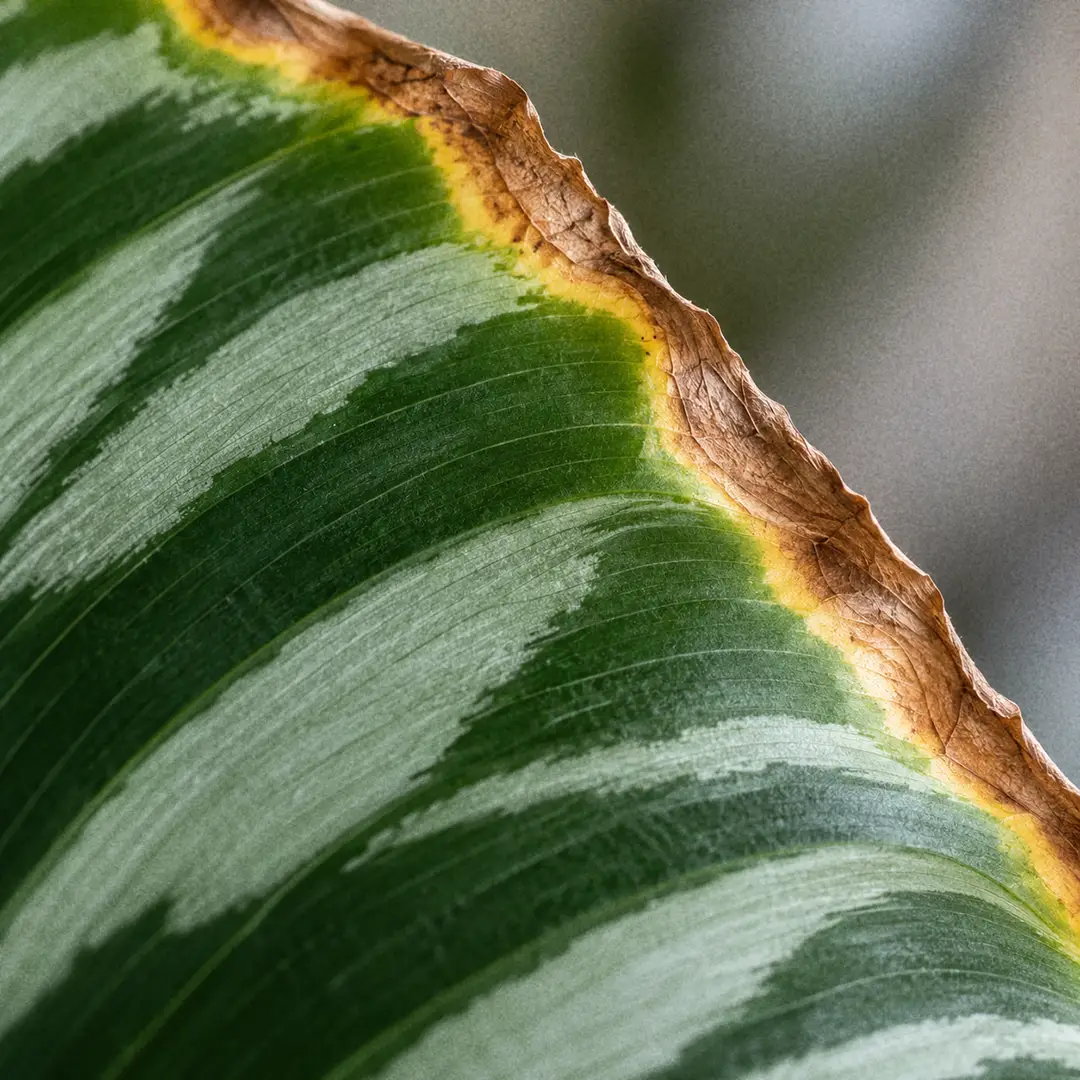
How to Tell Them Apart
Look at the stem between two leaves. If you can see a length of bare stem with a node and a stubby aerial root, you have a climber. If the leaves all emerge from one tight point near the soil with barely any stem showing, you have a self-header.
What Climbers Need
Climbers want something to grab. Give a Heart-leaf or a Silver Sword a moss pole, a coir pole, or even a plank of cork, and the aerial roots latch on. Once they do, leaf size increases noticeably, sometimes doubling over a season. Left trailing from a shelf they stay alive and pretty, but the leaves stay small, which is a perfectly valid choice if that is the look you want.
What Self-Headers Need
Self-headers spread sideways rather than upward. Imperial Green, Rojo Congo and Birkin all build a rosette that eventually wants a pot wide enough to sit in without tipping. No pole, no trellis. They also cannot be propagated from a stem cutting the way a vine can, so plan on buying rather than multiplying.
☀️ Philodendron Light Requirements
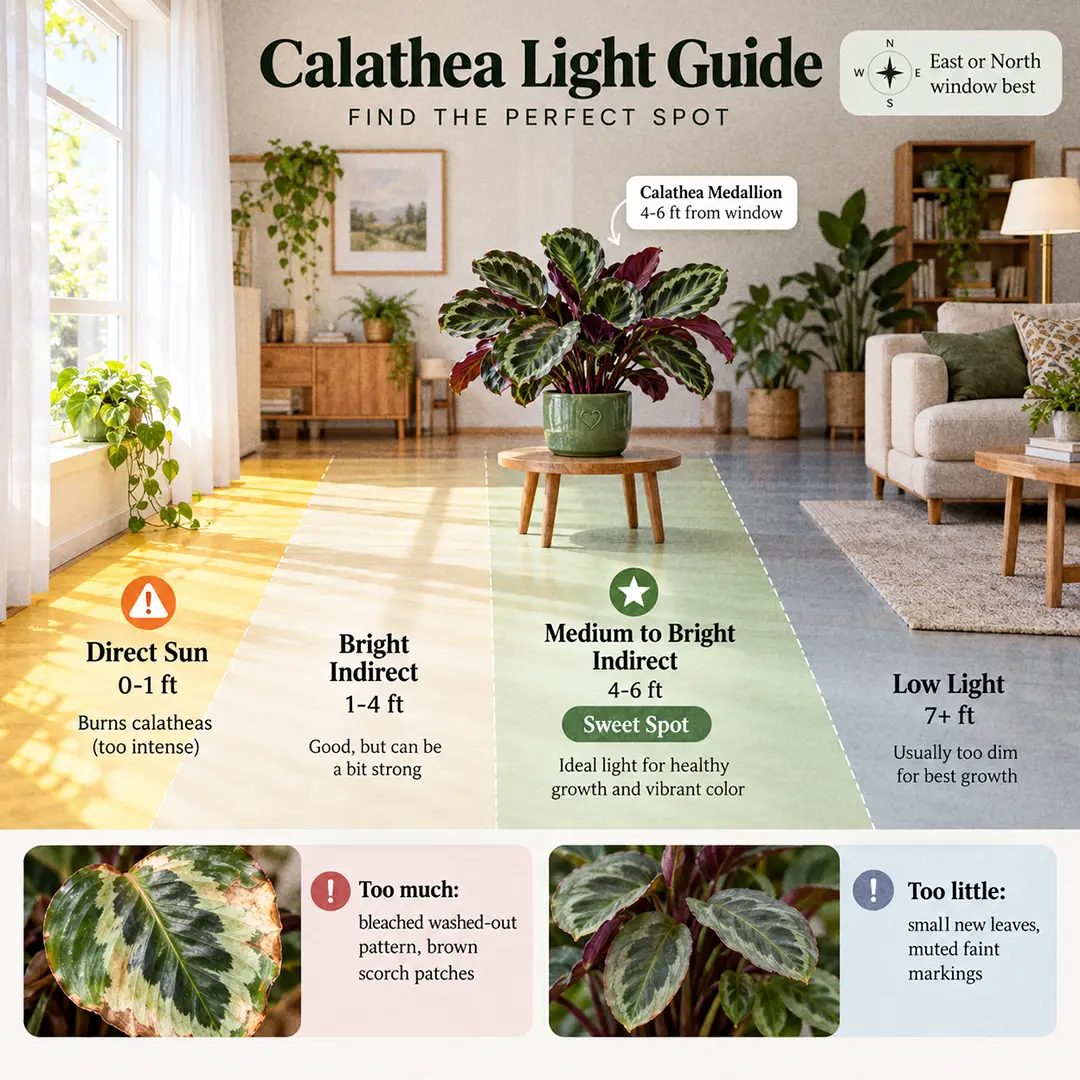
The Sweet Spot
Bright indirect light, two to four feet back from an east or north window. That answer covers essentially every type in this guide. A south or west window works too, as long as a sheer curtain softens the afternoon hours. The genus evolved under a rainforest canopy, so dappled light is what the leaves are built for.
Too Little Light
Growth slows first, then the gaps between leaves stretch out and the plant looks leggy. Variegated types lose their pattern fastest: a Pink Princess in a dim corner reverts to plain green and does not come back. If you cannot improve the placement, a grow light sorts it out cheaply.
Too Much Light
A few hours of direct summer sun bleach the leaf surface to a washed-out yellow-green, and the damage does not heal. Velvet-leaved types burn faster than glossy ones because the texture holds heat. If new leaves come out pale and crisp at the edges, move the plant back a foot and wait.
💧 Watering Philodendrons
Watering Frequency
Push a finger into the mix. When the top inch or two feels dry, water. In a bright room in summer that lands around every five to seven days; in winter it can stretch to two weeks. Pot size matters more than plant type, since a small pot in a warm room dries out twice as fast as a large one.
How to Water
Take the pot to the sink and run water through until it streams out the drainage holes, then let it drain fully before it goes back on the saucer. This flushes salt buildup as a side effect. Bottom watering works well for the velvet types, whose leaves hate being splashed.
Signs You Got It Wrong
Yellow lower leaves with damp mix means too much water, and this is by far the most common way philodendrons die indoors. Crispy brown edges with curled leaves and a light pot mean the opposite. When in doubt, wait a day. The genus handles thirst far better than it handles root rot.
🪴 Best Soil and Pots for Philodendrons
What the Mix Needs to Do
These are epiphytes and hemiepiphytes. In the wild their roots sit in leaf litter against tree bark, never in dense ground soil. Straight potting compost from a bag holds too much water and suffocates them slowly. Air pockets are the whole game.
A Mix That Works
Two parts orchid bark, two parts coco coir or peat, one part perlite, and a handful of horticultural charcoal if you have it. That blend drains in seconds and still holds enough moisture to get through a week. A ready-made chunky aroid mix saves the mixing if you only have one or two plants.
Choosing a Pot
Drainage holes are non-negotiable. Go up one size only when roots show at the holes, because a pot with too much spare soil stays wet in the middle. Terracotta suits heavy-handed waterers; plastic or glazed ceramic suits anyone who forgets. See our repotting guide for the timing.
💦 Philodendron Humidity and Temperature
Ideal Humidity
Most philodendrons cope fine at 40 to 50 percent, which is ordinary indoor air in a home that is not running heating hard. The exceptions are the velvet-leaved ones. Gloriosum and Verrucosum both want 60 percent or above, and they show their displeasure as brown crisping along the leaf edge within days.
Easy Humidity Boosters
Group plants together so they share transpired moisture, set pots on a pebble tray, or run a small humidifier nearby during winter. Misting looks helpful, but the effect lasts about fifteen minutes and invites fungal spotting on velvet leaves, so skip it.
Temperature Range
Anywhere between 65 and 80°F (18 to 27°C) keeps them growing. Below 55°F (13°C) growth stops and cold damage starts showing as blackened patches. Keep them away from draughty doors in winter, off the radiator shelf, and out of the blast of an air conditioning vent in summer.
🍼 Feeding Philodendrons
When and How Often
Feed every three to four weeks from early spring through late summer, then stop entirely once growth slows in autumn. A plant that is not actively pushing leaves cannot use the nutrients, and the leftover salts build up in the mix and burn the root tips.
What to Use
A balanced liquid houseplant fertiliser at half the label strength does the job for the whole genus. Half strength is deliberate: full-dose feeding on a fortnightly schedule is the fastest way to brown the leaf tips. Worm castings work as a gentler alternative if you would rather not measure.
Signs of Overfeeding
A white crust on the soil surface, brown tips on otherwise healthy leaves, and new growth that comes in small and distorted. Flush the pot with plain water three or four times, skip the next two feeds, and it recovers. More on timing in our fertilizing guide.
🌿 1. Heart-leaf Philodendron (Philodendron hederaceum)
Why It's Popular
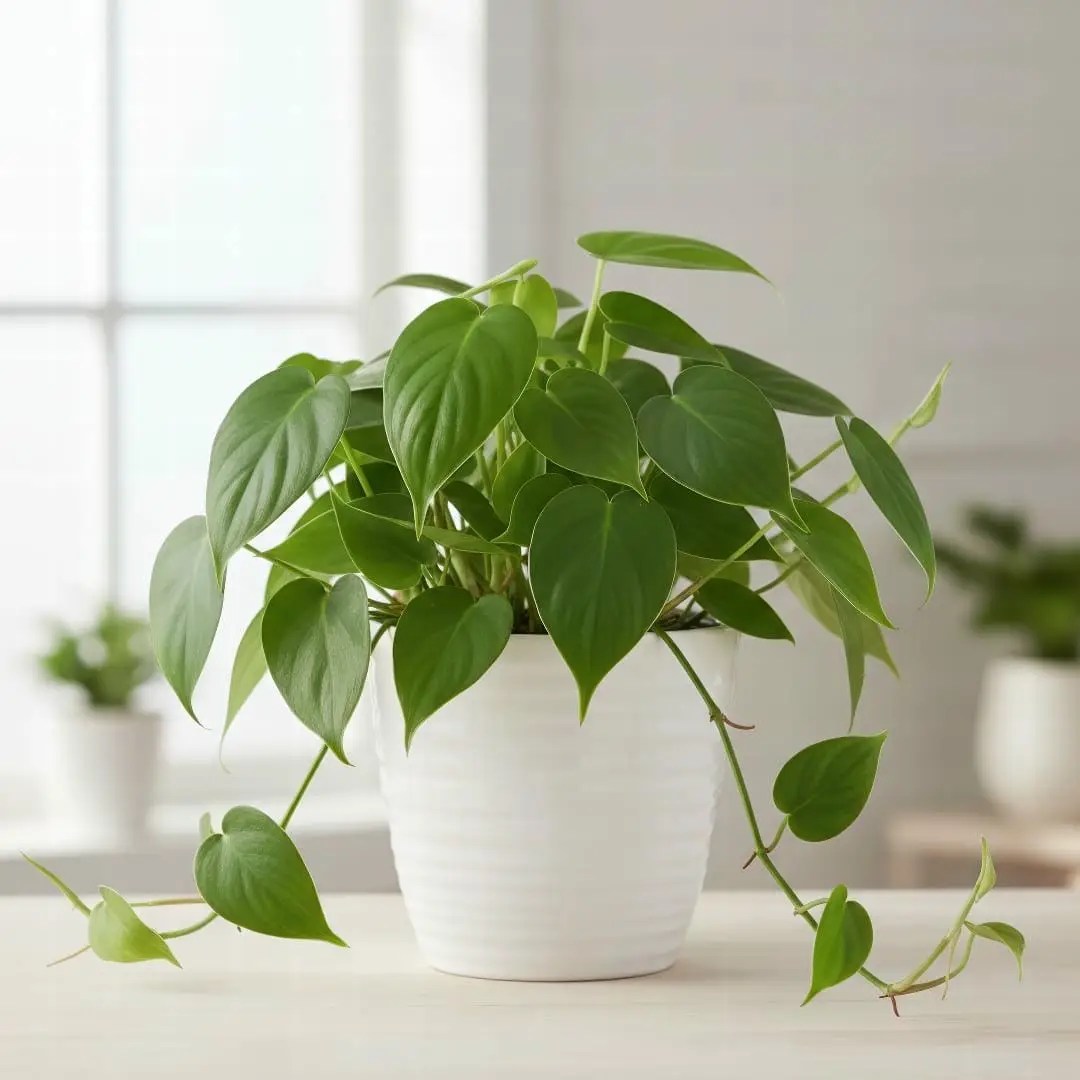
The plant that starts most collections. Glossy, deep green, perfectly heart-shaped leaves on a vine that grows fast enough to be satisfying and roots in a glass of water in under three weeks. It also handles a north-facing room better than almost anything else here.
Care Notes
- Tolerates lower light than the rest of the genus, though growth slows.
- Pinch the tips every few months or it turns into three long bare vines.
- The cheapest and most available philodendron in most shops.
Full details in our 👉 Heart-leaf Philodendron care guide.
🌿 2. Philodendron Brasil
Why It's Popular
The same species as the Heart-leaf, with a streak of chartreuse painted down the middle of each leaf. No two leaves are marked alike, and a mature trailing specimen reads as two plants growing together.
Care Notes
- Needs brighter light than plain Heart-leaf to hold the yellow stripe.
- Prune any fully green vines, or they take over and the variegation fades out.
- Occasional all-yellow leaves are normal and can be left alone.
Full details in our 👉 Philodendron Brasil care guide.
🌿 3. Lemon Lime Philodendron
Why It's Popular
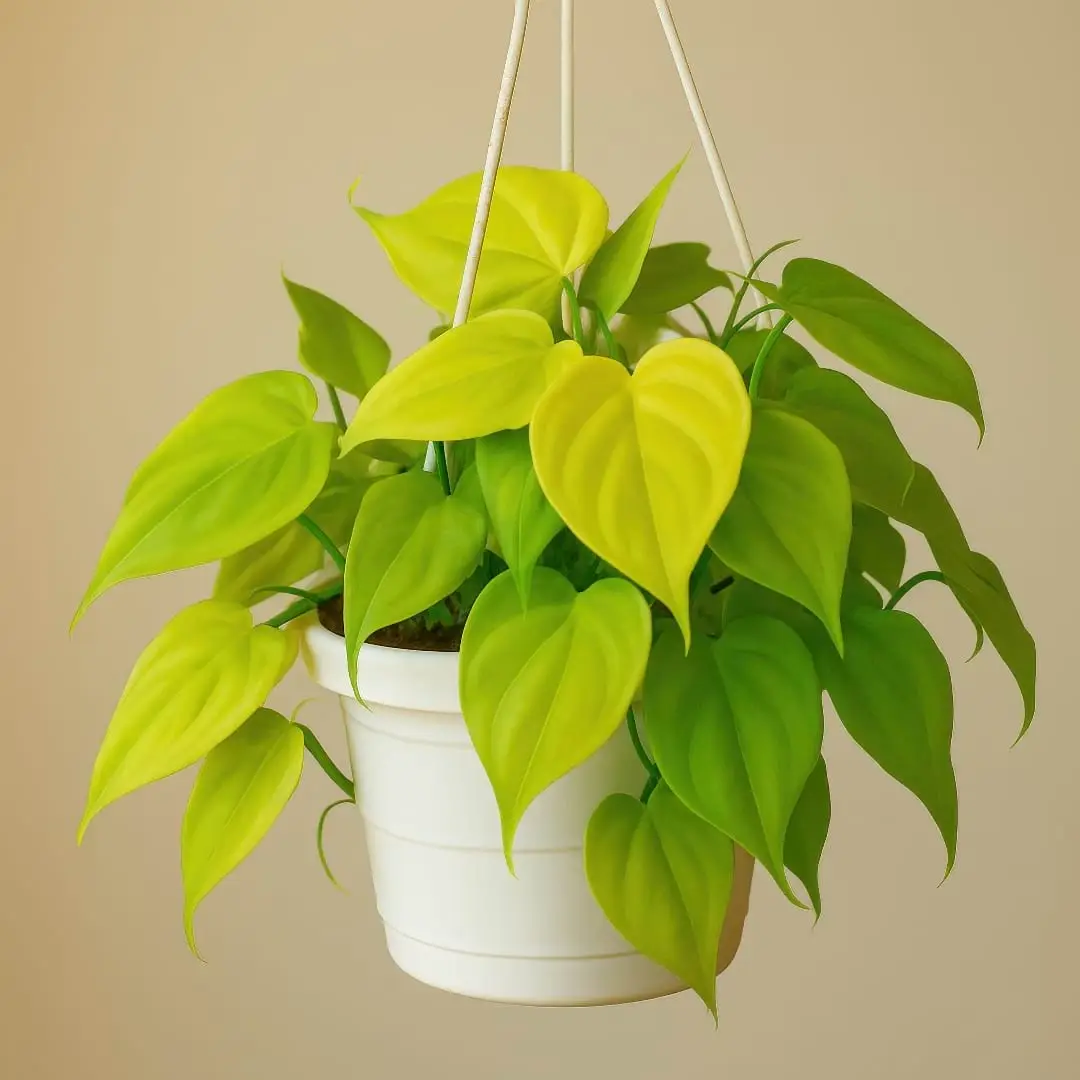
A solid neon chartreuse version of the Heart-leaf, with no variegation pattern at all, just one electric colour across the whole plant. New leaves emerge almost yellow and deepen slightly as they age. It lights up a dark shelf better than any white-variegated plant.
Care Notes
- Bright indirect light keeps it neon; shade turns it a dull sage green.
- Grows and roots exactly like the standard Heart-leaf.
- Looks best trailing where the backlit leaves glow.
Full details in our 👉 Lemon Lime Philodendron care guide.
🌿 4. Velvet Leaf Philodendron
Why It's Popular
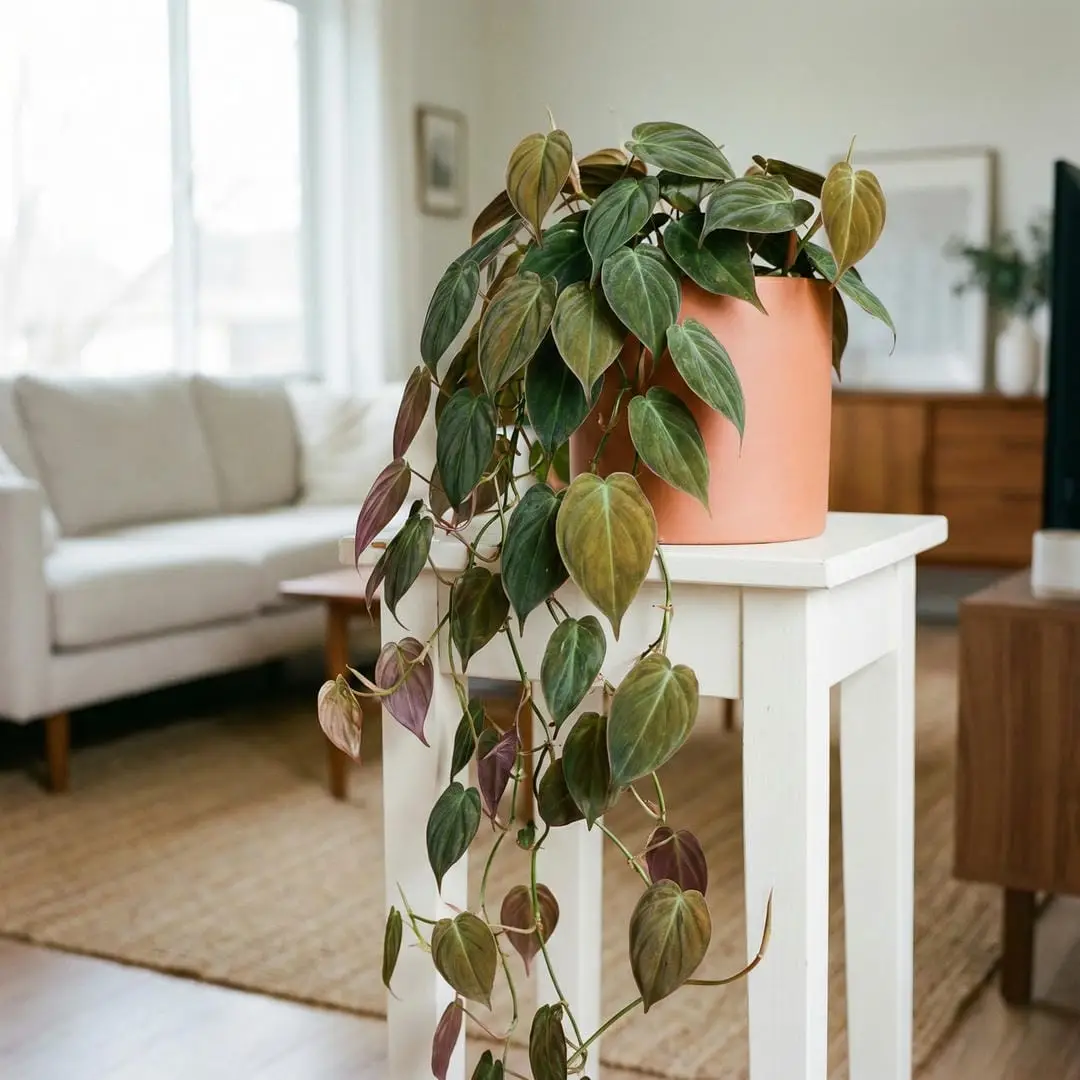
Botanically it is still Philodendron hederaceum, but the juvenile form has a matte velvet surface with coppery-bronze undersides and faint pale veining. Grown on a pole it eventually switches to the familiar glossy adult leaf, which surprises a lot of owners.
Care Notes
- Keep water off the leaves; the velvet nap spots easily.
- Wants slightly higher humidity than the glossy hederaceum forms.
- Climb it on a pole if you want the leaves to size up.
Full details in our 👉 Velvet Leaf Philodendron care guide.
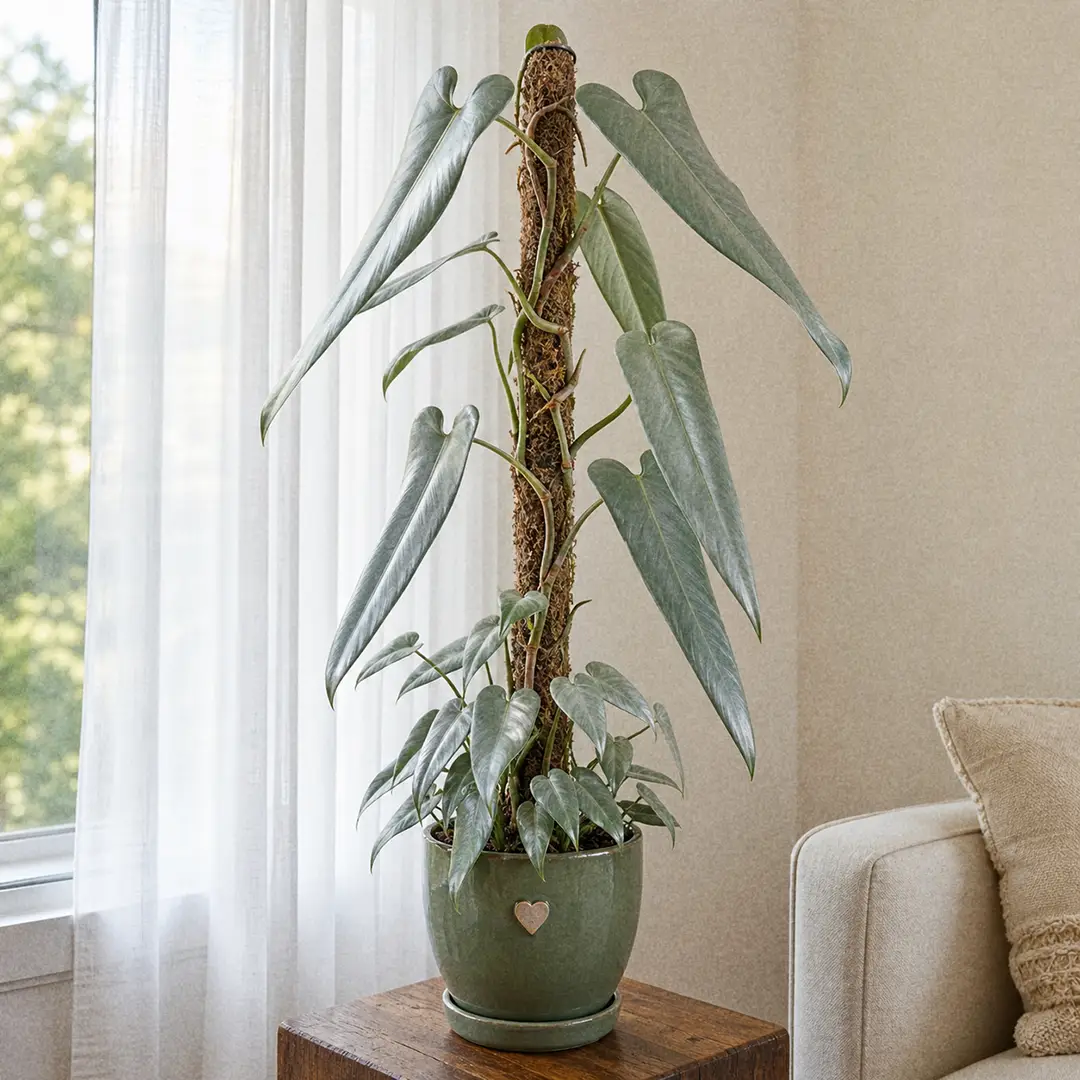
🌿 5. Silver Sword Philodendron (Philodendron hastatum)
Why It's Popular
Long, arrow-shaped leaves with a metallic pewter sheen that shifts as you walk past. It is a true species rather than a cultivar, and it climbs hard. On a pole the juvenile spear-shaped leaves widen into lobed adult ones, which is the whole reward of growing it.
Care Notes
- Give it a pole early; the transformation only happens when it climbs.
- The silver is strongest in bright indirect light.
- Faster than it looks, often a leaf every two or three weeks in summer.
Full details in our 👉 Silver Sword Philodendron care guide.
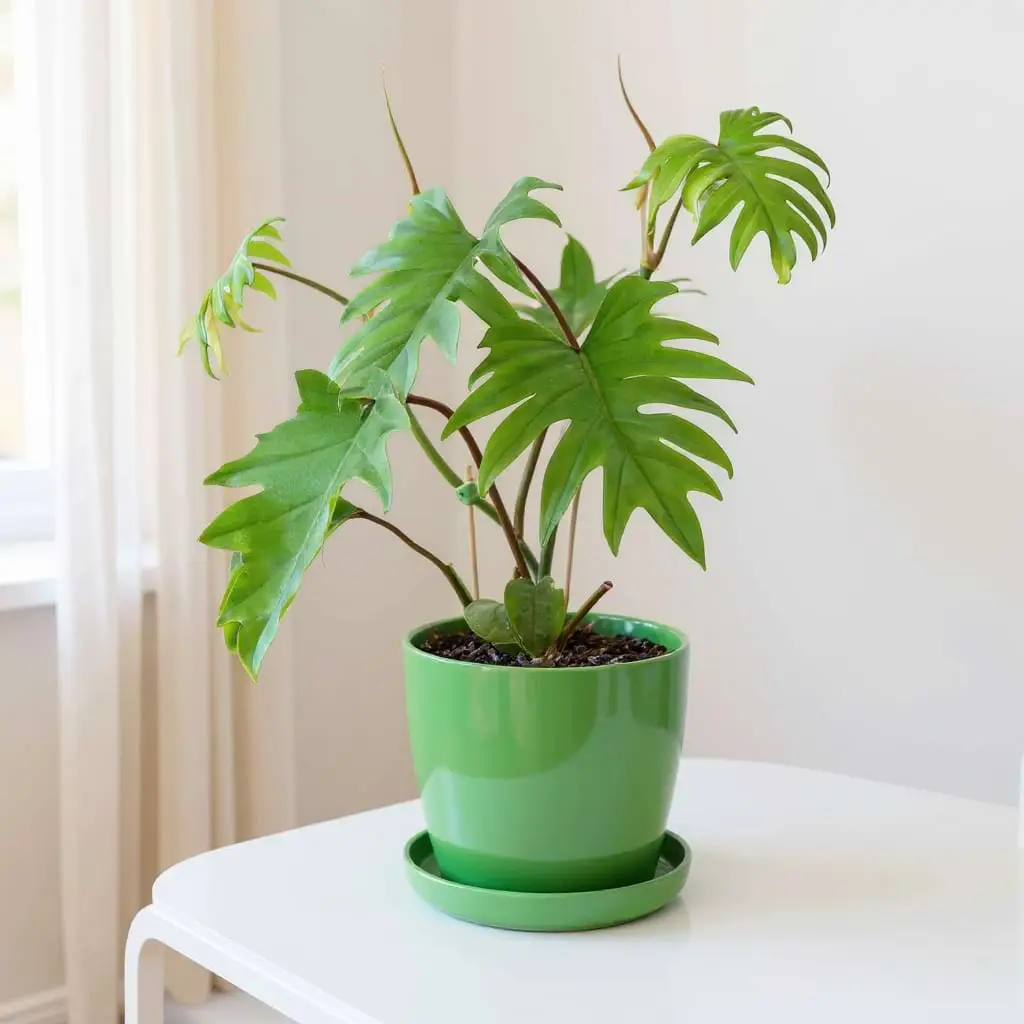
🌿 6. Philodendron Mayoi
Why It's Popular
The one that looks like a palm frond. Deeply divided leaves with five to seven finger-like lobes and red-toned petioles, growing on a vining stem. Nothing else in the genus has this silhouette, and it is still uncommon enough to get questions.
Care Notes
- Needs a pole to produce the fully divided adult leaves.
- Juvenile leaves are simple and undivided; patience is the requirement.
- Reddish stems are normal colouring, not stress.
Full details in our 👉 Philodendron Mayoi care guide.
🌿 7. Philodendron Florida Ghost
Why It's Popular
New leaves open ghostly white or cream, shift to lime, then settle into deep green as they harden. Three colours on one plant at once is the appeal. The leaves are multi-lobed, with an outline that looks almost carved.
Care Notes
- The white phase is temporary on every leaf; this is not variegation.
- Higher light extends the pale phase and deepens the leaf shape.
- A climber, and a vigorous one once it finds a pole.
Full details in our 👉 Philodendron Florida Ghost care guide.
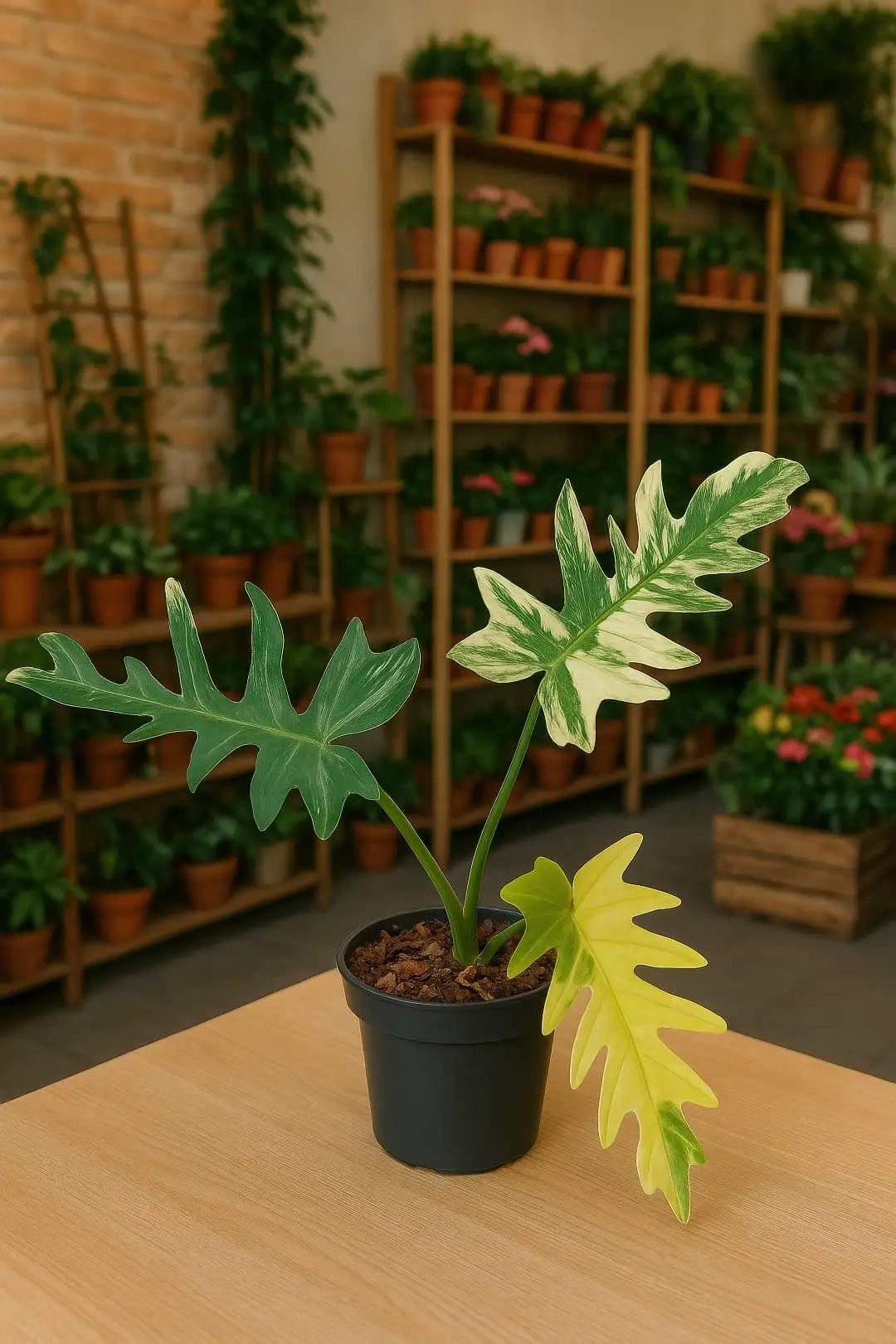
🌿 8. Philodendron Florida Beauty x Tortum
Why It's Popular
A hybrid that takes the creamy splash variegation of Florida Beauty and crosses it with the skeletal, thread-thin lobes of P. tortum. The result is a spidery, angular plant with cream flecking, and no two plants look the same.
Care Notes
- Variegation is unstable, so expect some plain leaves.
- Thin lobes dehydrate faster; keep humidity above 50 percent.
- A climbing type, and a slow grower compared to the hederaceum group.
Full details in our 👉 Florida Beauty x Tortum care guide.
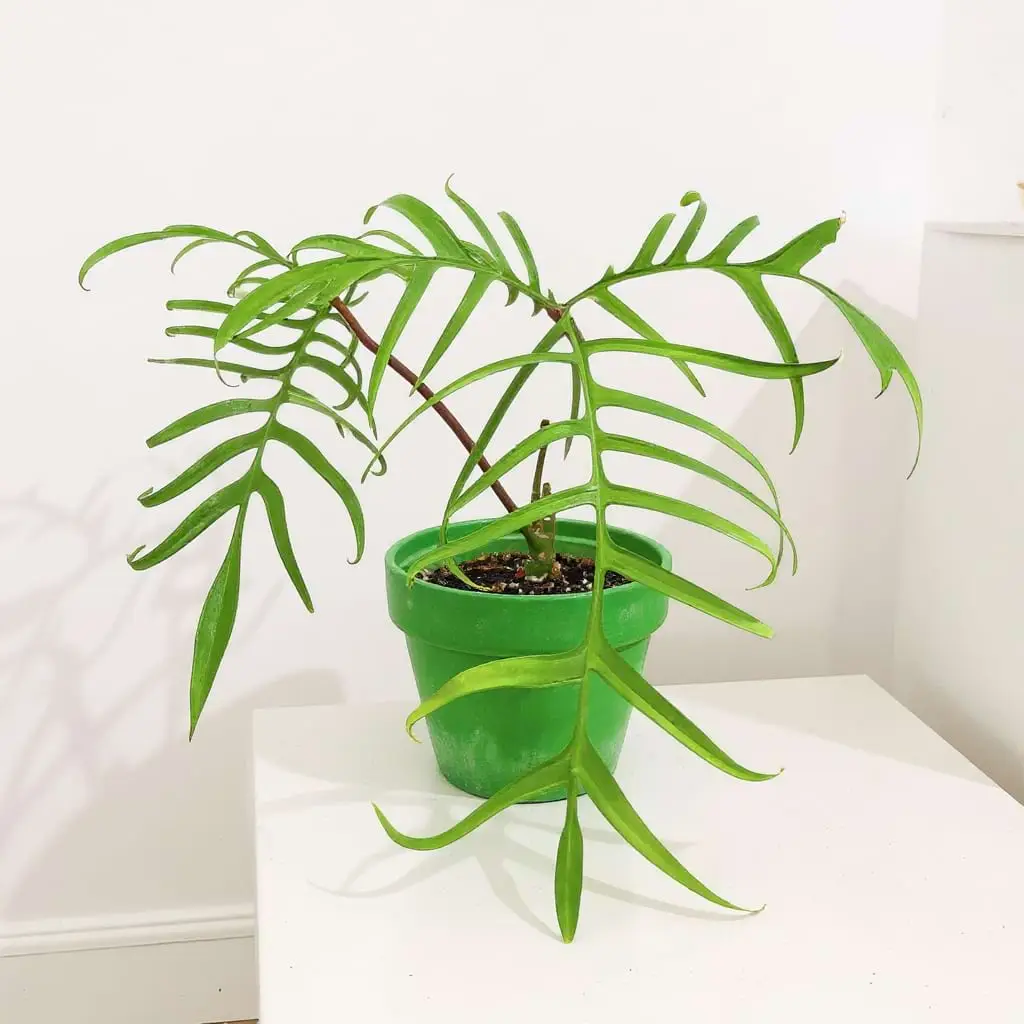
🌿 9. Philodendron Polypodioides
Why It's Popular
A fern-mimic philodendron with finely dissected leaves. They genuinely read as a frond until you check the stem. It is a species from the Brazilian Atlantic forest, and it tends to be the plant people buy once they already own the common types.
Care Notes
- Wants consistently high humidity; this one is not a shelf plant.
- Fine leaf segments show underwatering within a day or two.
- Climbs on a slab or pole rather than trailing well.
Full details in our 👉 Philodendron Polypodioides care guide.
🌿 10. Philodendron Pink Princess
Why It's Popular
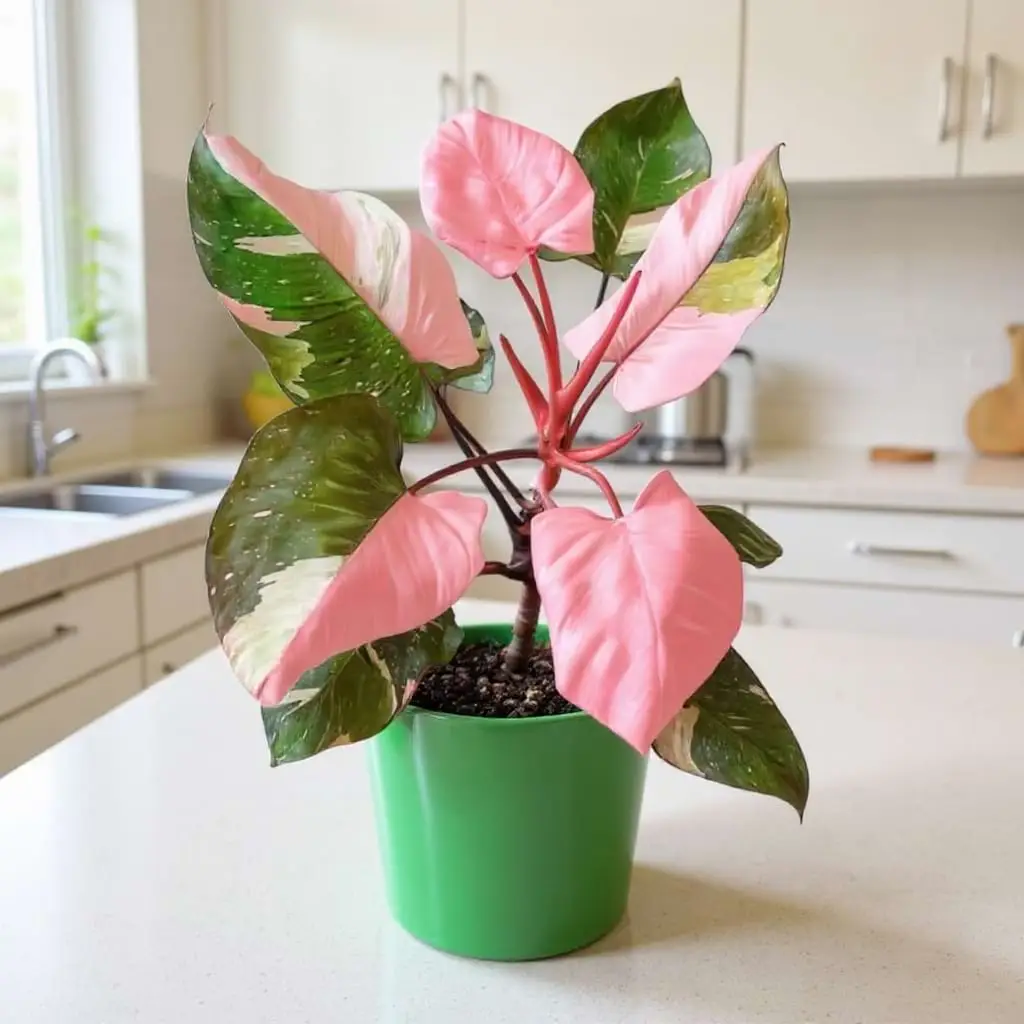
The famous one. Dark, almost black-green leaves splashed with bubblegum pink, on a climbing P. erubescens stem. Prices have dropped a lot since tissue culture arrived, so it is now a plant you can actually buy rather than just admire.
Care Notes
- Bright indirect light is mandatory or the pink stops appearing.
- Cut back to a node with pink on it if the plant starts reverting to green.
- Fully pink leaves cannot photosynthesise and will eventually brown out.
Full details in our 👉 Pink Princess care guide.
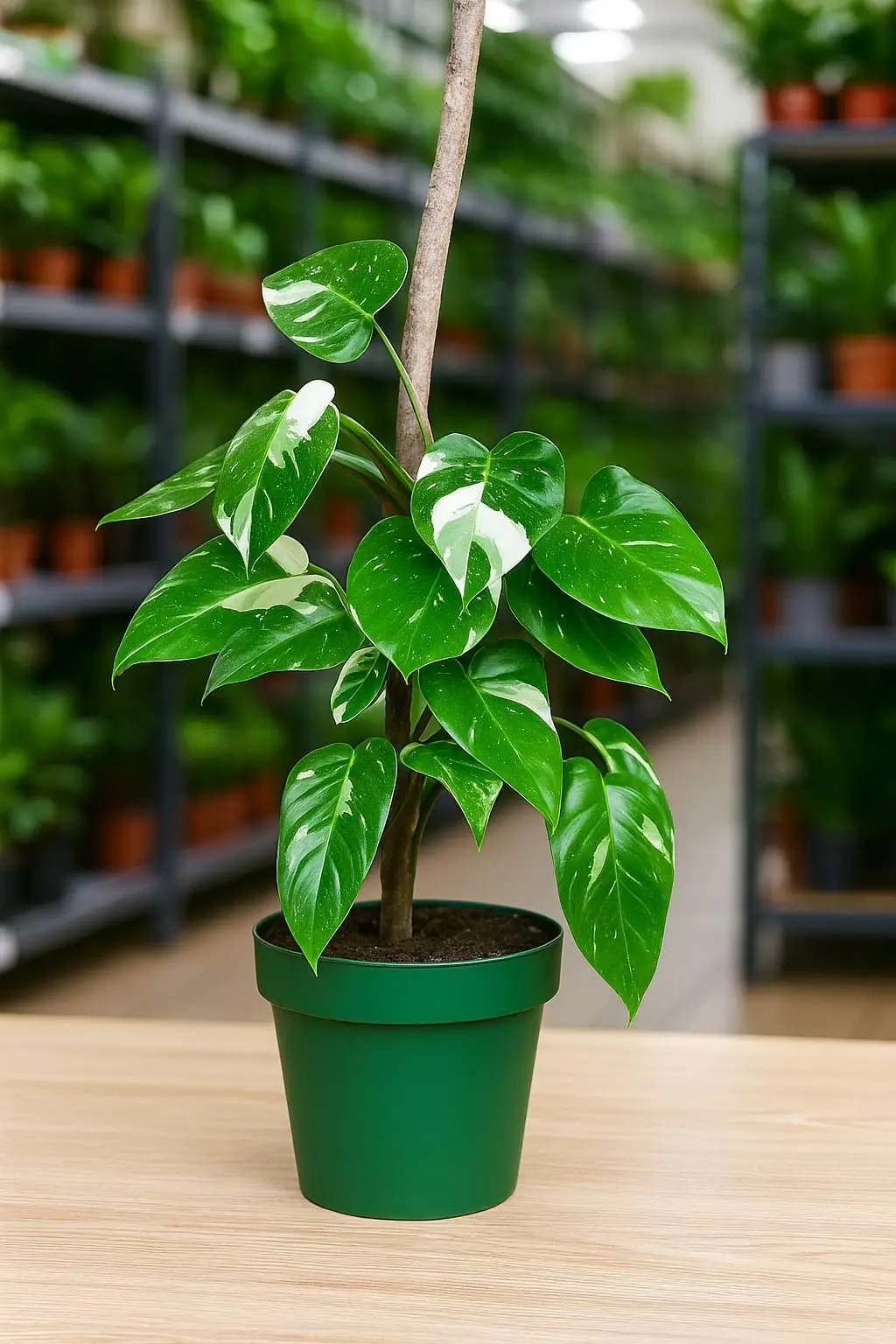
🌿 11. Philodendron White Princess
Why It's Popular
The same erubescens parentage as Pink Princess, with white and cream sectors instead of pink, plus pink-blushed stems. The contrast against deep green is sharper, and the variegation tends to be a little more stable.
Care Notes
- Same reversion rules as Pink Princess: prune back to a variegated node.
- White sections scorch in direct sun faster than green ones.
- A climber; give it a pole for full-size leaves.
Full details in our 👉 White Princess care guide.
🌳 12. Philodendron Birkin
Why It's Popular
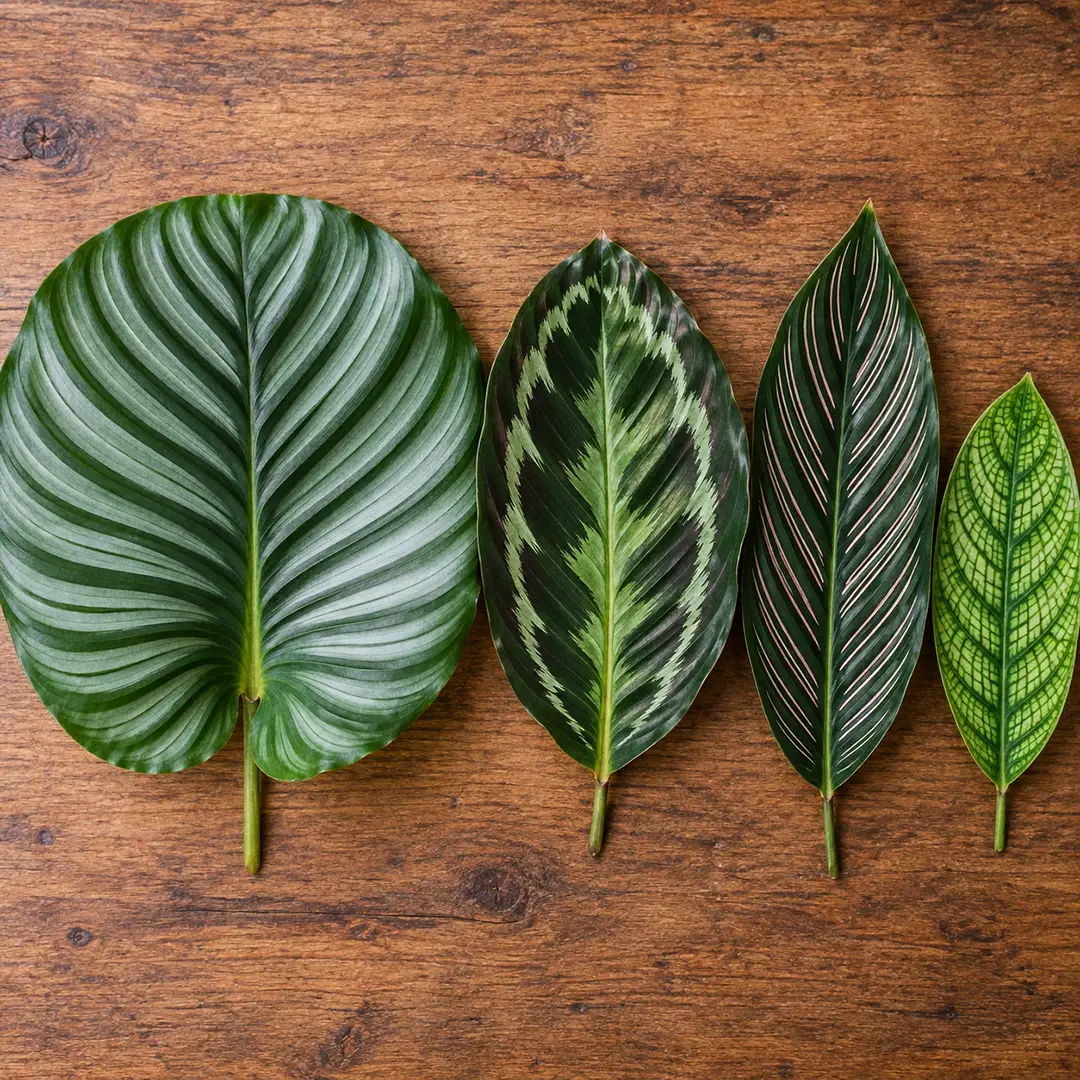
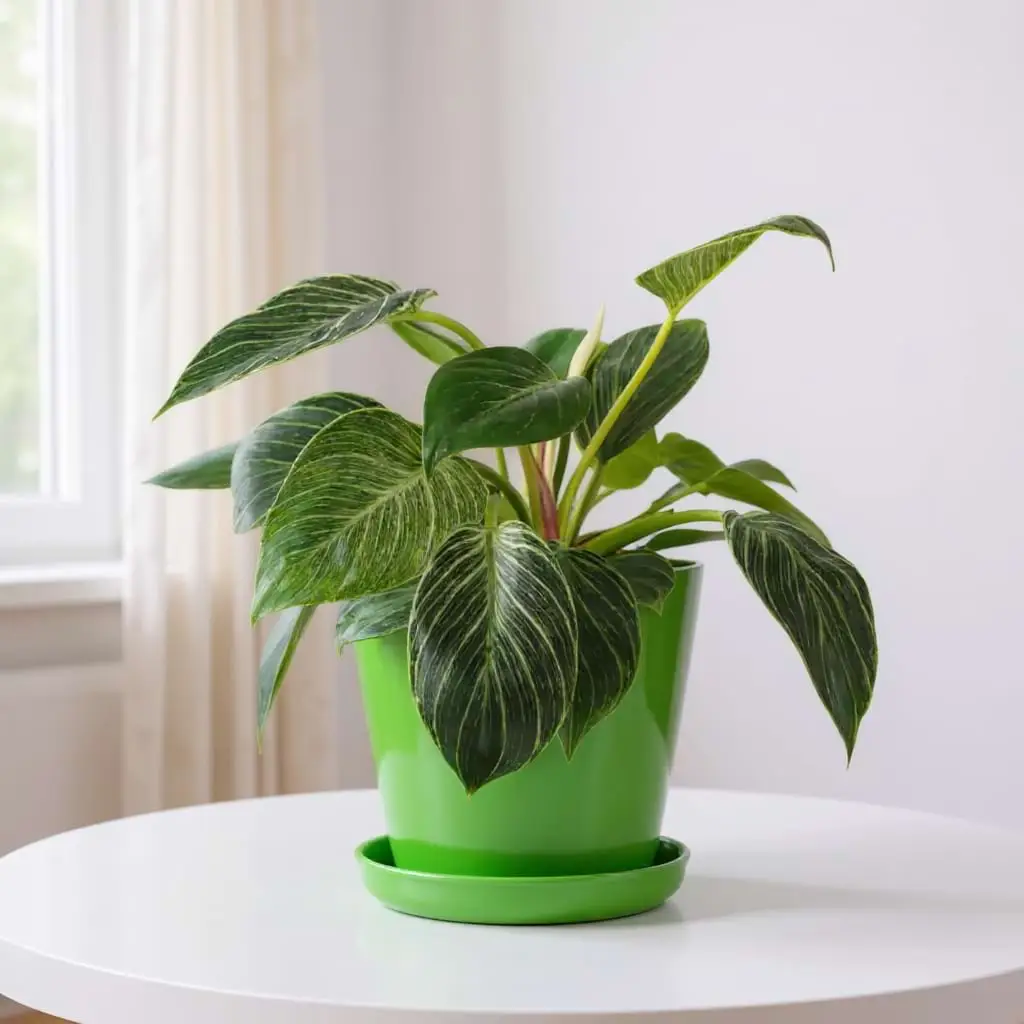
Dark green leaves pinstriped with fine white lines, on a compact self-heading plant that stays desk-sized for years. It appeared as a spontaneous mutation of Rojo Congo, which explains the occasional red leaf that shows up out of nowhere.
Care Notes
- Self-heading, so no pole and no stem cuttings.
- Pinstriping varies leaf to leaf and can revert to plain green or red.
- One of the few philodendrons that suits a small apartment long term.
Full details in our 👉 Philodendron Birkin care guide.
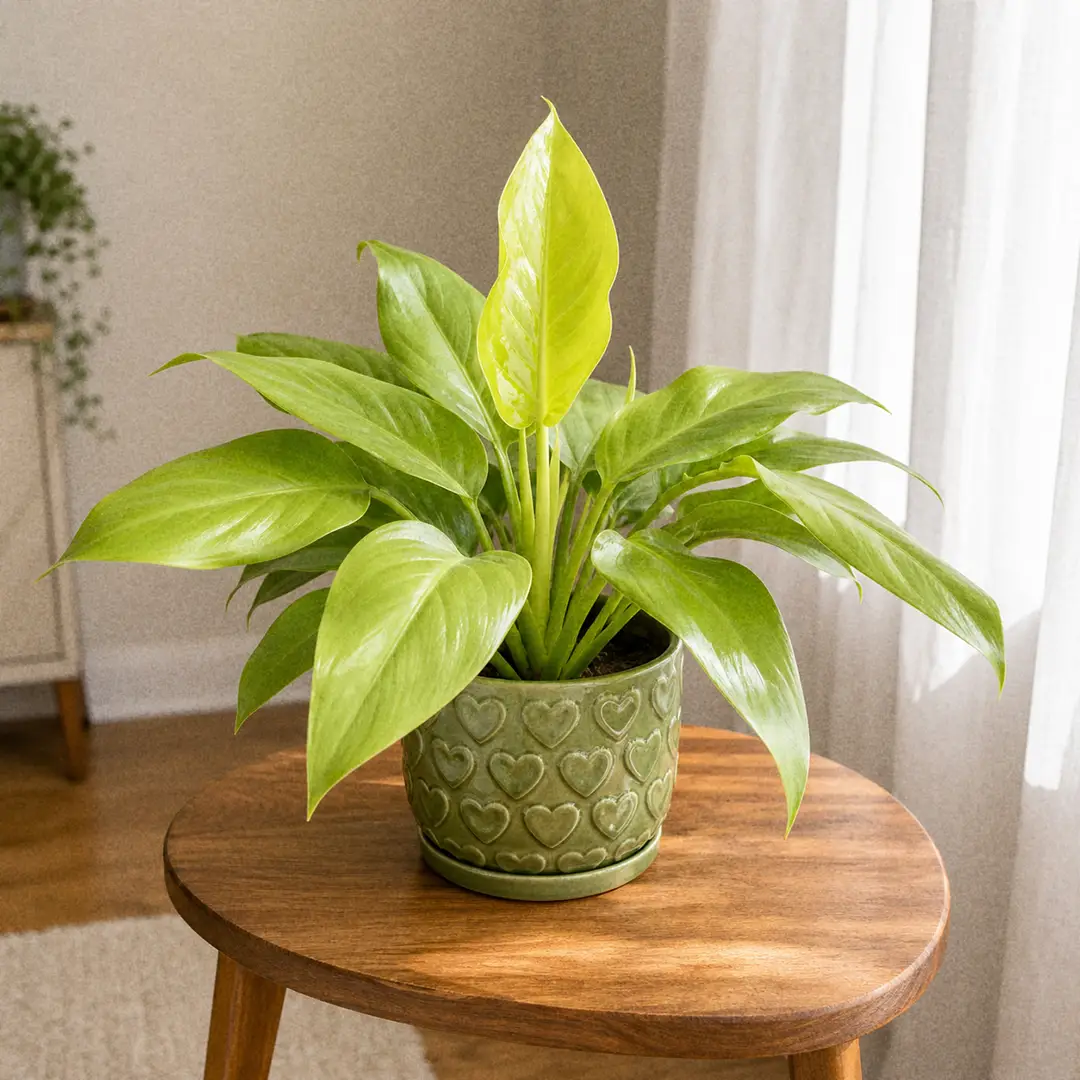
🌳 13. Moonlight Philodendron
Why It's Popular
New leaves open a startling neon yellow and darken to lime green over a few weeks, so a healthy plant always has a bright crown of new growth above older foliage. It clumps into a tidy mound rather than vining.
Care Notes
- Self-heading and compact, rarely above two feet.
- The yellow flush is strongest in bright indirect light.
- Older leaves darkening is normal ageing, not a problem.
Full details in our 👉 Moonlight Philodendron care guide.
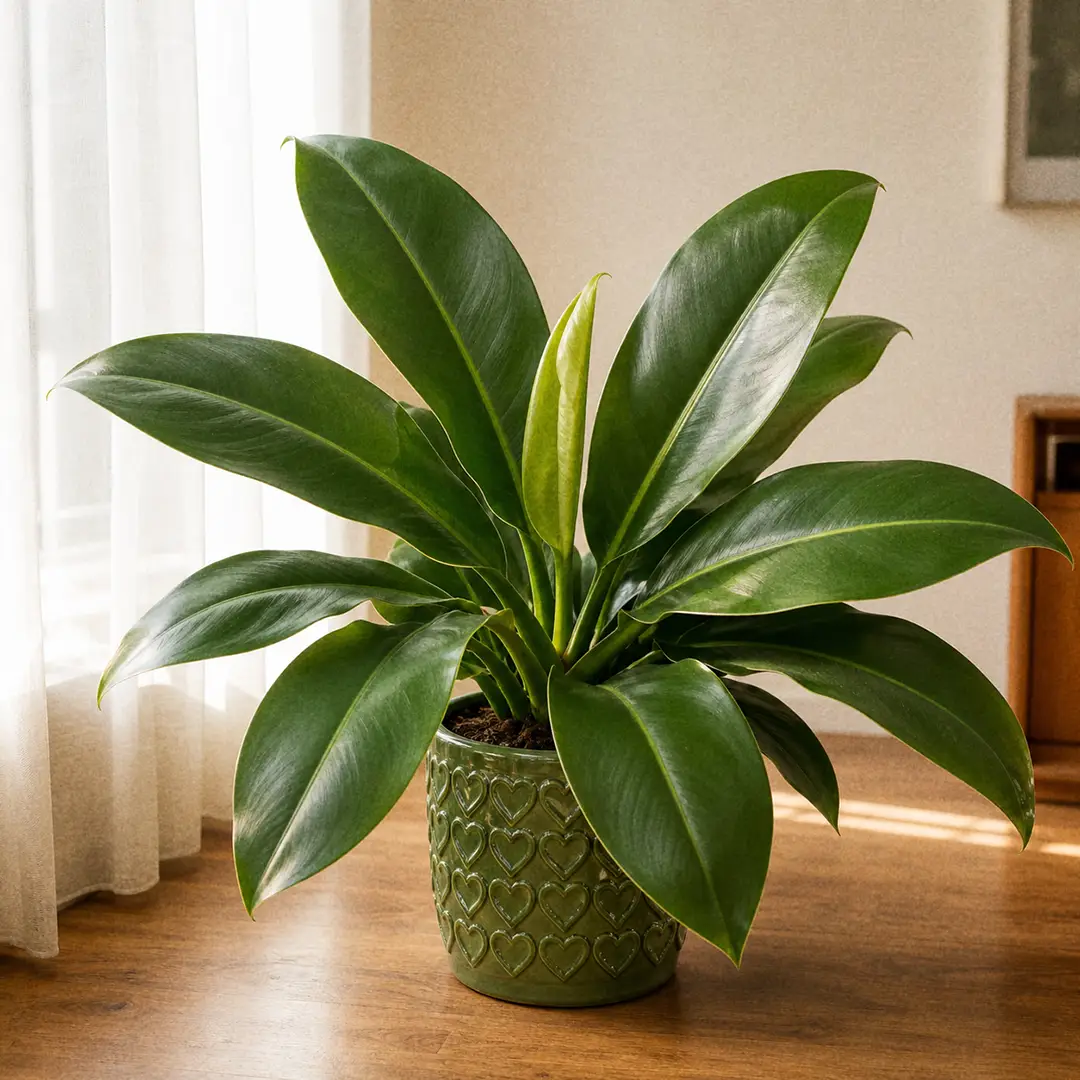
🌳 14. Imperial Green
Why It's Popular
Broad, glossy, deep green paddle leaves arranged in a low rosette. There is no pattern and no colour trick, just a lot of leaf surface and a strong architectural outline. If you find variegation fussy, this is your philodendron.
Care Notes
- Self-heading, spreading wider than tall over time.
- Handles medium light better than most self-headers.
- Wipe the leaves; dust shows badly on that much gloss.
Full details in our 👉 Imperial Green care guide.
🌳 15. Imperial Red
Why It's Popular
Every new leaf opens a glossy deep burgundy and then matures to dark green, so a
healthy plant carries both colours at once. It is the same compact self-heading
rosette as Imperial Green, with a colour trick running through the middle of it.
Care Notes
- Self-heading, so no moss pole and no training.
- Red new growth fading to green is normal maturation, not a problem.
- Brighter light deepens the red and holds it longer.
Full details in our 👉 Imperial Red care guide.
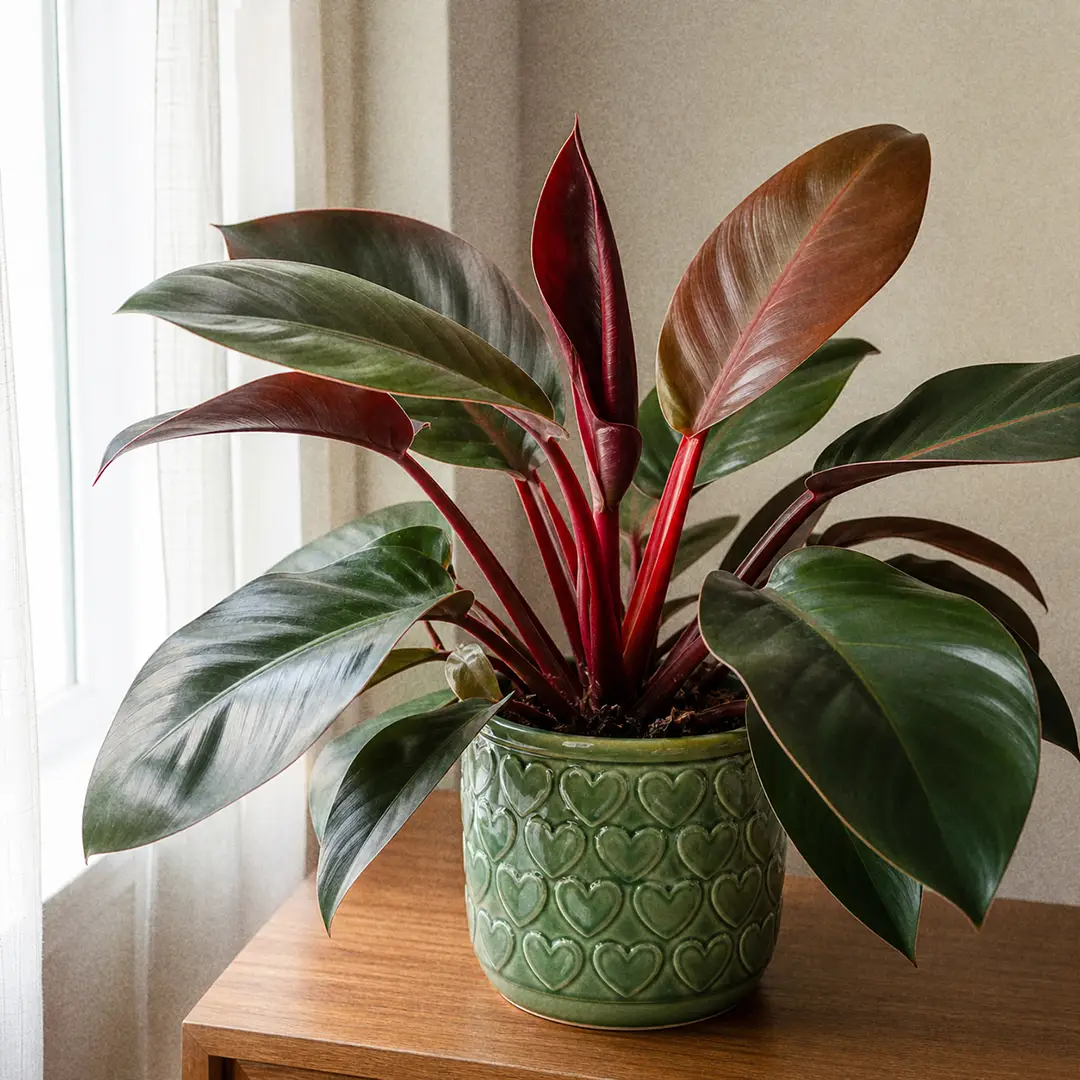
🌳 16. Rojo Congo
Why It's Popular
New leaves unfurl a deep burgundy red and mature to dark green, while the petioles and stems hold the colour permanently. It is a hybrid of P. tatei and P. erubescens, and the parent plant that Birkin mutated from.
Care Notes
- Self-heading and large; give it floor space rather than a shelf.
- Red new growth fading to green with age is correct behaviour.
- Bright light keeps the stems the deepest colour.
Full details in our 👉 Rojo Congo care guide.
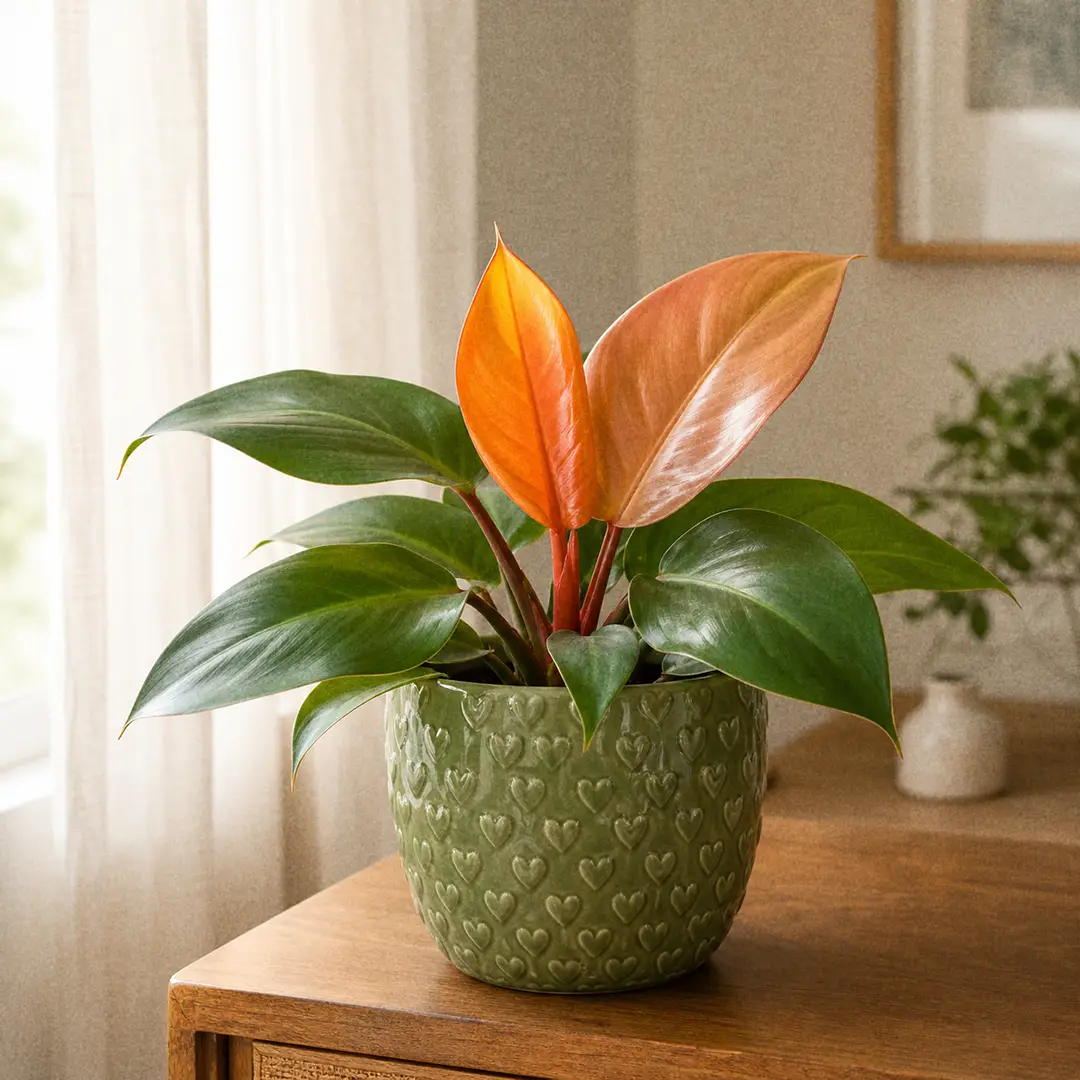
🌳 17. Prince of Orange
Why It's Popular
New leaves open a bright copper orange, fade through salmon, and settle to green, so the crown always carries a warmer colour than the rest of the plant. It is another erubescens hybrid, and it stays self-heading and compact.
Care Notes
- Self-heading, usually topping out around two feet.
- The orange flush fades fast in low light, so keep it bright.
- Frequently confused with Moonlight; the new growth is orange, not yellow.
Full details in our 👉 Prince of Orange care guide.
💎 18. Philodendron Ring of Fire
Why It's Popular
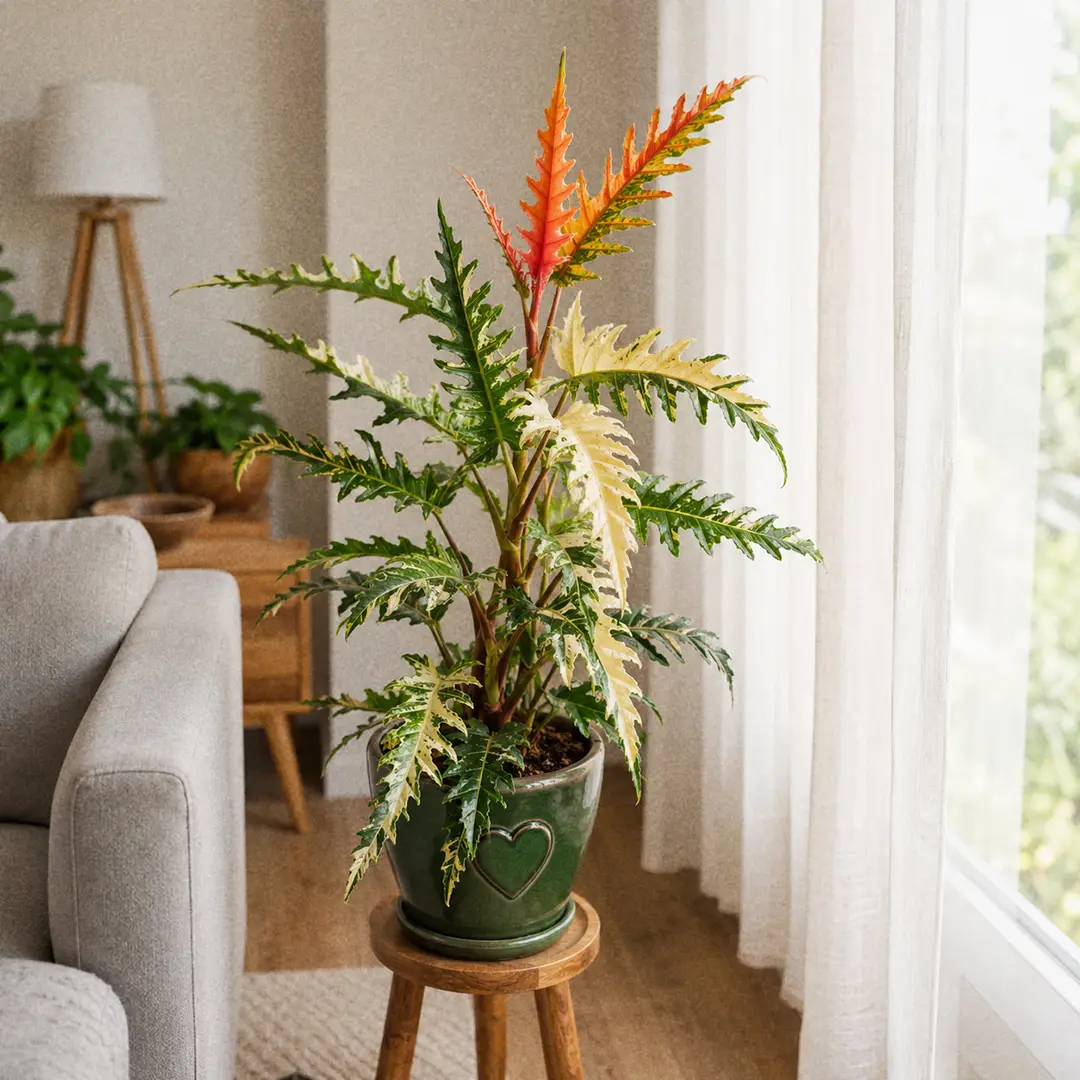
Serrated, deeply cut leaves that emerge cream or orange and mature through green with irregular variegated sectors. Every leaf comes out different from the last, which is the point of owning it. It is also slow and costly, so buy it knowing that.
Care Notes
- Very slow: a few leaves a year is a normal pace.
- A climber, though it takes years to need real height.
- Variegation is unstable, so some leaves come out plain.
Full details in our 👉 Ring of Fire care guide.
💎 19. Philodendron Gloriosum
Why It's Popular
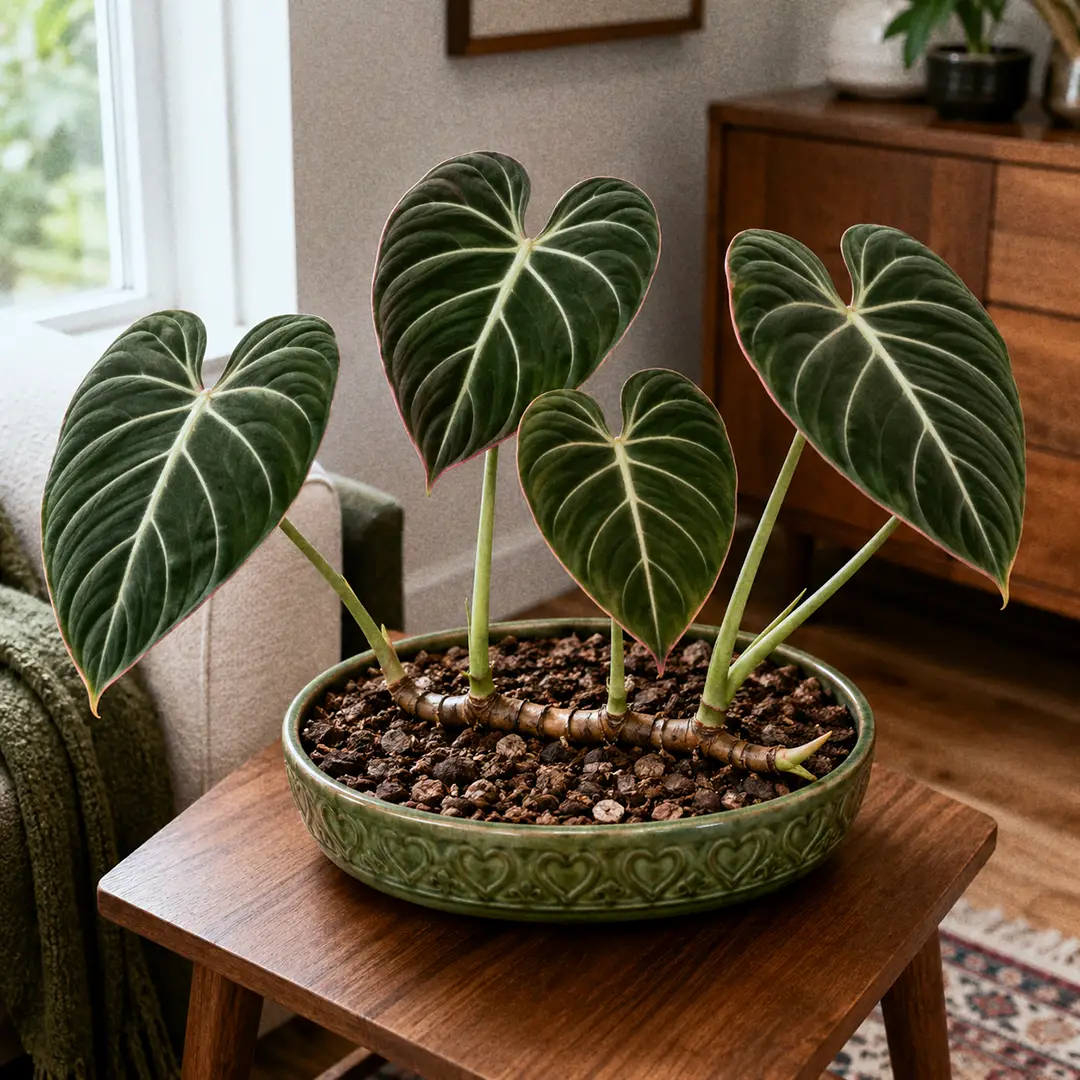
Huge, heart-shaped, matte velvet leaves with bright white veins running across them. It is a crawler rather than a climber: the rhizome creeps horizontally along the soil surface, which means it needs a long shallow pot instead of a deep one.
Care Notes
- Plant the rhizome on the surface, never buried, or it rots.
- Wants 60 percent humidity and dislikes water on the leaves.
- Use a wide, shallow container and let the rhizome run.
Full details in our 👉 Philodendron Gloriosum care guide.
💎 20. Philodendron Verrucosum
Why It's Popular
Velvet leaves with dark green upper surfaces, red undersides, and petioles covered in soft bristly hairs, which is where the name comes from. Unlike Gloriosum it climbs, and on a pole the leaves get genuinely large.
Care Notes
- The fussiest plant on this list: high humidity or it declines fast.
- Sensitive to hard tap water; filtered or rainwater is better.
- Give it a pole and warmth and it grows faster than its reputation suggests.
Full details in our 👉 Philodendron Verrucosum care guide.
🏷️ Two Plants That Changed Genus
What Happened
In 2018 botanists moved a group of self-heading, deeply lobed species out of Philodendron into the genus Thaumatophyllum, based on DNA work confirming they sit on a separate branch. Hope Selloum and Xanadu were both caught in that reshuffle.
Why We Still List Them Here
Nurseries still sell them labelled Philodendron, shoppers still search for them that way, and the care is identical to the self-heading philodendrons above. Calling them anything else in a shop mostly earns a blank look.
What to Say Out Loud
Either name is fine in conversation. If you are buying, labelling, or writing a plant list, Thaumatophyllum is the current correct genus and Philodendron is the trade name you will see on the tag.
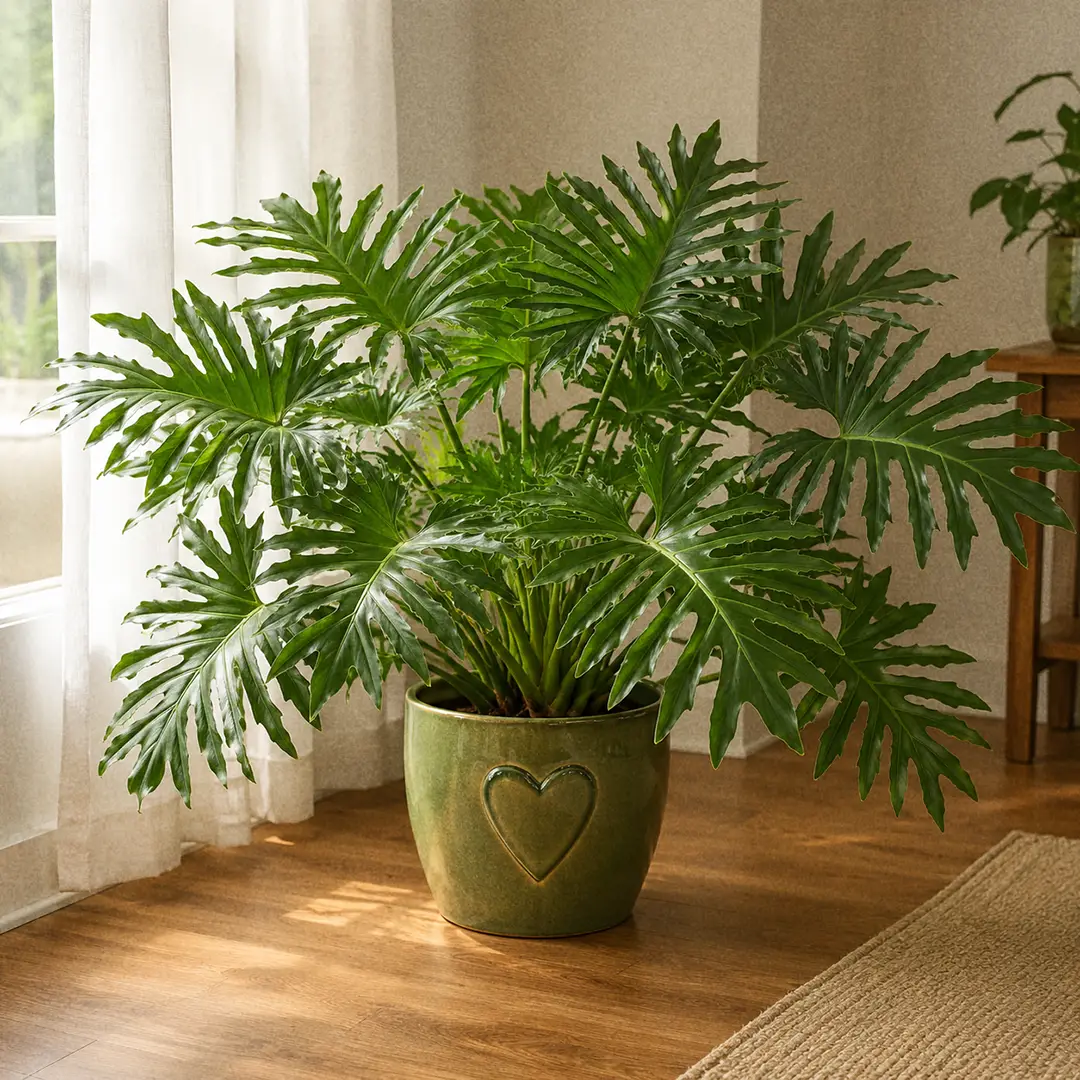
🌳 21. Hope Selloum
Why It's Popular
Enormous deeply lobed leaves on a self-heading plant that fills a corner and reads as a small tree after a few years. It is the most cold-tolerant plant in this guide and the one most likely to survive a neglectful owner.
Care Notes
- Needs real floor space; mature spread can reach five feet.
- Tolerates brighter light than any true philodendron here.
- Older lower leaves yellow and drop naturally as the trunk forms.
Full details in our 👉 Hope Selloum care guide.
🌳 22. Xanadu
Why It's Popular
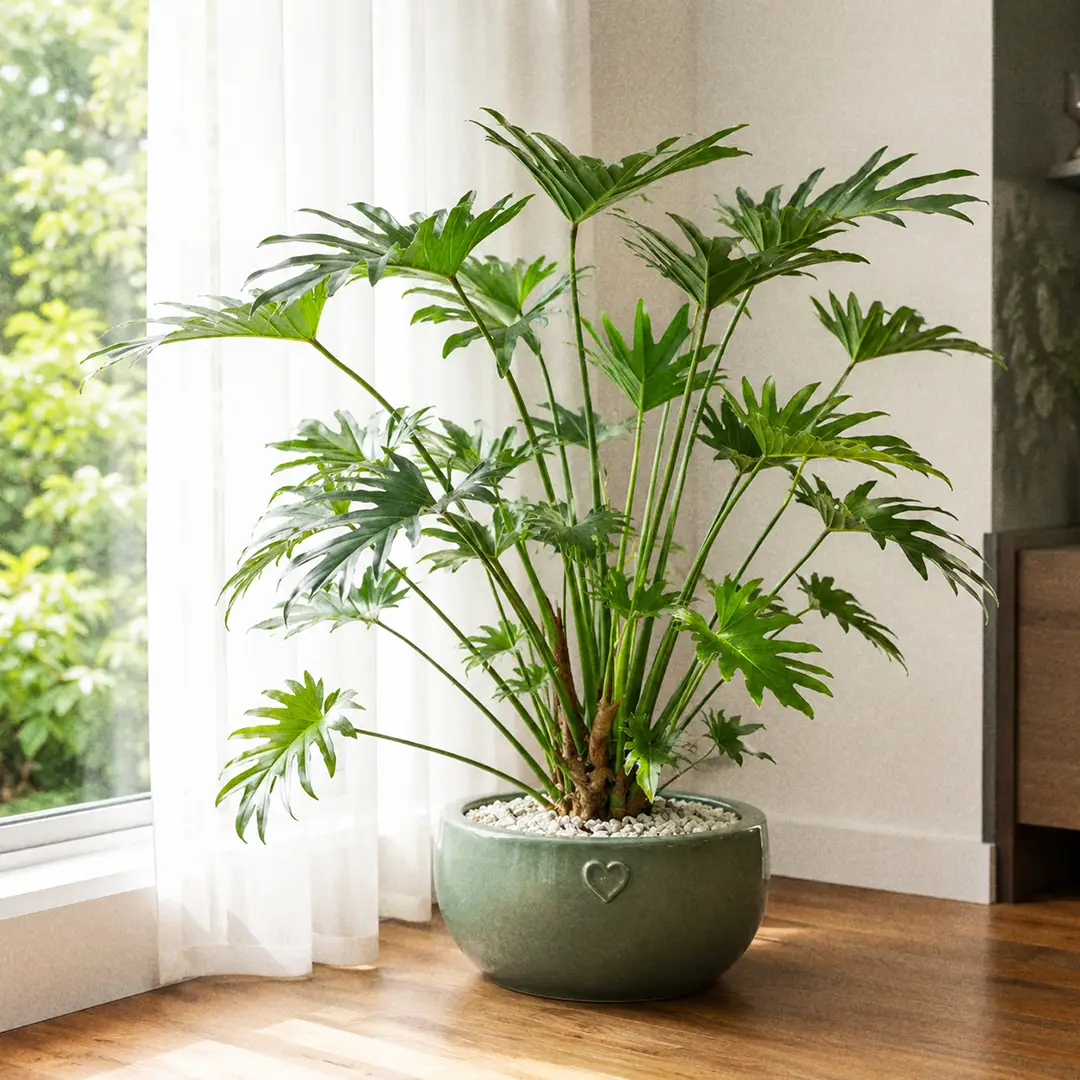
A compact version of the Selloum look. Lobed leaves on a tight, mounding plant that stays around three feet wide instead of taking over a room. It is a registered cultivar and one of the tidiest large-leaved plants you can buy.
Care Notes
- Self-heading and mounding, and slow to outgrow its spot.
- Handles direct morning sun without scorching.
- Divide the clump at repotting if you want a second plant.
Full details in our 👉 Xanadu care guide.
🩺 Common Philodendron Problems
Yellow Leaves
Lower leaves yellowing while the mix stays damp is overwatering, and it is the number one killer in this genus. Tip the plant out and check for mushy brown roots. Even yellowing across new growth is a different signal, usually hunger or old spent soil.
Brown Crispy Edges
Low humidity, underwatering, or mineral buildup from tap water, in that order of likelihood. Velvet types show it first. Flush the pot thoroughly, switch to filtered water for a month, and raise the humidity before you start worrying about disease.
Small Leaves and Long Gaps
The plant wants more light, or it is a climber with nothing to climb. Both produce the same stretched look. Move it closer to the window and add a pole, and the next few leaves come in noticeably larger.
Pests
Spider mites show up as fine webbing and stippled leaves in dry winter air, and mealybugs hide in leaf joints as white cottony specks. Both respond to a thorough wipe-down and repeat treatment with neem oil every seven days for a month.
❓ Frequently Asked Questions
How do you grow a philodendron plant indoors?
Bright indirect light a few feet from an east or north window, water when the top inch or two of mix has dried, and a chunky bark-based potting mix. Feed at half strength every three or four weeks through spring and summer. Climbing types also need a pole if you want full-size leaves.
What is the difference between a climbing and a self-heading philodendron?
Climbers grow along a stem with spaced nodes and aerial roots, so they trail or scale a pole and propagate easily from cuttings. Self-headers push leaves from a short central crown, form a rosette, and cannot be cut and rooted the same way.
How much light does a philodendron need?
Bright indirect light suits nearly all of them. East windows, north windows, or two to four feet back from a south or west window all work. Deep shade stretches the stems and drains the colour out of variegated types.
How often should I water my philodendron?
Check the mix rather than a calendar. Water when the top inch or two feels dry, typically every five to twelve days depending on pot size, light and season. Velvet-leaved types like Gloriosum prefer steadier moisture than the glossy vines.
Are philodendrons toxic to cats and dogs?
Yes. The ASPCA lists the genus as toxic to both, thanks to insoluble calcium oxalate crystals that cause mouth irritation, drooling and vomiting when chewed. Hang them well out of reach, or browse our pet-safe plants instead.
Which philodendron is easiest for a beginner?
Heart-leaf Philodendron, without much competition. It copes with lower light, forgives a skipped watering, roots in a glass of water, and grows fast enough that you can see progress. Brasil and Lemon Lime are the same plant with more colour if you want something brighter.
🪴 See also 🪴
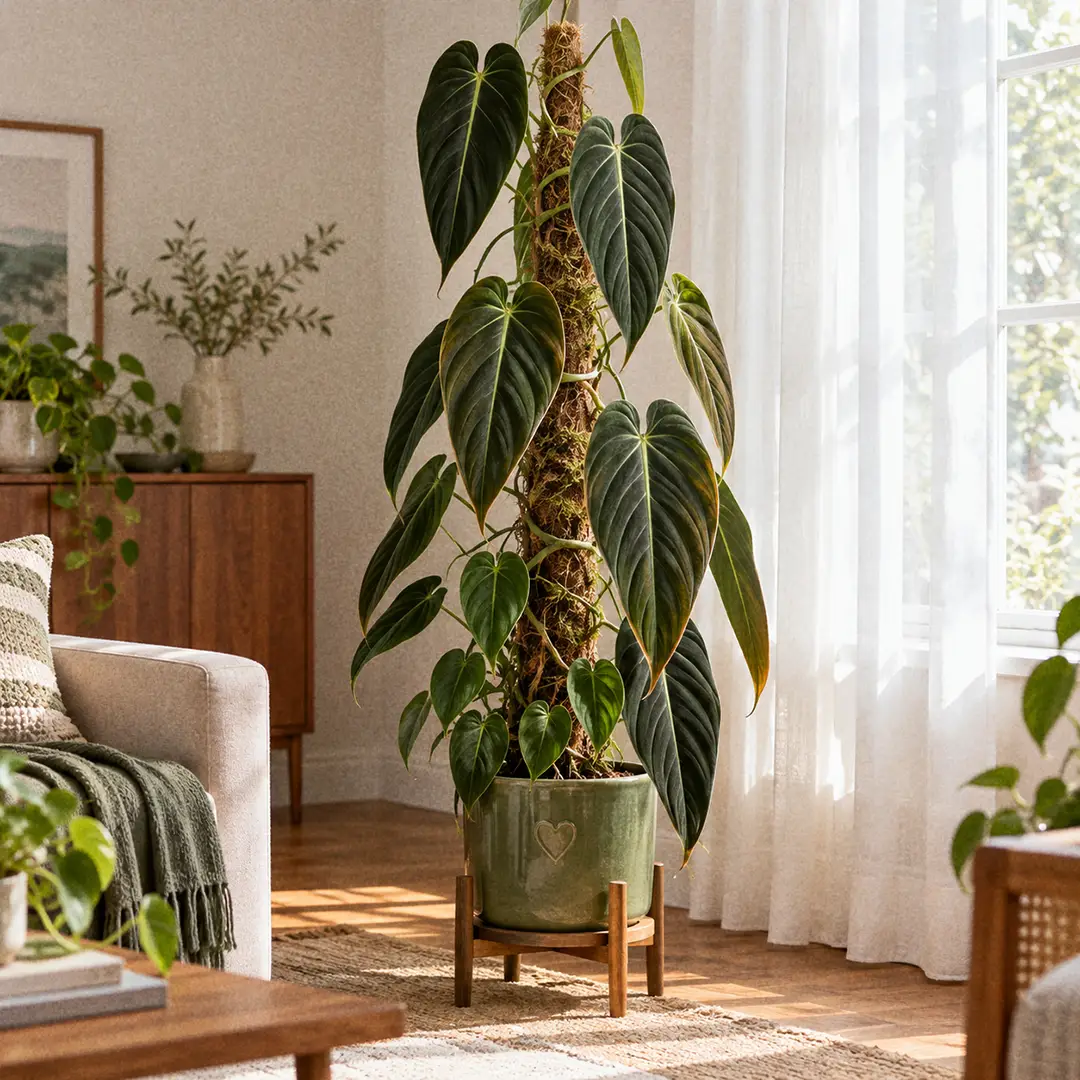
Complete Guide to Philodendron Melanochrysum Care and Growth
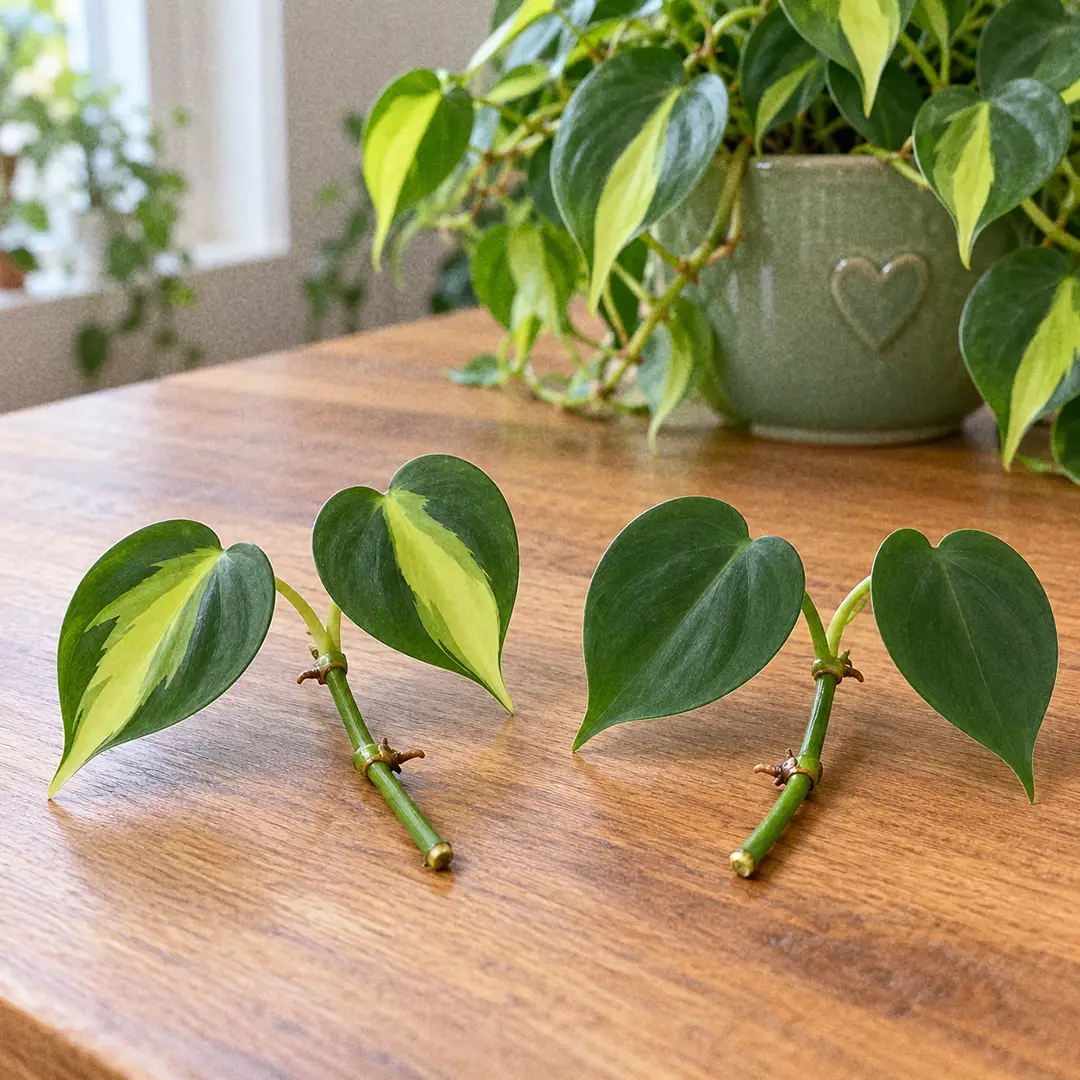
How to Propagate Philodendron Brasil (and Keep the Variegation)
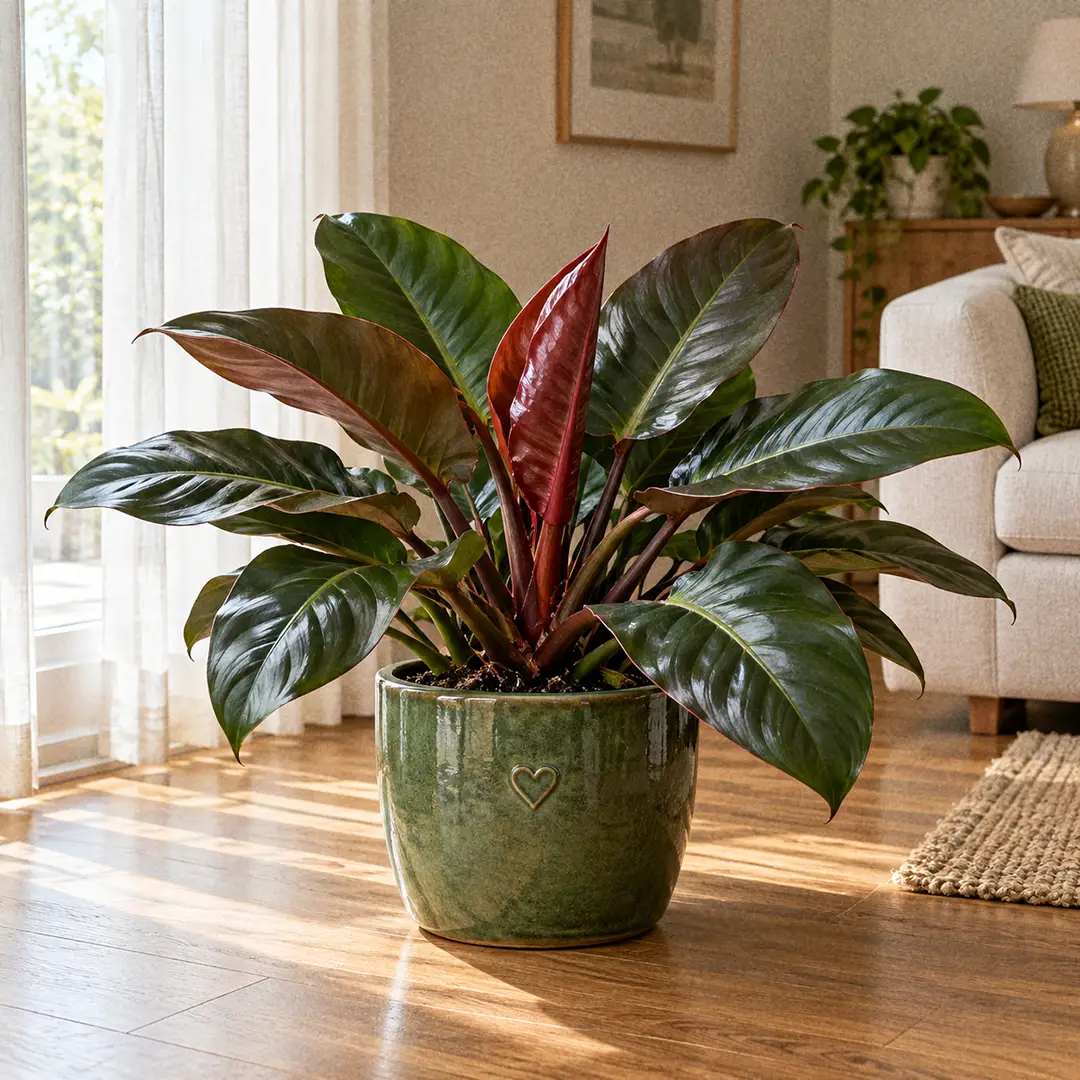
Complete Guide to Imperial Red Care and Growth
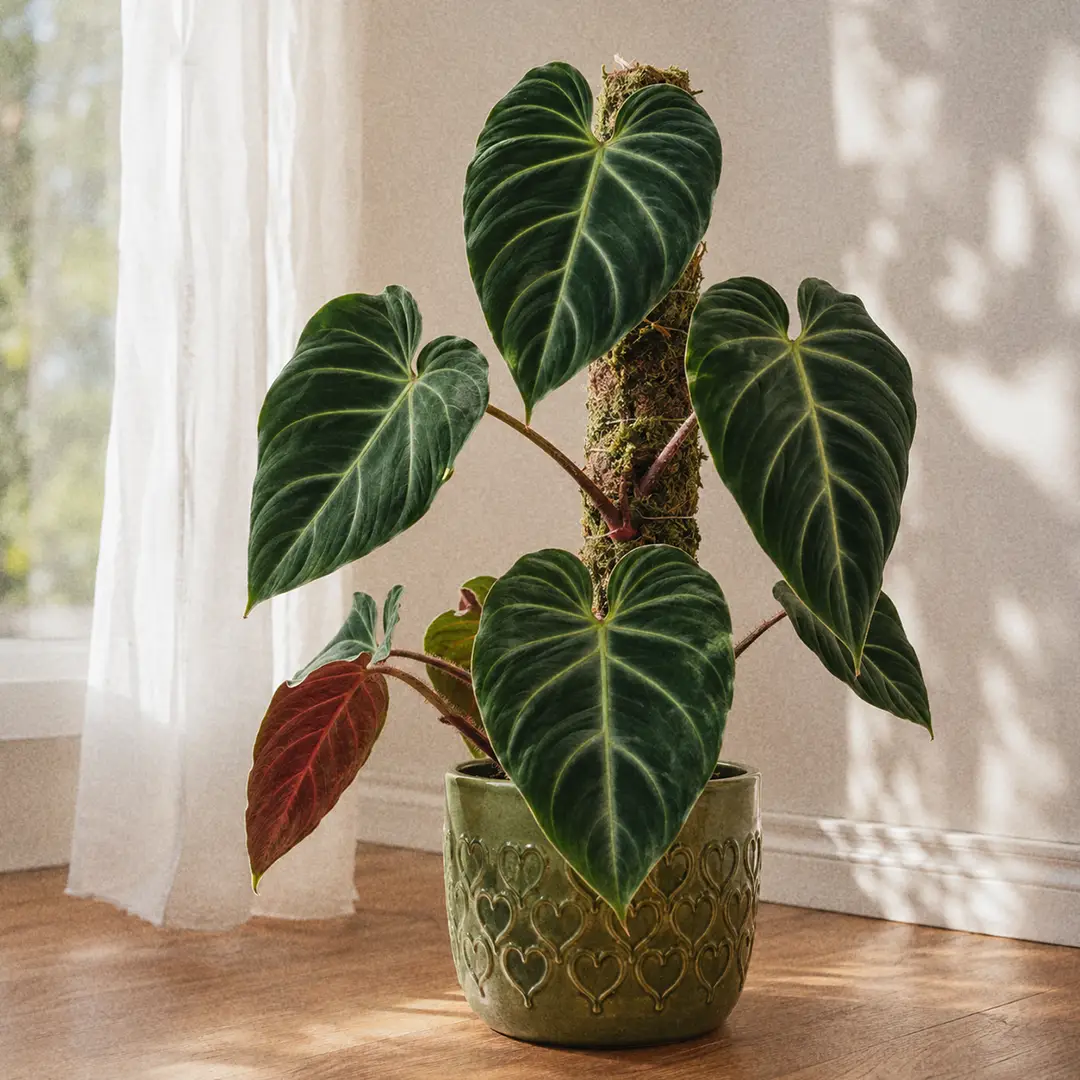
Complete Guide to Philodendron Verrucosum Care and Growth
Complete Guide to Philodendron Ring of Fire Care and Growth
Complete Guide to Philodendron Gloriosum Care and Growth
Complete Guide to Philodendron Birkin Care and Growth
Complete Guide to Xanadu Care and Growth
Complete Guide to Hope Selloum Care and Growth
Complete Guide to Silver Sword Philodendron Care and Growth
Complete Guide to Moonlight Philodendron Care and Growth
Complete Guide to Imperial Green Care and Growth
Complete Guide to Rojo Congo Care and Growth
Complete Guide to Prince of Orange Care and Growth
Complete Guide To Velvet Leaf Philodendron Care and Growth
Complete Guide To Heart-leaf Philodendron Care and Growth
Complete Guide to Philodendron Florida Beauty x Tortum Care and Growth
Complete Guide to Philodendron Mayoi Care and Growth
Complete Guide to Philodendron Polypodioides Care and Growth
Complete Guide to Philodendron White Princess Care and Growth
Complete Guide To Lemon Lime Philodendron Care and Growth

Houseplant101 Forum
Questions & Comments
Ask a question, share your plant experience, or help other plant owners.
Comments are temporarily unavailable.
Open the Houseplant101 ForumNo comments yet
Be the first to ask a question or share your experience about this page.
Log in or create an account
Comments use your Houseplant101 Forum account, but you can stay on this page.
Create a new account