
 AI Overview
 🪴 In This Guide 🪴

📋 All 10 String of Plants at a Glance
Here is the whole family in one table, ranked roughly from easiest to trickiest. Every plant links to its full care guide.
| # | Plant | Leaf Shape | Family | Difficulty | Pet Safe |
|---|---|---|---|---|---|
| 1 | String of Hearts | Marbled hearts | Apocynaceae | Easy | Yes |
| 2 | String of Rubies | Red-tinged beans | Asteraceae | Easy | Mostly |
| 3 | String of Bananas | Curved bananas | Asteraceae | Easy | No |
| 4 | String of Fishhooks | Flat hooks | Asteraceae | Easy | No |
| 5 | String of Buttons | Stacked triangles | Crassulaceae | Easy | No |
| 6 | String of Coins | Thick silver discs | Cucurbitaceae | Easy | Caution |
| 7 | String of Nickels | Flat round coins | Apocynaceae | Easy | Yes |
| 8 | String of Dolphins | Leaping dolphins | Asteraceae | Moderate | No |
| 9 | String of Turtles | Turtle-shell rounds | Piperaceae | Moderate | Yes |
| 10 | String of Pearls | Round green beads | Asteraceae | Medium-Hard | No |
💜 1. String of Hearts (Ceropegia woodii)

Why You Want It
Heart-shaped leaves marbled in silver on wiry purple stems that can trail three feet or more. It grows fast, forgives missed waterings, propagates from a single node, and even makes little aerial tubers you can pot up. If you buy one string plant, buy this one.
Care Snapshot
- Light: Bright, filtered light; a little gentle direct sun deepens the marbling.
- Water: Let the top half of the soil dry, then water well.
- Trickiness: Almost none; it politely wilts before it dies.
- Pet note: Considered pet safe.
Read the full 👉 String of Hearts care guide.
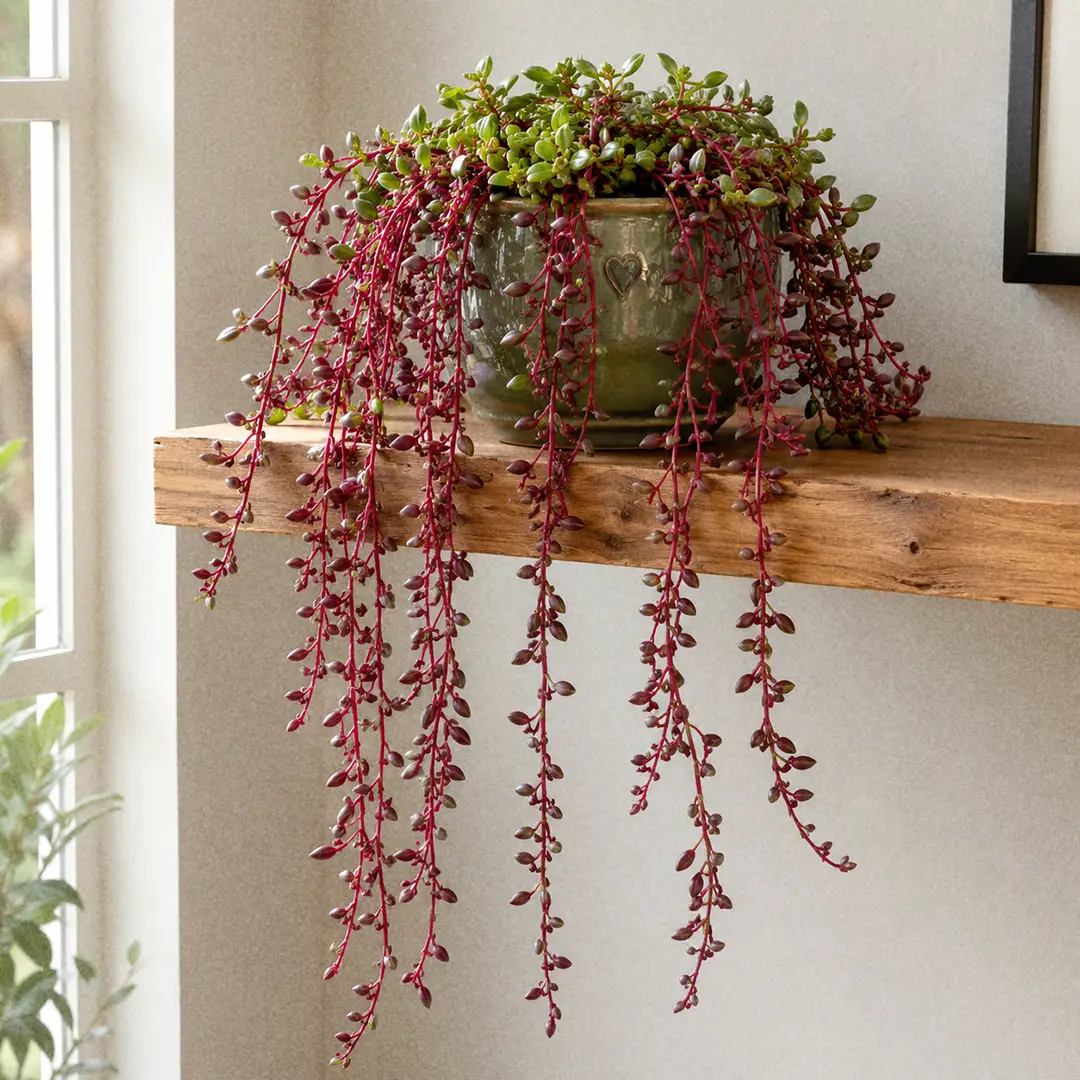
❤️ 2. String of Rubies (Othonna capensis)
Why You Want It
Bean-shaped leaves on bright red stems that deepen to ruby under strong sun, plus yellow daisy flowers that actually show up indoors. It is the easiest of the sun-loving succulent strings and the only one that blooms reliably on a windowsill.
Care Snapshot
- Light: Bright with 2-4 hours of direct sun; the color depends on it.
- Water: Soak and dry, fully.
- Trickiness: Low; it just fades to green without enough sun.
- Pet note: Treat as mildly toxic in quantity.
Read the full 👉 String of Rubies care guide.
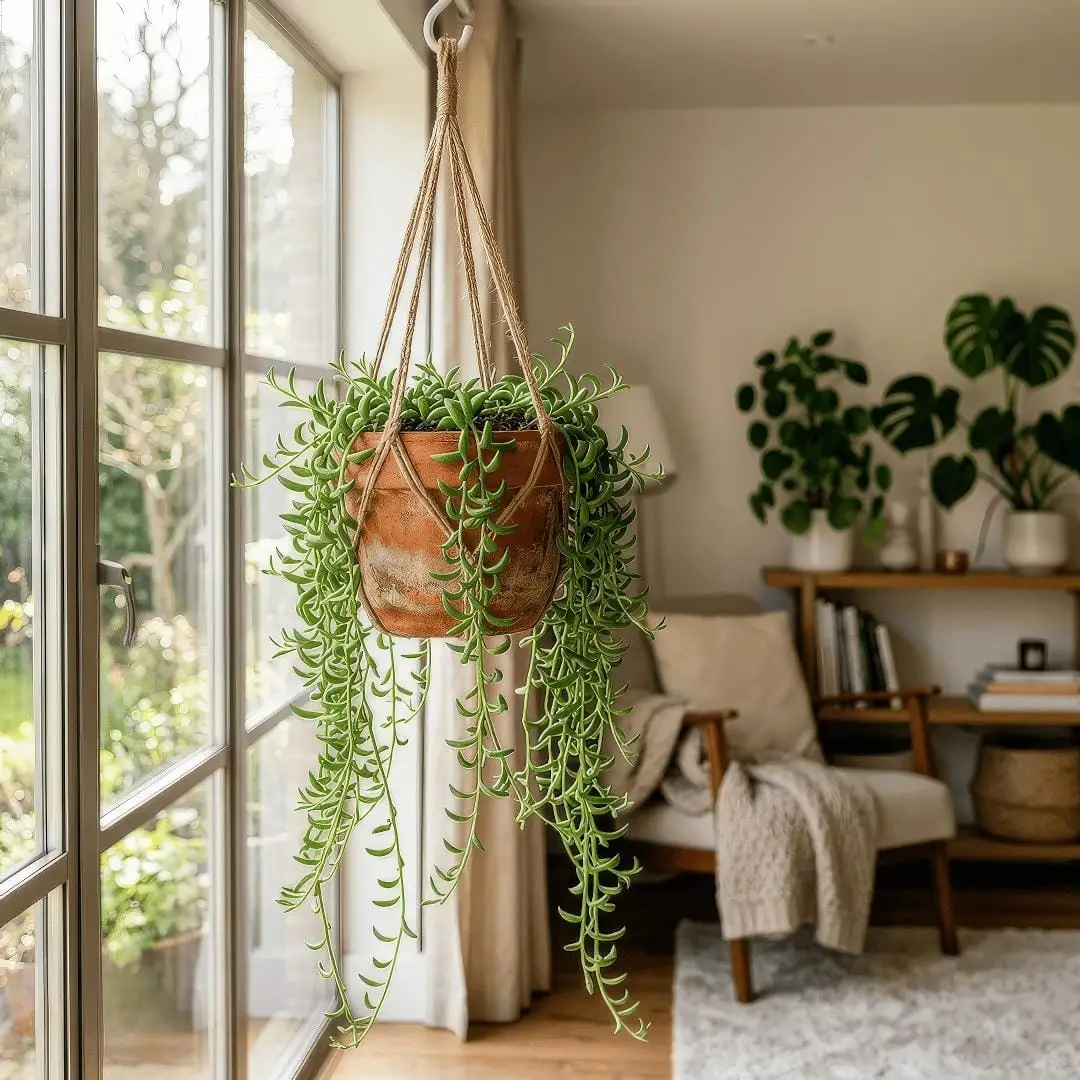
🍌 3. String of Bananas (Senecio radicans)
Why You Want It
Glossy, banana-curved leaves on stems that grow fast enough to measure by the month. It delivers the classic cascading-string look with a fraction of the fuss of String of Pearls, which makes it the string I recommend to recovering Pearls-killers.
Care Snapshot
- Light: Bright light with some gentle direct sun.
- Water: Soak and dry; the leaves wrinkle slightly when thirsty.
- Trickiness: Low.
- Pet note: Mildly toxic; hang it high.
Read the full 👉 String of Bananas care guide.
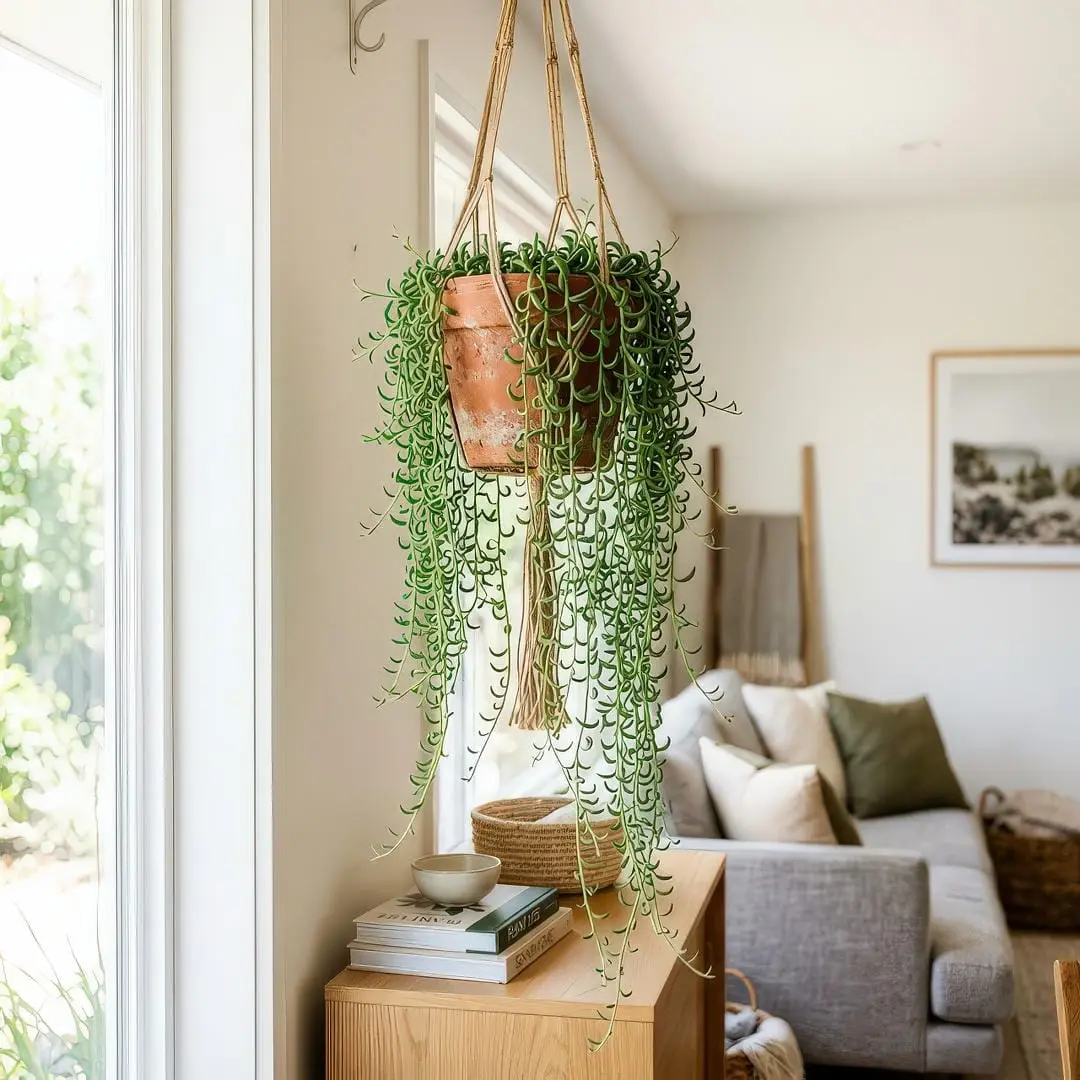
🪝 4. String of Fishhooks (Senecio radicans 'Fish Hooks')
Why You Want It
The same species as String of Bananas in a sleeker cut: longer, flatter, hook-shaped leaves spaced along fast-trailing stems. It reads as a finer, moodier cascade and tolerates the same neglect. Strands can reach several feet in a couple of seasons.
Care Snapshot
- Light: Bright with a few hours of direct sun.
- Water: Soak and dry.
- Trickiness: Low; among the most drought-proof hanging plants anywhere.
- Pet note: Mildly toxic, same as Bananas.
Read the full 👉 String of Fishhooks care guide.
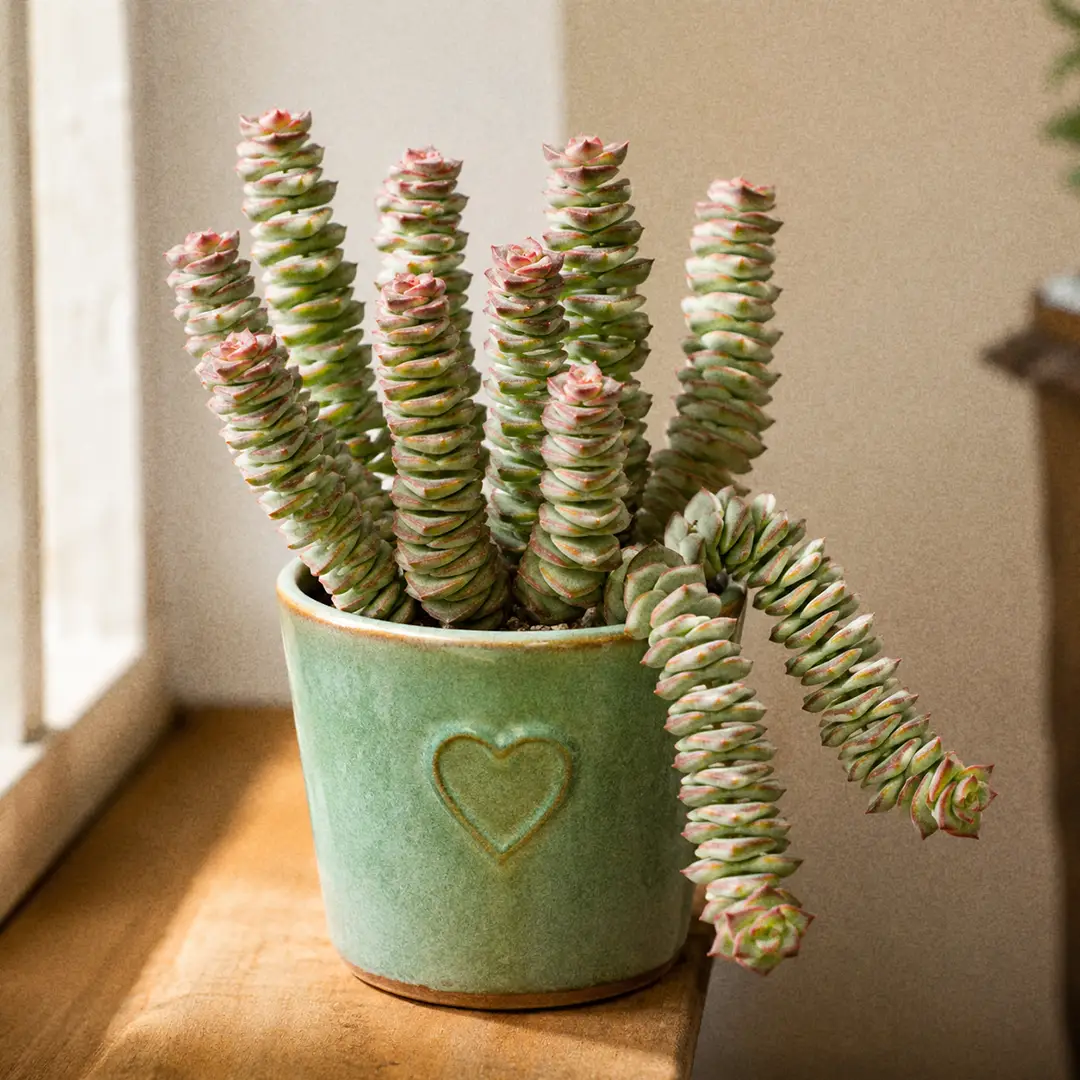
🧵 5. String of Buttons (Crassula perforata)
Why You Want It
The odd one out, and the architectural star of the family. Triangular leaves stack in tight spirals around the stem, as if threaded like buttons on a cord, growing upright first and trailing as the columns lengthen. Good sun paints the leaf edges pink. It shares the famously easygoing nature of its cousin the Jade Plant.
Care Snapshot
- Light: Bright with 3-4 hours of direct sun for tight stacks and pink edges.
- Water: Soak and dry; ease off in midsummer and winter.
- Trickiness: Low; it stretches in dim light but beheading fixes it.
- Pet note: Mildly toxic, like all Crassulas.
Read the full 👉 String of Buttons care guide.
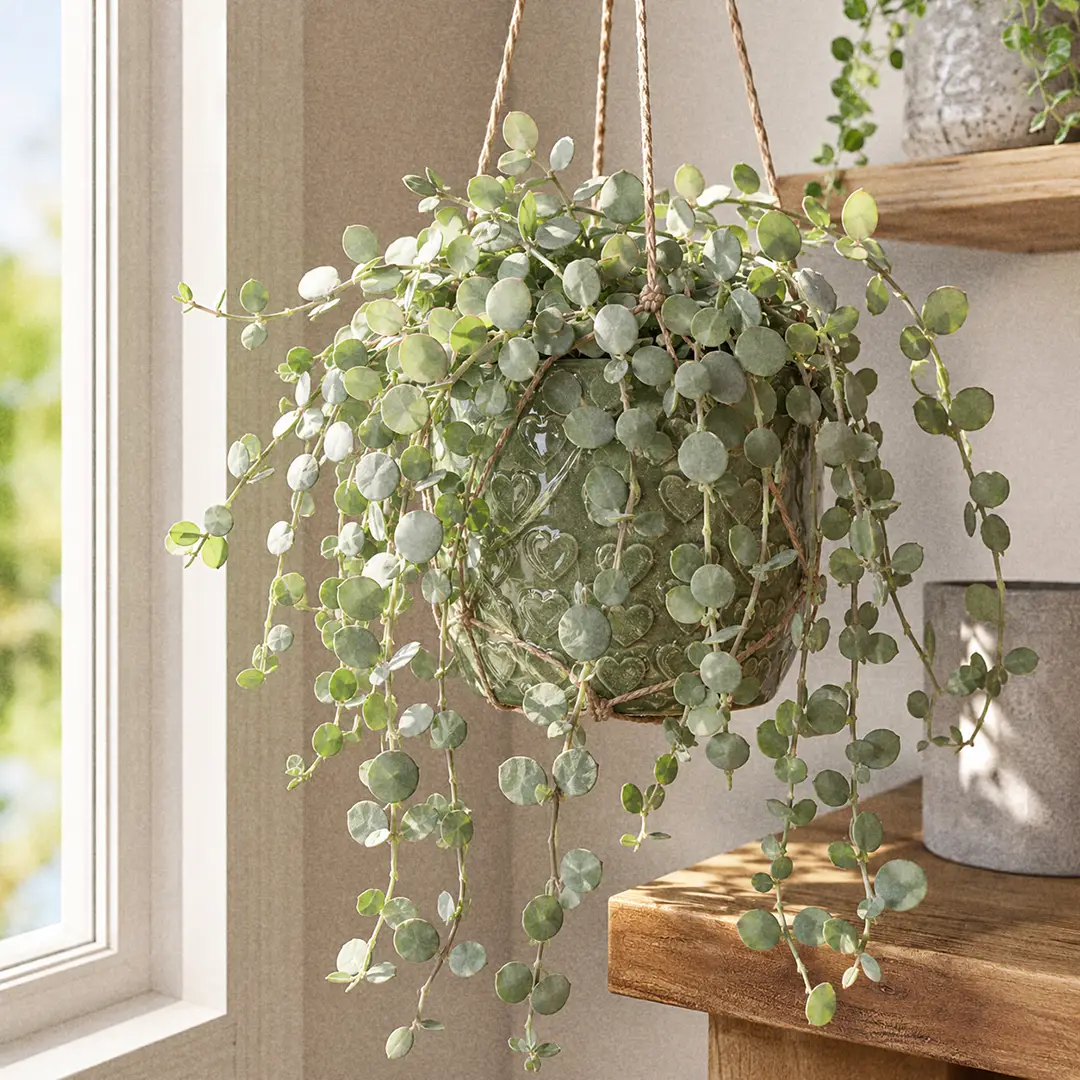
🪙 6. String of Coins (Xerosicyos danguyi)
Why You Want It
Thick, round, silver-green discs on sturdy stems, courtesy of a Madagascan cucumber relative. Unlike the danglers, this one climbs, throwing out curling tendrils that will happily scale a small trellis. It handles stronger direct sun than any other plant on this list.
Care Snapshot
- Light: The sunniest window you own; real direct sun is welcome.
- Water: Soak and dry, sparingly.
- Trickiness: Low, as long as you resist overwatering.
- Pet note: Toxicity is not well documented; keep it out of reach.
Read the full 👉 String of Coins care guide.
💿 7. String of Nickels (Dischidia nummularia)

Why You Want It
Flat, round, milky-green leaves strung close along thin stems, like a run of small coins. It is an epiphyte that grows on tree bark in the wild, which makes it the humidity lover of the group and a natural for bathrooms and kitchens with a bright window.
Care Snapshot
- Light: Bright indirect; no harsh direct sun.
- Water: Water when the chunky mix approaches dry; loves a humid room.
- Trickiness: Low once you respect the epiphyte roots: bark-rich mix, never dense soil.
- Pet note: Considered pet safe.
Read the full 👉 String of Nickels care guide.
🐬 8. String of Dolphins (Senecio peregrinus)

Why You Want It
A hybrid of String of Pearls and the candle plant, with leaves that genuinely look like a pod of leaping dolphins. It is the conversation piece of the family. Care difficulty sits between its parents: tougher than Pearls, touchier than Bananas.
Care Snapshot
- Light: Bright with gentle morning sun; strong heat flattens the dolphin shape.
- Water: Soak and dry, carefully; it rots faster than Bananas.
- Trickiness: Moderate. Keep it cool and bright to hold the leaf shape.
- Pet note: Mildly toxic.
Read the full 👉 String of Dolphins care guide.
🐢 9. String of Turtles (Peperomia prostrata)

Why You Want It
Tiny round leaves painted with a turtle-shell pattern on threadlike stems. It is the miniature jewel of the collection and a terrarium favorite. The twist: it is a rainforest Peperomia, not a succulent, so everything you learned from the plants above gets turned upside down.
Care Snapshot
- Light: Bright indirect only; direct sun bleaches the pattern.
- Water: When the top inch dries; never fully bone dry.
- Trickiness: Moderate. It sulks in dry air and rots in soggy soil, so the margin is narrower.
- Pet note: Pet safe.
Read the full 👉 String of Turtles care guide.
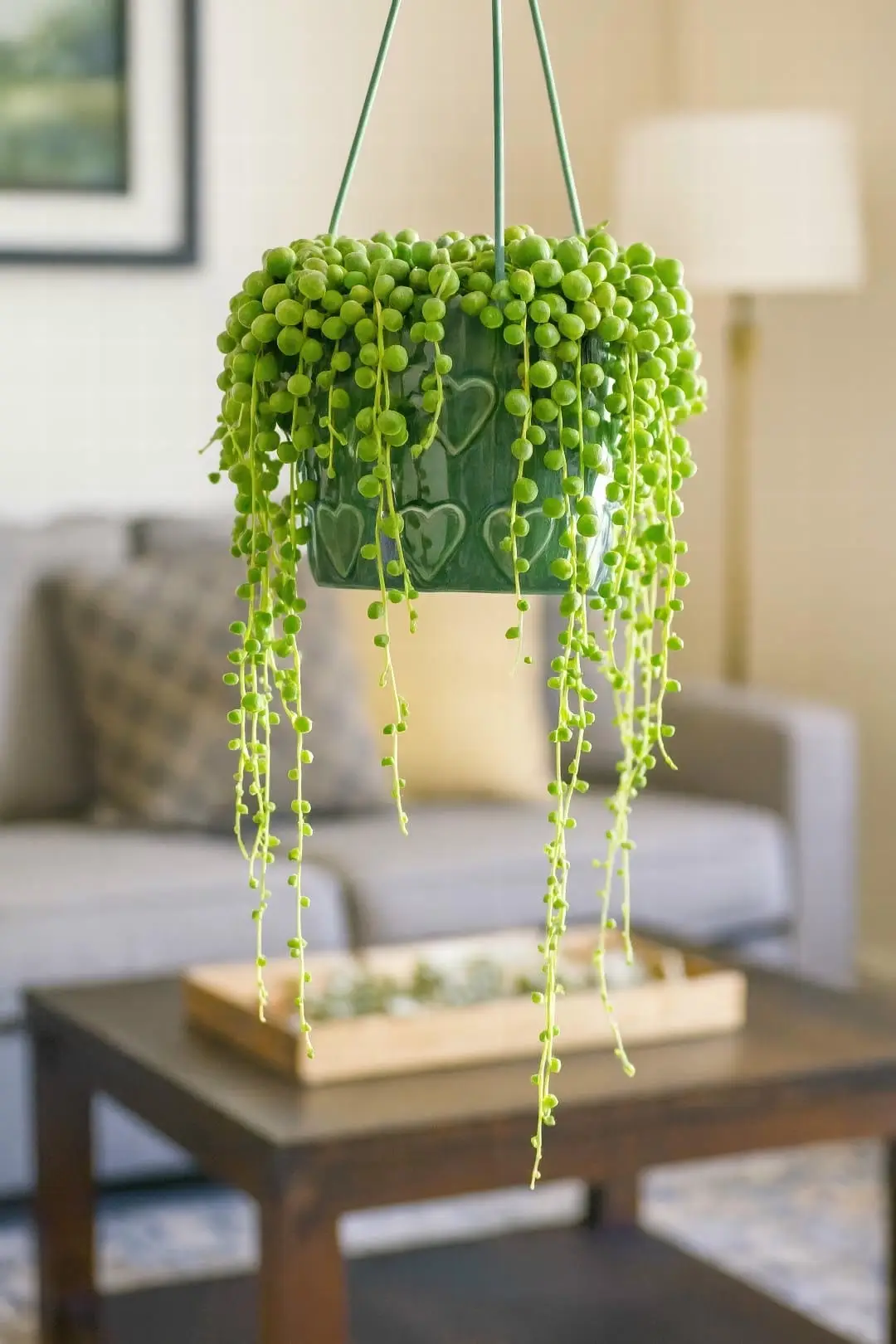
📿 10. String of Pearls (Curio rowleyanus)
Why You Want It
The icon that started the whole craze: perfect green beads on threads, unmistakable in a hanging pot. It is also the diva of the family. Shallow roots, thin stems, and zero tolerance for wet soil mean it punishes mistakes faster than any other string. Gorgeous, worth it, and best attempted after you have kept an easier string alive for a season.
Care Snapshot
- Light: Very bright with gentle direct sun; dim corners are a death sentence.
- Water: Soak and dry with discipline. When in doubt, don't.
- Trickiness: The highest here. Shrunken pearls mean thirst, mushy pearls mean rot.
- Pet note: Mildly toxic; keep it hanging high.
Read the full 👉 String of Pearls care guide.
💡 String of Plants Care 101: The Shared Rules
Light: Bright Wins
Every string on this list wants a bright spot; they differ only in how much direct sun they can take. The succulent strings (Pearls, Bananas, Fishhooks, Dolphins, Rubies, Buttons, Coins) welcome a few hours of real sun. Hearts likes it filtered. Turtles and Nickels want bright but indirect, and will scorch where the succulents thrive. Whatever the plant, remember the crown: the top of the pot needs as much light as the dangling strands, or the plant goes bald from above.
Water: The Universal Killer Is the Watering Can
Every plant here dies the same way: wet soil, rotted roots, mushy stems. For the succulent strings, water only when the soil is bone dry, then drench and drain. Turtles and Nickels drink a little sooner, when the top of the mix dries, but even they hate a soggy pot. If you take one habit from this page, take the soak and dry method.
Soil: Match the Roots
Gritty cactus mix with extra perlite suits the succulent strings. Nickels, the epiphyte, wants a chunky bark-based blend closer to orchid mix. Turtles takes a light, airy houseplant mix. All three recipes share one goal: air around the roots, fast drainage, no standing moisture.
Propagation: The Whole Family Is Generous
Every string propagates from cuttings, most of them absurdly easily. Lay succulent-string cuttings on dry mix and they root where the nodes touch. Hearts roots in water, soil, or from its little tubers. This is the real joy of collecting strings: one healthy plant becomes gifts for every friend you have. The succulent propagation guide covers the technique.
🧬 Who's Actually Related to Whom
The "String of" label hides a family reunion with a lot of gatecrashers. Pearls, Bananas, Fishhooks, Dolphins, and Rubies are all daisies (Asteraceae), which is why their care is nearly identical. Hearts and Nickels are milkweed relatives (Apocynaceae) despite looking nothing alike. Buttons is a Crassula alongside the Jade Plant, Turtles is a Peperomia cousin of the Watermelon Peperomia, and Coins is, delightfully, a cucumber (Cucurbitaceae).
The practical takeaway: when you learn one Senecio string, you have learned five plants. The other five each play by their own family's rules, so check the individual guide before assuming.
🔍 The Rare Strings Not on This List
A few less common strings float around specialty shops and might join this collection someday. String of Watermelons (Curio herreanus) has striped teardrop leaves and follows String of Pearls care. String of Tears (Curio citriformis) is its smaller cousin with pointed teardrop beads. String of Needles (Ceropegia linearis) is a narrow-leaved relative of String of Hearts and takes the same care. If you spot one, buy it and apply the closest cousin's guide; the family rules above hold.
❓ Frequently Asked Questions
Are all String of plants succulents?
Most are, but not all. String of Turtles is a rainforest Peperomia and String of Nickels is an epiphyte that grows on tree bark in nature. Both want gentler light and more moisture than the true succulent strings like Pearls, Bananas, and Rubies.
Which String of plant is the easiest to grow?
String of Hearts is the most forgiving all-rounder, growing fast and bouncing back from neglect. Among the true succulents, String of Rubies and String of Bananas are the easiest. String of Pearls is the hardest of the family.
Which String of plants are safe for cats and dogs?
String of Hearts and String of Turtles are considered pet safe. The Senecio strings (Pearls, Bananas, Fishhooks, Dolphins) are mildly toxic and can cause vomiting if chewed, so hang them out of reach.
Why is String of Pearls so hard to keep alive?
Its shallow roots and thin stems leave almost no margin for error. Too much water rots it, too little light stretches it, and by the time symptoms show, the damage is done. Growers who master the soak-and-dry method in a bright window do fine, but easier strings teach the same lesson with less heartbreak.
Can I plant different String of plants together in one pot?
Only if their care matches. The sun-loving succulent strings (Pearls, Bananas, Fishhooks, Dolphins, Rubies, Buttons) can share a container since they all want bright light and dry-out periods. Keep Turtles and Nickels separate, because they need more moisture and gentler light than their potmates could tolerate.
How often should I water a String of plant?
For the succulent strings, water thoroughly only when the soil is completely dry, roughly every 10 to 14 days in summer and monthly in winter. String of Turtles and String of Nickels prefer a drink when the top inch of their mix dries, without ever going bone dry.
Why is my String of plant going bald on top?
The crown at the top of the pot needs as much light as the trailing strands. When a hanging plant sits with its top in shadow, the crown thins while the tips keep growing. Rotate the pot, move it so light hits the soil surface, and coil a few cuttings back on top to refill bare patches.
Are there other String of plants not on this list?
A few less common ones exist: String of Watermelons (Curio herreanus), String of Tears (Curio citriformis), and String of Needles (Ceropegia linearis). They follow the same care as their closest cousins on this list, and we may add full guides for them in the future.
🪴 See also 🪴
Complete Guide to String of Buttons Care and Growth
Complete Guide to String of Rubies Care and Growth
Complete Guide to String of Pearls Care and Growth
Complete Guide To String of Dolphins Care and Growth
Complete Guide to String of Bananas Care and Growth
Complete Guide To String of Fishhooks Care and Growth

Houseplant101 Forum
Questions & Comments
Ask a question, share your plant experience, or help other plant owners.
Comments are temporarily unavailable.
Open the Houseplant101 ForumNo comments yet
Be the first to ask a question or share your experience about this page.
Log in or create an account
Comments use your Houseplant101 Forum account, but you can stay on this page.
Create a new account