
Hoya Krohniana
Hoya krohniana
Hoya Eskimo, Hoya Super Silver, Hoya Krohniana Black Leaves, Silver Heart Hoya


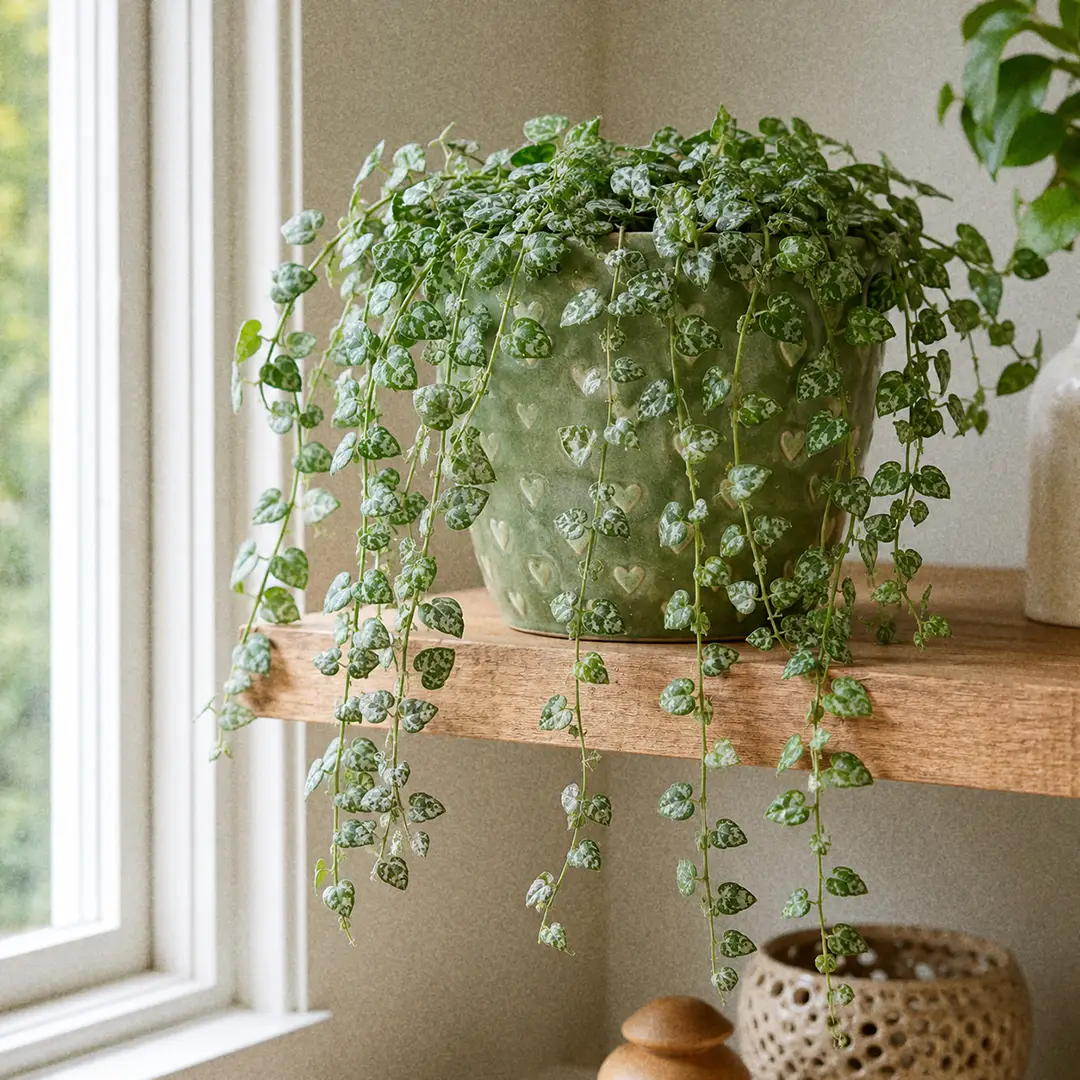
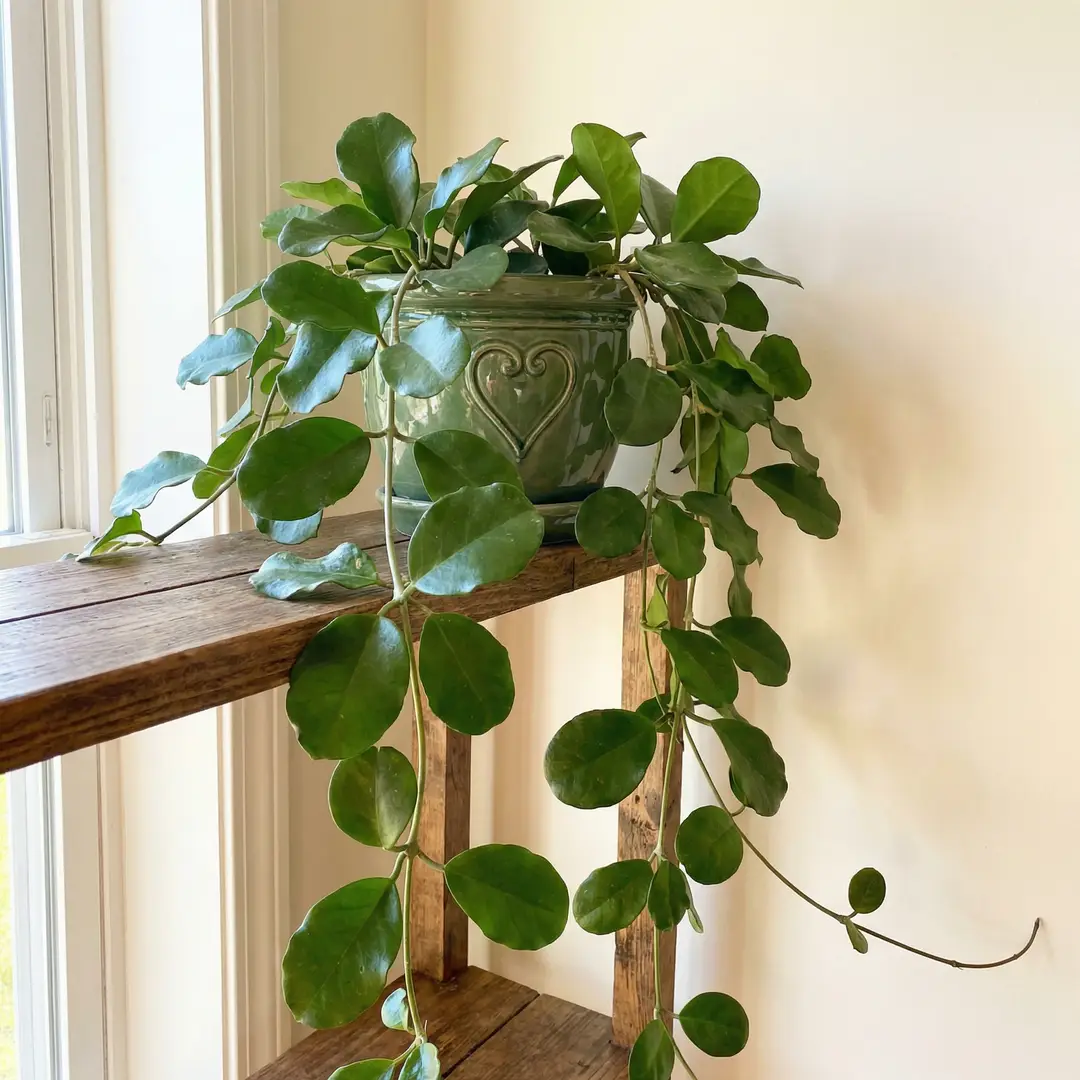
Hoya krohniana is the little heart-leaved wax plant that blooms while it is still small, covering itself in silver-flecked spade-shaped leaves and clusters of fuzzy cream flowers. Learn how to grow it indoors, keep the silver bright, and get it to flower.
📝 Hoya Krohniana Care Notes
🌿 Care Instructions
⚠️ Common Pests
📊 Growth Information
🪴 In This Guide 🪴

☀️ Hoya Krohniana Light Requirements (Indoor Lighting Guide)
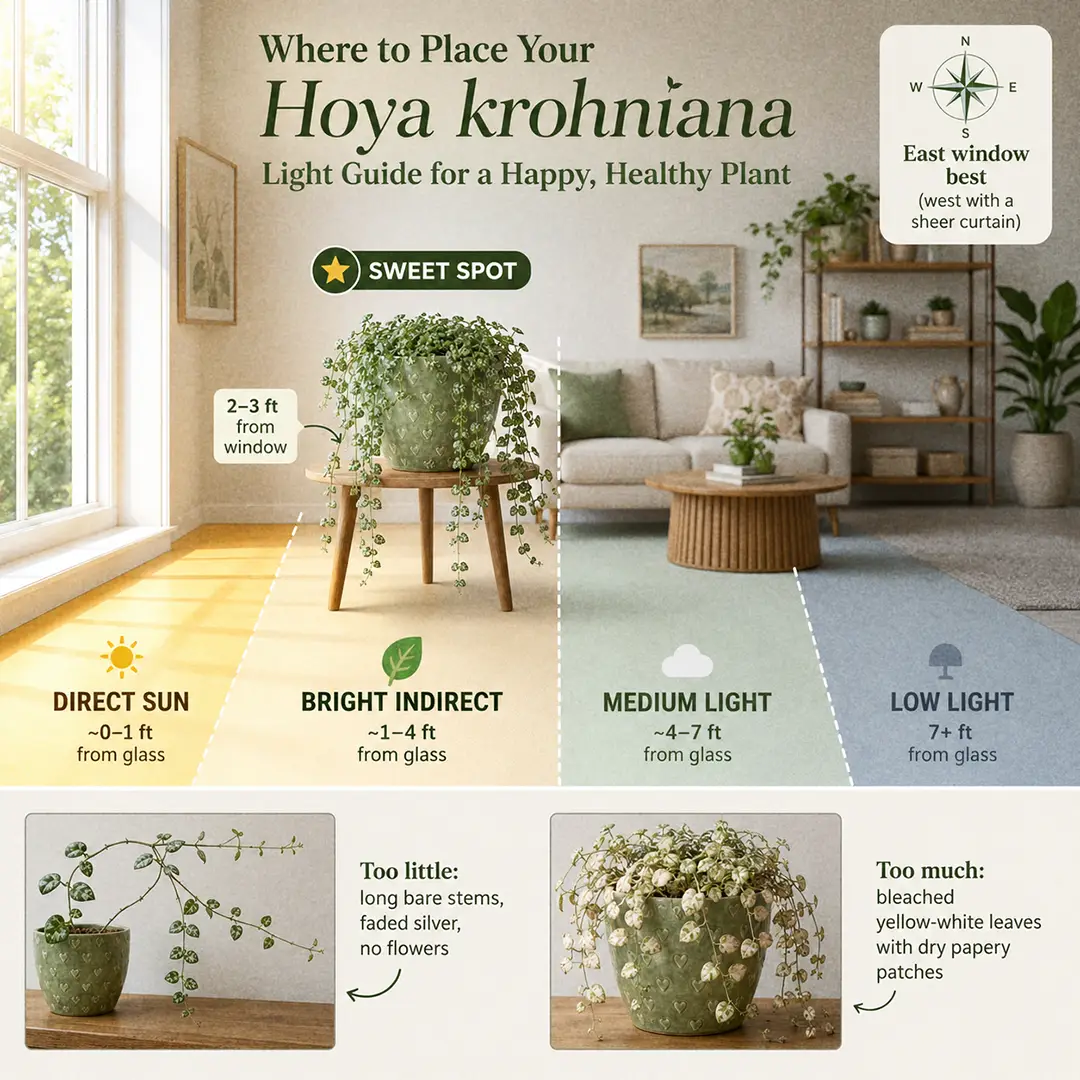
The Sweet Spot
Hoya krohniana wants bright indirect light with a couple of hours of gentle direct sun, and an east-facing window is the easiest way to give it that. Morning sun lands on the leaves while the air is still cool, then the plant coasts on bright light for the rest of the day. A west window works if you hang a sheer curtain, and a spot one to three feet back from a south window is fine too.
This is an epiphyte from Philippine forests, so it evolved growing up tree trunks where dappled light reaches it in patches. That is why it takes more sun than a fern would and less than a cactus. If you are still learning to read a room by eye, our indoor lighting guide is the place to start.
Too Little Light
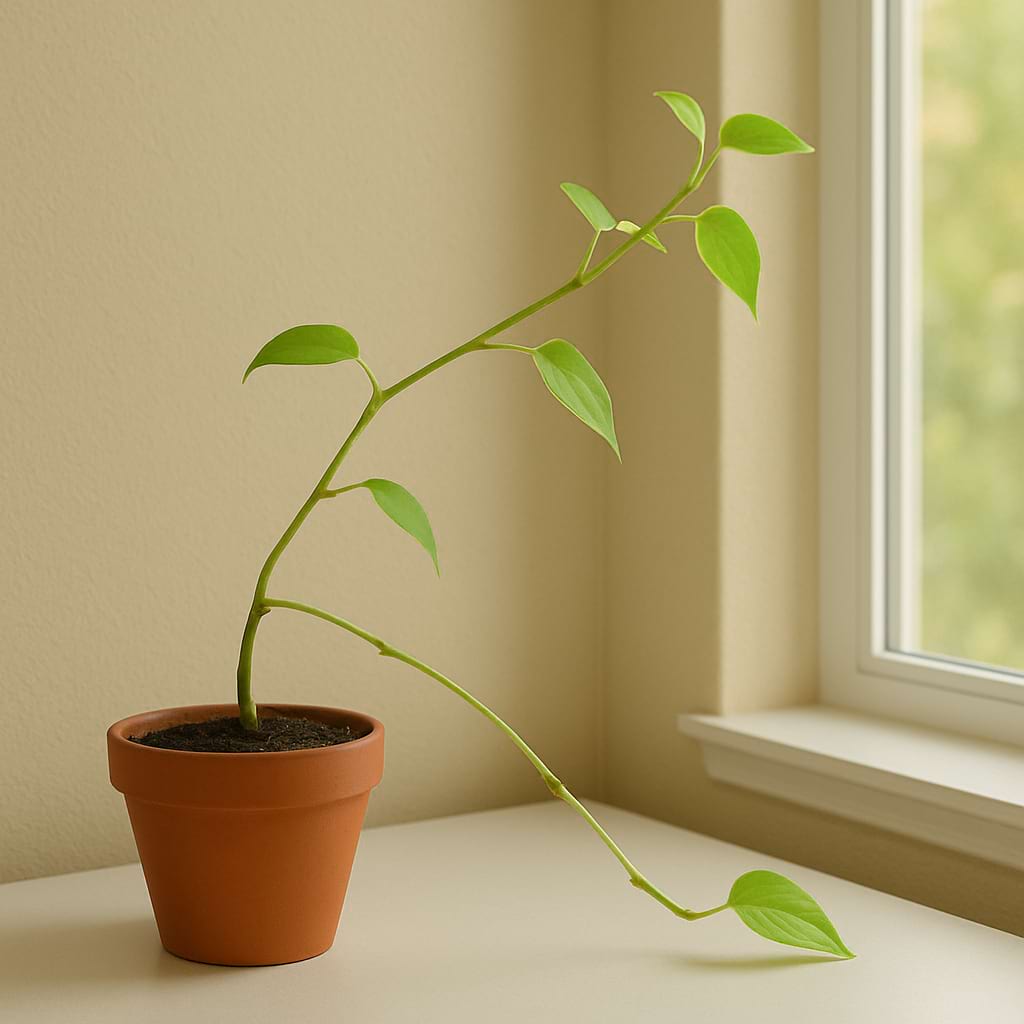
In a dim corner this plant does not die, it just stops being interesting. New vines stretch out with long gaps between leaf pairs, which is leggy growth, and the leaves that do form come out smaller and flatter green with the silver flecking faded. Flowering stops completely.
Winter is when most people lose the plot on light. A window that was perfect in July can be too dark by December, so either move the plant closer to the glass or run a grow light for a few hours a day.
Too Much Light
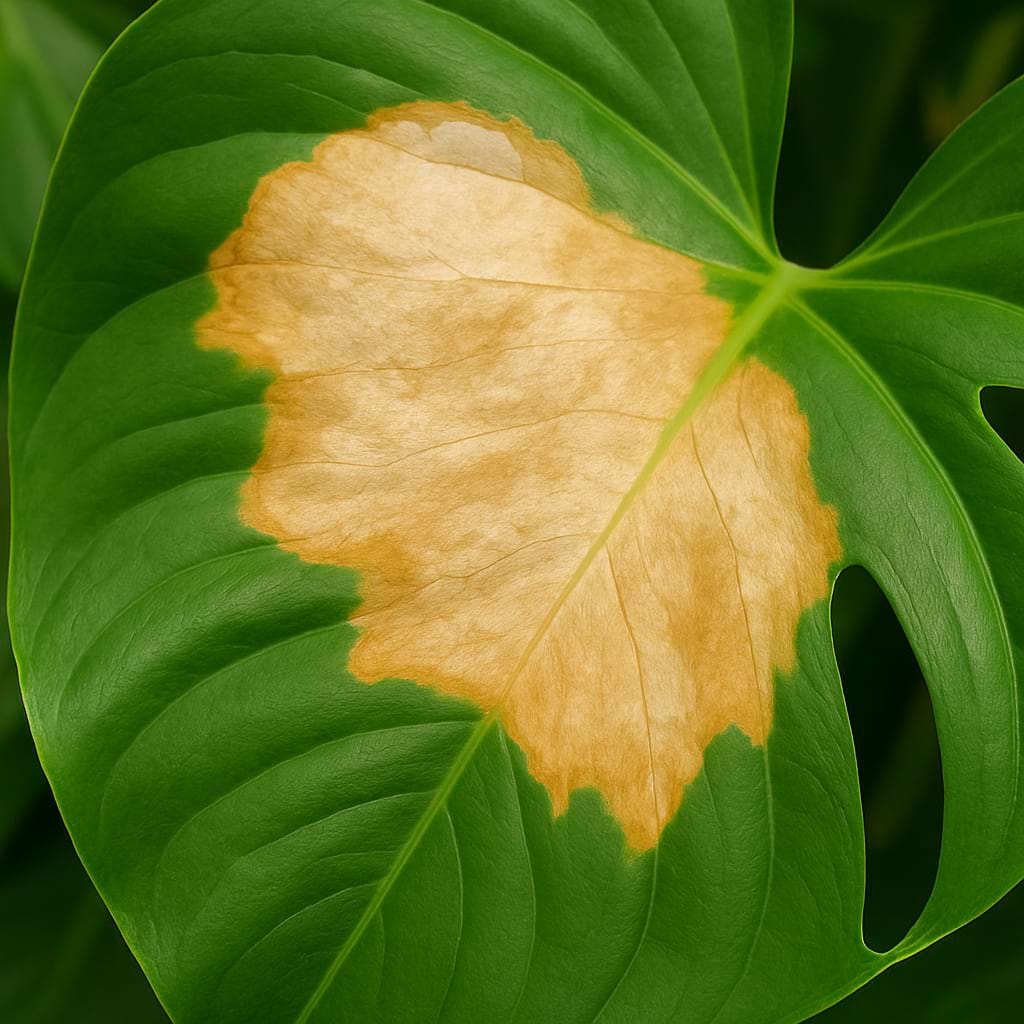
Several hours of hot afternoon sun through glass will bleach the leaves to a pale yellow-white and leave dry papery patches, which is sunburn. Those marks never heal, so move the plant back rather than waiting to see if it adjusts.
A reddish or bronze blush on leaves getting strong morning sun is a different thing entirely. That is sun stress pigment, it is harmless, and on a krohniana it usually means the plant is bright enough to bloom.
💧 Hoya Krohniana Watering Guide (How to Water Properly)
Watering Frequency
Let the mix dry most of the way, roughly three quarters down the pot, then water thoroughly. In a small pot in a bright spot that tends to land somewhere between every 7 and 12 days in summer, stretching to every two or three weeks in winter. Chunky bark mixes dry faster than you expect, so check rather than counting days.
Here is the part that separates this plant from the thick-leaved hoyas. Those leaves are succulent, but they are also tiny, so the reservoir is small. A Hoya obovata can sit bone dry for three weeks and shrug. A krohniana left that long starts wrinkling. Aim for dry, not desiccated.
How to Water
Take it to the sink and water until it runs freely from the drainage holes, then let it drain completely before it goes back on its saucer. Bark mixes can go water-repellent when very dry, and the first pour will run straight through the gaps without wetting anything. If that happens, water once, wait five minutes, then water again. Bottom watering solves it neatly for a small pot.
Signs of Trouble
The leaves are your gauge. Slightly soft or faintly wrinkled leaves mean thirsty, and they plump back up within a day of a good soak. Get in the habit of squeezing one between finger and thumb each week.
Yellow leaves on a pot that is still damp mean the opposite problem, and that is where root rot starts. Confusingly, a rotting plant also wrinkles, because dead roots cannot drink. If the leaves look thirsty and the soil is wet, do not reach for the watering can. Unpot it and look at the roots. Our watering guide covers the general logic.
🪴 Best Soil for Hoya Krohniana (Potting Mix & Drainage)
What the Soil Needs
In the wild this plant is not in soil at all. It clings to bark with its roots in leaf litter and moss, drenched by rain and then dried by moving air within hours. Your pot has to imitate that: airy, chunky, fast-draining, and holding just a little moisture. Regular potting compost stays wet for days and is the single most common way people kill a hoya.
DIY Soil Mix
A blend that works reliably is 2 parts orchid bark, 1 part perlite, 1 part coco coir or peat-free compost, with a handful of horticultural charcoal if you have it. That gives you big air gaps between the chunks with just enough fine material to hold water for a day or two. Some growers add a little pumice for weight, which helps if a trailing plant keeps tipping its pot.
Pre-Made Options
Bagged orchid mix or a labelled aroid mix both make a decent base, though most are still slightly too fine straight from the bag. Cut either one half and half with extra bark and perlite and you are there. Our soil guide explains why drainage matters so much in a container, and the potting soil guide compares what is on the shelf.
🍼 Fertilizing Hoya Krohniana
When and How Often
Feed every 2-4 weeks from spring through early autumn, then stop entirely for winter. This is a moderate grower, not a hungry one, and a bark mix holds almost no nutrients of its own, so little and often beats an occasional big dose. Always water lightly first so the fertilizer never hits dry roots directly.
What to Use
A balanced liquid houseplant feed at quarter to half the label strength covers the growing season. Once buds start forming, switching to something higher in potassium, such as a tomato feed at quarter strength, supports better flowering. Our fertilizing guide explains the ratios and the fertilizers guide covers products.
Over-Fertilizing Signs
Brown crispy leaf tips and edges on a plant you have been watering properly usually mean salt buildup, not dry air. A white crust on the bark or around the drainage holes confirms it. Flush the pot with plain water two or three times, then skip a couple of feeds. Too much nitrogen also pushes soft leafy growth at the expense of flowers.
🌡️ Hoya Krohniana Temperature Range
Ideal Range
Normal warm room temperatures suit it well, roughly 60-80°F (16-27°C). It grows fastest at the upper end of that range with good light and humidity. Below 50°F (10°C) the plant stops growing and becomes far more vulnerable to rot, since cold wet roots are a bad combination for any epiphyte.
The Cool Winter Nudge
A slightly cooler and drier winter, with nights around 55-60°F, seems to help set flower buds the following season. You do not need to engineer this deliberately. Most homes cool down near the windows in winter anyway, and simply watering less during those months does the rest.
Drafts and Heat Sources
Keep the plant away from radiators, heating vents, and the direct blast of air conditioning. Dry moving air pulls moisture out of the small leaves faster than the roots can replace it, and the vine tips go crispy first. A cold draft from a leaky window in winter is worse still, especially on a pot that was recently watered.
💦 Hoya Krohniana Humidity Requirements
Ideal Humidity
This one is more relaxed than its reputation suggests. It grows perfectly well at ordinary household humidity of 40-50%, and it looks noticeably better above 60%, with plumper leaves and no crisping at the growing tips. Nurseries grow it at 60-80%, which is why a new plant sometimes sulks for a few weeks after coming home.
Easy Humidity Boosters
Grouping plants together raises local humidity for free, and a pebble tray under the pot helps a little. A small humidifier running near the plant in winter is the only method that reliably moves the number. Skip daily misting, which does almost nothing for humidity and leaves water sitting on the leaves. Our humidity guide has the full picture.
🌸 Hoya Krohniana Flowers (How to Make It Bloom)
What the Flowers Look Like
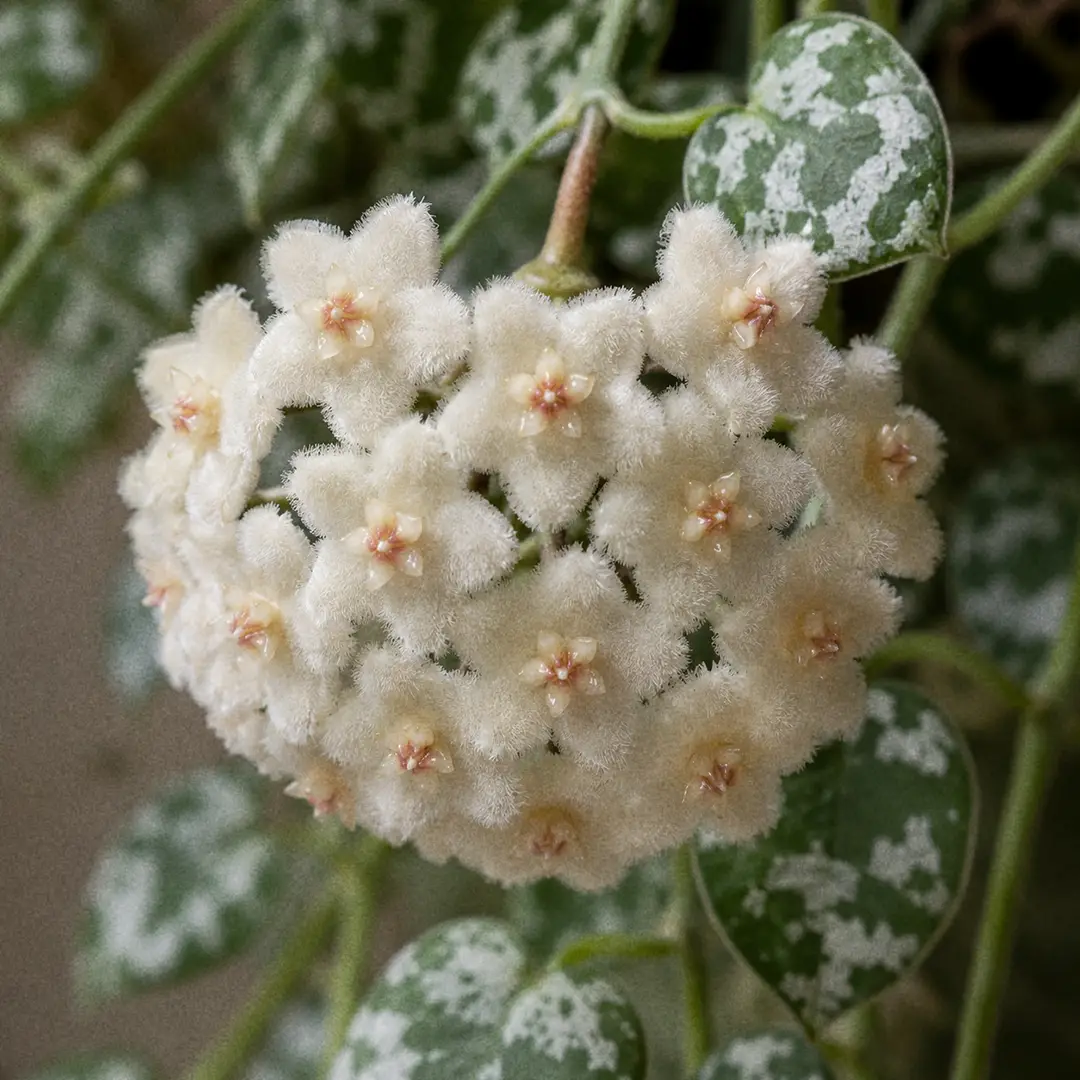
The flowers come in rounded clusters called umbels, each carrying roughly 15 to 20 tiny star-shaped blooms that are creamy white with a pale centre. What makes them memorable up close is the texture: every petal is coated in fine velvety hairs, so the whole cluster looks like a handful of miniature cotton puffs rather than the glossy porcelain stars of a Hoya carnosa.
They carry a sweet scent that gets stronger in the evening, which is normal for this branch of the genus. It is a gentler perfume than the closely related Hoya lacunosa, so put the plant somewhere you walk past rather than expecting it to fill a room. Each cluster lasts around a week, typically from late spring through summer.
How to Trigger Bloom
Light does most of the work. A plant getting a few hours of morning sun and bright light afterwards will usually bloom, and one on a dim shelf will not, no matter how well you water it. Adding potassium once you spot buds helps, as does a slightly cooler drier winter beforehand.
Age matters less here than with most hoyas, which is the appeal. Krohniana commonly flowers on a young plant with only a handful of vines, sometimes within its first year in your care, where a Hoya callistophylla can make you wait years.
Never Cut the Spurs
Hoya flowers grow from short bare stubs called peduncles, and the same spur reblooms year after year, often producing more clusters each time. They look like dead twigs. Cut them off and you have thrown away that flowering site permanently. Leave the spent flowers to drop on their own, and if the plant sets buds and then drops them, that is usually a move, a temperature swing, or the pot drying out completely mid-cycle.
🏷️ Hoya Krohniana Types and Varieties
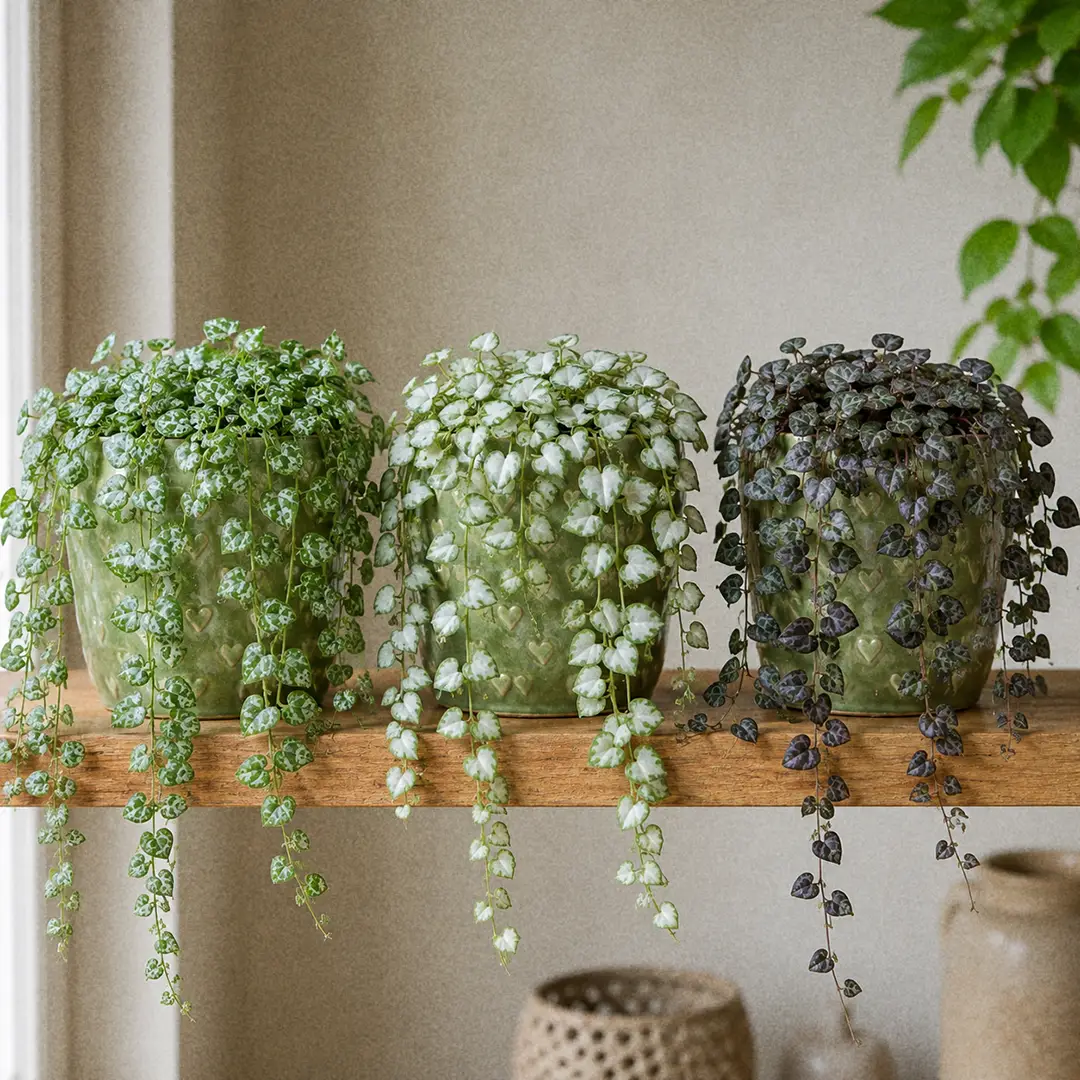
Care is the same across every form, so the only real decision is which leaf colour you want. Be aware that nursery labels in this group are loose, and the same plant travels under several names.
Hoya krohniana (green form)
The standard plant: small thick spade-shaped leaves about an inch long, deep green with scattered silver flecks and a distinct dimple where the leaf meets the stem. It is the cheapest form and it flowers just as freely as the fancy ones.
Hoya krohniana 'Eskimo'
The most widely sold selection, with heavy silver speckling that can cover most of the leaf surface. Sold interchangeably as 'Silver' in a lot of shops. Bright light brings out the contrast, while a dim shelf mutes it back toward plain green within a few leaf pairs.
Hoya krohniana 'Super Silver'
A step further than Eskimo, selected for leaves that are close to solid silver with only a thin green margin and midrib. It is the pricier one and the slowest to bulk up, but it is the plant most people picture when they search for this species. Many vendors treat 'Eskimo' and 'Super Silver' as the same thing, so buy from a photo rather than a name.
Hoya krohniana 'Black Leaves'
The opposite look, with leaves in a very dark olive that reads almost black in strong light, sometimes with faint silver dusting. It is often labelled Hoya lacunosa 'Black Leaves' instead, which brings us to the confusion below.
Krohniana vs Lacunosa
These two are close enough that botanists have gone back and forth on whether krohniana is a separate species at all. In practice, sort them by leaf shape: krohniana leaves are heart-shaped or spade-shaped, lacunosa leaves are oval to lance-shaped. Lacunosa also has the stronger evening scent. If you like this plant, it pairs well with the equally small-leaved Hoya wayetii and the needle-leaved Hoya linearis.
🪴 Potting and Repotting Hoya Krohniana
When to Repot
Hoyas flower better slightly pot-bound, so resist the urge to upgrade early. Every 2-3 years is plenty, and the real triggers are roots pushing out of the drainage holes, water running straight through without wetting anything, or bark that has broken down into dark crumbly mush. Spring is the right season, and never repot a plant that is in bud.
Choosing a Pot
Go one size up at most, about an inch wider than the old pot. An oversized pot holds a mass of damp mix the roots never reach, and that is where rot begins. Drainage holes are non-negotiable. Plastic and glazed ceramic both work with a chunky mix, and terracotta is fine if you accept watering more often. Our plant pots guide compares the materials, and a hanging pot suits the trailing habit.
Step-by-Step Repotting
Water lightly a day ahead so the roots are not brittle. Ease the plant out, tease away loose old bark without combing through the root ball, and trim off anything brown and soft. Set it at the same depth in fresh mix, working the chunks in gently around the roots rather than pressing down hard.
Wait about a week before the first proper watering so any damaged roots seal over, and keep the plant out of direct sun while it settles. Our repotting guide walks through the general process.
✂️ Pruning Hoya Krohniana
When to Prune
Early spring, just before the growing season, so the plant puts its energy into the new shoots you have encouraged. Light trimming through summer is fine too. Avoid cutting anything in winter, when regrowth is slow and cut ends sit open for weeks.
How to Prune
Use clean sharp snips and cut just above a leaf pair. Take out any dead or bare stems at the base, and shorten a vine that has run away from the rest of the plant. The milky sap that beads at the cut is normal for a hoya and can irritate sensitive skin, so wipe it off and wash your hands afterwards.
Pinching for Bushiness
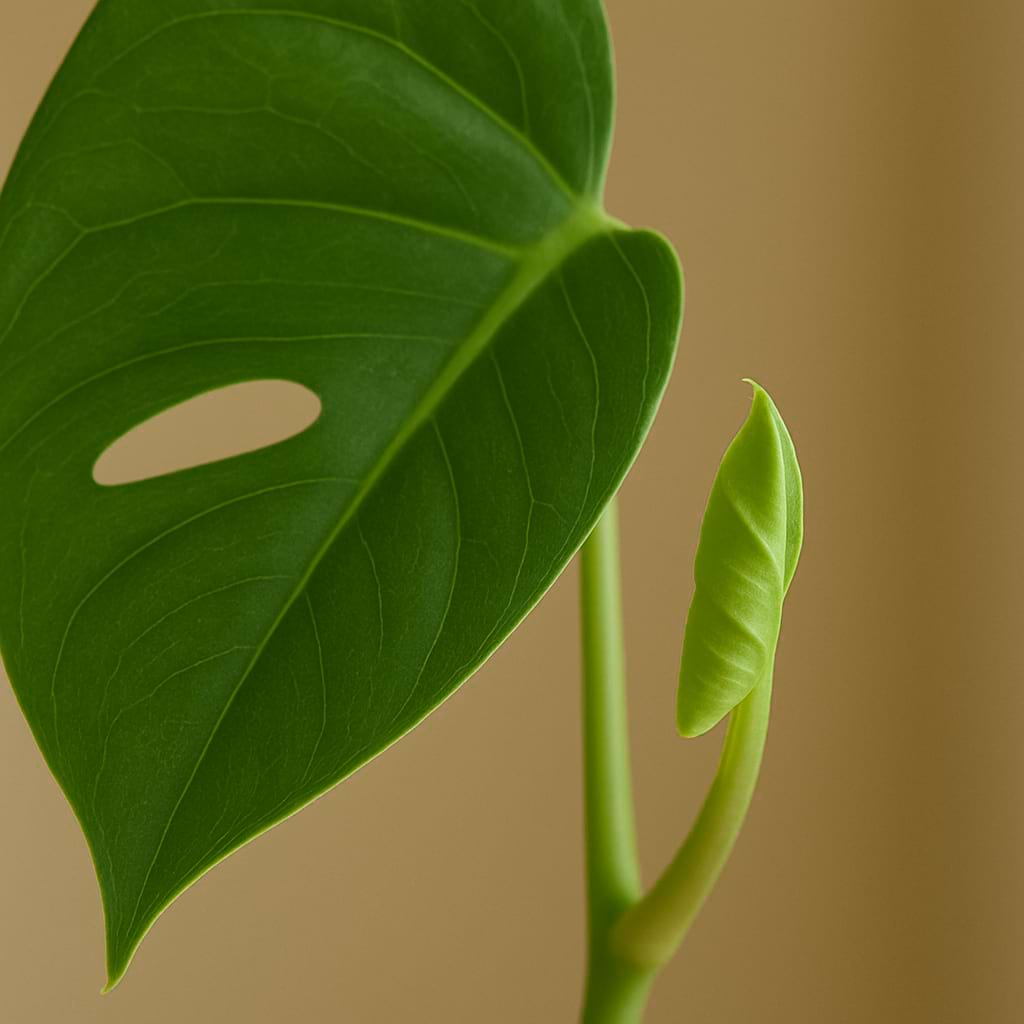
This plant branches more willingly than most hoyas, and pinching the tip out of a long vine pushes it to send out two shoots from the leaf pair below. Do that on a few vines each spring and you get a full basket instead of three long strings. Save the pieces you remove, since each one is a cutting. And it bears repeating: never cut a bare flower spur.
🌱 How to Propagate Hoya Krohniana
Best Method: Stem Cuttings
Stem cuttings root easily and quickly, which is why this plant spreads through collections so fast. Late spring and summer are the best time, when the plant is actively growing and warmth speeds everything up. A single leaf will not work, unlike a succulent, because there is no growth point on it. You need a node, the little bump on the stem where a pair of leaves attaches.
Step-by-Step
Choose a healthy vine and cut a piece with two or three leaf pairs, snipping about half an inch below the lowest node. Strip the leaves off that bottom node so it sits bare, since buried leaves rot.
Root it in one of three ways. In water, stand the cutting in a jar with the bare node submerged and the leaves clear of the surface, and change the water weekly. In damp sphagnum moss, tuck the node into moss wrung out until it is barely wet, inside a loosely closed bag or tub. Or go straight into perlite or your bark mix, kept lightly moist. Our water propagation guide covers the jar method in detail.
Keep the cutting warm and in bright indirect light. Roots usually appear in two to four weeks, and once they are an inch or two long, pot the cutting into a small container of normal mix. Water-grown roots need a week or two of slightly damper soil to adjust.
Tips for Success
Put three or four cuttings in one small pot rather than one on its own. A single rooted cutting looks sparse for a year, while a group fills out in a season. Bottom heat from a propagation mat cuts the rooting time noticeably, and a little humidity around the cutting keeps the small leaves from wrinkling while it has no roots. Skip fertilizer until you see new leaves.
🐛 Hoya Krohniana Pests and Treatment
Common Pests
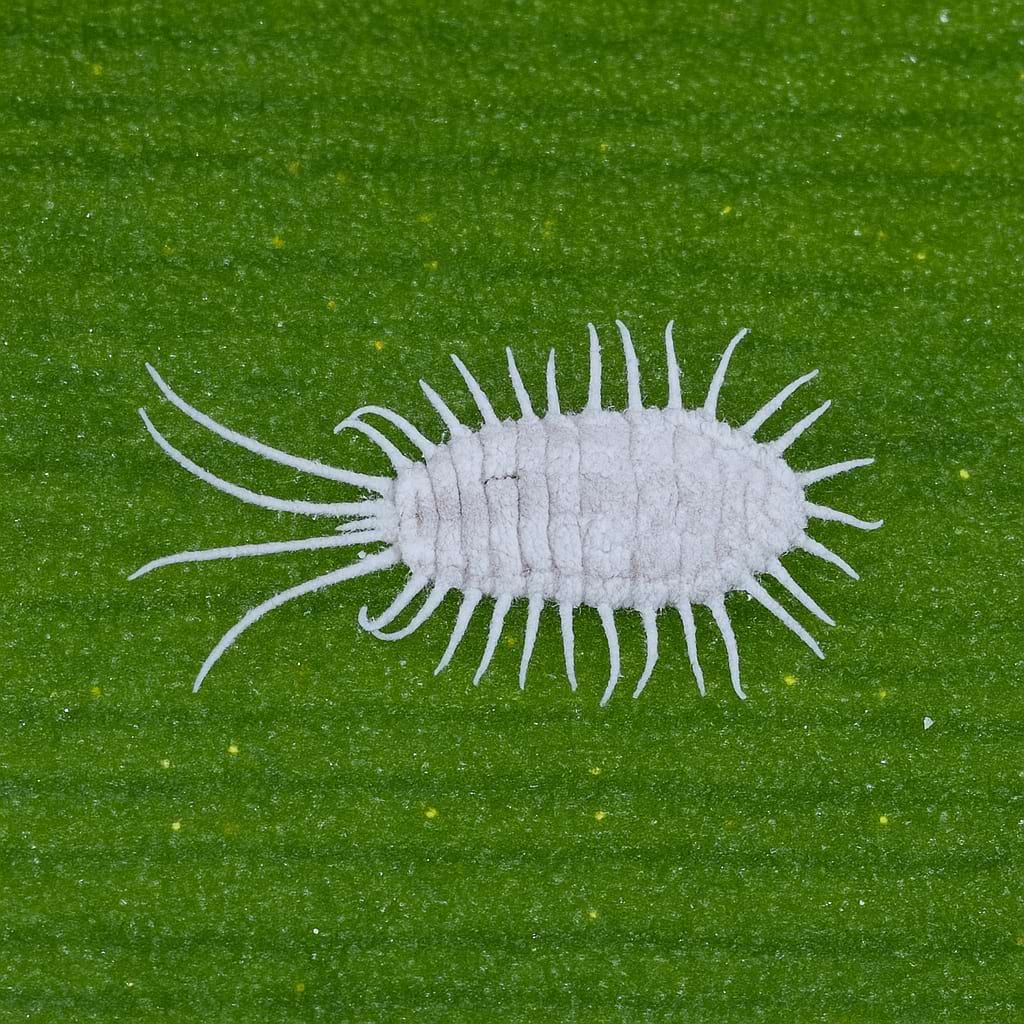
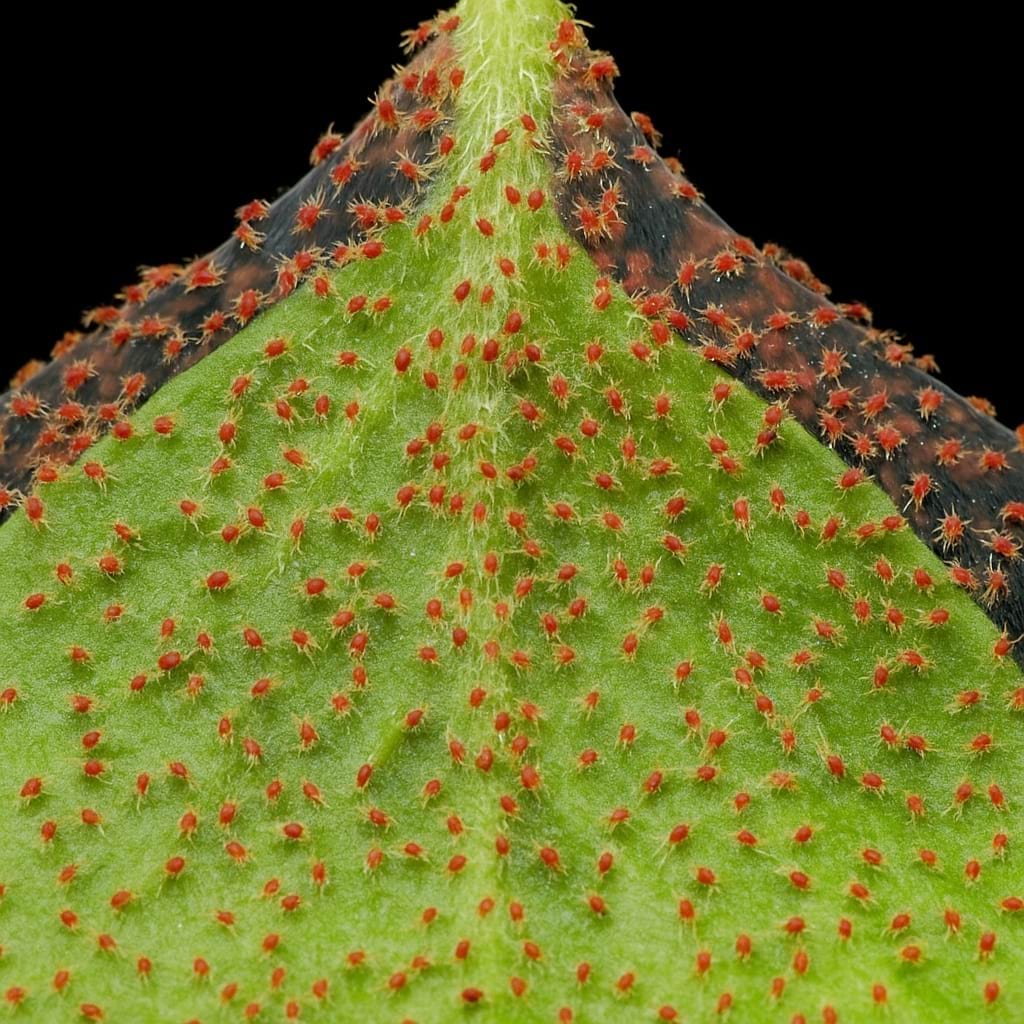
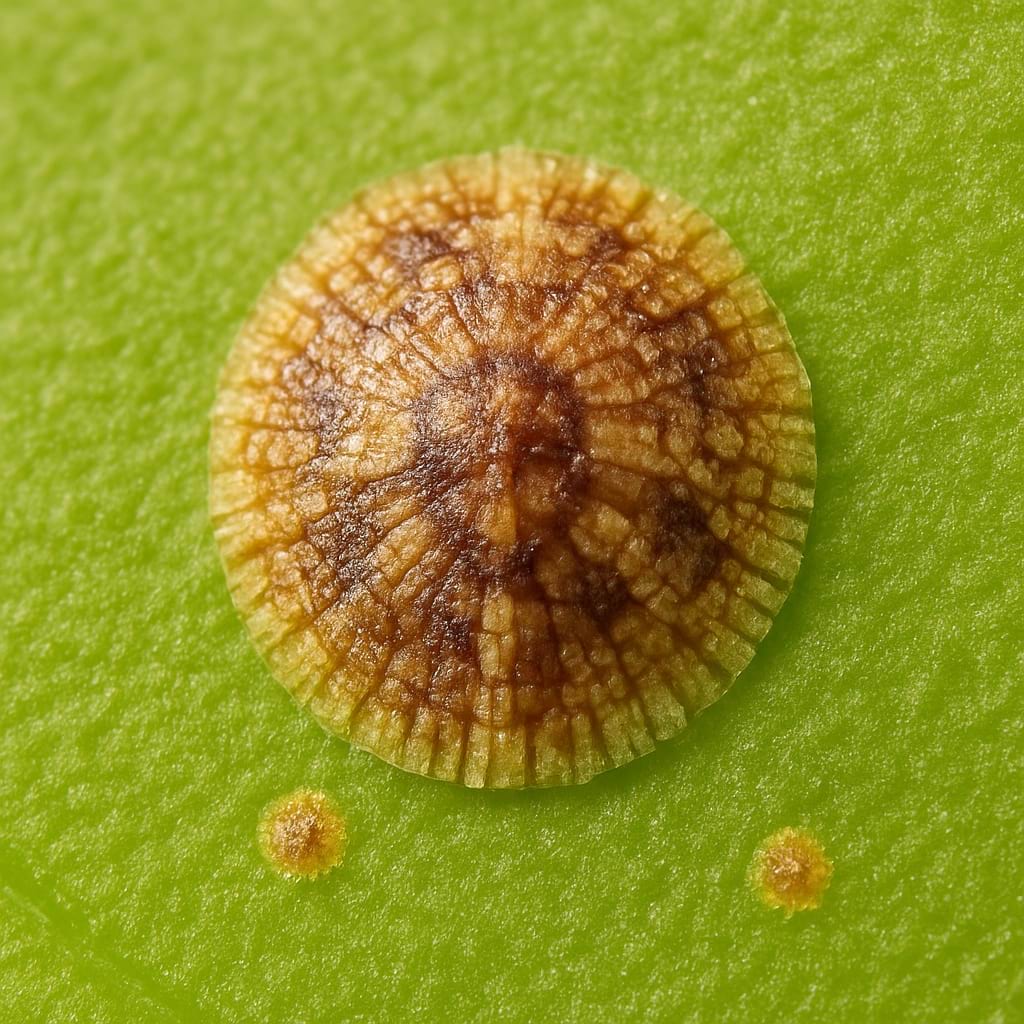
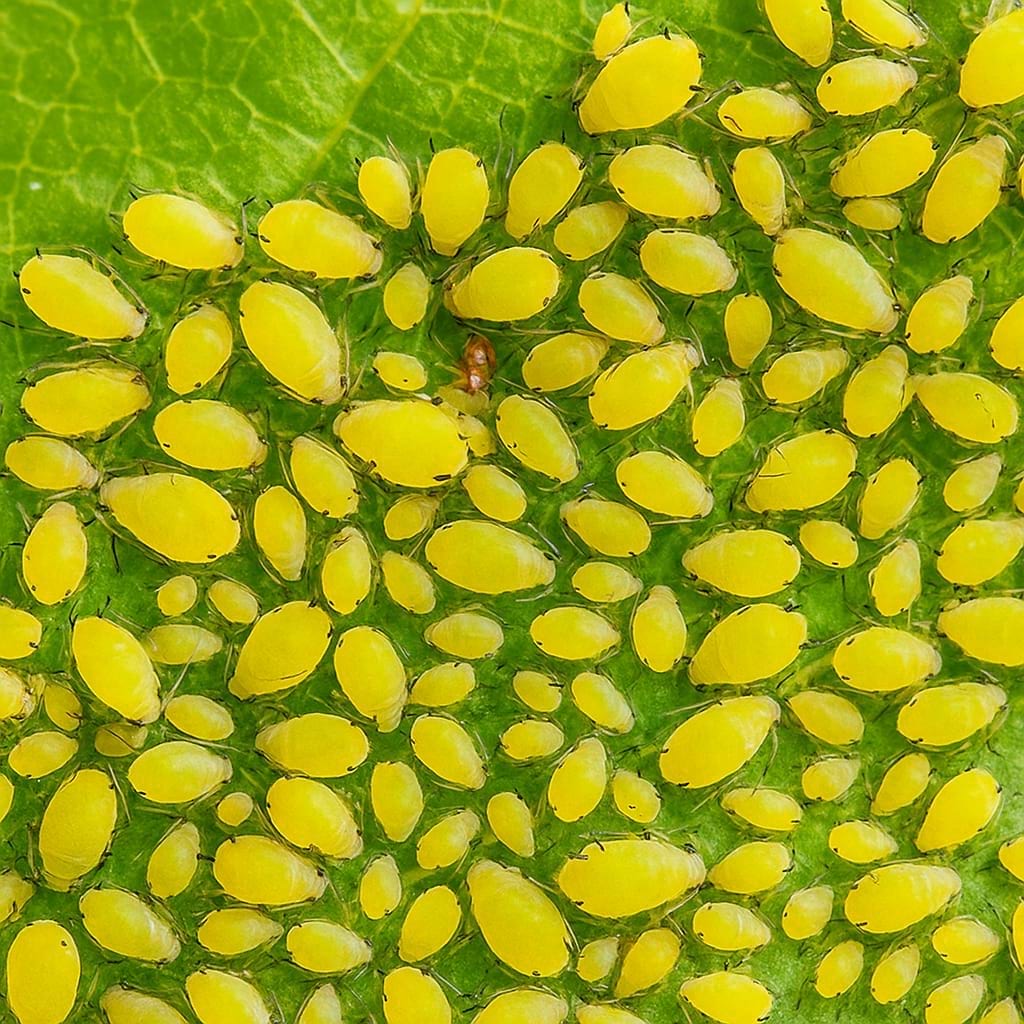
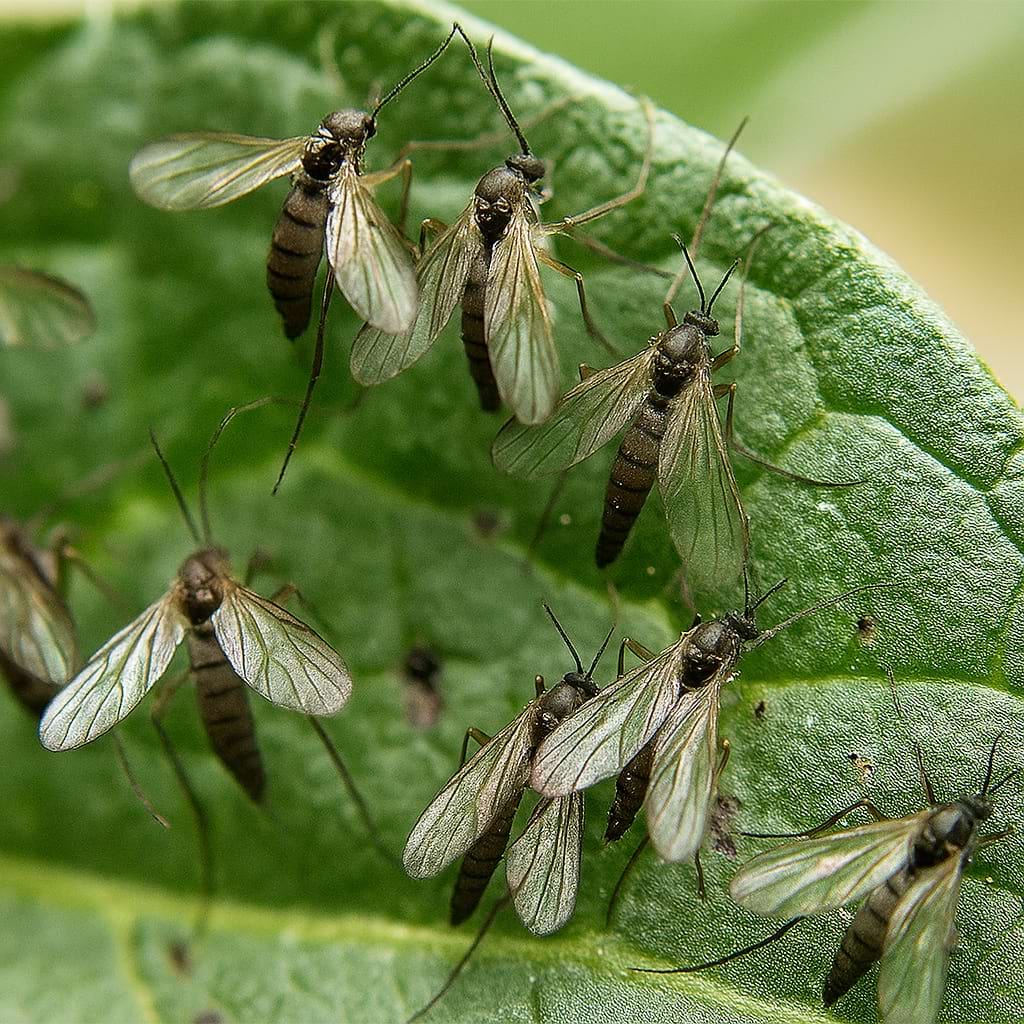
Mealybugs are the number one problem, and this plant gives them ideal cover. They hide in the tight leaf axils and in the dense tangle where the vines cross, looking like specks of white cotton. Check there first every time. Spider mites turn up in hot dry rooms, leaving fine webbing between the leaves and a stippled dull look on the surface. Scale insects sit along the stems as small brown bumps that scrape off with a fingernail. Aphids go straight for flower buds and soft new tips, and fungus gnats are a signal that your mix is staying wetter than it should.
Treatment and Prevention
Dab mealybugs and scale with a cotton bud dipped in rubbing alcohol, then treat the whole plant with insecticidal soap or neem every seven days for three rounds to catch the eggs. Spider mites need a thorough rinse in the shower first, since spraying alone rarely reaches the undersides. Do not spray anything oily onto open flowers.
Quarantine every new plant for a few weeks, because a hoya arriving with mealybugs will share them with the whole shelf. Wiping the leaves monthly doubles as an inspection.
🩺 Common Hoya Krohniana Problems
Yellowing Leaves and Rot
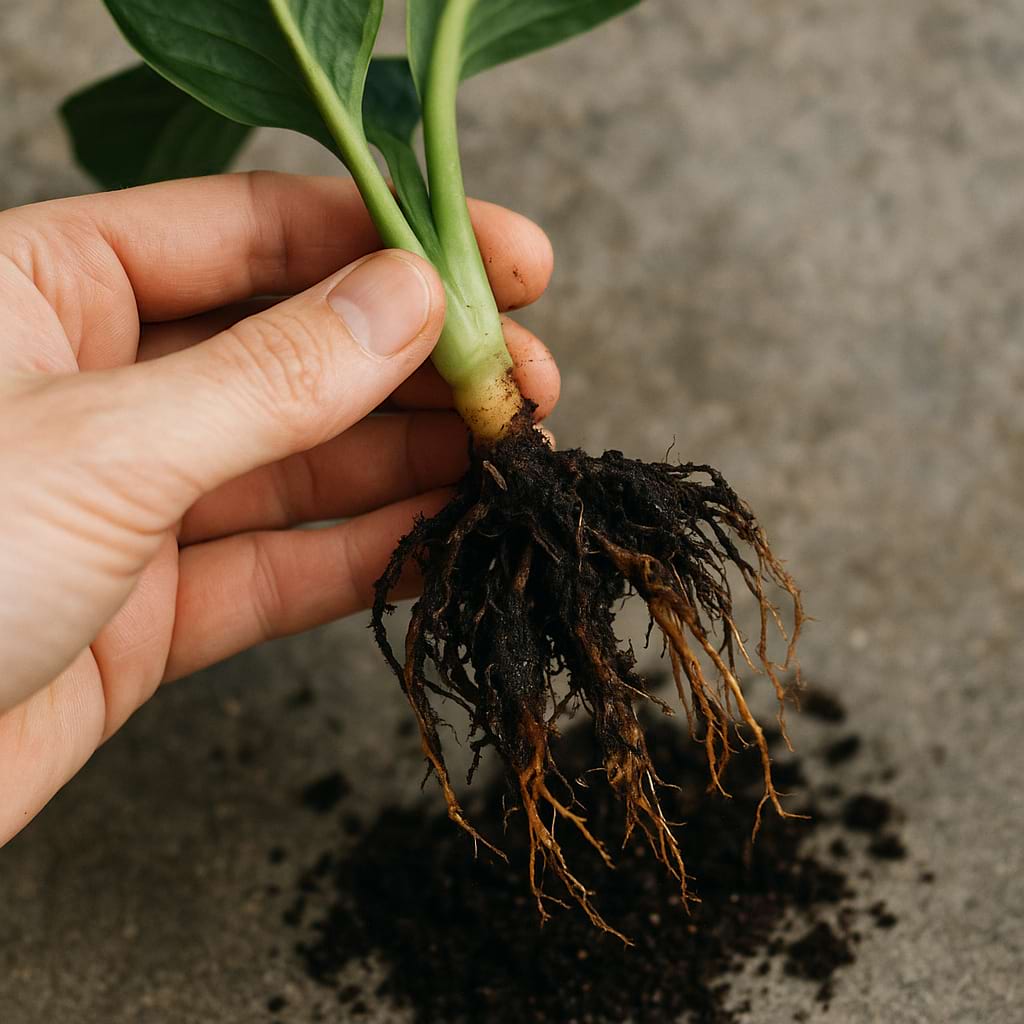
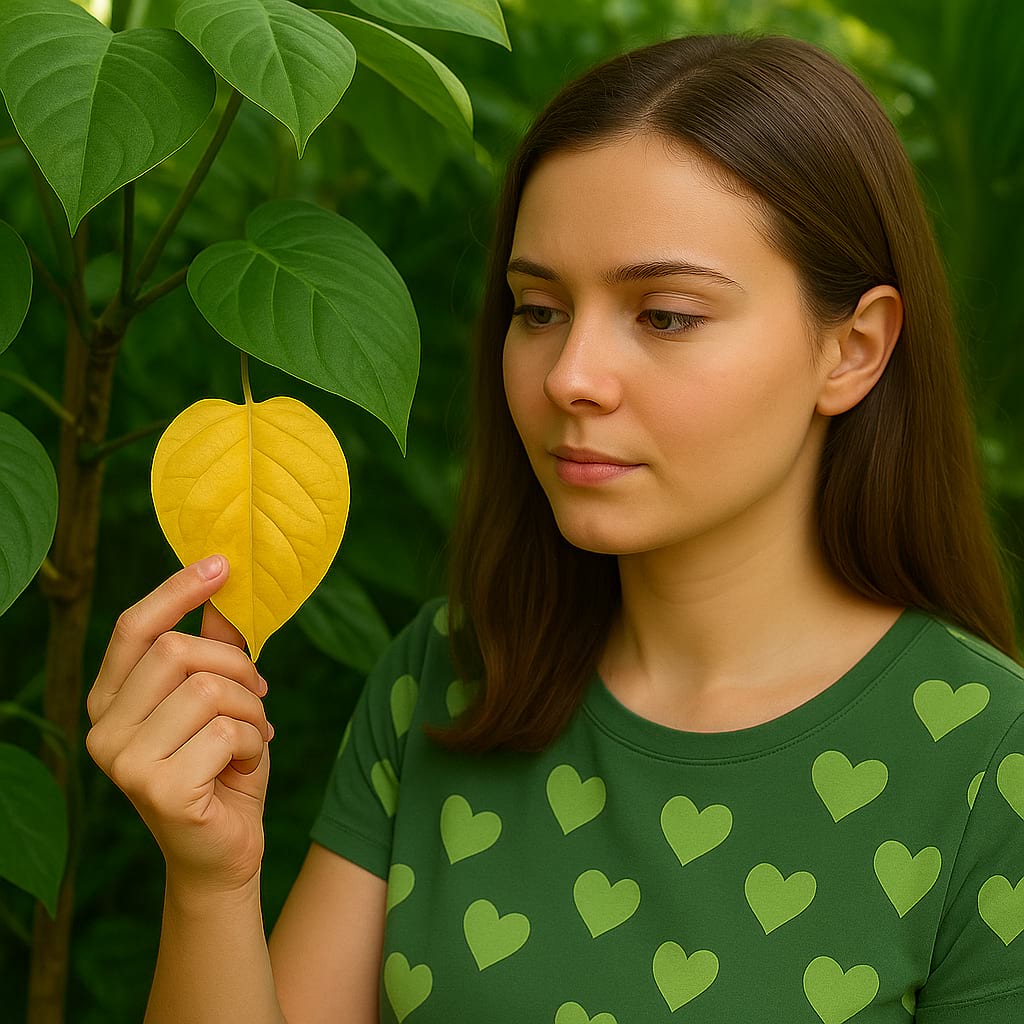
Yellow leaves on a plant in damp mix mean overwatering, and left alone that becomes root rot. Unpot the plant, cut away brown mushy roots back to firm white tissue, and repot into fresh dry bark mix in a clean pot. Hold off watering for a week. If the base of the stem has gone soft, the plant itself may not recover, so take cuttings from the healthiest vines immediately and start again.
Wrinkled Leaves and Crispy Tips
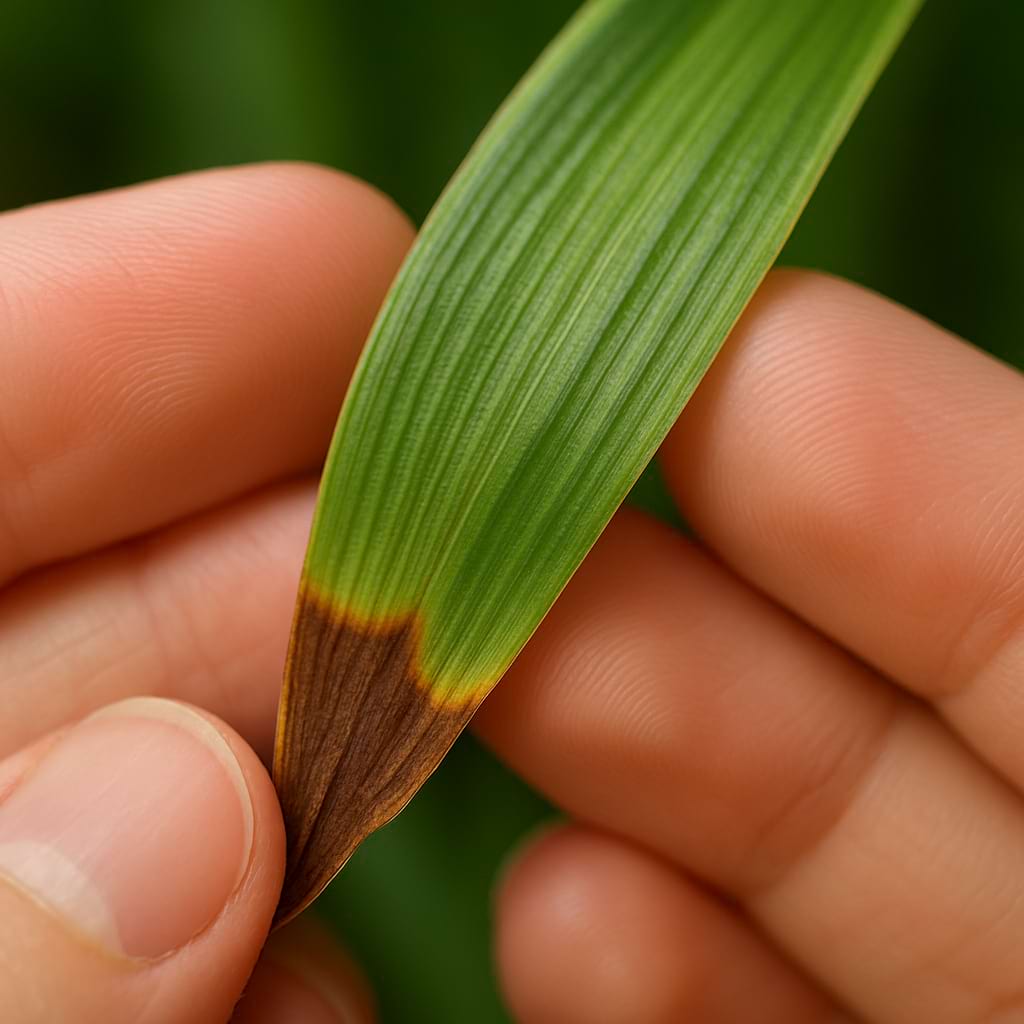
Wrinkling is the plant's thirst signal, and one thorough soak usually fixes it overnight. If it does not, the roots are the problem, not the schedule. Brown crispy edges point at dry air, a heat source too close, or fertilizer salts in the mix, and a plant sitting beside a radiator all winter will show all three.
Leggy Vines and No Flowers
Long stretches of bare stem between leaf pairs are leggy growth from too little light, and new leaves coming in smaller than usual confirm the same diagnosis. Move it brighter and prune the worst vines back in spring. A healthy plant that never blooms is failure to bloom, and the causes in order of likelihood are not enough light, too much nitrogen, and someone having cut the flower spurs off.
🖼️ Hoya Krohniana Display and Styling Ideas
Solo Setups
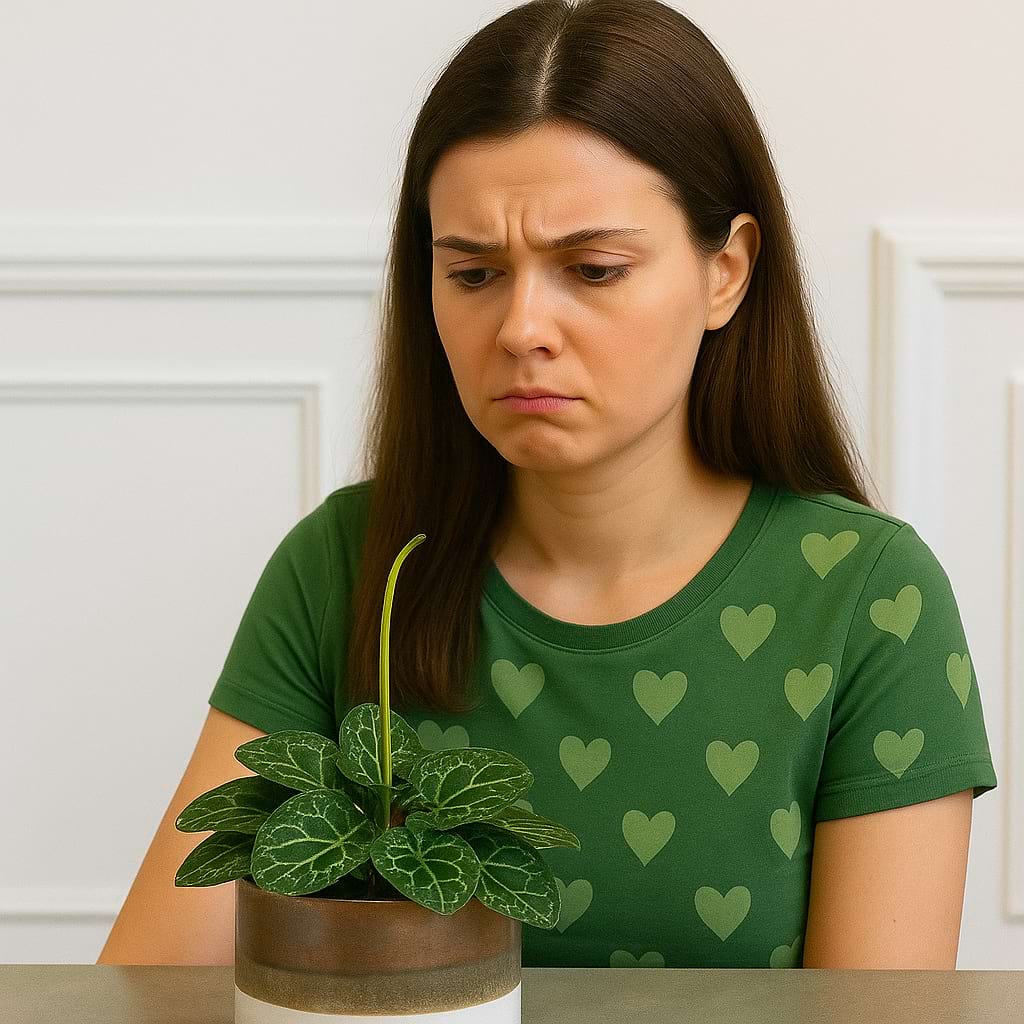
The leaves are small, so this plant works best where people get close to it. A hanging basket at eye level near an east window, a bookshelf edge, or a small side table beside a reading chair all beat a high ledge nobody looks at. A pale or light-toned pot makes the silver flecking stand out, which is the whole reason to grow the Eskimo forms.
Trained and Grouped
Krohniana twines willingly, so a small wire hoop or a mini trellis pushed into the pot turns it into a neat vertical plant that shows both leaf surfaces. Grouped, it plays well against bigger-leaved relatives: a broad Hoya obovata or a Sweetheart Hoya gives the contrast in scale, and all three want the same light and water.
Where Not to Put It
Keep it off dim north-facing shelves, where it goes leggy and never flowers. Avoid the spot directly above a radiator, and skip enclosed cases with no air movement, since still humid air on a plant with dense crossing vines is how fungal spotting starts.
👍 Hoya Krohniana Pro Care Tips
☀️ East window, morning sun. A couple of hours of gentle direct light is what turns a green plant into a flowering one.
🌸 Never cut the bare flower spurs. They rebloom from the same point every year, and they look like dead twigs.
💧 Squeeze a leaf weekly. Slightly soft means water it, firm means wait. It beats any schedule.
🪴 Keep the pot snug. Slightly root-bound plants flower better, and an oversized pot invites rot.
🍼 Feed light and often. Quarter strength every two weeks beats a full-strength dose once a month.
🌱 Root cuttings in threes. One rooted cutting looks bare for a year, three look like a plant in a season.
🔍 Check the leaf axils monthly. Mealybugs hide exactly where the leaves meet the stem.
❄️ Ease off in winter. Cooler, drier and brighter through the dark months sets up spring flowers.
❓ Frequently Asked Questions
Is Hoya krohniana toxic to cats and dogs?
No. Hoyas are listed as non-toxic to cats and dogs by the ASPCA, and krohniana is no exception. The milky sap that leaks from a cut stem can irritate sensitive skin and may cause mild stomach upset if a pet eats a lot of leaves, but it is not a poisoning risk.
Is Hoya krohniana the same as Hoya lacunosa?
They are closely related and repeatedly confused, and some botanists treat krohniana as a form of lacunosa. In the trade they are separated by leaf shape: krohniana leaves are heart-shaped or spade-shaped with a dimple at the base, while lacunosa leaves are oval to lance-shaped. Lacunosa flowers are also more strongly scented.
What is the difference between Eskimo and Super Silver?
Officially, Super Silver is the selection with the heaviest silver coverage, close to solid silver leaves, while Eskimo has heavy but broken speckling. In practice most sellers use the two names interchangeably for the same plant, so buy from a clear photo rather than a label.
Why are my Hoya krohniana leaves wrinkled?
Usually thirst, because the small leaves hold less water than thicker-leaved hoyas. Soak the pot thoroughly and they should plump up within a day. If the mix is already wet and the leaves are still wrinkled, the roots have rotted and cannot take up water, so unpot and check them.
How fast does Hoya krohniana grow?
Moderately. Expect a foot or so of new vine per season in good light, with the plant reaching around three feet of trail indoors over several years. The Super Silver form is noticeably slower than the green and Eskimo forms.
Why won't my Hoya krohniana bloom?
Light is the usual answer, and this plant needs a few hours of gentle direct sun to flower well. The other two causes are a fertilizer too heavy in nitrogen and accidentally pruning off the bare flower spurs. Age is rarely the issue, since krohniana blooms younger than most hoyas.
Can I grow Hoya krohniana in a bathroom?
Yes, provided the bathroom has a bright window and reasonable ventilation. The extra humidity suits it well. A windowless bathroom will not work, and a steamy room with no airflow raises the risk of fungal spotting on the leaves.
Does Hoya krohniana need a moss pole?
No. It is small enough to trail from a basket or twine around a little hoop, and it does not develop the heavy aerial roots that make a moss pole useful for climbing aroids. A hoop is decorative here, not structural.
Can I root a single leaf?
No. A leaf on its own will sometimes sit in water for months and even grow a root, but it has no node and therefore no growth point, so it will never become a plant. Always take a cutting with at least one node on the stem.
ℹ️ Hoya Krohniana Info
Care and Maintenance
🪴 Soil Type and pH: Chunky bark-based epiphyte mix with perlite and a little coir
💧 Humidity and Misting: Happy at 50% and better above 60%, which keeps the vine tips from crisping.
✂️ Pruning: Trim only to shape or to remove dead growth, and never cut off the bare flower spurs.
🧼 Cleaning: Wipe the small waxy leaves with a soft damp cloth every month or two. Dust dulls the silver flecking quickly.
🌱 Repotting: Repot every 2-3 years in spring, moving up only one pot size and keeping the plant slightly snug.
🔄 Repotting Frequency: Every 2-3 years
❄️ Seasonal Changes in Care: Bright light, steady feeding and warmth from spring to early autumn, then a cooler and drier winter that helps set flower buds.
Growing Characteristics
💥 Growth Speed: Moderate
🔄 Life Cycle: Evergreen epiphytic perennial vine
💥 Bloom Time: Late spring through summer, occasionally again in autumn, with each umbel lasting about a week
🌡️ Hardiness Zones: 10-12
🗺️ Native Area: Forests of the Philippines
🚘 Hibernation: No true dormancy. Growth slows in winter and the plant prefers cooler nights near 55-60°F with much less water.
Propagation and Health
📍 Suitable Locations: East windowsills, hanging baskets near bright windows, small trellises, shelf edges, bright bathrooms with good airflow
🪴 Propagation Methods: Root stem cuttings with two nodes in water, damp moss, or perlite through the warm months.
🐛 Common Pests: Mealybugs, Spider Mites, Scale Insects, Aphids, Fungus Gnats
🦠 Possible Diseases: Root rot, fungal leaf spotting in cold wet conditions, stem rot at the soil line
Plant Details
🌿 Plant Type: Epiphytic trailing and twining vine
🍃 Foliage Type: Evergreen succulent leaves
🎨 Color of Leaves: Deep green with silver flecking, near-solid silver in Eskimo forms, and blackish olive in the Black Leaves form
🌸 Flower Color: Creamy white with a pale pink or yellow centre
🌼 Blooming: Yes, readily and from a young age once the vines are established
🍽️ Edibility: Not grown as an edible plant.
📏 Mature Size: 3-4 feet of trailing or climbing vine indoors
Additional Info
🌻 General Benefits: Pet-safe, blooms younger than most hoyas, stays compact enough for a small shelf, and carries fragrant flowers that open in the evening
💊 Medical Properties: No documented medicinal uses.
🧿 Feng Shui: A heart-leaved trailing vine traditionally kept for warmth and affection in a room, and a good softener for a hard shelf edge or a corner.
⭐ Zodiac Sign Compatibility: Taurus
🌈 Symbolism or Folklore: Affection, quiet devotion, small steady growth
📝 Interesting Facts: Hoya krohniana was described in 2006 by Kloppenburg and Siar and named after Cindy Krohn, the collector who circulated the plant. Botanists still argue about whether it is a distinct species or a heart-leaved form of Hoya lacunosa, and leaf shape is the feature that separates them in the trade.
Buying and Usage
🛒 What to Look for When Buying: Look for firm plump leaves with clear silver flecking and at least two or three vines coming out of the mix. Skip plants with wrinkled leaves, dark soggy soil, or bare lower stems, and check the leaf undersides for pests.
🪴 Other Uses: Hanging basket specimen, small trellis or hoop plant, shelf plant for a bright bathroom, and an easy first hoya for a new collector.
Decoration and Styling
🖼️ Display Ideas: Hanging baskets, high shelves, small wire hoops, bookcase edges, grouped hoya collections near an east window
🧵 Styling Tips: The leaves are tiny, so this plant reads best up close at eye level rather than across a room. A pale pot makes the silver flecking stand out.
🪴 See also 🪴
Complete Guide to Hindu Rope Care and Growth
Complete Guide to Sweetheart Hoya Care and Growth
Complete Guide to Hoya Wayetii Care and Growth
Complete Guide to Hoya Crimson Queen Care and Growth
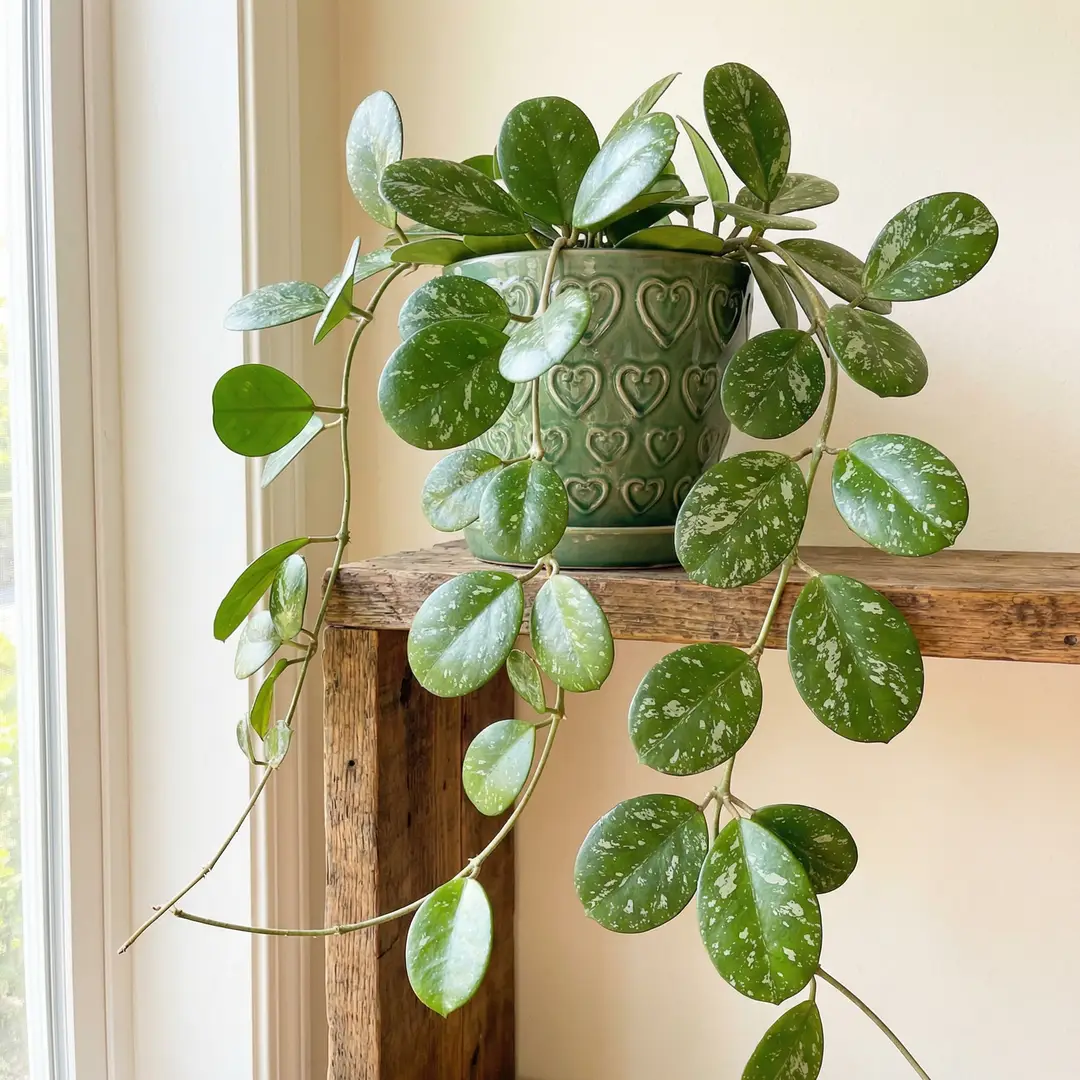
Complete Guide to Hoya Obovata Care and Growth
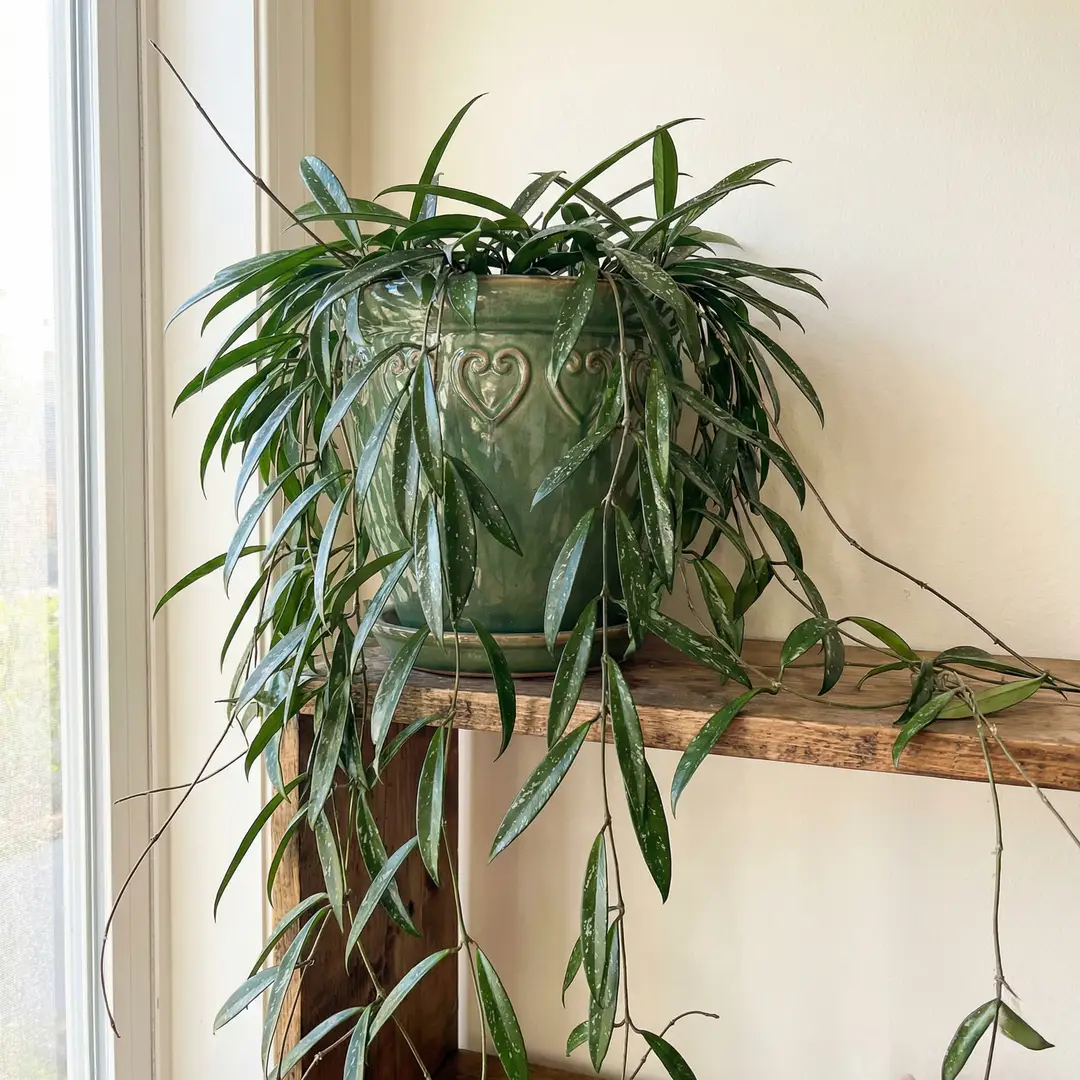
Complete Guide to Hoya Pubicalyx Care and Growth
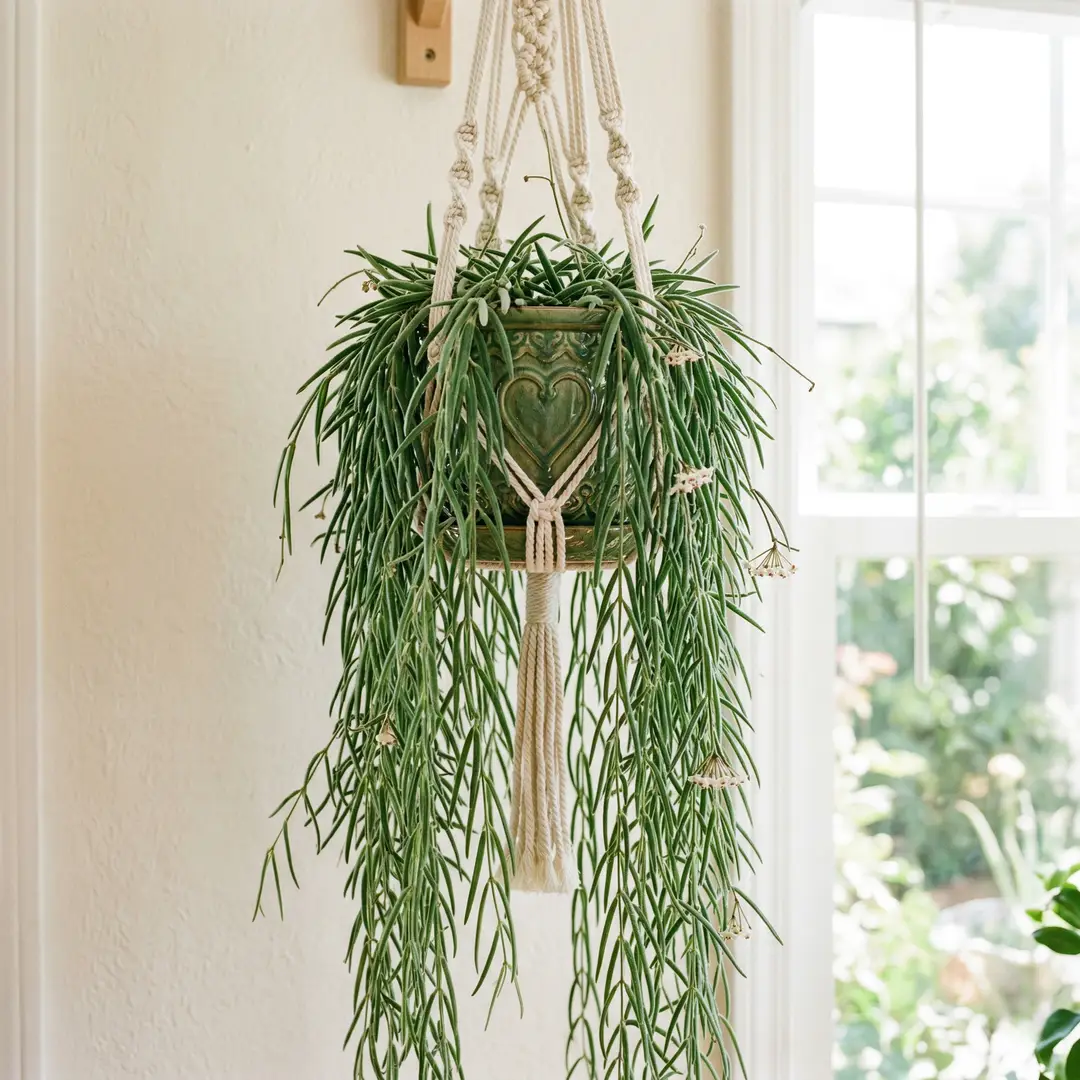
Complete Guide to Hoya Linearis Care and Growth
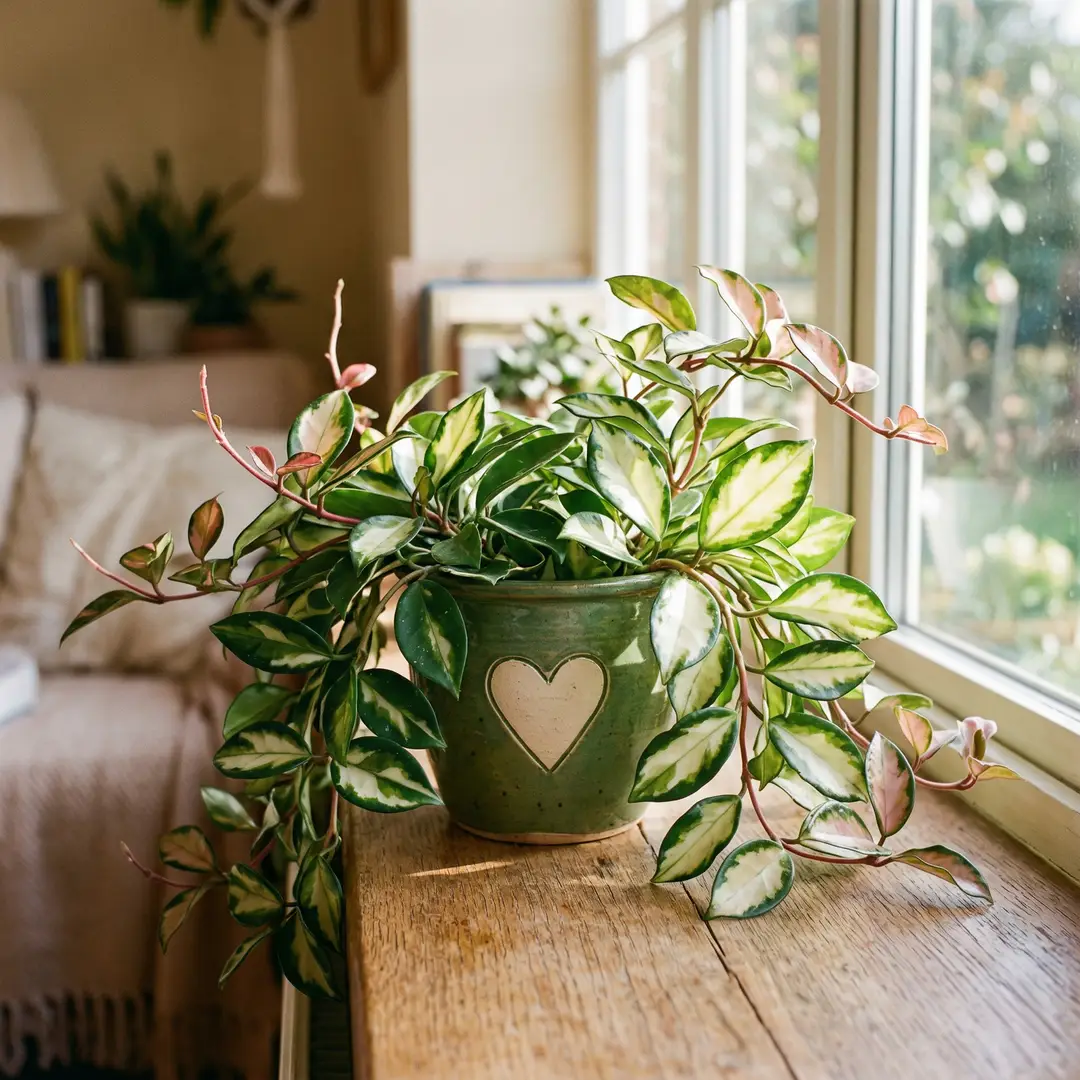
Complete Guide to Hoya Crimson Princess Care and Growth

Houseplant101 Forum
Questions & Comments
Ask a question, share your plant experience, or help other plant owners.
Comments are temporarily unavailable.
Open the Houseplant101 ForumNo comments yet
Be the first to ask a question or share your experience about this page.
Log in or create an account
Comments use your Houseplant101 Forum account, but you can stay on this page.
Create a new account