
🪴 In This Guide 🪴
We may earn a commission when you buy through these links. How we choose products →

🔍 Reading Calathea Orbifolia Brown Edges
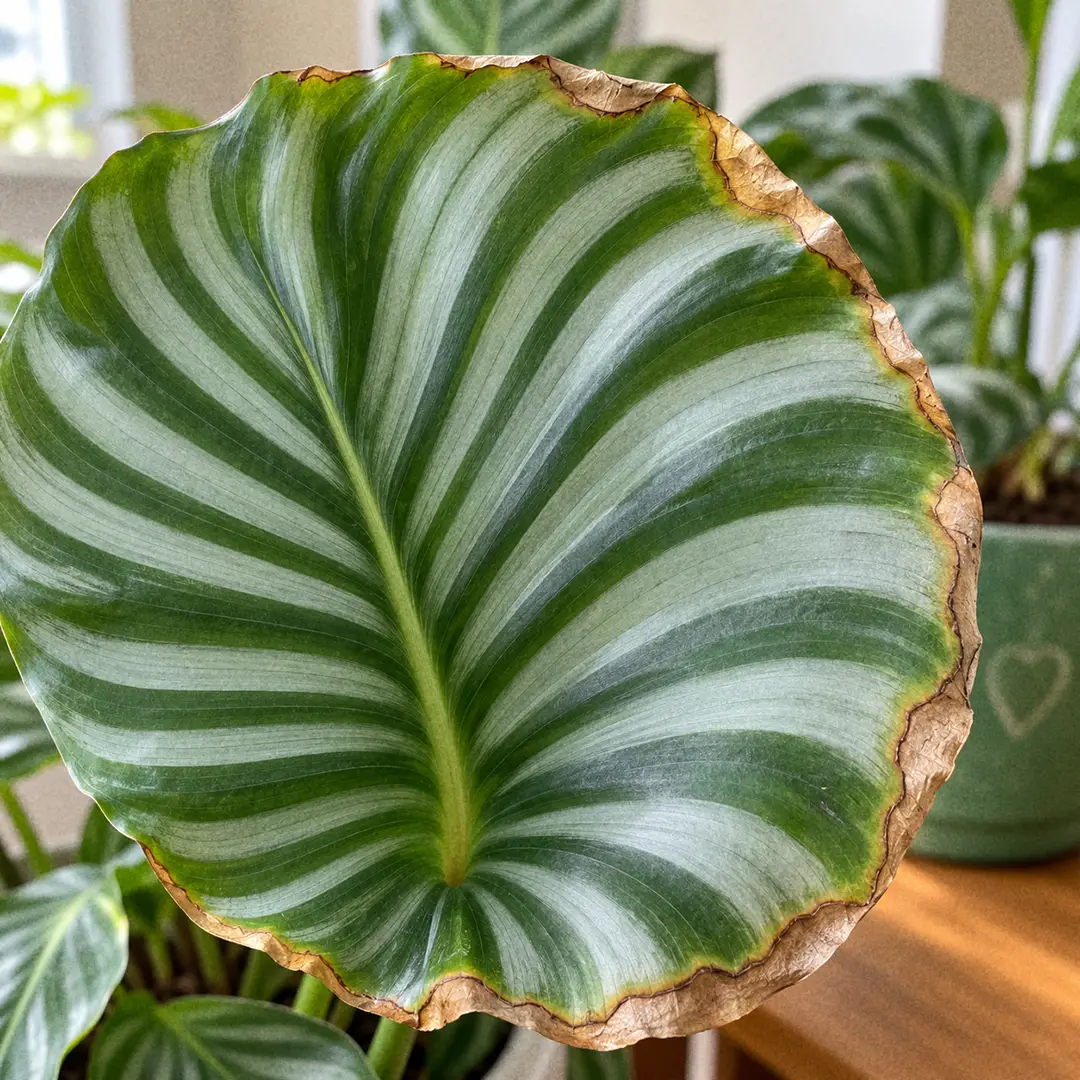
Before you change anything, look closely at one damaged leaf. Where the brown sits, and what sits next to it, narrows the cause down to one or two suspects.
Symptom-to-Cause Table
| What you see | Most likely cause | Check first |
|---|---|---|
| Thin crispy brown margin that creeps inward over weeks | Tap water chemicals or salt buildup | Your water source, white crust on the soil |
| Crispy edges on many leaves after the heating came on | Humidity below about 50 percent | A hygrometer next to the plant |
| Brown tips only, at the far end of the leaf | Uneven watering or dry air | How dry the pot gets between drinks |
| Yellow band that turns brown behind it, soft lower leaves | Overwatering or root rot | Pot weight, smell, the roots |
| Pale or brown patches in the middle of the leaf | Direct sun or cold damage | Window distance, drafts at night |
| Leaves rolled lengthwise and stiff | Thirst or dry air | Soil moisture |
| Leaves rolled and soft, soil wet | Root trouble | The roots |
Crispy Margins That Creep Inward
This is the classic orbifolia complaint. The very edge goes tan and papery, sometimes with a thin darker line where dead tissue meets green, and each week a little more of the rim goes. The pattern is even all the way round the leaf and appears on old and new leaves alike. That slow, steady creep points to what goes into the pot: fluoride, chlorine and dissolved salts arriving with every watering and parking at the leaf margins. Dry air produces almost the same look, and the two usually team up.
Brown Tips and a Yellow Halo
Brown confined to the leaf tip, with clean sides, tends to mean water swings. The pot dried hard once or twice, and the tissue farthest from the roots gave up first. A yellow band spreading ahead of the brown is a different story. That halo shows living tissue failing slowly, which is what happens when roots sit wet and cannot take up water. If you see yellow first and brown second, stop watering and read the root section below.
Brown Patches Mid-Leaf
Damage that starts in the middle of the blade rather than at the edge is rarely about water quality. Bleached or tan patches on the leaves nearest the window mean sun. Dark, glassy or grey-brown patches that appear within a day or two of a cold night mean chill, often from a leaf pressed against winter glass. Our sunburn and leaf scorch guide shows the sun version in detail.
🌀 Calathea Orbifolia Leaves Curling: Damage or Prayer Movement?
Curling is the second most common orbifolia worry, and half of the time nothing is wrong. Calatheas move their leaves every day, so you need to tell normal movement from stress.
How Night Folding Looks
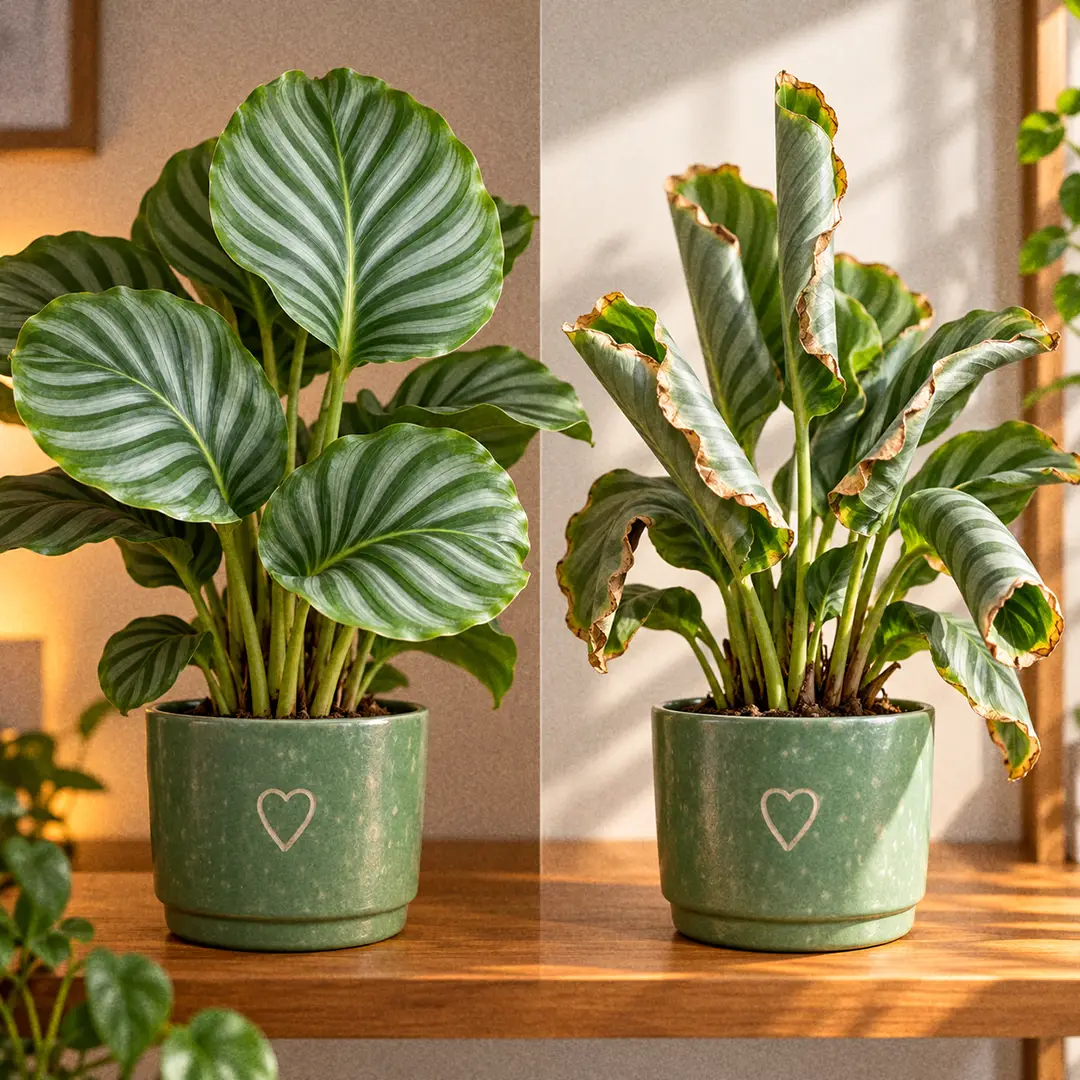
In the evening the leaves lift. A small swollen joint at the top of each leaf stalk (the pulvinus) tilts the blade upward, and by morning it lowers again. Orbifolia moves less dramatically than a prayer plant, so you may only notice the leaves standing a little taller at night. The key detail is that the blade itself stays flat and soft. This is healthy behaviour, covered in the prayer plant movement section of the main guide.
How Damage Curling Looks
Stress curling rolls the blade itself. The two halves of the leaf curl toward each other along the midrib, turning a round leaf into a loose taco or tube, and it stays that way at midday. The plant is cutting the surface it loses water from. Orbifolia's leaves are wide and thin, often eight to twelve inches across, so they lose water fast and roll sooner than a small-leaved calathea would. A new leaf that is still unfurling from its scroll is also rolled, and that is normal.
Crisp Curling vs Limp Curling
Squeeze a curled leaf gently between two fingers. Stiff, papery curling with dry soil is thirst, or dry air if the soil is still damp. The leaves usually open within a day of a proper drink or a humidifier. Soft, limp curling with wet soil is the worrying one, because roots that are rotting cannot deliver water, and the plant curls in soggy soil exactly as it would in dry soil. The general curling leaves guide covers the other causes, including pests.
🧭 Why Calathea Orbifolia Gets Brown, Crispy Leaves
Every calathea browns at the edges for the same reasons, as our calathea care guide explains. Orbifolia simply shows it first. Its leaves are the largest in the group and the tissue is thin, so a lot of water leaves through a lot of margin. Salts carried in that water end up at the edge, and the edge is also the first part to dry out. A small leaf can hide a millimetre of damage. A twelve-inch orbifolia leaf puts a brown ring right where you look.
Tap Water: Fluoride, Chlorine and Salts
Calatheas are sensitive to fluoride, and many water suppliers add it deliberately. Chlorine or chloramine, calcium and magnesium from hard water, and residue from fertilizer build up in the soil too. Leaving water to stand overnight lets some chlorine escape and does nothing for fluoride or minerals. Softened water is worse than plain tap, because a salt-based softener swaps hardness for sodium, which the plant cannot use and the soil cannot shed. Our tap water vs filtered water guide goes through each option.
Humidity Below 50 Percent
Orbifolia wants 60 percent or more. In my experience it starts marking once the room sits under about 50, and a heated room in winter often drops to 30. The damage comes in waves that line up with the heating season, and it hits the newest leaves while they are still soft. Sometimes a leaf even tears or browns as it unrolls because the scroll dried before it could open.
Watering Swings and Root Rot
Orbifolia likes the soil evenly damp, drying only in the top inch. Letting it go bone dry and then flooding it produces brown tips and crisp curling. Keeping it constantly wet does the opposite damage. The roots suffocate, root rot sets in, and the leaves yellow before they brown. Big plants in oversized pots are the usual victims, because the soil in the middle stays wet for days.
Sun, Cold Drafts and Fertilizer Salts
Direct sun bleaches the stripes and scorches patches within an afternoon. Temperatures below about 60°F (15°C), a leaf touching cold glass, or a winter draft from a door cause dark patches and limp edges. Hot air from a radiator dries one side of the plant faster than the other. Feeding at full strength adds salt that ends up at the margins just like tap water minerals, so feed at a quarter strength or not at all while the plant recovers.
🛠️ How to Fix Calathea Orbifolia Brown Edges, In Order
Work through these in order and change one thing a week if you can, so you know what actually worked.
Step 1: Change the Water
Switch to distilled water, collected rainwater, or reverse osmosis water. All three are low in fluoride and salts. A standard carbon jug filter is an improvement because it removes chlorine, but it leaves most of the fluoride and dissolved minerals behind, so it will not stop the browning on its own. Use the water at room temperature. If your house has a softener, find the unsoftened tap or skip tap water altogether.
Step 2: Raise the Humidity
Put a hygrometer next to the plant before you buy anything, because most people guess their humidity too high. If it reads under 50 percent, a small humidifier running near the plant is the one method that reliably raises the number and keeps it there. Grouping plants helps a little. A pebble tray helps very little. Misting barely helps: the effect is gone within minutes, and water left on the leaves overnight invites fungal spots. Our humidity guide and the humidifier roundup cover the options.
Step 3: Flush the Soil
Accumulated salts stay in the pot after you switch water. Take the plant to the sink, scrape off any white crust from the soil surface, and pour your clean water slowly through the pot until three or four pot volumes have run out of the drainage holes. Let it drain completely before it goes back on the saucer. If you have been using softened water, repot into fresh mix instead, since sodium flushes out poorly.
Step 4: Check the Roots If Anything Is Yellow or Soft
A yellow halo, limp curling in wet soil, or a sour smell means the roots come before everything else. Slide the plant out of its pot. Healthy orbifolia roots are pale and firm, and you will see small white tubers along some of them, which are normal storage organs. Brown, mushy roots that pull apart need cutting back to firm tissue and a repot into fresh, airy mix in a pot only just bigger than the root ball. Afterwards, water when the top inch is dry, and a moisture meter takes the guesswork out on a big pot.
✂️ Trimming Brown Edges on Calathea Orbifolia
Why Brown Never Turns Green
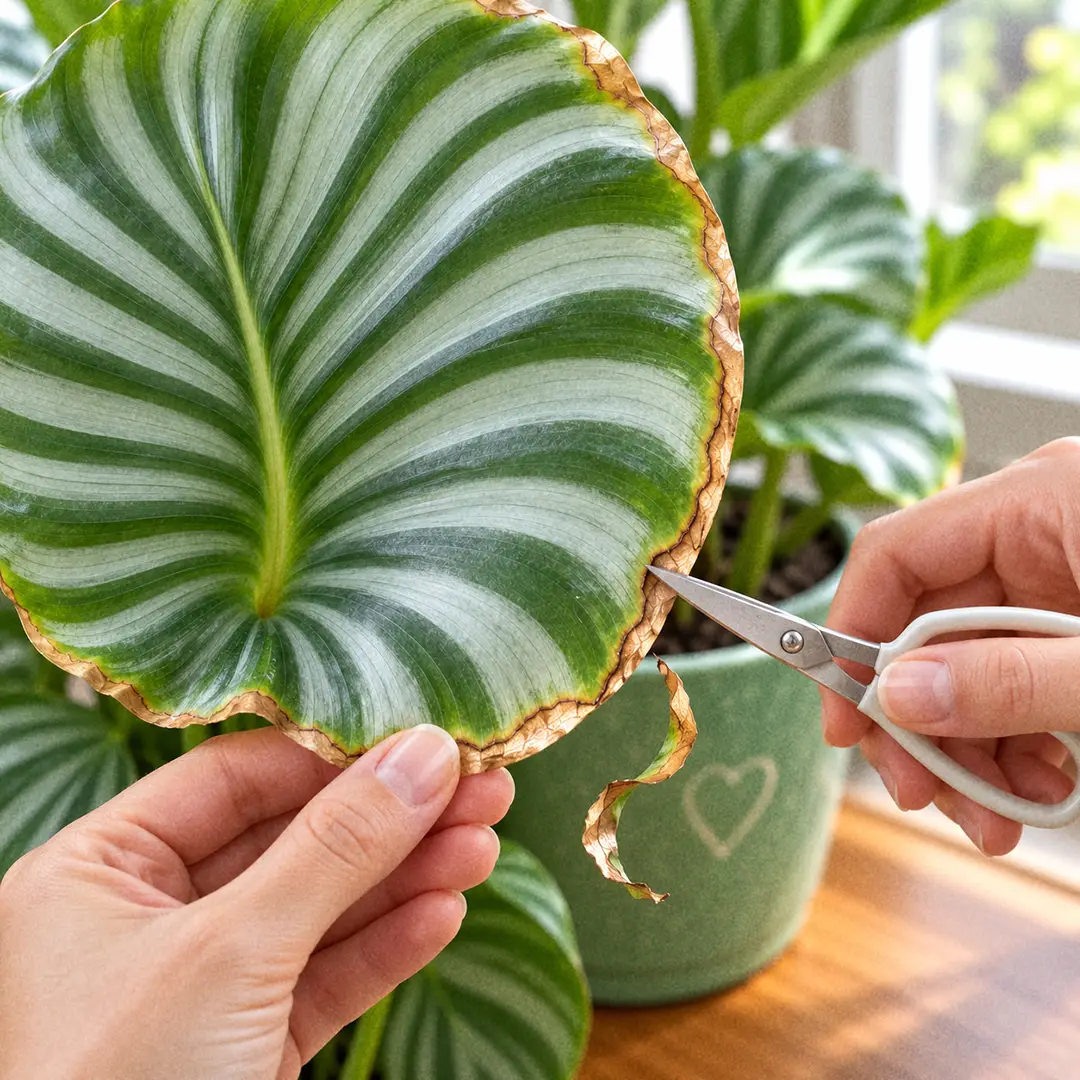
Browned tissue is dead, and no change in care brings it back. The leaf will keep working with its green area, so trimming is purely cosmetic. It does no harm, and it makes it much easier to see whether new damage is appearing.
How to Trim Along the Leaf Shape
Use sharp, clean scissors, or small bypass pruners for a thick leaf. Cut just inside the brown, leaving a hair-thin line of dead tissue, and follow the curve of the leaf so the round shape survives. Cutting into green tissue opens a fresh wound that often browns again along the new edge. A slightly wavy cut that follows the stripes looks far more natural than a straight snip.
When to Remove the Whole Leaf
Take the whole leaf off when more than about half of it is brown or yellow, when it is limp and yellow from root trouble, or when trimming would leave it an odd shape you dislike. Follow the stalk down and cut it close to the soil line. An orbifolia with a handful of healthy leaves recovers faster than one propping up several dying ones.
📅 Calathea Orbifolia Recovery Timeline
New Leaves Are the Scorecard
Old leaves will not improve, so stop judging the plant by them. Watch the next leaf that unrolls from the centre. If it opens fully with clean edges, whatever you changed is working. If it opens and starts browning within a few weeks, something is still off, most often humidity during the heating season.
A Realistic Timeline
In a warm room during spring and summer, a healthy orbifolia pushes out a new leaf every few weeks. Expect the first clean leaf four to eight weeks after you fix the water and air. In winter growth slows and it can take two or three months. A plant recovering from root rot may produce nothing for a month or more while it rebuilds roots.
Why Is My Calathea Orbifolia Dying?
Brown edges on a plant that is still standing upright are cosmetic damage. A plant that is genuinely dying drops or collapses several leaves at once. That is usually root rot from constant wet soil, a long spell bone dry, or cold. Check the roots before anything else: if some are still firm and white, cut away the rest, repot, and give it warmth and patience. For every other cause of browning across houseplants, see our brown crispy edges guide, and for everyday care, the complete Calathea orbifolia guide.
❓ Frequently Asked Questions
Why does my calathea orbifolia have brown edges?
Nearly always the water, the air, or both. Fluoride, chlorine and salts in tap water collect at the leaf margins and burn them, and humidity below about 50 percent dries the same margins from outside. Switch to distilled or rainwater, flush the pot, and run a humidifier near the plant.
Will brown edges on calathea orbifolia turn green again?
No. Browned tissue is dead and stays brown. You can trim it off along the leaf shape for looks, and you judge the fix by whether the next new leaf comes in with clean edges.
Why are my calathea orbifolia leaves curling?
Curling along the length of the leaf means the plant is losing water faster than it can replace it, from dry soil, dry air or strong light. If the soil is wet and the leaves are limp as well as curled, check the roots for rot. Leaves lifting and folding up in the evening is normal prayer plant movement.
Is it normal for calathea orbifolia leaves to fold up at night?
Yes. The leaves lift at a joint at the top of the stalk in the evening and drop again by morning. The blade itself stays flat and soft. Evening lifting is normal. Curling that is still there at midday means something is wrong.
Why is my calathea orbifolia dying?
A plant losing several leaves at once is usually suffering from root rot, a long spell of dry soil, or cold. Check the roots first: firm and white means the problem is above the soil, brown and mushy means rot. Brown edges alone on an otherwise upright plant mean damaged leaves, and the plant itself is usually fine.
Should I mist my calathea orbifolia to stop brown edges?
Misting barely helps. It raises humidity for a few minutes and leaves water sitting on the leaves, which can start fungal spots. A small humidifier running near the plant is what actually changes the number.
Is calathea orbifolia safe for cats and dogs?
Yes. The ASPCA lists calathea species as non-toxic to cats and dogs, so trimmed leaves and chewed edges are not a poisoning risk. A pet that eats a lot of any leaf may still get a mild upset stomach.
🪴 See also 🪴
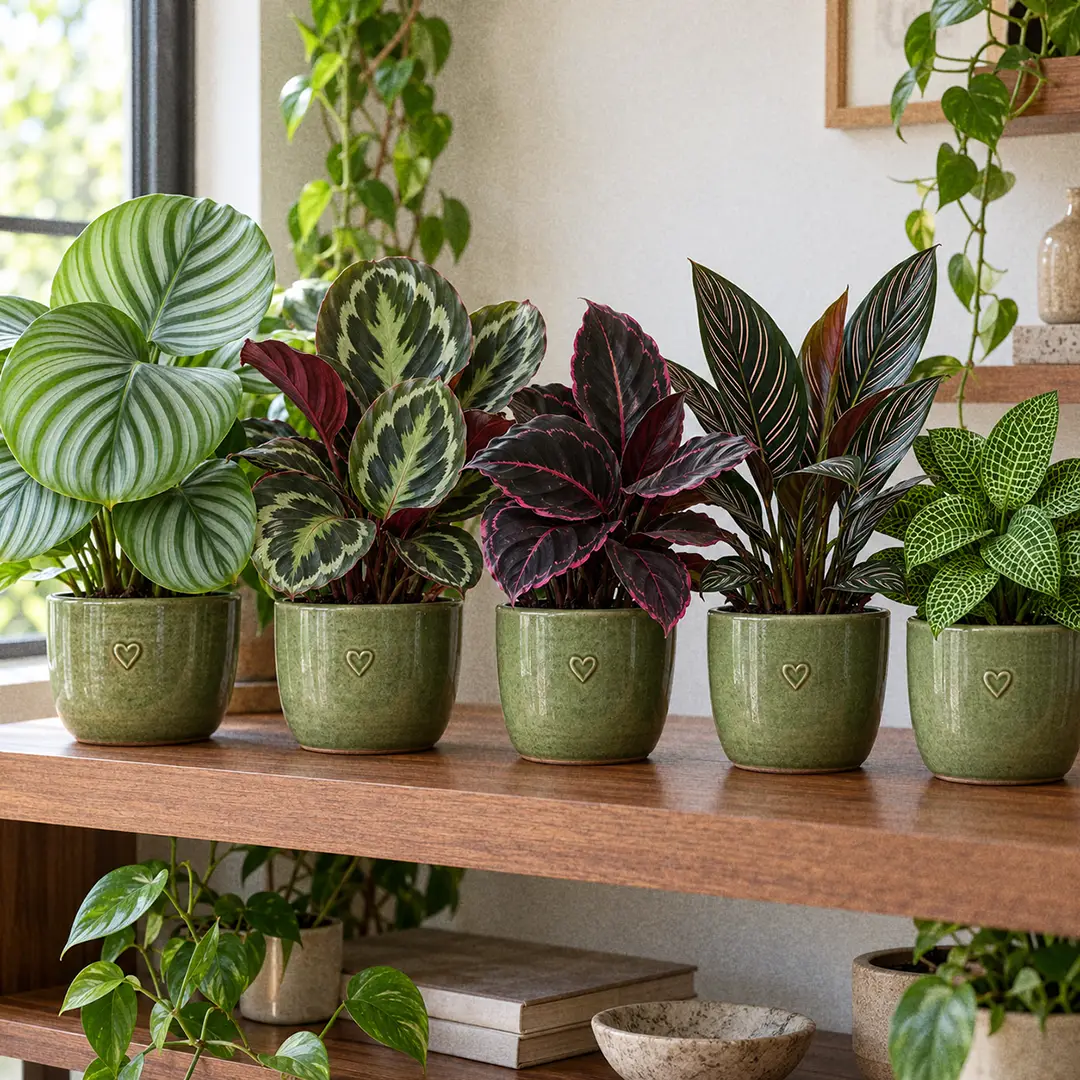
Calathea Care Indoors: Full Guide and 7 Types We Grow

Houseplant101 Forum
Questions & Comments
Ask a question, share your plant experience, or help other plant owners.
Comments are temporarily unavailable.
Open the Houseplant101 ForumNo comments yet
Be the first to ask a question or share your experience about this page.
Log in or create an account
Comments use your Houseplant101 Forum account, but you can stay on this page.
Create a new account