
 AI Overview
 🪴 In This Guide 🪴

A Note From Our Plant Expert
Anastasia here. Peperomia is the genus I recommend to people with a small flat, a curious cat, and no south-facing window, because almost every one of the fourteen plants below stays under a foot tall and none of them are toxic. The catch is that they look like ordinary leafy houseplants and are not. Those thick leaves are water tanks, so the watering can is the thing most likely to kill yours.
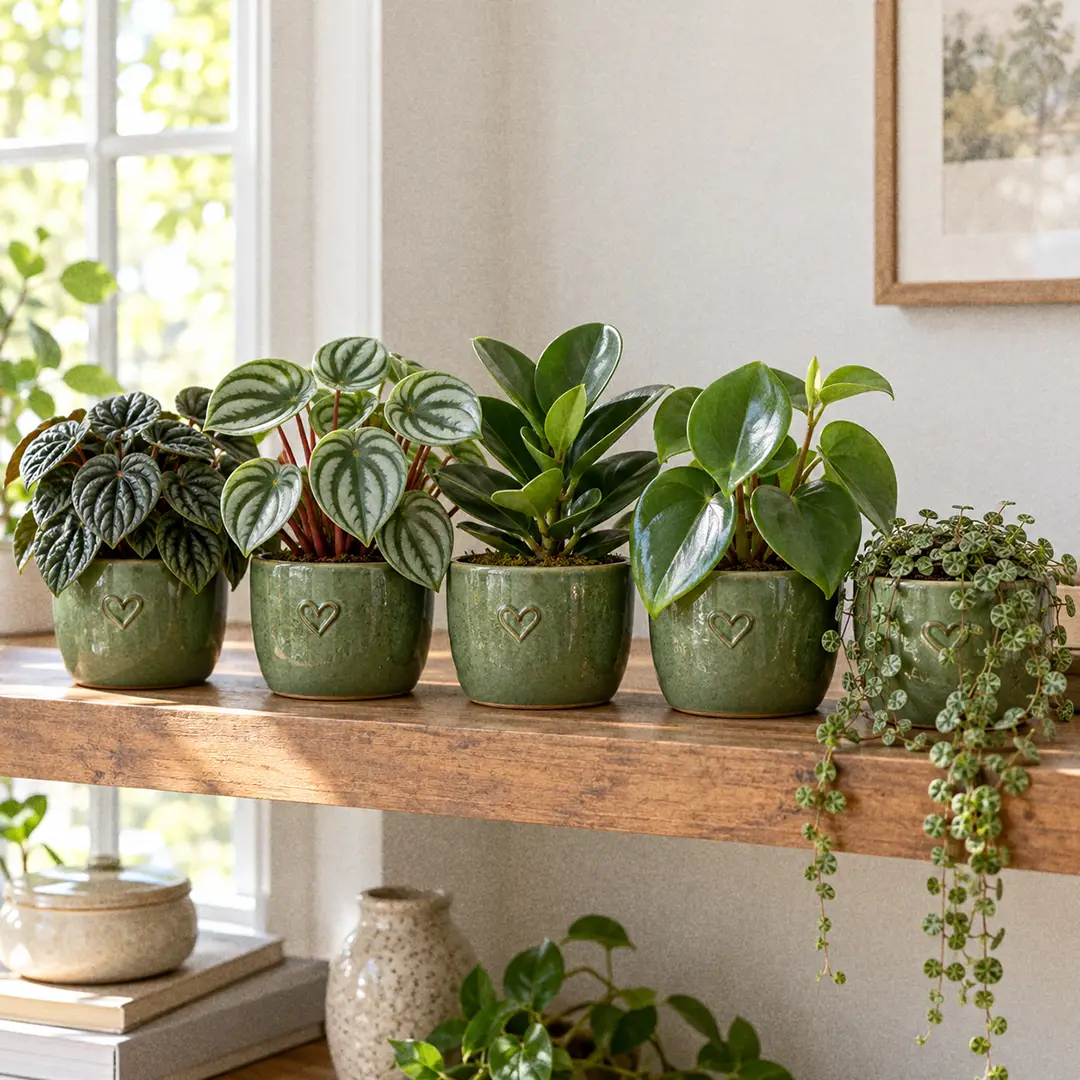
🧭 Peperomias Are Semi-Succulent, Which Decides How You Water Them
Peperomias sit in the pepper family, Piperaceae, alongside the vine that gives us black peppercorns. There are well over a thousand species, mostly from Central and South American rainforests, and the great majority of them do not grow in the ground. They perch on mossy branches and rock faces, with a thin root system that holds on rather than digs in.
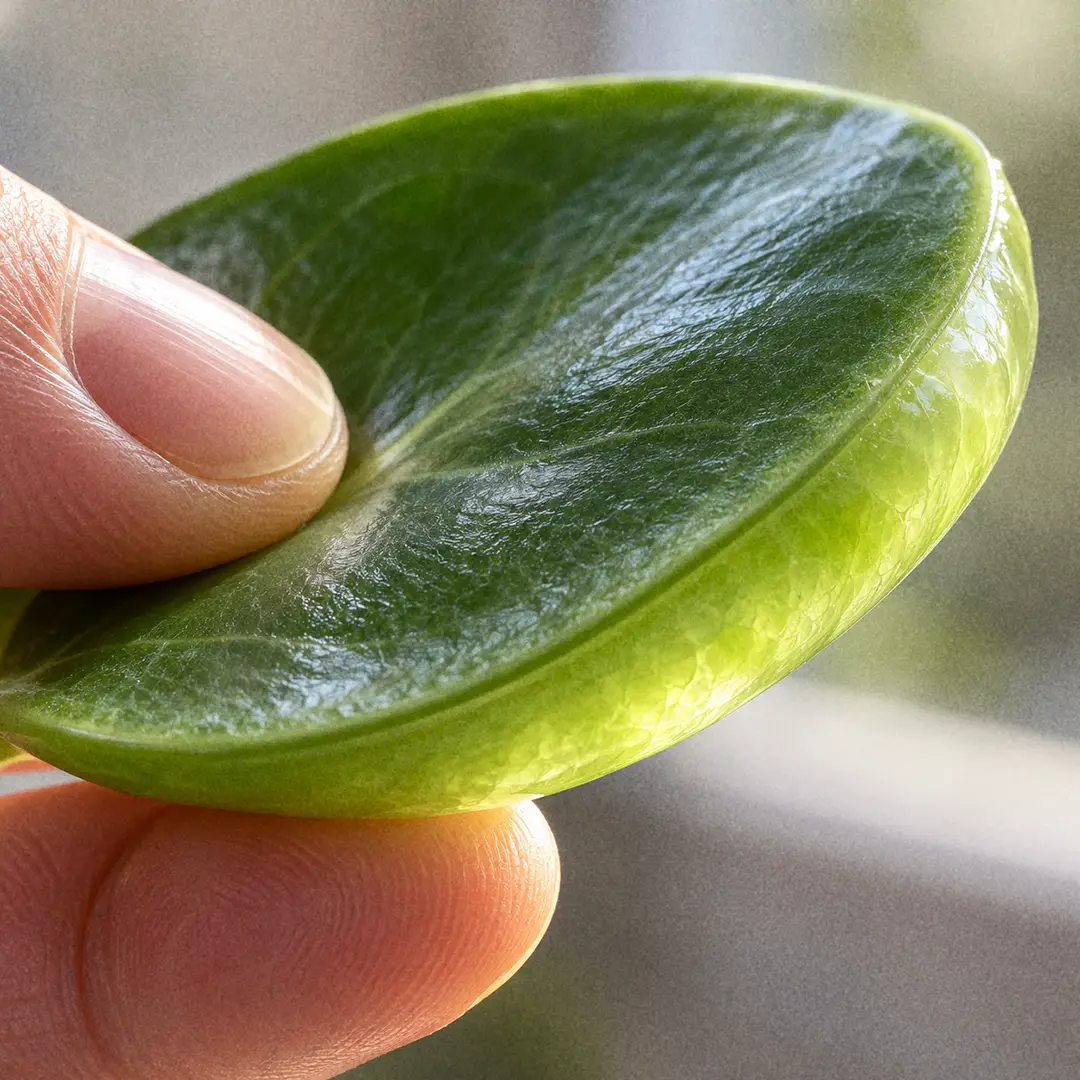
Why the Leaves Are So Thick
Life on a branch means the water runs off within minutes of the rain stopping. Peperomias solved that by storing water in the leaf itself, which is why a healthy leaf feels plump and slightly springy rather than papery. Squeeze one gently and you get the same resistance you would get from a jade plant leaf. The plant is carrying its own reservoir.
What That Means for Your Watering Can
A peperomia that has gone a week too long simply draws down its reserves. The leaves soften, the plant looks tired, and a good soak fixes it within a day. A peperomia sitting in wet soil has nowhere to put the extra water, and those fine surface roots suffocate and rot in a matter of days. Root rot is the number one killer in this genus by a wide margin, and it is usually fatal by the time the leaves tell you about it.
The One Rule to Remember
Treat a peperomia more like a succulent than like a fern. When you cannot decide whether to water, do not. That single habit will keep more peperomias alive than anything else on this page.
☀️ Peperomia Light Requirements Indoors
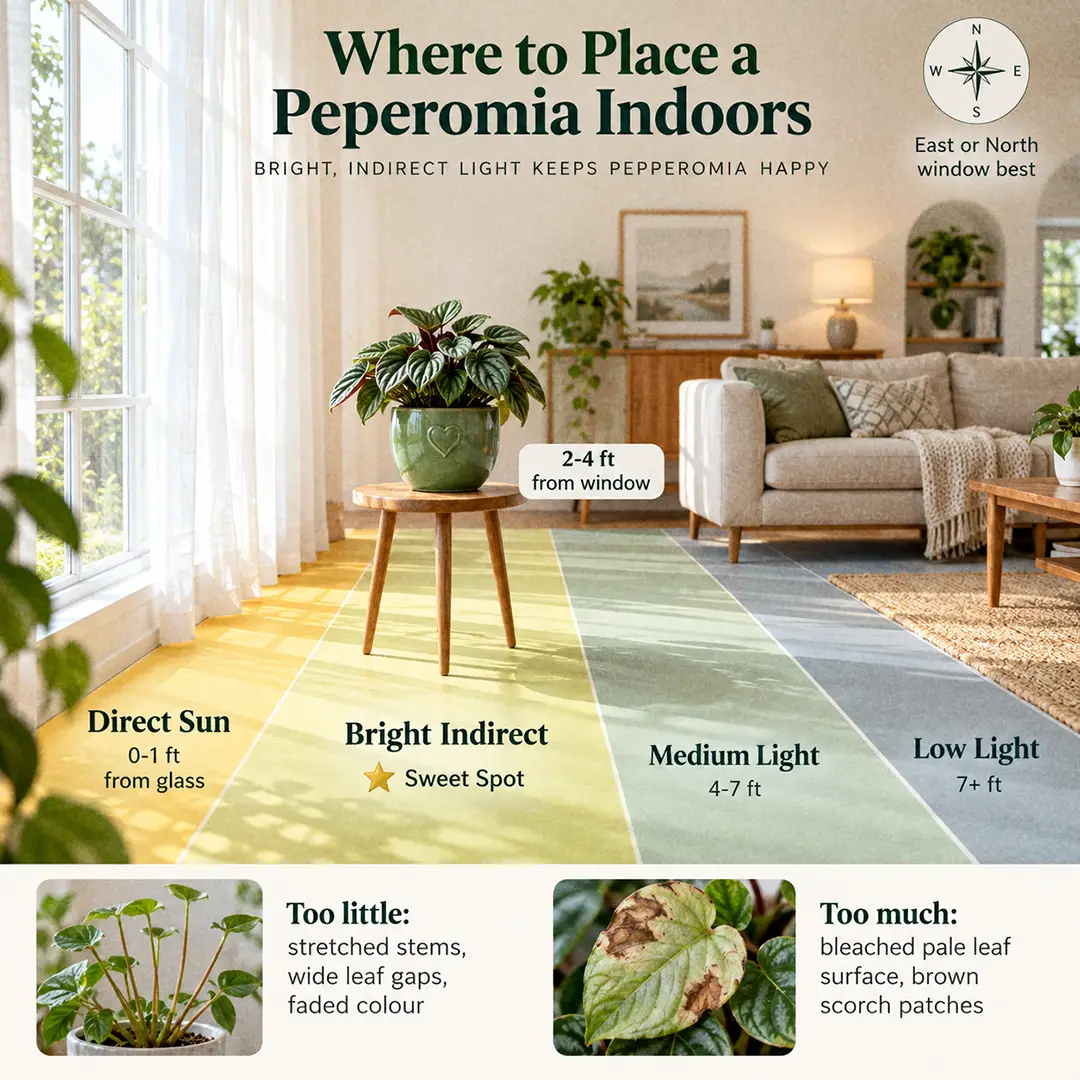
The Sweet Spot
Bright indirect light, two to four feet back from an east or north window. That covers every plant in this guide. A south or west window works if a sheer curtain takes the edge off the afternoon. Under a rainforest canopy these plants live in dappled shade, so soft light all day suits them better than a couple of hours of intensity.
Too Little Light
Peperomias survive low light better than most plants and grow badly in it. The stems stretch, the gaps between leaves widen, and the plant leans toward whatever light it can find. Coloured and variegated types lose their pattern first: a Rosso in a dim corner fades to plain green and stays that way. Worse, a plant in low light dries out slowly, which multiplies the risk of overwatering. If the room cannot offer better, a grow light costs less than replacing the plant.
Too Much Light
Direct midday sun bleaches the leaf surface to a pale washed-out green, and on the darker types it burns through to brown patches within a couple of days. Thin-leaved varieties like Watermelon Peperomia scorch faster than the fleshy ones. Move the plant a foot back from the glass and the new growth comes in normally, though the damaged leaves never recover.
💧 How to Water a Peperomia
Watering Frequency
In a bright room in summer, most peperomias want water every ten to fourteen days. In winter that stretches to three or four weeks. Treat those numbers as a starting point and then adjust. Pot size and room warmth change the answer more than the variety does, so a four-inch pot on a warm sill dries out roughly twice as fast as a six-inch pot on a cool shelf.
How to Check
Push a finger two inches into the mix. If it comes out with damp grit clinging to it, wait. Lifting the pot works even better once you learn the weight, because a watered peperomia feels noticeably heavier than a dry one. A moisture meter is worth having if you are the sort of person who waters out of habit rather than observation.
How to Water
Take the pot to the sink, run water through until it streams out the drainage holes, and let it drain completely before it goes back on its saucer. Never leave one standing in a full saucer. Bottom watering suits the rippled types, whose crinkled leaves trap droplets and spot.
Signs You Got It Wrong
Limp, thin, slightly wrinkled leaves on a light pot mean thirst, and a soak brings them back by morning. Yellow leaves dropping from a heavy, damp pot mean rot, and that needs the plant out of the pot and the roots inspected the same day. Our watering guide goes deeper if you want the full picture.
🪴 Best Soil and Pots for Peperomia
What the Mix Needs to Do
Those fine epiphytic roots need air around them. Bagged potting compost on its own holds water like a sponge, stays wet in the middle for a week, and kills peperomias slowly. What you want is a mix that drains within seconds of a soak and holds air between the particles.
A Mix That Works
Two parts peat or coco coir, one part orchid bark, one part perlite, and a handful of horticultural charcoal if you keep it around. That blend drains fast and still holds enough moisture for a fortnight. A ready-made chunky houseplant mix does the same job if you only have a plant or two. An orchid mix cut with a third potting soil also works in a pinch.
Choosing a Pot
Go smaller than you think. A peperomia root ball is tiny relative to the plant above it, and spare soil around the edges stays wet and rots the roots. Repot into the next size up only when roots show at the drainage holes, which for most types means every two or three years. Terracotta is genuinely useful here because it wicks moisture out through the walls. Our repotting guide covers the timing.
💦 Peperomia Humidity and Temperature
Ideal Humidity
Ordinary household air at 40 to 50 percent suits most peperomias. The thick leaves hold their own water, so the dry-air problems that plague calatheas rarely show up here. The exceptions are the thinner-leaved ones: String of Turtles, Watermelon Peperomia, and Parallel Peperomia all prefer 50 to 60 percent and crisp at the edges below that.
Easy Humidity Boosters
Group the pots together so they share transpired moisture, sit them on a pebble tray, or run a small humidifier nearby through the winter heating months. Skip misting. It does nothing for more than a quarter of an hour and leaves water sitting in the crinkles of a caperata leaf, which is where fungal spotting starts. There is more in our humidity guide.
Temperature Range
Peperomias are sometimes sold as radiator plants because they like the warm, bright spot above one. Anywhere from 65 to 80°F (18 to 27°C) keeps them growing. Below 50°F (10°C) they stop and start dropping leaves. Cold drafts from a winter door are a common and easily missed cause of sudden leaf loss, so check what is behind the plant before you blame the watering.
🍼 Feeding Peperomia
When and How Often
Once a month from early spring to late summer, then nothing at all through autumn and winter. These are slow growers with small root systems and a modest appetite. A plant that is not actively pushing new leaves cannot use what you pour on it, and the leftover salts sit in the mix and scorch the root tips.
What to Use
A balanced liquid houseplant fertiliser at quarter to half the label strength. Treat half strength as the ceiling rather than the target. Worm castings worked into the top of the mix each spring are a gentler option if measuring dilutions is not your idea of a good time.
Signs of Overfeeding
A white crust on the soil surface, brown leaf tips on an otherwise healthy plant, and new leaves coming in small or distorted. Flush the pot with plain water three or four times, skip the next two feeds, and it sorts itself out. Our fertilizing guide has the schedule in detail.
🌿 1. Emerald Ripple Peperomia (Peperomia caperata)
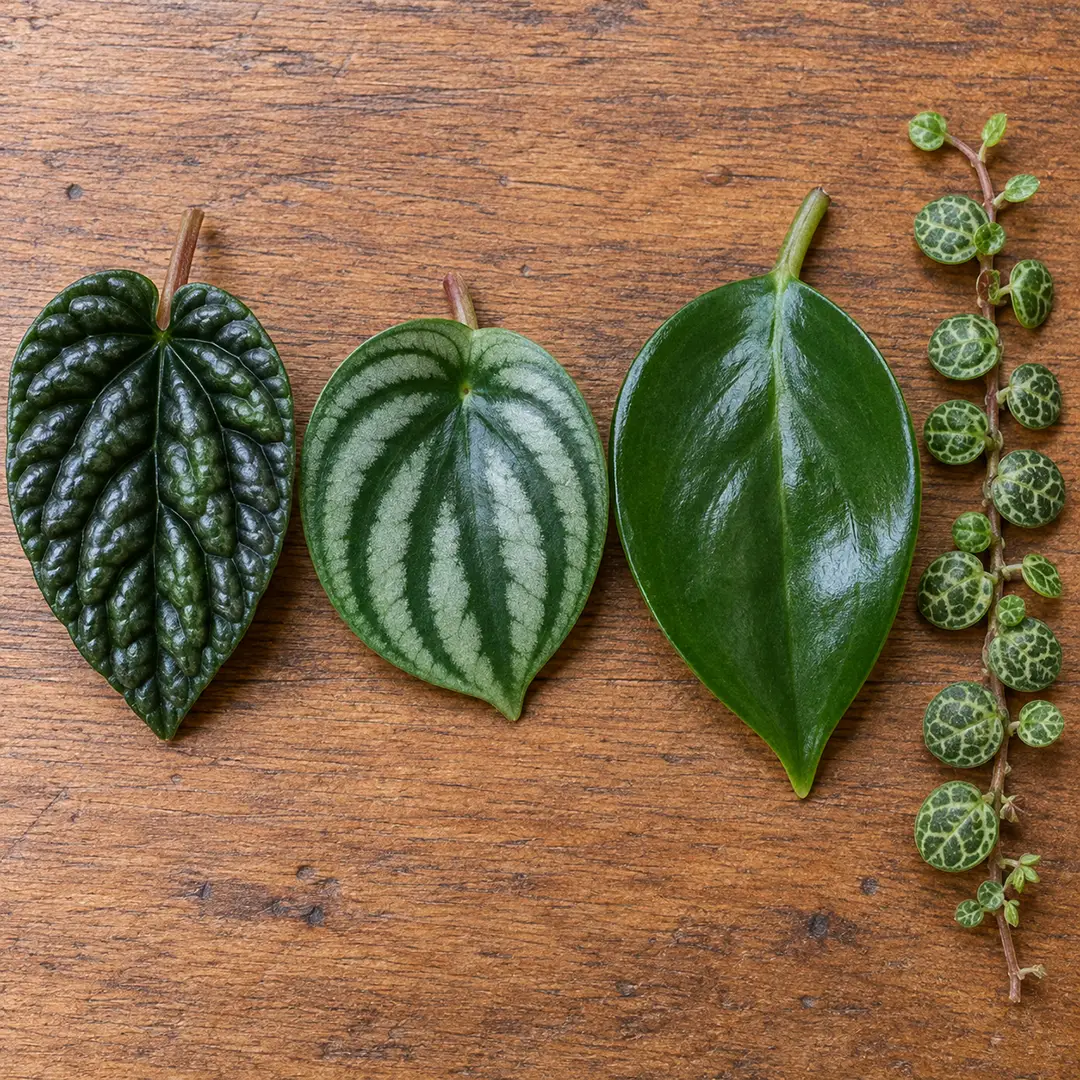
Why It's Popular
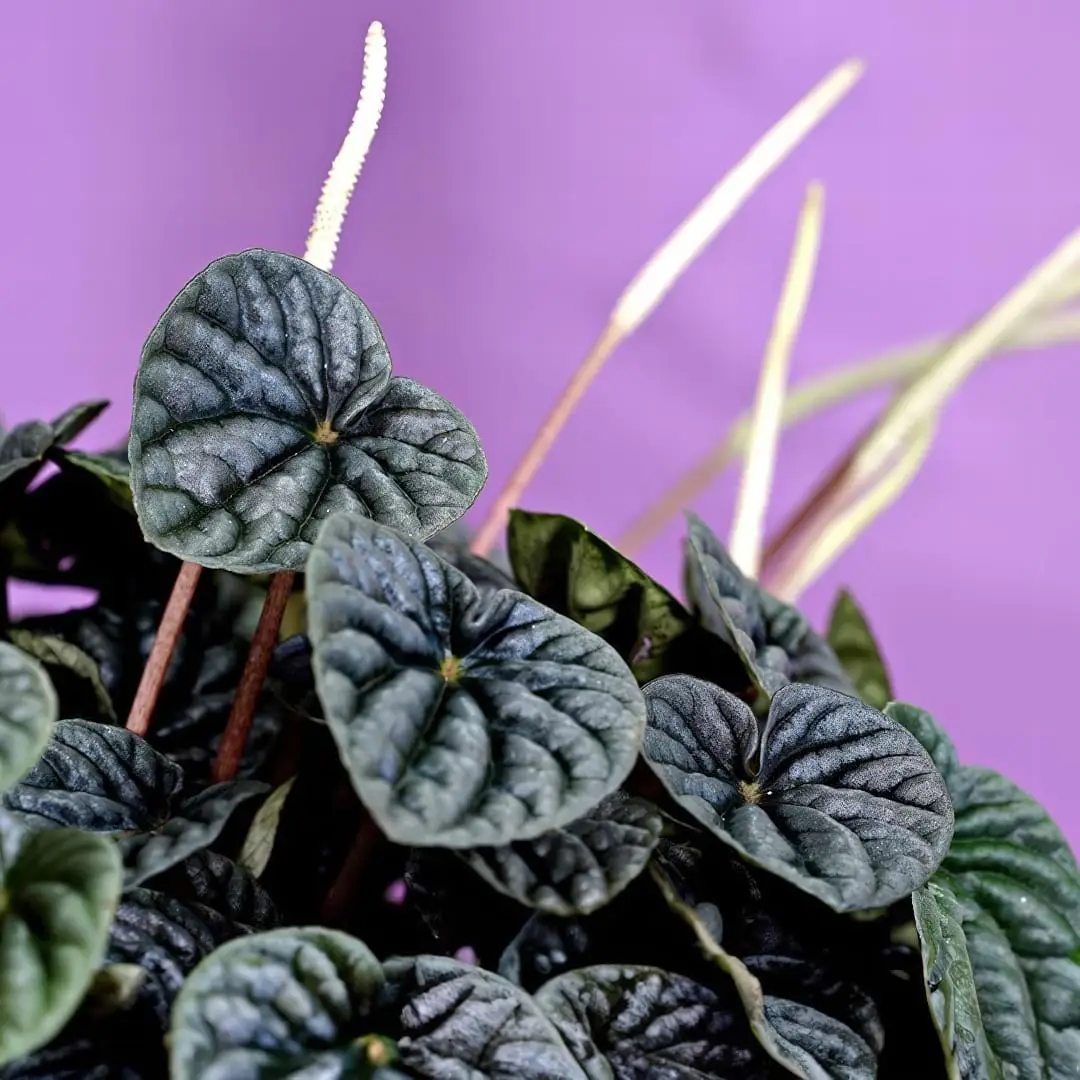
The species behind half the peperomias in the shops. Deep green heart-shaped leaves so heavily corrugated that the surface looks quilted, carried on short red-tinged stalks in a tight little rosette. Nothing else in the genus has that texture.
Care Notes
- Stays around 8 to 12 inches and never needs a bigger pot in a hurry.
- The ripples trap water, so water at the soil and not over the top.
- Roots readily from a single leaf pushed into damp mix.
Full details in our 👉 Emerald Ripple Peperomia care guide.
🌿 2. Red Ripple Peperomia (Peperomia caperata 'Red Ripple')
Why It's Popular
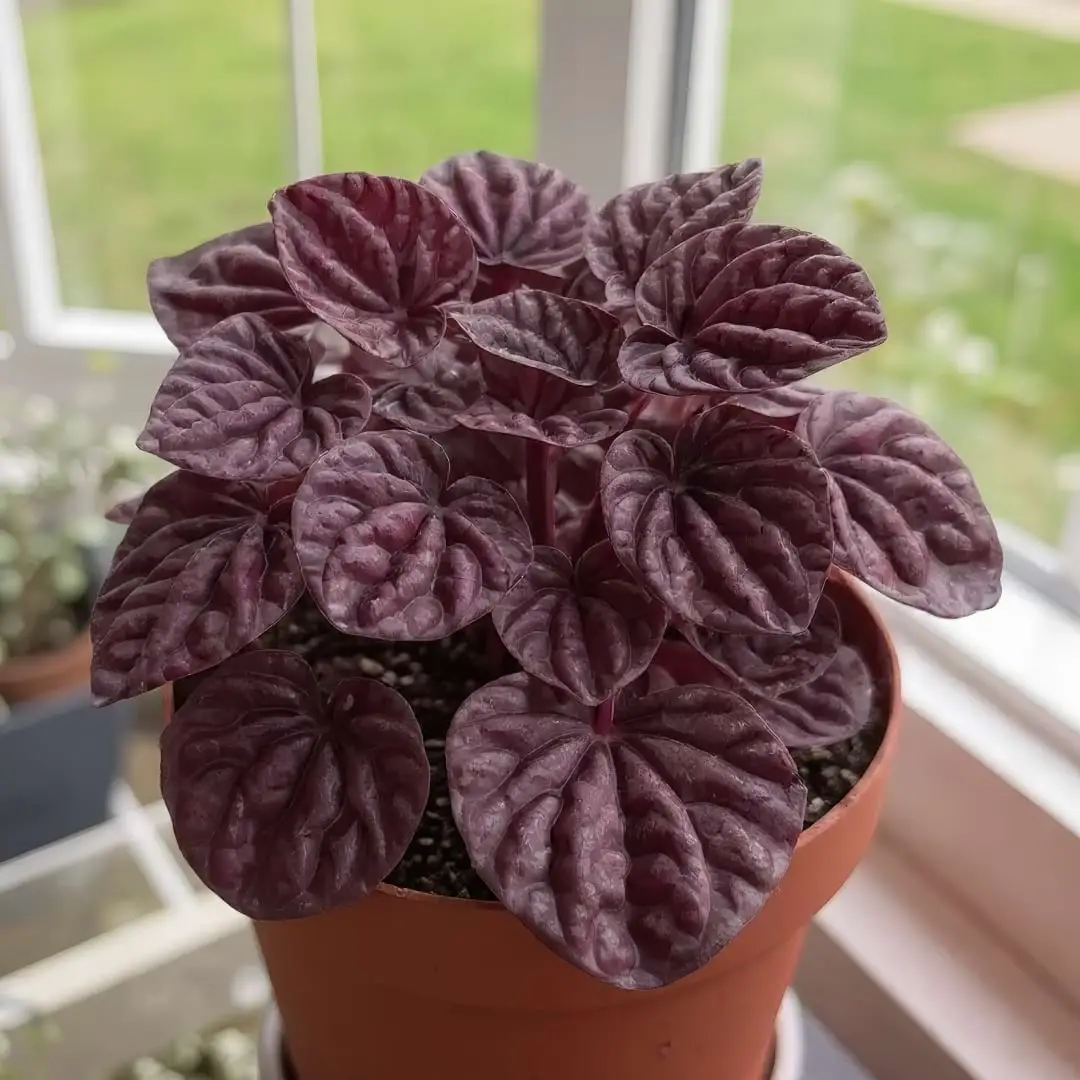
Same quilted texture as the Emerald, with the leaf undersides and stalks flushed a deep wine red that shows through the ripples from above. In good light the whole plant reads burgundy rather than green.
Care Notes
- Needs brighter indirect light than the plain green form to hold the red.
- Compact at 6 to 8 inches, so it suits a desk or a narrow sill.
- Colour fades in a dim corner and does not come back in the same leaves.
Full details in our 👉 Red Ripple Peperomia care guide.
🌿 3. Peperomia Rosso (Peperomia caperata 'Rosso')
Why It's Popular
The one people stop and ask about. Narrow, pointed, glossy dark green leaves above, brilliant red beneath, with the two colours meeting at a sharp edge. Rosso also throws its rat-tail flower spikes more willingly than most peperomias do.
Care Notes
- Wants steady bright indirect light to keep the red saturated.
- Grows to about 6 to 8 inches in a tight rosette.
- Leaf cuttings root well, and the pups come true to the parent.
Full details in our 👉 Peperomia Rosso care guide.
🌿 4. Silver Ripple Peperomia (Peperomia caperata 'Silver Ripple')
Why It's Popular
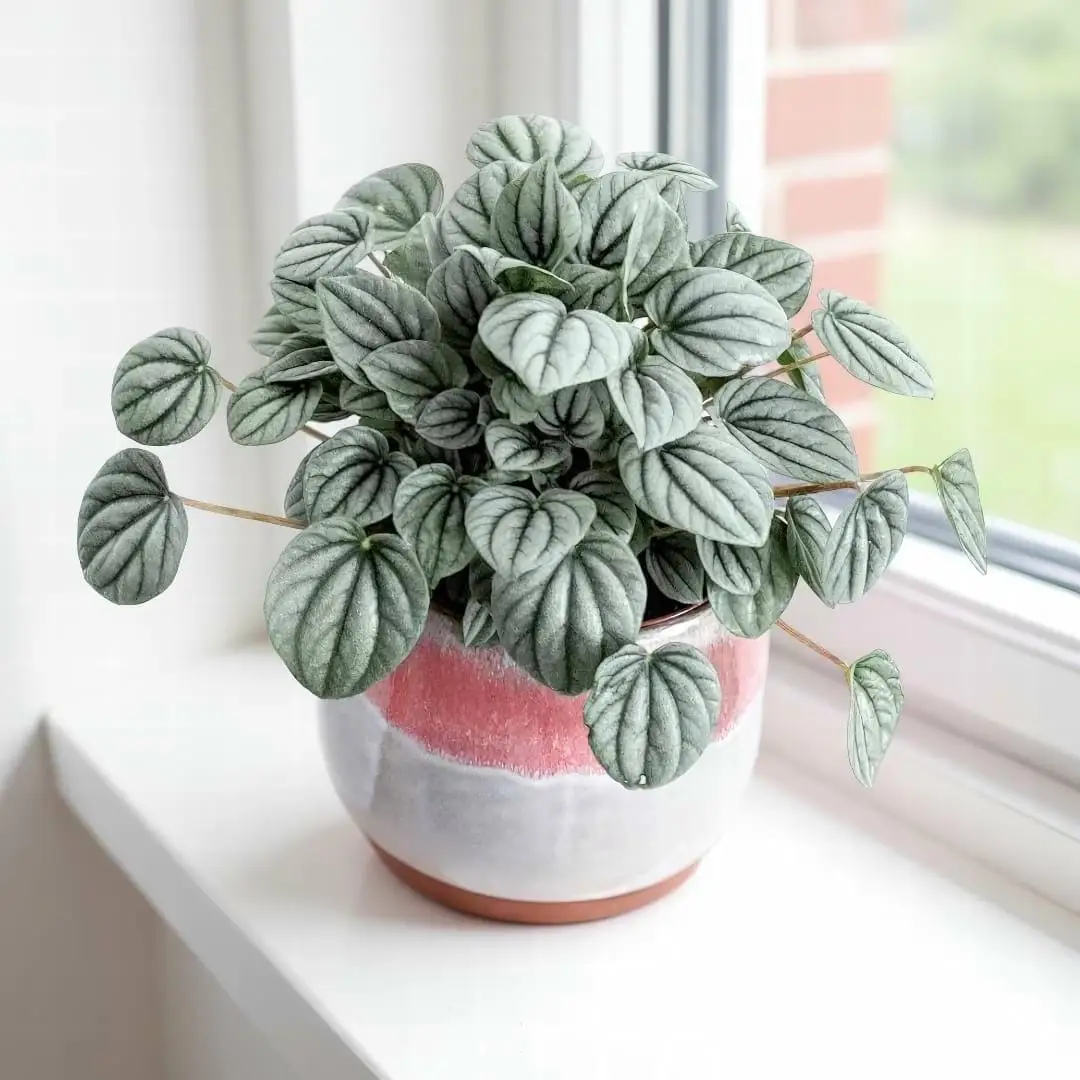
The caperata texture in pewter. Silver-grey leaves with darker green sunk into the valleys of each ripple, which gives the plant a frosted look under window light. It brightens a shelf that green plants disappear into.
Care Notes
- Reaches 8 to 10 inches and spreads slowly outward.
- Silvering is a surface effect and holds up better in slightly lower light than Rosso does.
- Avoid splashing the leaves, since water marks show badly on the silver.
Full details in our 👉 Silver Ripple Peperomia care guide.
🌿 5. Peperomia Napoli Nights
Why It's Popular
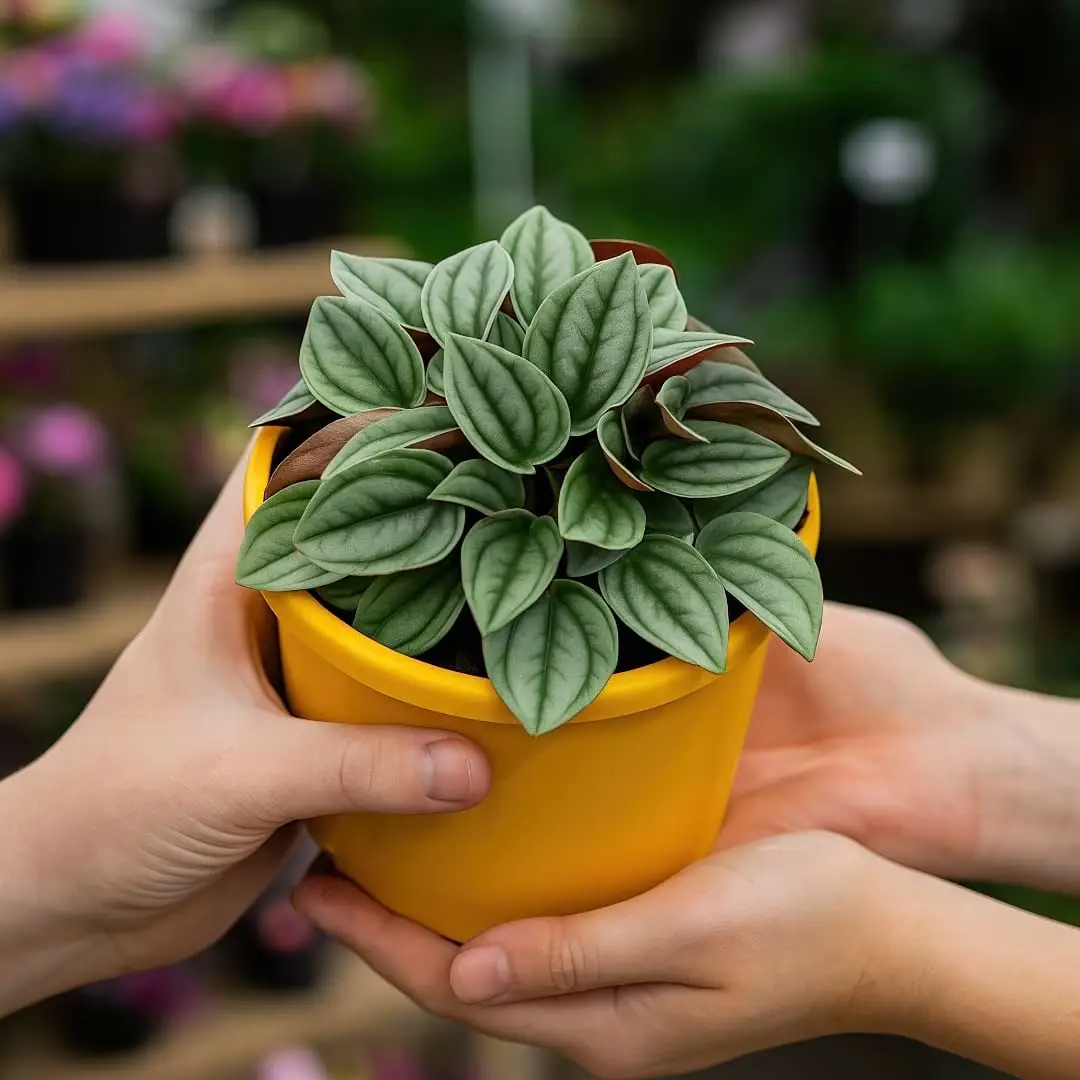
A newer caperata-type hybrid with slim, pointed, silver-blue leaves marked by dark green veins pressed deep into the surface. It has a cooler, more architectural look than the rounder ripples, and it stays neat without any pruning.
Care Notes
- Compact at 6 to 10 inches and slow enough to live in one pot for years.
- Holds its silver-blue tone in moderate light better than most coloured types.
- Still young in the trade, so expect to pay a little more than for an Emerald Ripple.
Full details in our 👉 Peperomia Napoli Nights care guide.
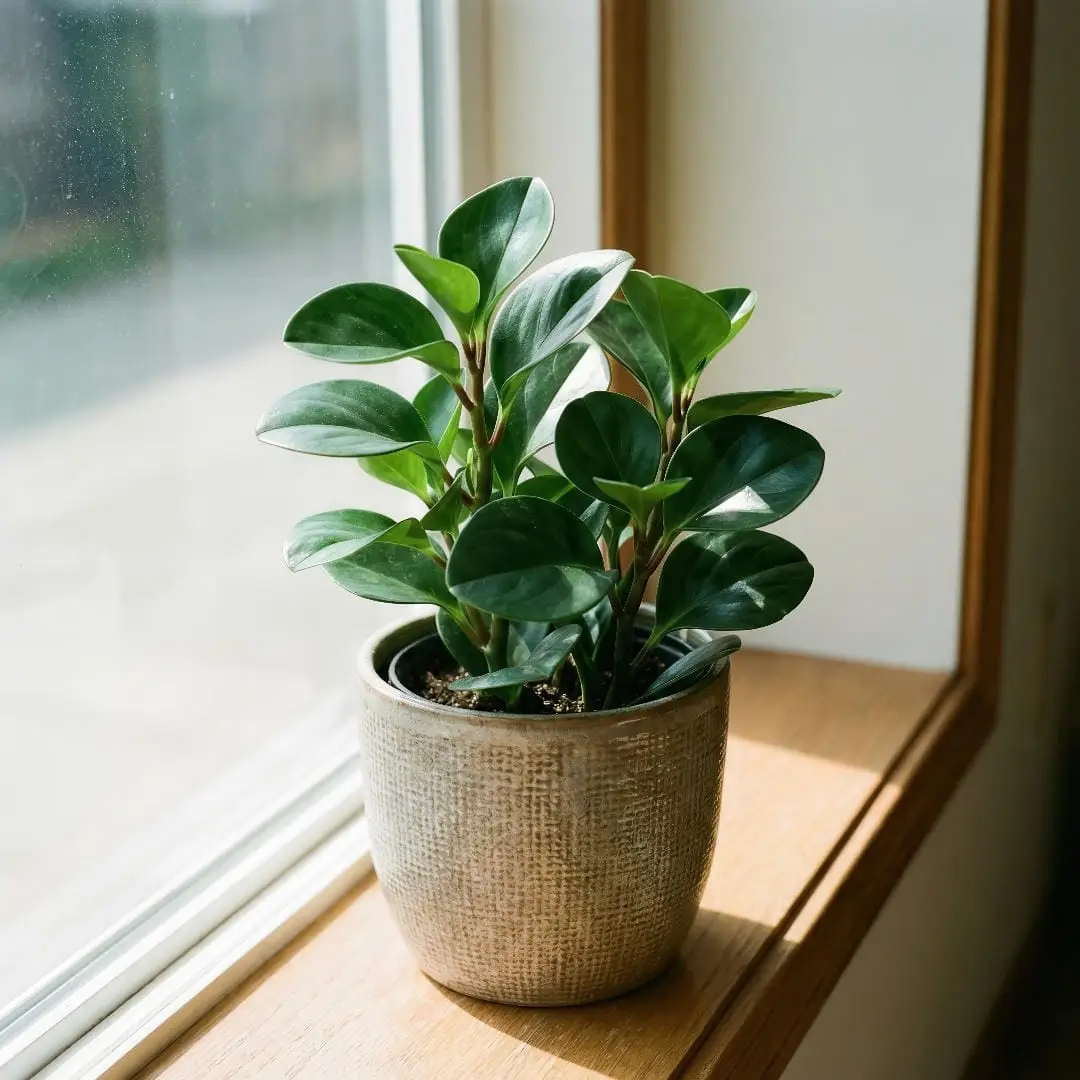
🌳 6. Baby Rubber Plant (Peperomia obtusifolia)
Why It's Popular
The toughest plant in the genus and the one to buy first. Thick, glossy, spoon-shaped leaves on upright fleshy stems, sold plain green or in a cream-edged variegated form. The leaves are so plump they squeak slightly when you press one.
Care Notes
- Handles a dim corner and a forgotten watering can better than anything else here.
- Grows 10 to 18 inches indoors and stays bushy if you pinch the stem tips.
- Stem cuttings root in water within a fortnight.
Full details in our 👉 Baby Rubber Plant care guide.
🌳 7. Raindrop Peperomia (Peperomia polybotrya)
Why It's Popular
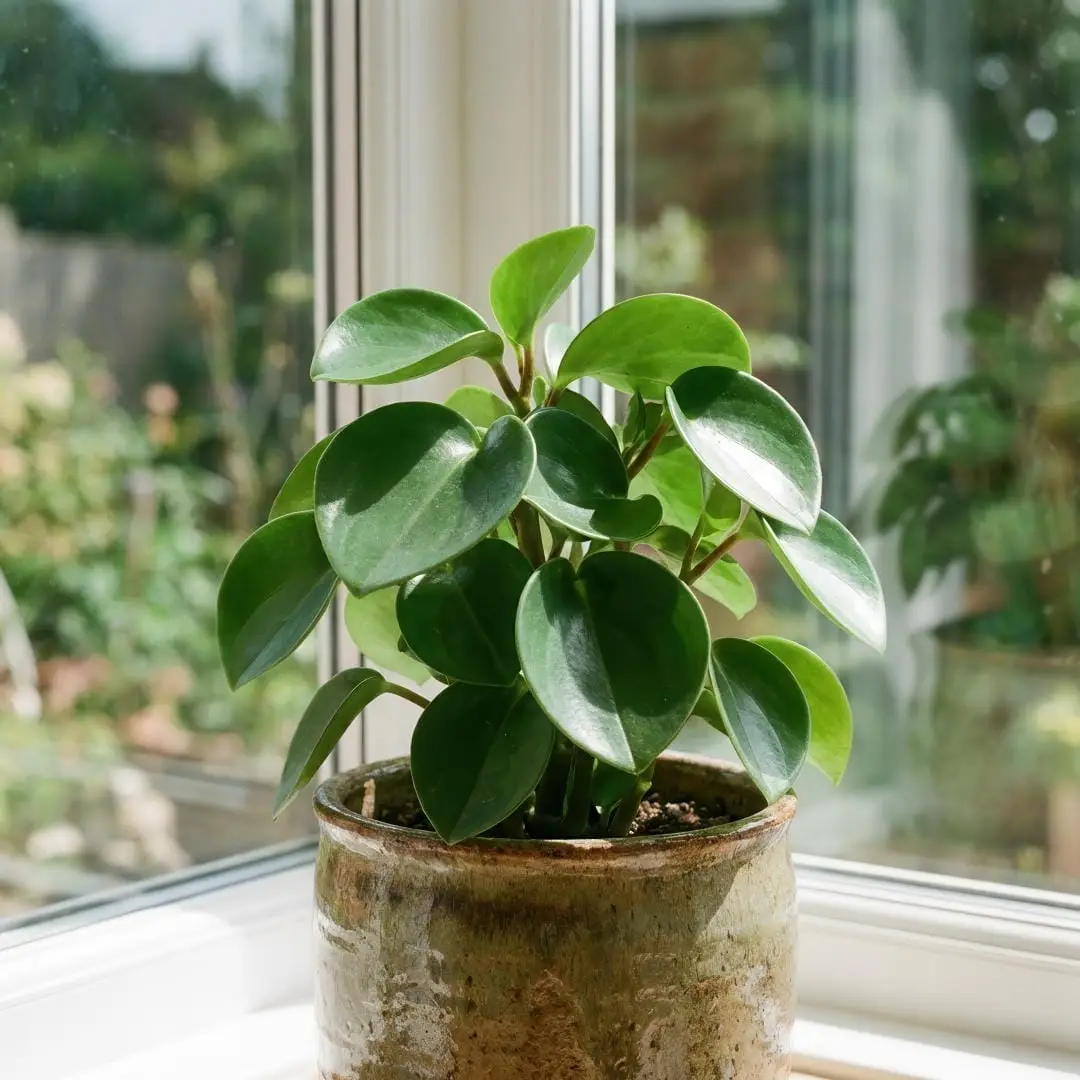
Big, glossy, teardrop-shaped leaves held out on long stalks, each one coming to a point that gives the plant its name. It is the peperomia most often mistaken for a Chinese Money Plant, and the one that looks most like a designer bought it for you.
Care Notes
- Reaches 10 to 18 inches and carries the largest leaves in this list.
- Heavy leaves flop if the light is too low, so give it a bright spot.
- Rotate the pot a quarter turn weekly or it leans hard toward the window.
Full details in our 👉 Raindrop Peperomia care guide.
🌳 8. Watermelon Peperomia (Peperomia argyreia)
Why It's Popular
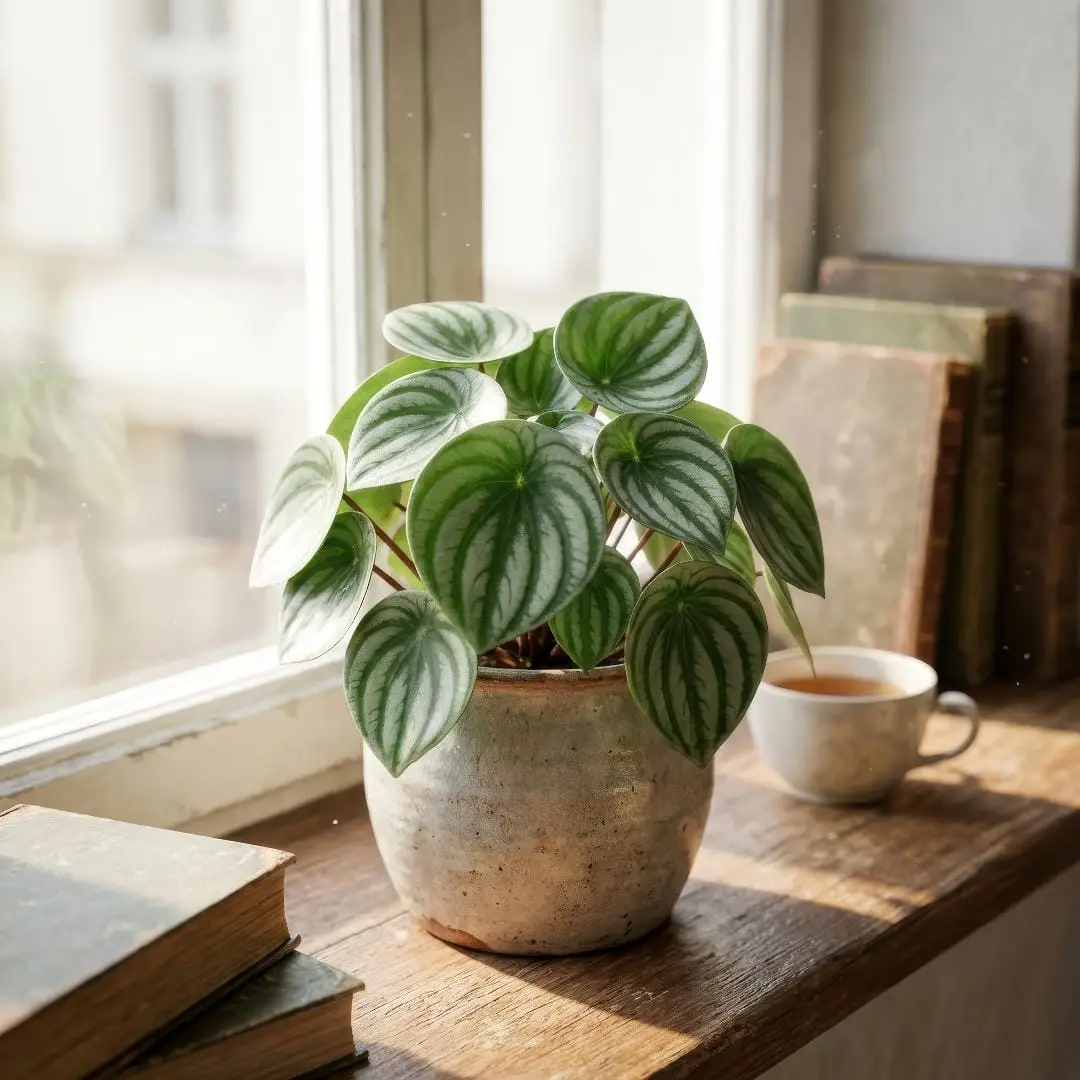
Oval leaves banded in alternating silver and dark green, exactly like the rind of a watermelon, held on dark red stalks that radiate from the centre of the pot. Plenty of people buy this one for the leaves alone and only later discover it is a peperomia.
Care Notes
- Thinner leaves than its cousins, so it wants 50 to 60 percent humidity and slightly steadier moisture.
- Stays around 8 to 12 inches and is rated moderate rather than easy.
- Propagates from a leaf cut in half across the middle and set in damp mix.
Full details in our 👉 Watermelon Peperomia care guide.
🌳 9. Teardrop Peperomia (Peperomia orba)
Why It's Popular
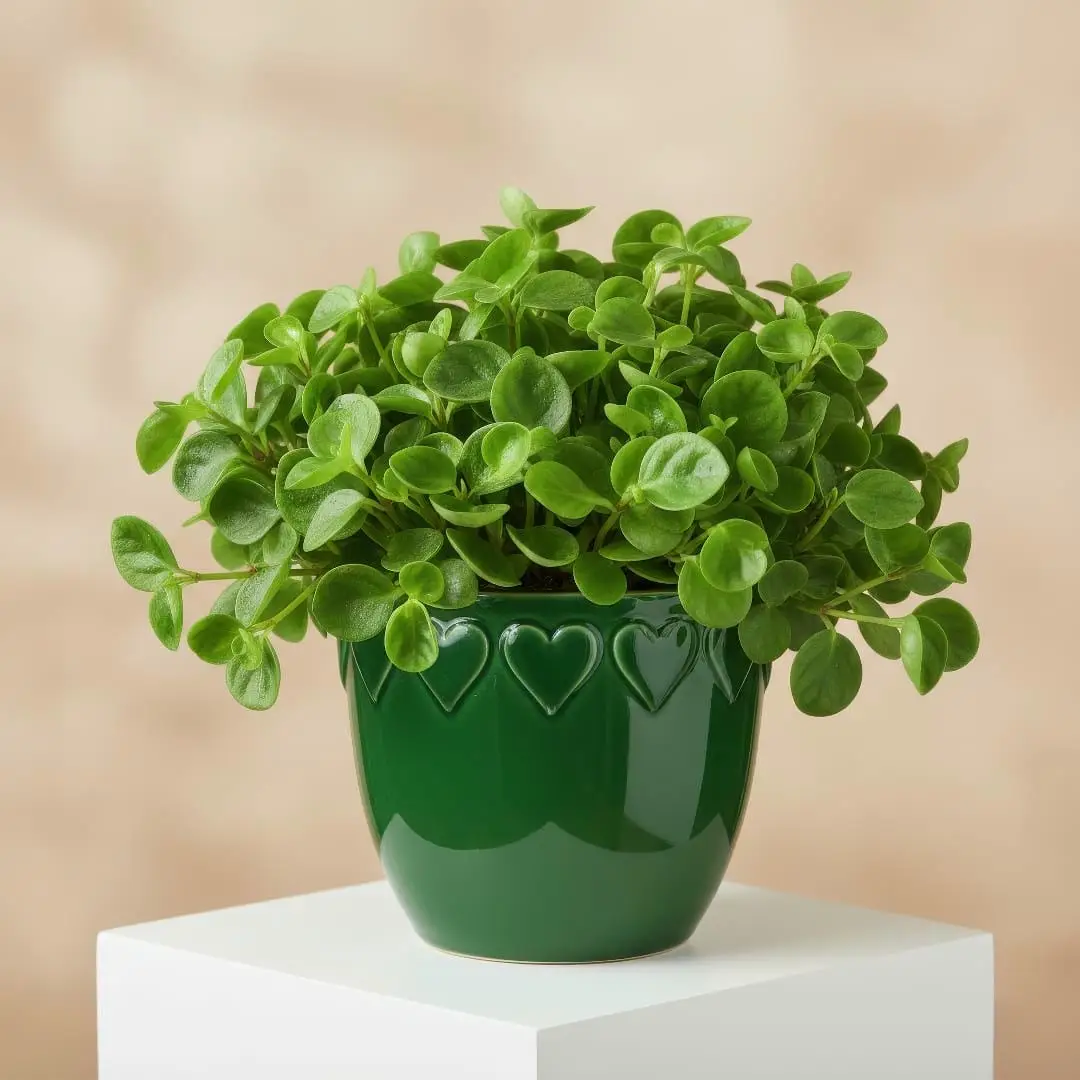
A small, tidy mound of thick green teardrop leaves with a faint pale stripe down the centre vein. It is often sold as 'Pixie' or 'Pixie Lime', and it is about as low-demand as houseplants get.
Care Notes
- Tops out at 6 to 8 inches, which makes it a genuine desk plant.
- Very thick leaves, so it goes three or four weeks between drinks in winter.
- The variegated form needs brighter light to keep its cream margins.
Full details in our 👉 Teardrop Peperomia care guide.
🌳 10. Peperomia Green Bean (Peperomia ferreyrae)
Why It's Popular
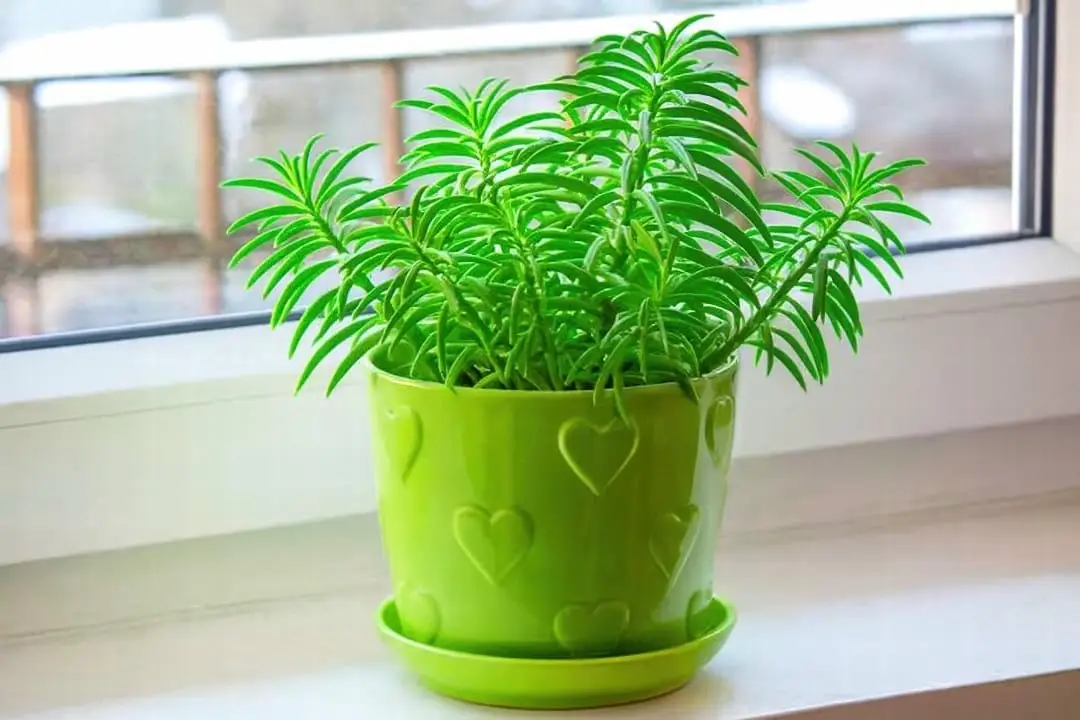
The oddest-looking plant in the genus. Instead of flat leaves it produces narrow, folded, bean-shaped ones that stand upright along the stem, each with a translucent window running down its length to let light reach the inner tissue. It looks more like a succulent than a peperomia.
Care Notes
- Reaches about 12 inches and eventually sprawls, which is part of its charm.
- The most drought-tolerant plant on this page. Water it like a succulent.
- Needs the brightest light here, short of direct midday sun.
Full details in our 👉 Peperomia Green Bean care guide.
💎 11. String of Turtles (Peperomia prostrata)
Why It's Popular
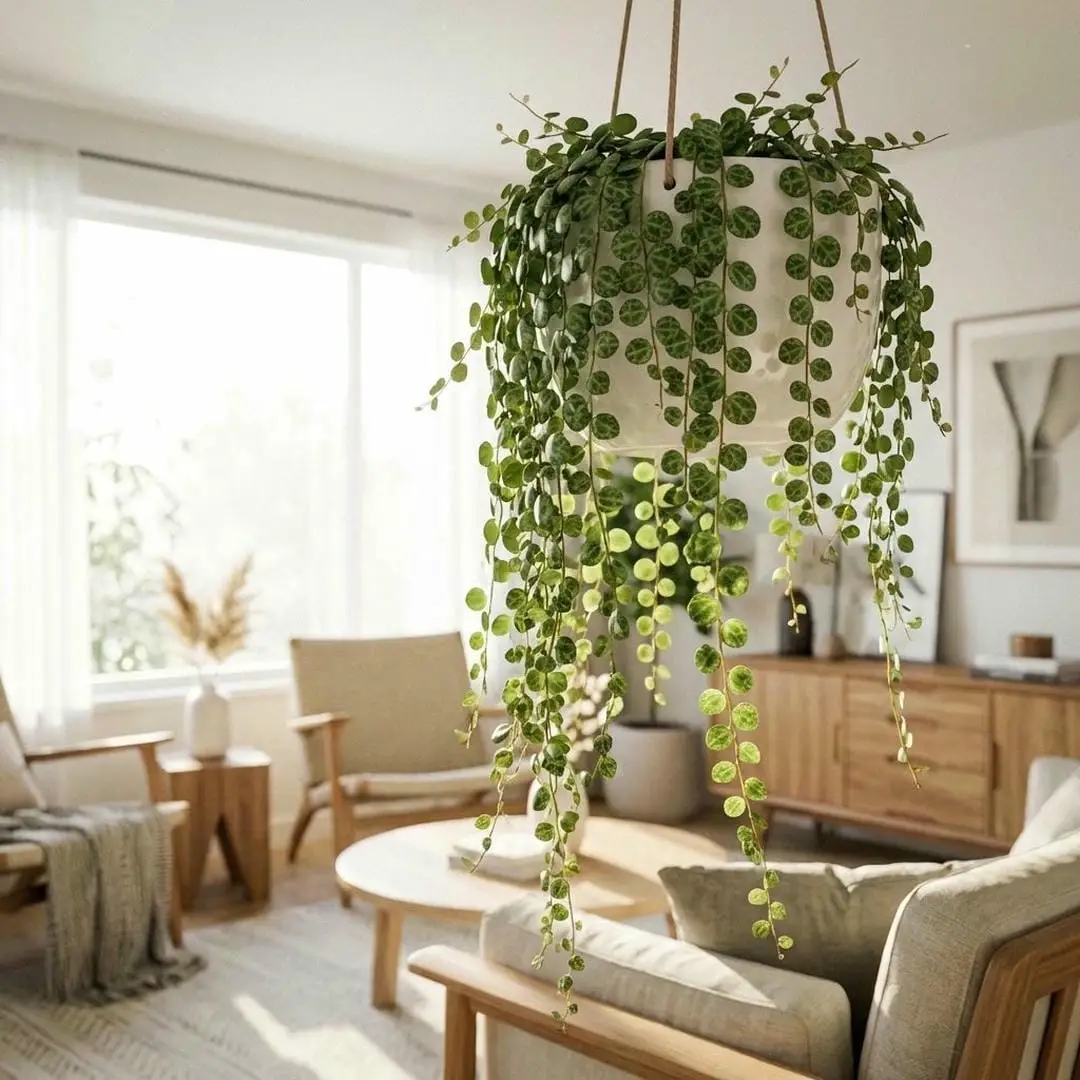
Tiny round leaves patterned with pale veins that look like the shell of a miniature tortoise, strung along thread-fine trailing stems. It is the most collected peperomia and the one that generates the most panicked messages, because it punishes overwatering faster than any other type here.
Care Notes
- Trails 1 to 3 feet from a shelf edge or a hanging pot.
- Shallow pot, very gritty mix, and 50 to 60 percent humidity.
- Slow to establish, so resist the urge to repot a new plant. Rated moderate.
Full details in our 👉 String of Turtles care guide.
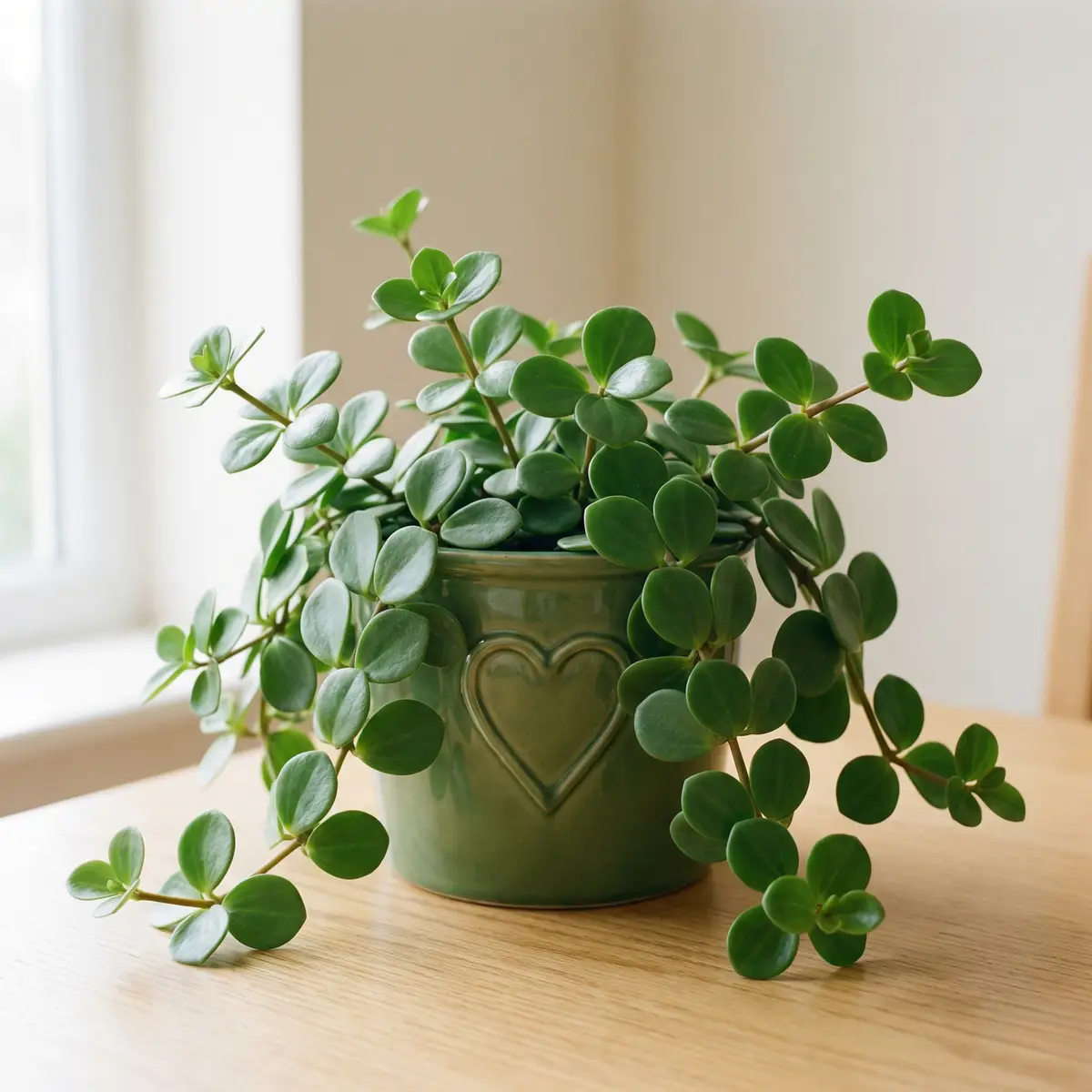
💎 12. Peperomia Hope (Peperomia tetraphylla 'Hope')
Why It's Popular
Small round coin-like leaves in whorls of three or four along trailing stems. It gives you the String of Turtles look with a fraction of the drama, growing faster, forgiving more, and filling a hanging pot in a single season.
Care Notes
- Stems reach 12 to 18 inches from a plant only 6 to 8 inches tall.
- Thicker leaves than String of Turtles, so ordinary room humidity is fine.
- Pinch the tips to keep it full rather than stringy.
Full details in our 👉 Peperomia Hope care guide.
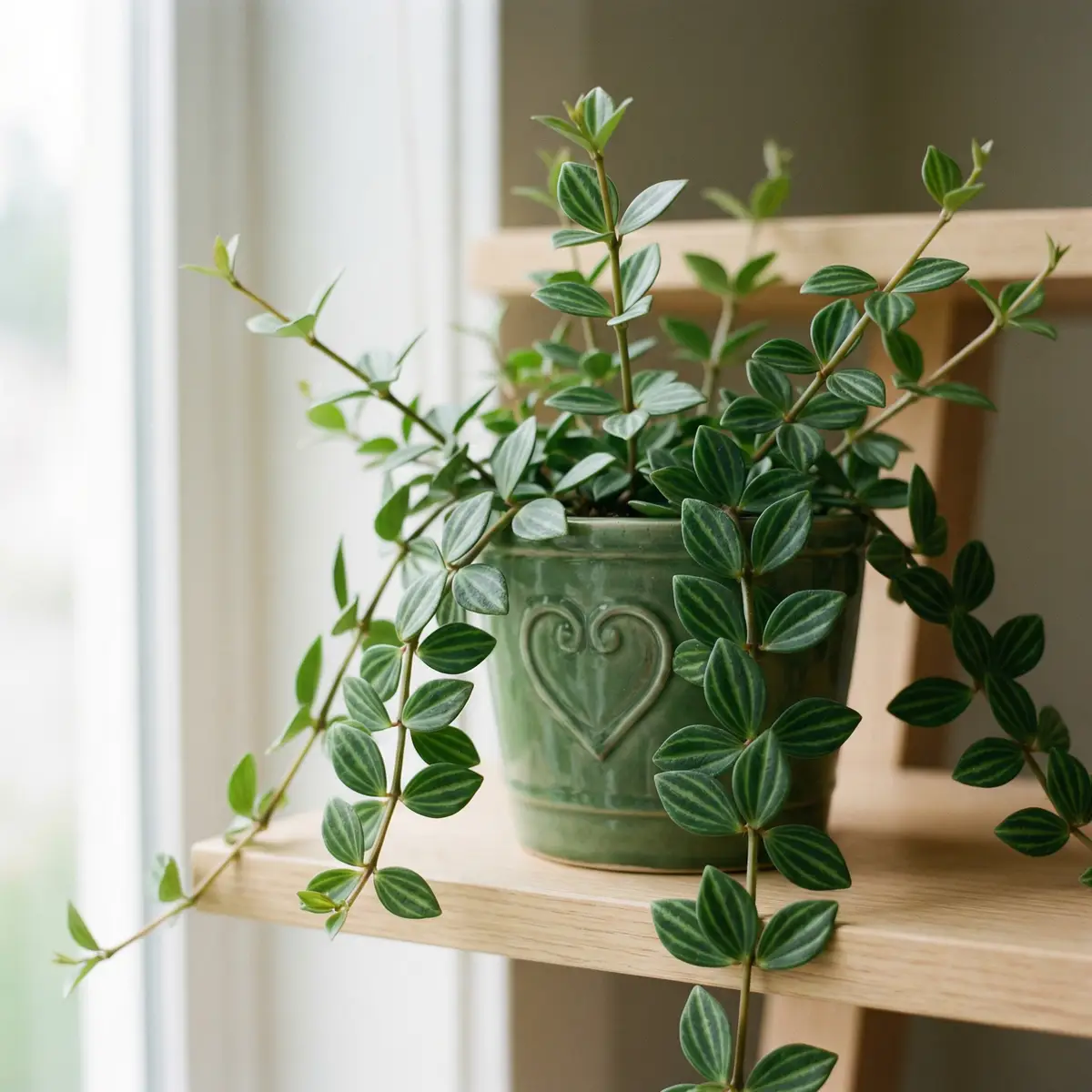
💎 13. Beetle Peperomia (Peperomia angulata)
Why It's Popular
Small oval leaves in deep glossy green, each ruled with several pale lengthwise stripes that make them look like little beetle backs. The stems start upright and then tip over and trail, so the plant works on a shelf or in a hanging pot without any training.
Care Notes
- Around 4 to 8 inches upright with stems reaching 12 to 24 inches.
- Among the easiest trailing peperomias and far less fussy than String of Turtles.
- Stem cuttings root in water in a couple of weeks.
Full details in our 👉 Beetle Peperomia care guide.
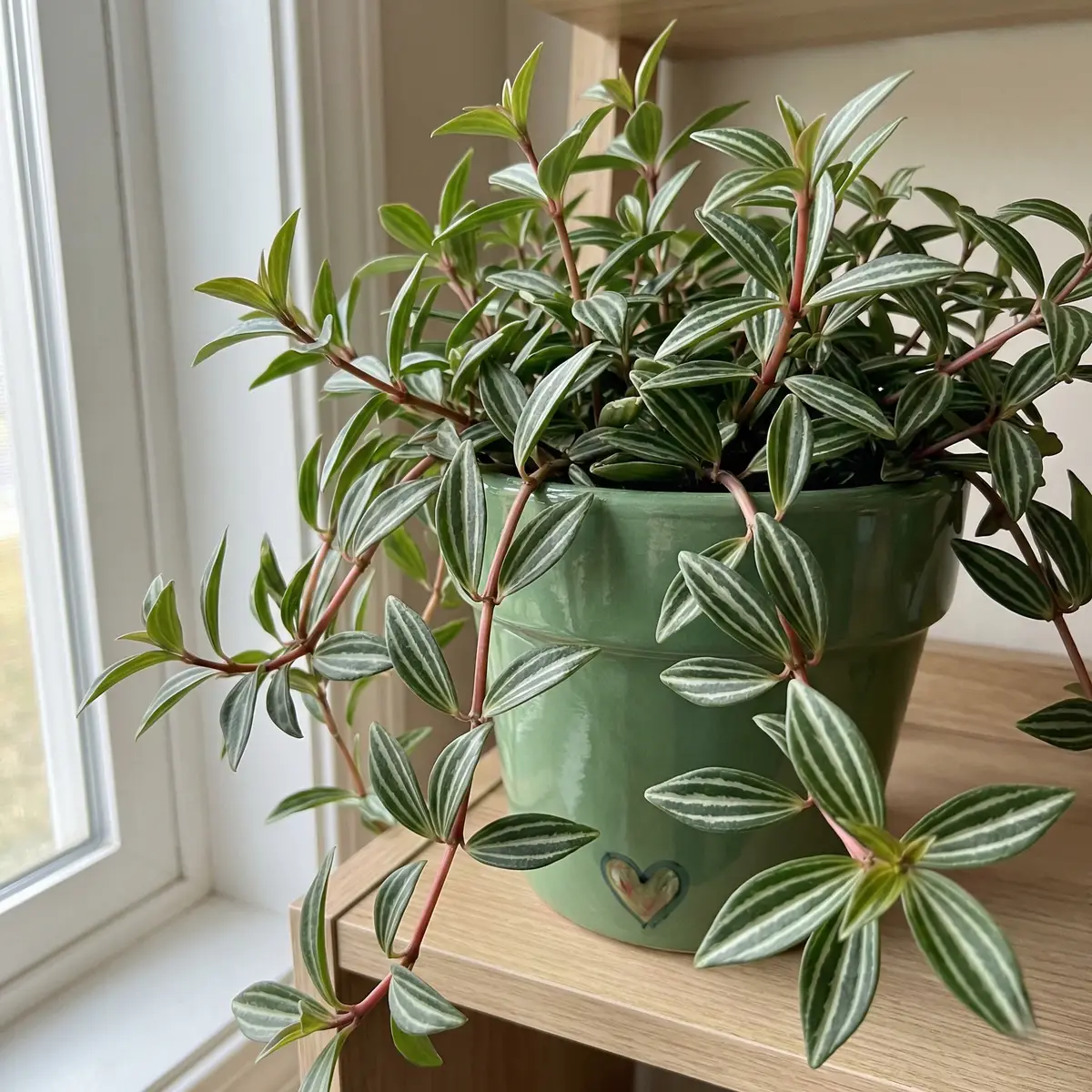
💎 14. Parallel Peperomia (Peperomia puteolata)
Why It's Popular
Pointed olive-green leaves in whorls of four, each striped with parallel silver veins running from base to tip, carried on striking red stems. It grows upright to start with and then arches over, which gives it a fountain shape nothing else here matches.
Care Notes
- Reaches 8 to 12 inches upright before the stems tip over and run past 24 inches.
- Thinner leaves, so it likes 50 to 60 percent humidity and does not want to dry out bone dry.
- Cut it back hard in spring and it branches from the base instead of going bald.
Full details in our 👉 Parallel Peperomia care guide.
🏷️ The Plant That Is Not a Peperomia
Pilea Peperomioides
The Chinese Money Plant is called Pilea peperomioides because its leaves resemble a peperomia, which is a botanical compliment rather than a family relationship. It sits in the nettle family, Urticaceae, while peperomias sit in the pepper family. The shops sell them side by side and the names do the rest.
How to Tell Them Apart
A Pilea holds perfectly round flat leaves on long stalks that rise straight out of the soil, with the stalk joining in the middle of the leaf rather than at the edge. A Raindrop Peperomia, the usual source of the mix-up, has thicker leaves that come to a point and attach at the base. Pileas also want more water and more frequent feeding, so treating one like a peperomia leaves it thirsty.
🩺 Common Peperomia Problems
Yellowing Leaves and Sudden Leaf Drop
Wet soil, nearly every time. Lift the plant out of the pot and check the roots: healthy ones are white and firm, rotting ones are brown, soft, and smell sour. Cut the damage away, repot into fresh gritty mix and a smaller pot, and water sparingly for a month. Left alone, root rot takes the whole plant.
Limp, wrinkled leaves on a light pot are the opposite problem and much easier to fix, because the leaf reservoirs have simply run down. Water thoroughly at the sink and the plant firms up overnight. If it keeps happening within a week of watering, the mix has gone hydrophobic and the water is running down the sides instead of soaking in, so bottom water it for a couple of cycles.
Brown Crispy Edges
Low humidity on the thin-leaved types, or mineral buildup from hard tap water. Flush the pot thoroughly, switch to filtered or rainwater for a month, and raise the humidity around String of Turtles, Watermelon and Parallel Peperomia before you go looking for a disease.
Leggy Stems and Lost Colour
Not enough light. The gaps between leaves stretch, the plant leans, and coloured cultivars wash out to green. Move it closer to the window or add a grow light, then cut the stretched growth back in spring so the plant rebuilds from the base.
Pests
Mealybugs are the usual visitor, hiding as white cottony specks where the leaf stalk meets the stem. Spider mites turn up in dry winter air and leave fine webbing with stippled leaves. Both respond to a thorough wipe-down and neem oil every seven days for a month. Check new plants before they join the shelf.
❓ Frequently Asked Questions
How do you care for a peperomia plant indoors?
Bright indirect light two to four feet from an east or north window, water only when the top half of the pot has dried, and a chunky fast-draining mix in a small pot with drainage holes. Feed at quarter to half strength once a month through spring and summer, then stop. The thick leaves mean underwatering is survivable and overwatering usually is not.
How often should you water a peperomia?
Every ten to fourteen days in summer and every three to four weeks in winter, but check the pot rather than the date. Push a finger two inches in and water only if it comes out dry. Lifting the pot to feel the weight works even better once you know what a watered one feels like.
Are peperomias toxic to cats and dogs?
No. The ASPCA lists peperomia species as non-toxic to cats, dogs and horses, which is why they turn up on every pet-safe plant list including ours. A chewed leaf may still upset a stomach, simply because leaves are not food.
Why are my peperomia leaves falling off?
Wet soil and rotting roots cause most sudden leaf drop. Tip the plant out and look for brown mushy root tips. Cold drafts do it too, and so does the shock of moving from a bright greenhouse to a dim living room, though that settles down within a few weeks.
Is a Chinese Money Plant a peperomia?
No. Pilea peperomioides borrows the name because the leaves look similar, but it belongs to the nettle family rather than the pepper family. Its round leaves attach in the middle to long stalks rising from the soil, and it wants noticeably more water than a true peperomia.
Do peperomias need high humidity?
Most do not. Ordinary indoor air at 40 to 50 percent suits the thick-leaved types perfectly well. String of Turtles, Watermelon Peperomia and Parallel Peperomia have thinner leaves and prefer 50 to 60 percent, which a pebble tray or a small humidifier covers.
Which peperomia is easiest for a beginner?
Baby Rubber Plant, comfortably. Thick leaves, upright stems, tolerance for a dim corner, and a habit of forgiving mistakes that would kill a String of Turtles. If you want something trailing instead, Peperomia Hope is the forgiving one.
🪴 See also 🪴
Complete Guide to Baby Rubber Plant Care and Growth
Complete Guide to Beetle Peperomia Care and Growth
Complete Guide to Peperomia Hope Care and Growth
Complete Guide to Parallel Peperomia Care and Growth
Complete Guide to Watermelon Peperomia Care and Growth
Complete Guide to Raindrop Peperomia Care and Growth
Complete Guide to String of Turtles Care (Peperomia prostrata)
Complete Guide To Peperomia Orba Care and Growth
Complete Guide To Peperomia Green Bean Care and Growth
Complete Guide to Peperomia Napoli Nights Care and Growth
Complete Guide To Silver Ripple Peperomia Care and Growth

Complete Guide To Peperomia Rosso Care and Growth
Complete Guide To Red Ripple Peperomia Care and Growth

Houseplant101 Forum
Questions & Comments
Ask a question, share your plant experience, or help other plant owners.
Comments are temporarily unavailable.
Open the Houseplant101 ForumNo comments yet
Be the first to ask a question or share your experience about this page.
Log in or create an account
Comments use your Houseplant101 Forum account, but you can stay on this page.
Create a new account