

Moon Valley Pilea
Pilea mollis
Moon Valley, Pilea 'Moon Valley'


Moon Valley Pilea is a compact tropical houseplant with deeply ridged, crater-like leaves that look almost sculpted. This guide covers everything you need to keep its texture bold and its color vibrant indoors.
📝 Moon Valley Pilea Care Notes
🌿 Care Instructions
⚠️ Common Pests
📊 Growth Information
🪴 In This Guide 🪴

☀️ Moon Valley Pilea Light Requirements (Indoor Lighting Guide)
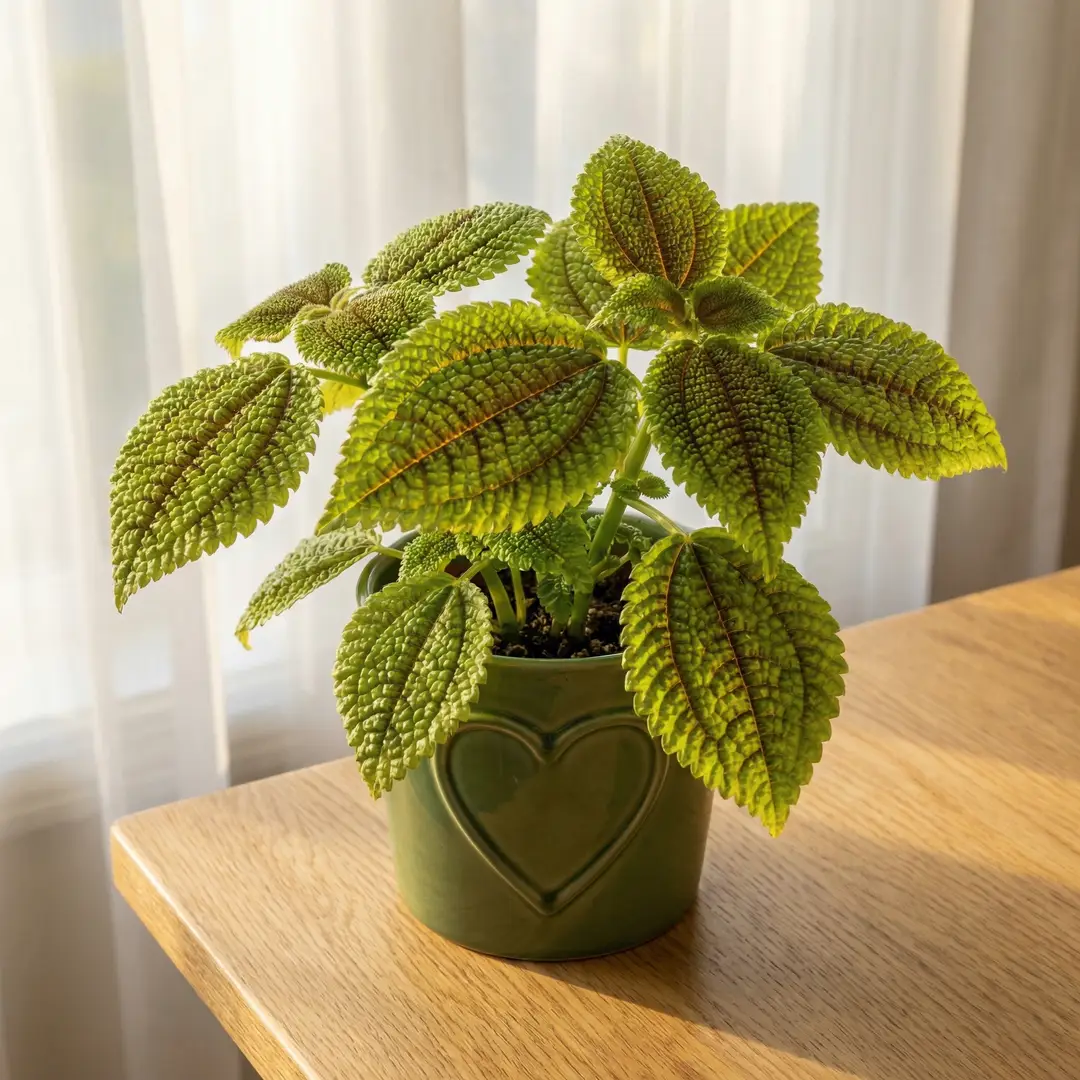
Moon Valley Pilea grows best in bright, indirect light. Think a spot a few feet back from an east- or north-facing window, or close to a west-facing window that does not get the harsh afternoon sun directly on the leaves. The plant does poorly at the extremes: low light slows growth and stretches stems into leggy, widely spaced leaves, while direct midday sun bleaches the chartreuse color and scorches the textured surface.
The leaf texture of Moon Valley Pilea is actually more prominent in bright indirect light than in dim conditions. The deep ridges and valleys in the leaf surface cast stronger shadows under good light, which gives the leaves their three-dimensional, crater-like appearance. In low light, the same leaves look flatter and the color contrast between the ridges and valleys is less distinct. Getting the light right genuinely improves how the plant looks, not just how it grows.
Best Light Conditions for Moon Valley Pilea
An east-facing window is often the sweet spot. The plant gets a couple of hours of gentle morning sun followed by bright, diffused light for the rest of the day. A few feet back from a bright south-facing window works well too, as long as the direct rays do not hit the leaves for more than an hour or so. Sheer curtains are a simple fix in rooms where direct sun is hard to avoid.
During winter in northern latitudes, the overall light level drops significantly. The plant will tolerate lower light for a few months but tends to get leggy. Moving it closer to the window in winter, or supplementing with a grow light, keeps growth compact and the color saturated.
Signs Moon Valley Pilea Is Not Getting Enough Light
The main signal is elongated stem internodes: the gaps between leaf pairs get larger and the plant looks stretched rather than dense. Leaves may also lose some of the bold bronze-brown vein color, fading toward a flat, pale green. If you see this, move the plant to a brighter spot and trim the leggy stems back to encourage compact regrowth.Signs of Too Much Direct Sun
Bleached, washed-out patches on the leaf surface, crispy brown tips, or a faded, yellowish overall color all point to too much direct light. Move the plant further from the glass, or add a sheer curtain to filter the rays.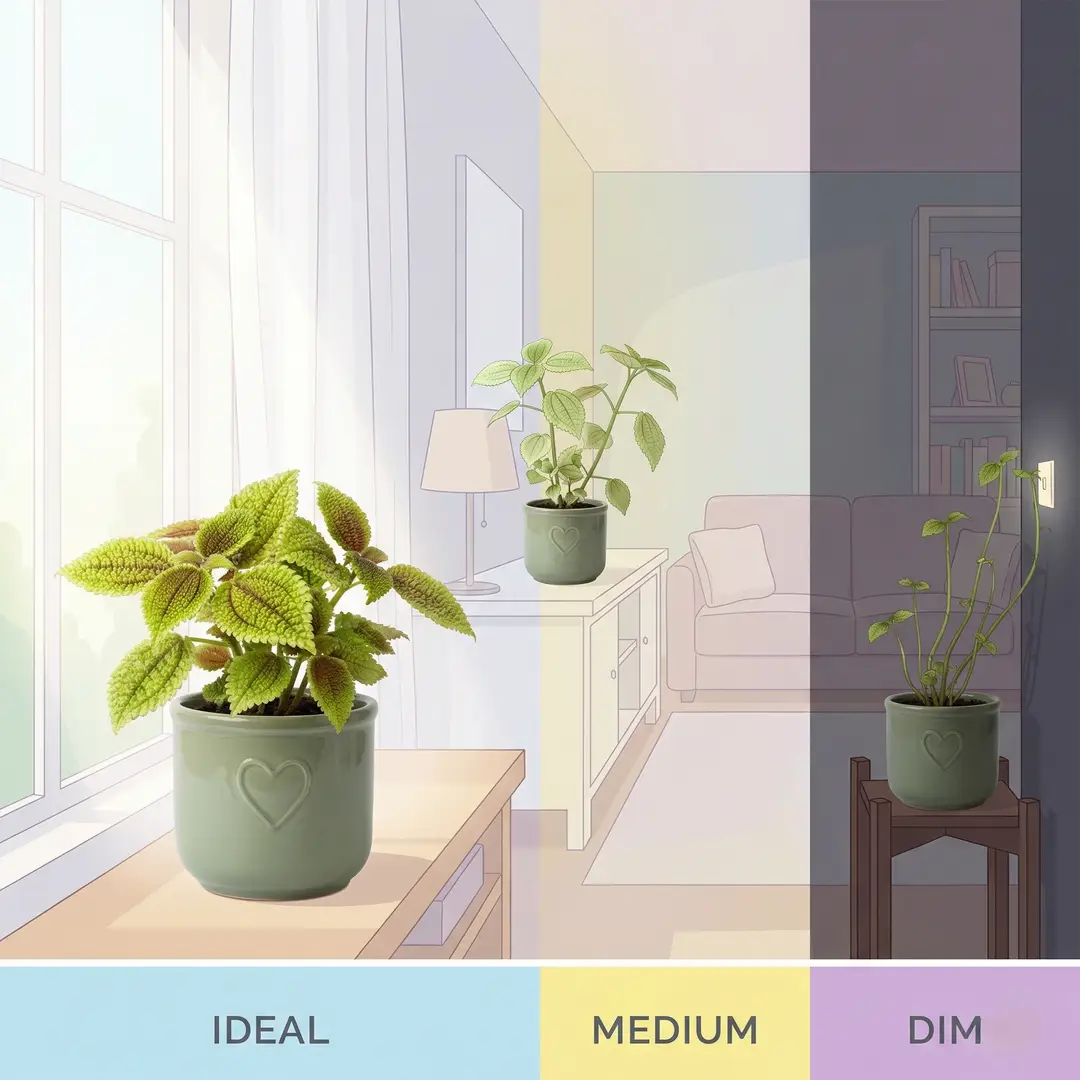
Grow Lights for Moon Valley Pilea
Grow lights work well for Moon Valley Pilea and are worth considering if your home lacks windows with sufficient brightness, or if you want to maintain active growth through winter in a northern climate. A full-spectrum LED grow light positioned 8-12 inches above the foliage and running 12-14 hours per day provides adequate intensity. The plant does not require natural sunlight specifically, and some growers find that grow-light-only conditions produce more consistent, compact growth than seasonal natural light, because the intensity and duration stay stable year-round.
If the leaves begin to look washed out or the surface loses its vivid chartreuse color under a grow light, increase the distance between the light and the plant slightly. If growth becomes very slow and stems stretch, decrease the distance or extend the daily light duration.
Grow lights are also useful for maintaining Moon Valley Pilea in interior rooms or offices that have no natural light access at all. The plant does well as a desk plant under office lighting supplemented with a small grow light, and it keeps its color and density much better in these conditions than most tropical houseplants would. In this sense, it is a more versatile placement option than its tropical origins might suggest.
💧 Moon Valley Pilea Watering Guide (How Often and How Much)
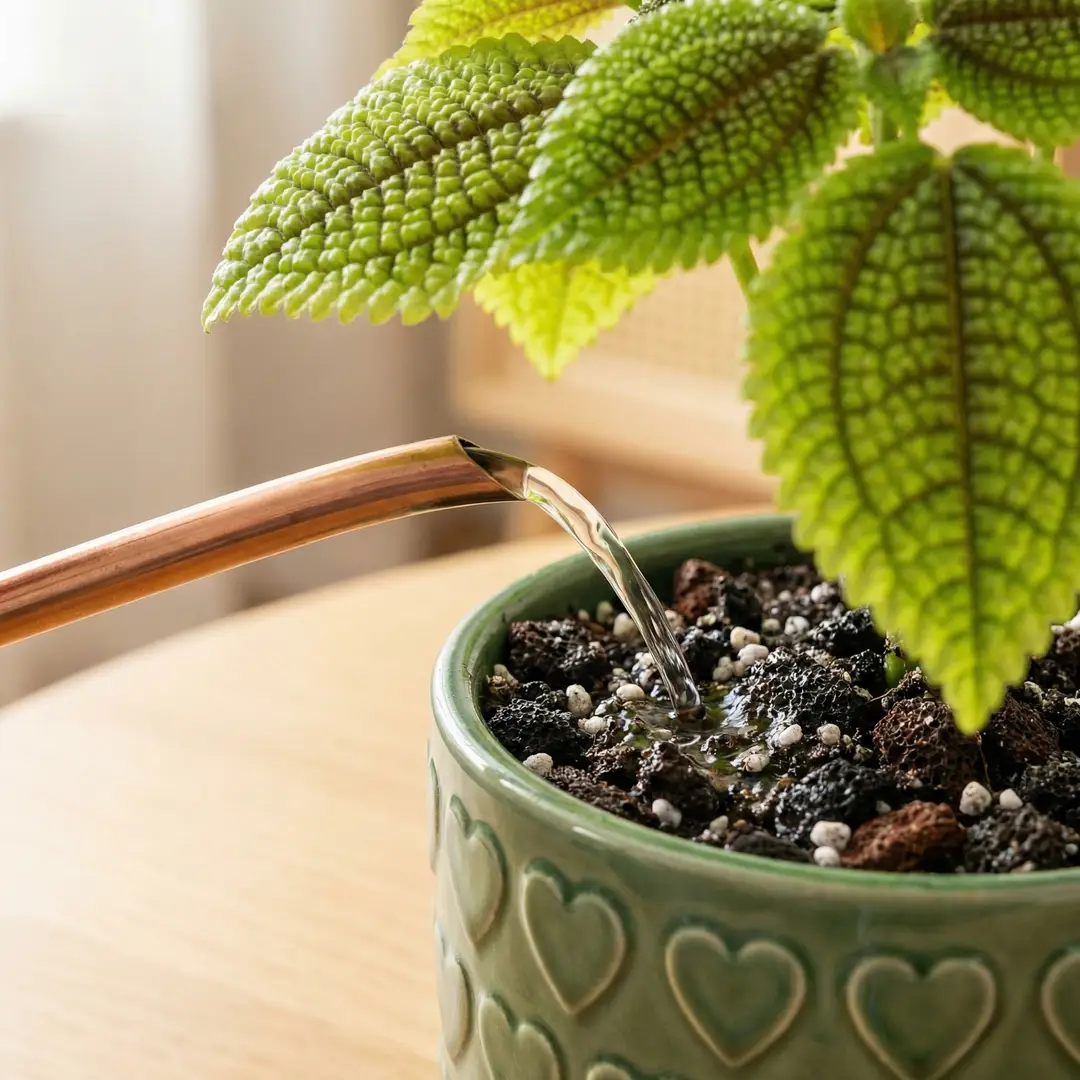
Water Moon Valley Pilea when the top inch of soil has dried out. The plant wants consistent moisture but it does not want to sit in wet soil. Overwatering is the most common mistake: the roots are shallow and fine, and they rot quickly if kept soggy. Underwatering, on the other hand, causes dramatic wilting that looks alarming but usually recovers within an hour or two of a thorough drink.
A good approach is to water slowly and thoroughly until water drains from the bottom, then let the soil approach dryness before watering again. In most homes this means watering every 7-10 days in summer and every 10-14 days in winter. The actual interval depends on your pot size, pot material, light level, and room temperature, so always check the soil rather than going strictly by schedule.
Reading Watering Signals
Moon Valley Pilea gives fairly clear signals when it needs water. The leaves lose their firmness and the stems droop slightly: not a dramatic collapse, more of a subtle softening and lean. The soil will feel dry to the touch well below the surface, and the pot will feel noticeably lighter than usual if you lift it.
The trickier situation is distinguishing between drought and overwatering, since both can cause drooping. The key difference: drought drooping reverses within an hour or two of watering. Overwatering drooping tends to persist, and is usually accompanied by yellowing lower leaves and a sour or off smell from the soil. When in doubt, unpot the plant and check the root color. Healthy roots are white to cream. Rotted roots are brown, black, or mushy.
Watering Method: Bottom vs Top
Moon Valley Pilea benefits from bottom watering occasionally, as it helps the roots draw moisture from below and reduces the risk of fungal issues on the densely textured leaf surface. Set the pot in a tray of water for 20-30 minutes, then drain fully. For regular watering, pouring at soil level (rather than overhead) is fine and is faster.
Avoid misting directly on the leaves. The ridged surface traps water and can encourage rot patches or fungal spotting in low-airflow conditions.
Seasonal Watering Adjustments
Cut back watering frequency in fall and winter. The plant’s growth slows, the soil dries out more slowly, and overwatering risk goes up as temperatures drop. When in doubt in winter, wait another day or two before watering.
In spring, as day length increases and the plant starts pushing new growth, you can gradually increase watering frequency back to the summer schedule. Watch the plant rather than the calendar: when you see new leaf buds or fresh stem growth, that is the signal to start watering more frequently again.
Overwatering vs Underwatering: How to Tell
The most common mistake with Moon Valley Pilea is watering on a fixed schedule rather than responding to what the plant and soil are telling you. Both overwatering and underwatering cause drooping and leaf discoloration, so the trick is reading the specific pattern of symptoms:
Underwatering shows as: soil that is dry more than an inch below the surface, a lightweight pot, leaves that are firm but slightly wilted, color that looks normal (not yellowing), and fast recovery (within 1-2 hours) after watering.
Overwatering shows as: soil that is consistently wet or compacted, a heavy pot that stays heavy, lower leaves turning yellow and soft, possible mushy spots at the base of stems, and wilting that does NOT recover after watering.
When you are not sure which one you are dealing with, the soil check is definitive. Stick a finger 2 inches into the soil. Dry? The plant needs water. Wet? Do not water, and investigate whether drainage is adequate.
🪴 Best Soil for Moon Valley Pilea (Potting Mix and Drainage)
Moon Valley Pilea needs a well-draining mix that still holds some moisture between waterings. A standard peat-based potting soil works, but it tends to compact over time and can retain too much water. A better option is a mix of 60% peat or coco coir and 40% perlite, which stays loose, drains fast, and resists compaction. Coco coir is also a more sustainable alternative to peat if you prefer to avoid it.
Pure potting mix from a bag is usually too dense for this plant on its own. If that is what you have available, mix in a generous handful of perlite per pot to open up the structure. Good drainage prevents the root rot that is the most common cause of Moon Valley Pilea decline.
For more detail on indoor potting mixes, the soil care guide covers the pros and cons of different mix ingredients and helps you match them to your watering habits.
Pot Choice and Drainage
Always use a pot with at least one drainage hole. Terra cotta is a good choice for Moon Valley Pilea because its porosity helps the soil dry out at a reasonable rate, which suits the plant’s preference for evenly moist but not saturated conditions. Plastic or glazed ceramic pots retain moisture longer, so if you tend to water frequently, terra cotta provides a useful buffer.
Saucers are fine to use, but empty them within an hour of watering. Sitting water in a saucer keeps the bottom of the soil saturated and raises root rot risk significantly, especially in low-light conditions where the soil dries slowly.
Soil pH for Moon Valley Pilea
Moon Valley Pilea prefers a slightly acidic to neutral soil pH, in the range of 6.0 to 7.0. Most commercial potting mixes fall in this range, so if you are using a standard mix with added perlite, pH management is usually not needed.
Problems can develop over time in areas with very hard tap water: repeated watering with alkaline water slowly raises the soil pH, which can lock out iron and manganese and cause interveinal chlorosis on new leaves. If you notice yellowing between the veins on young growth while older leaves stay green, pH drift is worth investigating. Using distilled or rainwater for watering, or adding a small amount of diluted acidic fertilizer, can help bring the pH back in range.
🍼 Fertilizing Moon Valley Pilea (Feeding Schedule and Tips)
Moon Valley Pilea is a moderately fast grower during the warm months and benefits from regular feeding to keep the foliage dense and the color vivid. Use a balanced liquid fertilizer (something like a 10-10-10 or 20-20-20 ratio) diluted to half the recommended strength, and apply it monthly from spring through early fall. Full-strength doses can cause fertilizer burn on the fine root system, so diluting is worth the small extra effort.
Stop feeding entirely in late fall and through winter. The plant’s metabolism slows considerably as day length drops, and fertilizing during this period encourages weak, leggy growth rather than compact new leaves.
For a full breakdown of fertilizer types and timing, the fertilizing guide is a useful reference.
Fertilizer Type: Liquid vs Slow-Release
Both liquid and slow-release granular fertilizers work for Moon Valley Pilea. Liquid fertilizers give you more control: you can skip a feeding if the plant is stressed, start the season late, or stop early, without worrying about what has already been applied to the soil.
Slow-release granules applied once at the beginning of the growing season are a lower-maintenance option. Use them sparingly, about half the recommended dose for the pot size, since the fine root system is sensitive to salt buildup. If you use slow-release granules, do not add additional liquid feeds during the same season.
Whatever type you use, always apply to moist soil rather than dry. Fertilizing a water-stressed plant concentrates salts around the roots and increases the risk of burn.
Signs of Nutrient Deficiency
Pale leaves, especially younger ones showing yellowing between the veins while the veins themselves stay green, can indicate a lack of nitrogen or iron. Small, underdeveloped new leaves and very slow growth despite adequate light and water suggest the plant is running low on nutrients overall. A consistent monthly feeding schedule through the growing season usually prevents these issues.
If deficiency signs appear despite regular feeding, check the soil pH. Iron and manganese deficiencies often result from pH drift in hard-water areas rather than an actual lack of nutrients in the fertilizer.
🌡️ Moon Valley Pilea Temperature Range (Ideal Conditions)
Moon Valley Pilea is a tropical plant and it shows in its temperature preferences. It grows best between 65°F and 80°F (18°C to 27°C) and does not tolerate cold well. Keep it away from temperatures below 50°F (10°C), which will cause cold damage, and well away from frosty windows in winter.
The enemies here are drafts and sudden swings. A position near a frequently opened exterior door, a drafty old window frame, or directly under an air conditioning vent can stress the plant even when the average room temperature seems fine. Consistent, moderate warmth is what it needs.
Outdoors in summer, Moon Valley Pilea thrives on a shaded patio or balcony as long as nighttime temperatures stay above 55°F (13°C). Bring it back in well before the first cold nights of fall.
Cold Damage and Winter Care
Cold damage on Moon Valley Pilea shows as dark, water-soaked patches on the leaves, usually starting on the outermost leaves nearest a cold surface or window. If you catch it early, move the plant to a warmer spot and remove any damaged leaves. The plant typically recovers as long as the damage did not reach the crown.
In winter, the combination of low temperatures and low humidity is harder on Moon Valley Pilea than either factor alone. Central heating dries the air while simultaneously warming the room, creating conditions that stress the plant from two directions. Keeping the plant a few feet from any exterior wall or window glass reduces the temperature differential between the root zone and the leaf tips.
Heat and Summer Care
On the warm end, Moon Valley Pilea handles temperatures up to about 90°F (32°C) reasonably well as long as humidity is adequate and the soil does not dry out too quickly. Above that, growth stalls and leaves may wilt even in moist soil as the roots struggle to move water fast enough. If your indoor temperatures push into the high 80s or above in summer, move the plant to a slightly cooler room or ensure it gets good air circulation.
During a hot summer spell, you may notice the plant wilting slightly in the afternoon even with moist soil. This is usually a temporary response to the combination of heat and high light. It tends to recover by evening without intervention.
💦 Moon Valley Pilea Humidity Needs (How to Increase Moisture)
Humidity is one of the more important care factors for Moon Valley Pilea. It originates from the humid forests of Central and South America, and it shows: the plant looks and grows best when ambient humidity stays above 50%. Standard indoor air in winter, especially in homes with forced-air heating, typically runs between 20% and 40%, which is low enough to cause crispy leaf edges and slowed growth.
The most reliable way to raise humidity around the plant is to group it with other moisture-loving houseplants. As each plant transpires, the collective creates a slightly more humid microclimate around the group. A small humidifier nearby is more effective still, especially in winter when heating dries the air significantly. See our humidity care guide for a comparison of methods.
Pebble trays are often suggested but have limited effect in most rooms. If you are relying on one alone, do not expect a major change. Grouping the plant with Friendship Plant and other humidity-loving Pilea relatives is a more practical approach that also looks great.
Signs of Low Humidity
Crispy, brown leaf edges are the first sign. They usually start at the tips and work inward. The textured leaf surface of Moon Valley Pilea can mask this at first since the ridged surface already looks irregular, but run your finger along the leaf margin and you will feel if the edge is dry and papery rather than firm. In severe dry conditions, leaves may curl slightly as well.
The timing of crispy edges matters for diagnosis. If they appear in winter shortly after you start running the central heating, low humidity is almost certainly the cause. If they appear in summer without any change in care routine, consider whether the plant has been sitting too close to an air conditioning vent, which can also dry the air around it significantly.
Seasonal Humidity Management
The most challenging period for humidity management is late fall through late winter: heating systems run at full output, windows stay closed, and the air inside most homes drops to its lowest humidity of the year. This is the period when Moon Valley Pilea is most likely to develop crispy edges and slower growth.
A few approaches that work without major infrastructure: grouping the plant with other humidity-lovers such as Friendship Plant and ferns on a shared tray adds measurable humidity to the immediate area through collective transpiration. Placing the plant in the bathroom during winter, even if it is not the primary location, gives it exposure to the higher post-shower humidity for part of each day. A compact ultrasonic humidifier near the plant is the most reliable solution if the room is large and other methods prove insufficient.
What does not work well: misting directly on the leaves. The deep ridges and valleys in Moon Valley Pilea’s leaf surface trap water and dry slowly, which can encourage mildew patches or brown spotting in poor airflow conditions.
🌸 Moon Valley Pilea Blooming (What to Expect Indoors)
Moon Valley Pilea rarely blooms indoors, and when it does, the flowers are small enough that many growers miss them. Mature plants may produce tiny clusters of pale pink or whitish flowers on short stalks. They are not showy, and the plant is grown entirely for its foliage rather than its flowers.
The flowers typically appear in late summer or early fall on plants that have been well-fed and growing in good light throughout the season. They emerge from the leaf axils, the junction where each leaf petiole meets the stem, as small rounded clusters with individual florets only a couple of millimeters across. The color is pale, ranging from near-white to a soft pink.
If you want to encourage blooming, provide bright indirect light throughout the year and let the plant mature in the same pot for a full season or two. Consistent feeding during the growing season helps as well. Still, do not count on it. The leaves are the attraction here, and a plant that never flowers is not a plant that is doing anything wrong.
What to Do With the Flowers
If your Moon Valley Pilea does flower, you have a couple of options. The flowers themselves are inconspicuous enough that most growers simply leave them. If you prefer to put the plant’s energy back into leaf growth, pinching off the flower clusters is fine. After flowering, the plant sometimes goes through a brief lull in vegetative growth before resuming, which is completely normal.
One thing to know: after a Moon Valley Pilea flowers and sets seed, the flowering stem sometimes dies back. This is normal for plants in the Urticaceae family and does not indicate a problem with the whole plant. Remove the dead stem at its base and the plant will continue growing from the remaining stems.
🏷️ Moon Valley Pilea Types and Related Pilea Varieties
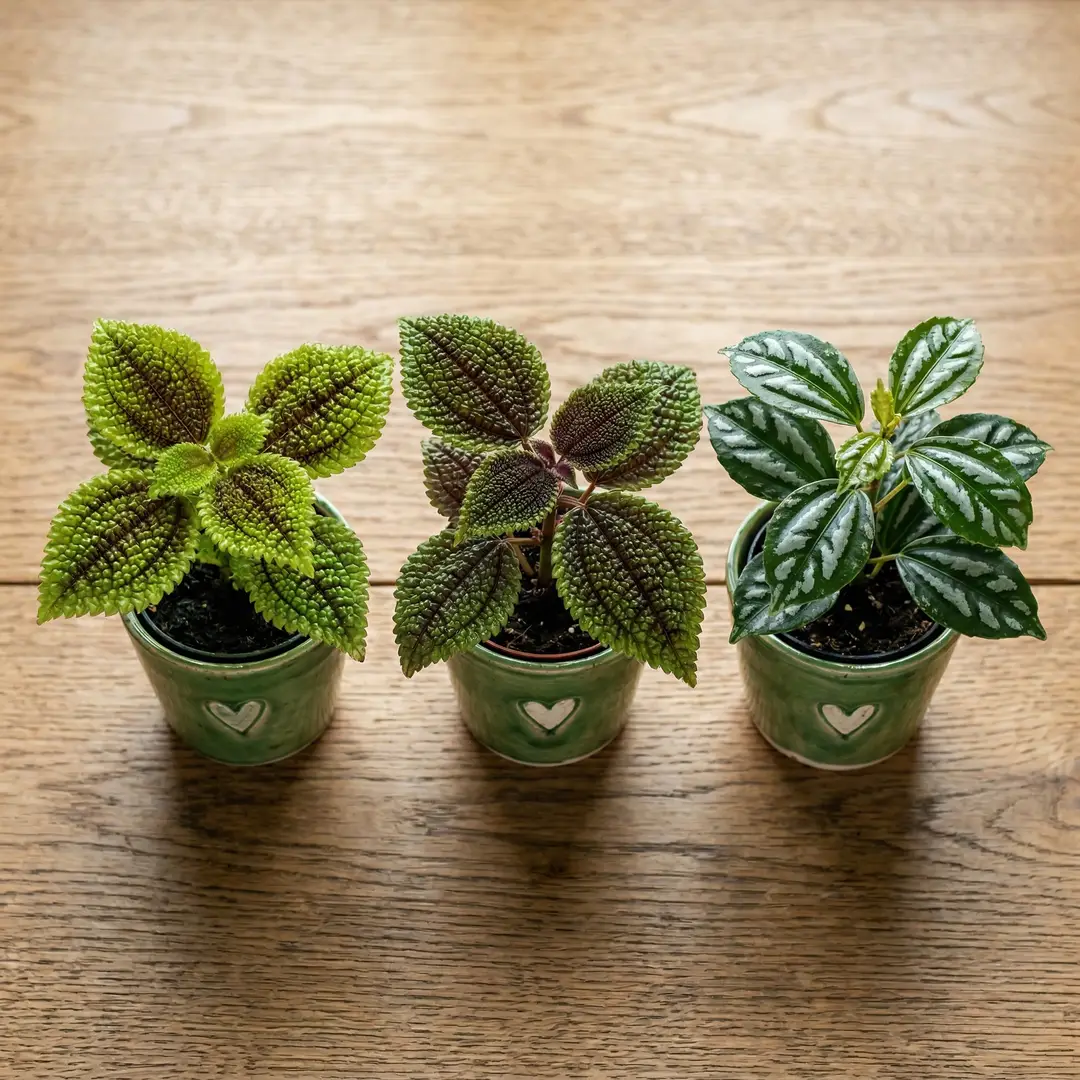
Moon Valley Pilea is a cultivar of Pilea mollis, a species from the cloud forests of Central and South America, particularly Colombia and surrounding regions. The species name mollis comes from the Latin for “soft” or “gentle,” likely a reference to the soft-textured, hairy leaf surface of the species in its natural form. The cultivar name ‘Moon Valley’ refers to the deeply pitted leaf surface that resembles a lunar landscape. In its native habitat it grows as a low, spreading groundcover on the humid forest floor, where it receives filtered, dappled light and consistently high moisture. That origin explains why it performs best in humid, warm indoor conditions with bright but not direct light. The deeply bullate (puckered) leaf texture is an adaptation: the ridged surface increases surface area for gas exchange and water absorption in the moist, nutrient-rich litter of the cloud forest floor.
Despite the specialized appearance, Moon Valley Pilea has no unusually demanding care requirements. The care matches what you would expect from the habitat: moderate light, consistent moisture, warmth, and humidity. It does not need special soil amendments, unusual watering techniques, or precise fertilizer formulations. Get the basics right and the plant thrives without much intervention.
The genus Pilea is large, containing several hundred species, and a handful have become popular houseplants with quite different looks from each other.
Friendship Plant (Pilea involucrata): Sometimes sold under the same common name as Moon Valley, Friendship Plant is closely related and looks similar, with deeply textured leaves in a dark bronze-green on top and reddish-purple below. The two plants are easy to confuse in small sizes.
Aluminum Plant (Pilea cadierei): A striking contrast to Moon Valley, the Aluminum Plant has smooth, oval leaves with bold silver patches between the veins. It is less textural but equally compact and easy to grow.
Chinese Money Plant (Pilea peperomioides): Completely different in form. Round, coin-shaped leaves on long petioles make it look nothing like Moon Valley, but it shares the same genus and similar care needs.
Artillery Fern (Pilea microphylla): Another close genus member with tiny, fern-like leaves and a weeping or trailing habit. Covered separately in its own Artillery Fern guide.
The Pilea genus is worth exploring if you enjoy the family. The variety in leaf shapes, colors, and textures across the genus is remarkable, and most members share similar care requirements.
Non-Pilea Plants With Similar Texture
If Moon Valley Pilea appeals to you because of the deeply ridged, textured leaves, a few other houseplants have comparable tactile appeal:
- Nerve Plant (Fittonia): Shares the compact, humidity-loving nature and highly patterned foliage, though the pattern is a network of veins rather than a puckered surface. It is a natural terrarium companion for Moon Valley Pilea.
- Polka Dot Plant (Hypoestes phyllostachya): Bold patterned leaves in a compact size, similar care requirements. Offers contrasting color splash rather than texture depth.
- Rex Begonia: Highly decorative, deeply textured leaves with metallic or multi-toned surfaces. More dramatic in size but shares the same love of indirect light and humidity.
None of these replace Moon Valley Pilea, but if you enjoy the textural plant category in general, exploring these makes the display more interesting.
Is Moon Valley Pilea the Same as Friendship Plant?
This is a question that comes up often, and the honest answer is: it depends on your source. Some plant vendors sell Pilea involucrata under the Moon Valley name, and the two plants do look similar at small sizes: both have deeply textured, oval leaves in a bronze-green color with reddish-purple undersides. However, technically Pilea mollis ‘Moon Valley’ and Pilea involucrata (the Friendship Plant) are different species.
In practice, if you have bought a plant labeled Moon Valley from a nursery and it has the deeply ridged chartreuse-green leaves with bronze veining, you have the right plant regardless of which species tag was attached. Both plants want the same care, and for most home growers the difference is academic. The guides for both Moon Valley Pilea and Friendship Plant on this site describe care that works for either species.
🪴 Potting and Repotting Moon Valley Pilea
Moon Valley Pilea is a compact grower that does not need frequent repotting. Every 1-2 years is usually sufficient, or when you notice roots coming out of the drainage holes or circling densely at the base of the root ball. Being slightly rootbound does not harm this plant and can actually keep growth tighter and more compact.
When you do repot, choose a new pot only 1-2 inches wider in diameter than the current one. Going too large adds excess soil that holds moisture the roots cannot use, increasing overwatering risk.
Spring is the best time to repot, as the plant is entering its active growth phase. Use a fresh, well-draining mix as described in the soil section. For more detail on the repotting process, the repotting guide walks through the steps clearly.
Refreshing Soil Without Full Repotting
If the plant seems to be declining but the roots have not outgrown the pot, a partial soil refresh can help. Remove the top inch or two of old mix and replace it with fresh material. This removes accumulated salts and improves aeration without disturbing the whole root system.
Replacing the top layer is also useful for plants that have developed salt deposits on the soil surface from hard tap water or heavy fertilizer use. The white crusty residue on the surface can slow water penetration over time, and removing it every season or two prevents buildup from becoming a problem.
Signs Moon Valley Pilea Needs Repotting
The clearest sign is roots growing out of the drainage holes or pushing up above the soil surface. A second sign is that the plant dries out noticeably faster after watering than it used to, indicating the roots have displaced most of the soil in the pot. Slowed growth despite good light and feeding, combined with either of these signs, is a reliable indicator.
One sign that is often misread: Moon Valley Pilea that looks slightly stressed in summer without an obvious cause is sometimes simply rootbound rather than needing more water or fertilizer. Before adding more inputs, check the roots.
✂️ Pruning Moon Valley Pilea (Keeping It Compact and Full)
Moon Valley Pilea grows fast enough during the warm months that it can get leggy or lopsided without occasional pruning. Pinching back the growing tips is the main technique: use clean, sharp scissors or your fingernails to remove the topmost pair of leaves and the stem section just below them. This triggers the node below the cut to produce two new branches, making the plant bushier over time.
Do not wait until the plant looks completely stretched before pruning. Making small pinches every few weeks during active growth is more effective than one drastic cut. The removed tips can be used directly for propagation.
Yellowing or damaged leaves can be removed at any time by pulling them cleanly at the base of the petiole. Keep the plant tidy by removing dead material before it becomes a site for fungal issues.
Moon Valley Pilea tends to get woody at the base after a year or two. This is normal, but if the lower stems become bare and the plant looks top-heavy, starting fresh with cuttings from the healthy upper growth is a legitimate option.
Pruning for Shape
If you want a symmetrical, mounded plant rather than a sprawling one, prune in a deliberate pattern. Start from the tallest stems and work outward, keeping the overall height consistent. Leaving some stems longer on the outer edges and shorter at the center gives a slight dome shape. Alternatively, for a more compact, low profile (useful on a crowded shelf), pinch all stems to the same height.
Avoid pruning during winter if you can. The plant’s recovery is slower in low light and reduced temperatures, and cuts made in winter sometimes leave the plant looking sparse for weeks. Spring to early fall is the window when Moon Valley Pilea bounces back from a trim within 2-4 weeks.
🌱 How to Propagate Moon Valley Pilea from Cuttings
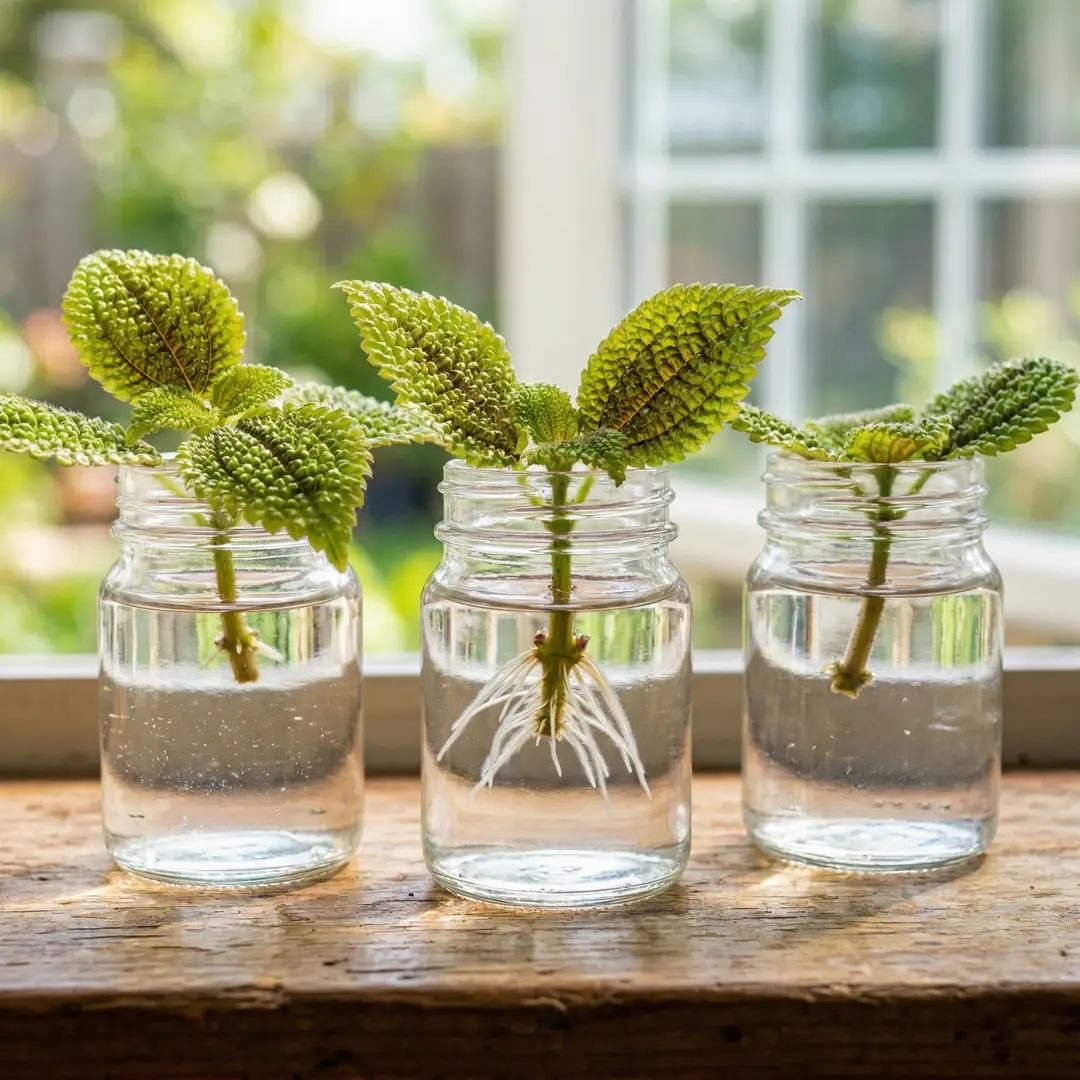
Moon Valley Pilea propagates readily from stem cuttings, making it one of the easier houseplants to share or multiply. Spring and early summer are the best times to take cuttings, as the plant is actively growing and rooting is faster, but successful propagation is achievable most of the year in warm indoor conditions.
Preparing the Cutting
Select a healthy stem tip 3-4 inches long with at least two sets of leaves. Cut cleanly just below a leaf node using sharp, clean scissors. Remove the leaves from the bottom 1-2 inches of the stem, leaving two or three leaf pairs at the top. If the remaining leaves are large, you can optionally trim them by half to reduce water loss while the cutting establishes roots.
Letting the cut end dry for 10-15 minutes before placing it in water or soil is optional but can reduce the chance of rot on the cut surface.
Water Propagation
Place the prepared cutting in a small jar of room-temperature water, making sure no leaves are submerged. Set it in bright indirect light and change the water every few days to keep it fresh and oxygenated. Roots typically appear within 2-4 weeks. Once roots are 1-2 inches long, transfer the cutting to moist potting soil. Water well after potting and keep the soil consistently moist for the first couple of weeks while the cutting adjusts to soil conditions.
See the water propagation guide for a more detailed walkthrough of this method.
Soil Propagation
You can also root cuttings directly in moist potting mix or perlite. Prepare the cutting as above, dip the cut end in rooting hormone powder if you have it (not required but speeds things up), and insert it into moistened perlite or a light seed-starting mix. Cover the pot loosely with a clear plastic bag or place it in a propagation box to hold humidity around the cutting. Keep it in bright indirect light and resist the urge to water too frequently: the mix should feel barely damp, not wet.
Check for resistance (a sign of rooting) after 3-4 weeks by gently tugging the stem. Once you feel the roots holding, remove the cover and treat as a normal plant, transitioning to regular watering.
See the soil propagation guide for more on this approach.
Propagation Success Rate and Timing
Moon Valley Pilea cuttings have a high success rate under normal indoor conditions. Failures are usually due to one of three things: cutting too small (fewer than two leaf nodes), overwatering the propagation medium and rotting the stem, or placing cuttings in insufficient light where rooting is very slow and the cutting depletes its energy reserves.
Late spring through early summer is the easiest time. Cuttings taken in deep winter can still root but may take twice as long as those taken during active growth.
🐛 Moon Valley Pilea Pests and How to Treat Them
Moon Valley Pilea is not particularly pest-prone, but the dense, ridged leaf surface can hide early infestations. Inspect the undersides of leaves and the stem joints regularly, especially during late winter and early spring when indoor air is driest and spider mites tend to flare up.
Moon Valley Pilea is not prone to pests as a rule, but a few species are worth watching for, particularly when plants are moved indoors after a summer outside, since outdoor conditions expose them to a wider range of insect species.
Spider mites are the most common problem on Moon Valley Pilea, and dry heated air in winter is the primary trigger. The first signs are a dusty, slightly bronzed look on the upper leaf surface, fine webbing in the leaf axils and stem joints, and tiny moving specks visible against a white piece of paper if you tap the plant over it. Treat by rinsing the plant under a shower or sink faucet to dislodge mites physically, then applying neem oil or insecticidal soap to all leaf surfaces including the deep ridges where mites shelter. Repeat every week for 3-4 weeks.
Mealybugs appear as small white cottony masses, most often in stem joints and the base of leaf petioles. Dab them individually with a cotton swab dipped in rubbing alcohol, then follow up with an insecticidal soap spray. Mealybugs can persist through one treatment easily, so checking back weekly is important.
Fungus gnats are a soil issue rather than a foliar one. Their larvae live in the top layer of moist soil and feed on fine roots and organic matter. Allow the top 1-2 inches of soil to dry out more consistently between waterings and the population drops quickly. Yellow sticky traps catch the adult gnats and help monitor the infestation level.


🩺 Moon Valley Pilea Problems and How to Fix Them
Most problems with Moon Valley Pilea trace back to watering or light. Root rot is the most serious issue and results from soil that stays wet too long, especially in a pot without drainage or in low-light conditions where the soil barely dries. Yellowing lower leaves and a soft, collapsing stem at the base are the signs. Remove the plant from its pot, cut away any black or mushy roots, and repot in fresh, dry mix. If more than half the root system is damaged, take healthy stem cuttings and start fresh.
Brown, crispy edges point to low humidity or infrequent watering. Check the soil first to distinguish between the two causes: dry soil plus crispy edges means underwatering; moist soil plus crispy edges means low humidity. Wilting that recovers quickly after watering means the plant has gone dry. Persistent wilting after watering, especially combined with yellowing lower leaves, points to root rot rather than drought.
Leggy growth is a light problem. The plant is reaching toward a light source it cannot quite reach. Move it closer to the window and cut back the stretched stems to encourage compact regrowth.
Pale, yellowing leaves with green veins on young growth may indicate an iron or manganese deficiency, often caused by a high soil pH. This is uncommon in fresh potting mix but can develop over time, especially in areas with hard water. Using distilled or rainwater and repotting into fresh mix every couple of years prevents it.
Powdery mildew can appear as a white, dusty coating on leaves in rooms with poor air circulation and moderate humidity. Improve ventilation around the plant and remove affected leaves. A diluted neem oil spray helps prevent spread.


🖼️ Moon Valley Pilea Display Ideas (Styling and Placement)
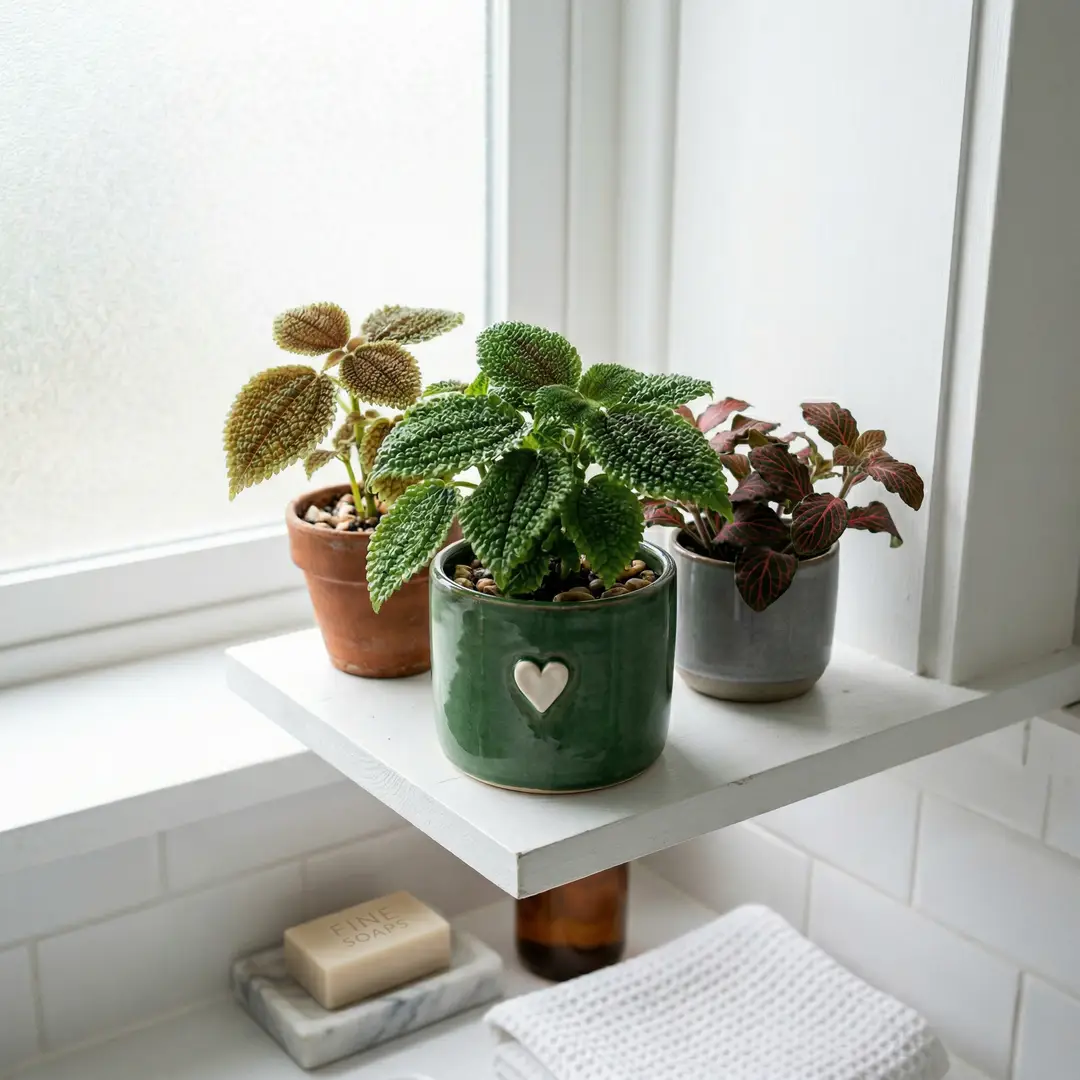
Moon Valley Pilea is a natural terrarium candidate. Its small size, love of high humidity, and striking texture make it one of the better choices for glass enclosures alongside mosses, nerve plants (Fittonia), and small ferns. In an open room, it works well grouped on a humidity tray with other moisture-loving tropicals.
For terrarium setup, Moon Valley Pilea works best in open-top or semi-open containers where there is some air circulation. Fully sealed terrariums can get too humid and stagnant for the plant, which increases the risk of stem rot and mildew on the leaf surfaces. A hinged lid left slightly ajar, or a container with mesh venting, is a good compromise. Plant it in a well-draining terrarium substrate: a drainage layer of lava rock or gravel, a thin layer of activated charcoal, and a top layer of coco coir mixed with perlite is a standard setup that works well. The plant stays compact in a terrarium, rarely exceeding 6-8 inches, and the enclosed humidity often produces the most vivid chartreuse-bronze leaf coloring you will see from this species.
On a desk or tabletop, it earns its keep as a textural accent. The ridged, crater-like surface catches light differently depending on the angle and time of day, giving the plant a visual depth that many smoother foliage plants lack. A simple white or terracotta pot keeps the focus on the leaves.
The bathroom is often an underrated location for Moon Valley Pilea. The naturally higher humidity from showers suits it, and as long as there is a window providing some light, it will grow well there. Pair it with Friendship Plant for a coordinated look, since the two are very similar in form and share care requirements.
For hanging or trailing use, Moon Valley Pilea is not ideal since it grows upright. Its compact, mounded shape is better suited to shelves, windowsills, and terrariums than to hanging baskets.
Color Pairings and Companion Plants
The chartreuse-green and bronze coloring of Moon Valley Pilea pairs well with plants in contrasting tones. Try it alongside dark-leaved plants like Chinese Evergreen in a deep burgundy variety, or the near-black foliage of some Alocasia cultivars. The yellow-green of Moon Valley’s leaf valleys pops against darker backgrounds, and the textural contrast between the deeply ridged Pilea and smoother-leaved companions adds visual complexity to a shelf or tabletop arrangement.
For a monochromatic approach, group Moon Valley Pilea with other Pileas in the chartreuse-to-bronze color range. Friendship Plant and the Moon Valley cultivar are nearly identical in coloring and form a cohesive pairing in a terrarium or grouped pot arrangement.
Seasonal Styling Adjustments
Moon Valley Pilea holds its color well year-round as long as light is adequate, which makes it a reliable foliage accent in changing seasonal displays. In fall and winter when many plants drop leaves or go dormant, the Pilea maintains its dense, textured form. Consider moving it to a more prominent position during months when the display needs a reliable, consistent presence.
In spring, the plant often puts on a flush of fresh growth that is slightly brighter in color than mature leaves. This new growth is the most vivid period for the plant’s colors and is a good time to photograph or feature it prominently in a display arrangement.
🌟 Moon Valley Pilea Care Tips (Pro Advice)
Pinch early and often. The most compact, bushy Moon Valley Pileas you see are the result of regular tip-pinching during the growing season. Start early in spring and keep at it every few weeks.
Check for mites in winter. Dry heated air from late fall through early spring is prime time for spider mites. A quick look at the undersides of a few leaves every week or two catches problems before they spread.
Terra cotta over plastic. The porous walls of a terra cotta pot help prevent the overwatering that kills more Moon Valley Pileas than anything else. It is an easy structural improvement to watering consistency.
Bottom watering once a month. A regular bottom-watering session saturates the root zone evenly and flushes dissolved salts from the soil surface downward, reducing salt buildup around the roots.
Group for humidity. Rather than misting, which can cause fungal patches on the ridged leaf surface, group Moon Valley Pilea with other tropical houseplants. The shared transpiration raises local humidity noticeably.
Rejuvenate every 2-3 years. After a couple of years, the lower stems get woody and bare. Rather than fighting it, take cuttings from the healthy upper growth, discard the woody base, and start fresh. The new plants will be compact and vigorous.
Clean the leaves with a soft brush. The deeply ridged leaf surface of Moon Valley Pilea collects dust in the valleys between the ridges, and a damp cloth does not reach it well. A soft-bristled paintbrush or a makeup brush makes it easy to gently sweep dust out of the pockets without damaging the leaf surface. Do this every few weeks in dusty rooms to keep the surface clean and pores unobstructed. Rinse occasionally under lukewarm water to flush the ridges completely.
Position where light hits the texture. The bullate leaf surface looks most dramatic when light comes from the side or slightly above at an angle, rather than from directly overhead. If you have a lamp or window that casts slightly angled light, place the plant where that light falls across the leaves. The shadows in the leaf valleys become visible and the three-dimensional quality of the texture is much more apparent.
Rotate the pot. Turn the pot a quarter turn every few weeks to keep the plant growing symmetrically toward the light source rather than leaning in one direction.
Use half-strength fertilizer. The fine root system of Moon Valley Pilea is sensitive to fertilizer burn. A diluted feed applied consistently beats a strong dose applied occasionally.
Do not mist the leaves. The deeply ridged surface traps water and dries slowly, which can encourage mildew or rot patches, particularly in lower-airflow rooms. Raise humidity by other means.
Inspect before bringing in from outside. If you move Moon Valley Pilea to an outdoor shaded spot in summer, check the leaves and stems carefully before bringing it back indoors in fall. Rinse the plant under a gentle stream of water, inspect the undersides of leaves and stem joints, and quarantine it from other houseplants for a week or two as a precaution. Outdoor plants can carry pests that spread quickly in the dry indoor environment.
Watch the soil after repotting. Fresh potting mix dries at a different rate than old, compacted soil. After repotting Moon Valley Pilea into new mix, check the soil more frequently for the first few weeks: new mix may hold more or less moisture than what the plant was in before, and it takes a few watering cycles to calibrate your schedule to the new conditions.
Fertilize with diluted fish emulsion in spring. If you want to use an organic fertilizer, diluted fish emulsion (at a quarter to half the recommended rate) is a gentle option that Moon Valley Pilea responds well to. It provides nitrogen and micronutrients in a slow-release form that is harder to over-apply than synthetic concentrates. The smell fades quickly after application if you water it in well.
Let it tell you. Moon Valley Pilea wilts dramatically when it gets too dry and recovers quickly when watered. That wilting is not permanent damage in most cases. Use it as a signal, though, rather than letting it happen repeatedly, since frequent wilt-and-recover cycles stress the roots over time.
❓ Frequently Asked Questions
Is Moon Valley Pilea toxic to cats and dogs?
No. Moon Valley Pilea (Pilea mollis) is non-toxic to cats, dogs, and humans, making it a safe choice for pet-friendly homes.Why are my Moon Valley Pilea leaves turning yellow?
Yellow leaves are almost always a watering issue. Overwatering causes soft, yellowing leaves starting at the base. Underwatering tends to produce yellowing with drooping. Check the soil before watering rather than watering on a schedule.Why does my Moon Valley Pilea look leggy?
Legginess means the plant is not getting enough light. Move it closer to a bright window and pinch back the stretched stems to encourage new, compact growth.How often should I water Moon Valley Pilea?
Water when the top inch of soil feels dry. In most homes that works out to every 7-10 days in summer and every 12-14 days in winter, but always check the soil rather than going by calendar.Can Moon Valley Pilea grow in a terrarium?
Yes, it is an excellent terrarium plant. Its small size, love of humidity, and striking texture make it one of the better choices for closed or semi-open terrariums.How do I propagate Moon Valley Pilea?
Take a 3-4 inch stem cutting just below a leaf node, remove the lower leaves, and place it in water or moist potting mix. Roots typically appear within 2-4 weeks.What causes Moon Valley Pilea leaves to curl?
Leaf curling is usually a response to low humidity, underwatering, or cold drafts. Check the soil moisture first: if it is very dry, water thoroughly. If the soil is adequately moist, the cause is likely environmental, either dry air or a cold draft from a window or vent. Move the plant away from the draft and raise humidity.Should I mist my Moon Valley Pilea?
No. The deeply ridged leaf surface traps water and dries slowly, which can encourage mildew patches or fungal spotting in low-airflow rooms. Raise humidity by grouping the plant with other houseplants or using a small humidifier instead.Why is my Moon Valley Pilea getting woody at the base?
Woody lower stems are a natural part of the plant’s aging process, not a sign of disease. After 1-2 years, the lower portions of the stems become woody and the lower leaves drop. This is normal. You can either leave it, since the upper growth is typically fine, or start fresh with cuttings from the healthy upper stems to get a compact young plant again.How do I clean Moon Valley Pilea leaves?
The deeply ridged leaf surface traps dust in the valleys between ridges. A soft-bristled brush (a dry paintbrush or makeup brush works well) can sweep dust out of the pockets without damaging the leaf. For a more thorough clean, rinse the plant under lukewarm water and let it drain fully before returning it to its spot. Avoid leaf-shine products as they can clog the surface texture.Is Moon Valley Pilea the same as Friendship Plant?
They are closely related but technically different species. Moon Valley Pilea is Pilea mollis, while Friendship Plant is Pilea involucrata. Both have deeply textured, bronze-green leaves and nearly identical care requirements. In nurseries the two are often sold under the same Moon Valley name, which causes confusion. For care purposes, treat them the same way.ℹ️ Moon Valley Pilea Info
Care and Maintenance
🪴 Soil Type and pH: Peat or coco coir mix with perlite
💧 Humidity and Misting: Prefers 50% or higher humidity. Dry air causes crispy edges and slow growth.
✂️ Pruning: Pinch back leggy stems to encourage a fuller, bushier shape. Remove dead or discolored leaves as needed.
🧼 Cleaning: Wipe leaves gently with a damp cloth to remove dust. Avoid using leaf-shine products on the textured surface.
🌱 Repotting: Every 1-2 years, or when roots begin circling the base of the pot.
🔄 Repotting Frequency: Every 1-2 years
❄️ Seasonal Changes in Care: Reduce watering slightly in fall and winter. Keep away from cold drafts and heating vents.
Growing Characteristics
💥 Growth Speed: Moderate to Fast
🔄 Life Cycle: Perennial
💥 Bloom Time: Rarely indoors; tiny pink or white flowers in clusters on mature plants
🌡️ Hardiness Zones: 10-12
🗺️ Native Area: Central and South America
🚘 Hibernation: No true dormancy; growth slows in winter
Propagation and Health
📍 Suitable Locations: Bright windowsills, terrariums, bathroom shelves, desktops
🪴 Propagation Methods: Easily propagated from stem cuttings placed in water or moist soil in spring or early summer.
🐛 Common Pests: spider-mites, fungus-gnats, and mealybugs
🦠 Possible Diseases: Root rot from overwatering; powdery mildew in low-airflow conditions
Plant Details
🌿 Plant Type: Tropical Perennial
🍃 Foliage Type: Evergreen
🎨 Color of Leaves: Chartreuse-green with bronze-brown ridges
🌸 Flower Color: Pale pink to white
🌼 Blooming: Rare indoors; insignificant flowers
🍽️ Edibility: Not edible
📏 Mature Size: 6-12 inches
Additional Info
🌻 General Benefits: Non-toxic to pets and children, air-purifying, compact size suits small spaces, striking texture adds visual interest.
💊 Medical Properties: None known
🧿 Feng Shui: The vibrant green of Moon Valley Pilea is associated with growth and fresh energy. Its compact form suits tabletop or desk placement in the east or southeast areas of a space.
⭐ Zodiac Sign Compatibility: Taurus
🌈 Symbolism or Folklore: Vitality, creativity, grounded energy
📝 Interesting Facts: The common name ‘Moon Valley’ refers to the deeply pitted surface of the leaves, which resembles a lunar landscape when viewed up close. Each leaf has a raised network of veins with sunken pockets between them, a texture called bullate, which is relatively rare among popular houseplants.
Buying and Usage
🛒 What to Look for When Buying: Choose a plant with compact, upright growth and firm, deeply ridged leaves. The color should be a clear chartreuse-green on top with bronze-brown veining. Avoid plants with pale, washed-out leaves (too much light) or stems that are stretched and sparse.
🪴 Other Uses: Excellent in terrariums and bottle gardens. Pairs well with other humidity-loving tropicals in grouped arrangements.
Decoration and Styling
🖼️ Display Ideas: Tabletops, bathroom shelves, terrarium centerpieces, grouped with ferns and nerve plants for a lush tropical look.
🧵 Styling Tips: The bold texture of Moon Valley Pilea reads best in simple, solid-colored pots. A matte white, terracotta, or deep green pot lets the leaves carry the visual weight without competition.
📚 References ▼
- 📘 Huxley, A. (1992). New RHS Dictionary of Gardening. Macmillan.
- 📘 Erhardt, W. et al. (2008). Zander: Handwörterbuch der Pflanzennamen. Ulmer.
🪴 See also 🪴

Complete Guide to Artillery Fern Care and Growth

Complete Guide to Friendship Plant Care and Growth

Complete Guide to Aluminum Plant Care and Growth

