

Hoya Linearis
Hoya linearis
Linear Wax Plant, Himalayan Hoya, Thread Hoya


Hoya linearis is the hoya that looks nothing like a hoya. Where its relatives have thick, waxy, succulent-type leaves, linearis produces cascading strings of narrow, soft, fuzzy needle-like leaves with a delicate texture found in no other commonly grown hoya. Native to the Himalayan foothills, it is also more cold-tolerant than most relatives and produces pendant clusters of small white flowers with a fresh lemon fragrance.
📝 Hoya Linearis Care Notes
🌿 Care Instructions
⚠️ Common Pests
📊 Growth Information
🪴 In This Guide 🪴

☀️ Hoya Linearis Light Requirements
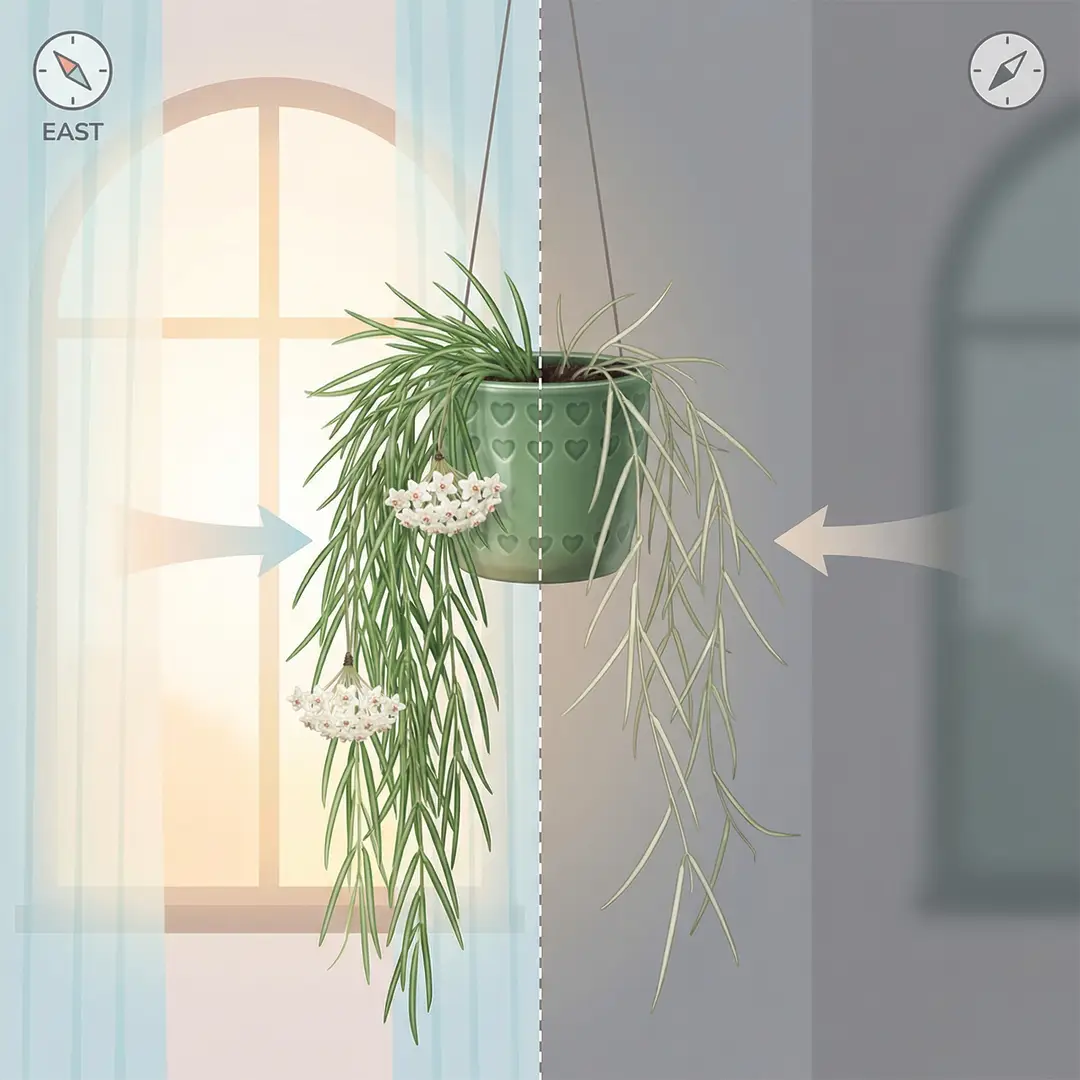
Hoya linearis thrives in bright indirect light, the same broad requirement as most hoyas. What is different from thick-leaved relatives is that the soft, thin leaves are more sensitive to prolonged direct sun than the waxy-surfaced hoyas. Strong, direct midday or afternoon sun can cause the needle-like leaves to bleach, crisp, or develop brown tips more readily than the protected waxy surface of a Hoya carnosa leaf.
Best Window Positions
An east-facing window is the ideal position for Hoya linearis indoors. The gentle morning light provides enough intensity for vigorous growth and blooming while the soft leaf surface stays comfortable. North of east, a few feet from a south window filtered by a sheer curtain, or a bright spot near a west window where afternoon direct sun does not fall directly on the plant are all good alternatives.
Avoid placing Hoya linearis in a window where direct sun hits the pendant strings during the hottest part of the day, particularly in summer. The thin leaves have less protective wax than other hoyas and scorch more easily under intense, direct exposure.
Low Light Performance
In low light, Hoya linearis grows slowly and rarely flowers. The needle-like leaves may also grow shorter and more sparsely spaced than normal, giving the cascade a thinner, less lush appearance. If the plant is producing noticeably short leaves and long bare sections between growth nodes, insufficient light is the likely cause. Move it closer to a window or add a full-spectrum grow light.Grow Lights
Full-spectrum LED grow lights work well for Hoya linearis in rooms without adequate natural light. Run the light for 12-14 hours daily using a timer, positioned 12-18 inches above the top of the cascade. The pendulous habit of linearis means the light source is above the growing tips, which is ideal for this plant since the naturally pendant growth already directs new growth upward before cascading down.💧 Watering Hoya Linearis
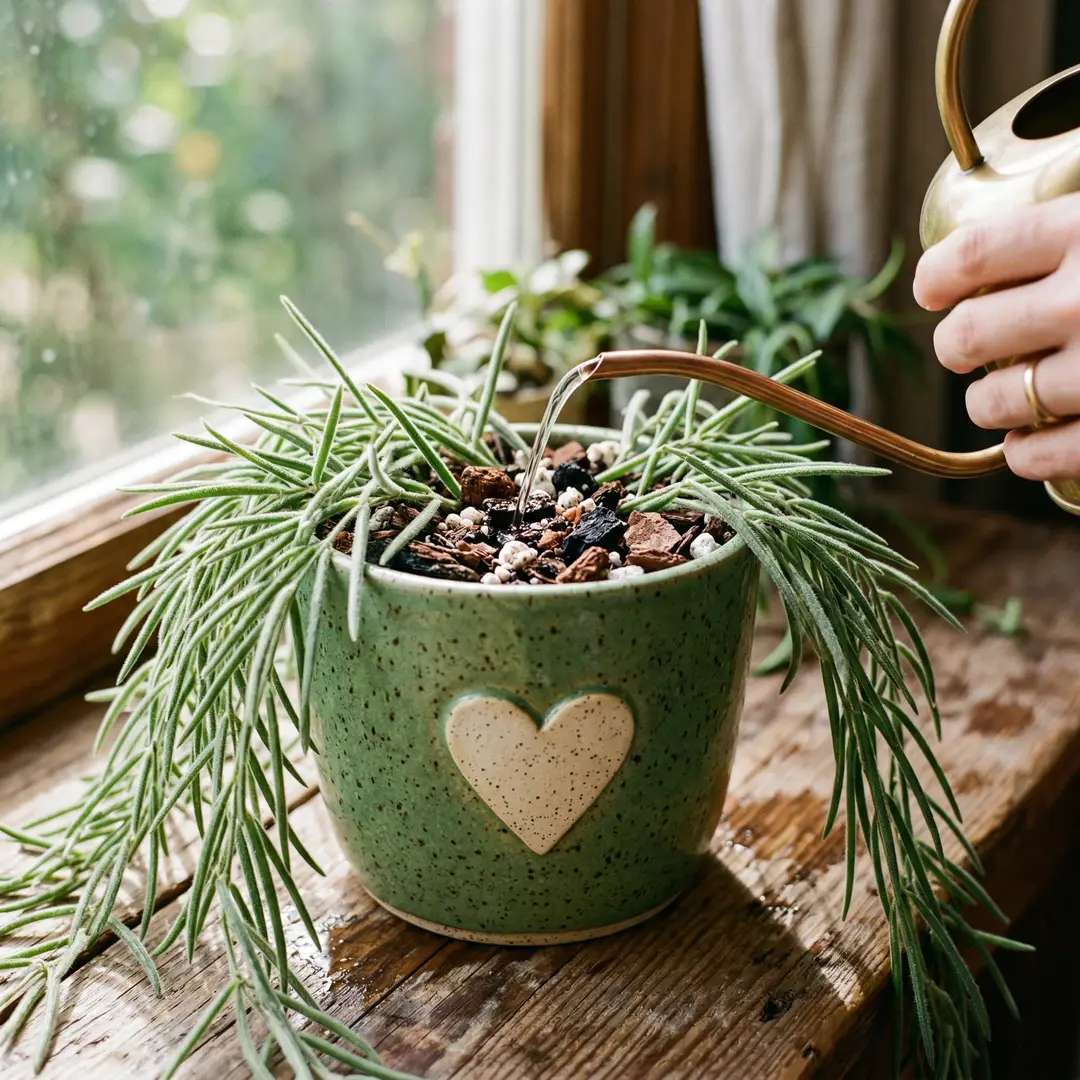
Watering Hoya linearis requires slightly more attention than other hoyas, because the needle-thin leaves hold much less water than the thick, succulent-style leaves of carnosa, australis, or obovata. Those plants have genuine water reserves that let you wait until the mix is bone dry. Linearis does not have that buffer.
The practical approach: allow the top half of the potting mix to dry out between waterings. Check by pressing your finger 2-3 inches into the mix. If it still feels damp at that depth, wait. If it is dry at that depth but the bottom of the pot is still holding some moisture, you can water. You do not need to wait for every last bit of moisture to leave the root zone.
How to Water
Water thoroughly when it is time. Take the pot to a sink and pour water evenly over the surface until it flows freely from the drainage holes. This flushes the entire root zone and washes out any accumulated fertilizer salts. Allow the pot to drain completely before returning it to its location. Never allow Hoya linearis to sit in standing water in a saucer.
In summer with active growth and warm temperatures, watering every 7-12 days is typical depending on pot size and room conditions. In winter with slower growth and lower light, the same pot may need watering every 14-21 days. Always check the mix rather than watering on a fixed schedule.
Signs of Overwatering and Underwatering
Overwatering is the more common problem. Signs include yellowing needle leaves, particularly at the base of the plant or on inner sections, and a generally limp or desaturated appearance despite moist soil. If multiple needles are yellowing at once and the soil has been consistently moist, check the roots immediately. Root rot can advance quickly in this species when the mix stays wet too long.
Underwatering in Hoya linearis shows as limp, slightly deflated needles that lack their usual turgid firmness. The leaves may also begin to slightly wrinkle or curl. Unlike thick-leaved hoyas that can tolerate this condition for weeks, Hoya linearis will begin dropping needles if left significantly dry for extended periods. Water it promptly when you see these signs and it typically recovers within a day.
Watering and Leaf Texture
One practical consideration specific to linearis is that the fuzzy, hairy leaf surface retains water droplets when water splashes onto the foliage during watering. Standing water on the leaf surface, particularly in humid conditions with poor air circulation, can create spots for fungal issues to develop. Water at the soil level rather than overhead, and ensure the plant has good air movement around it, particularly after watering.Watering Hanging Baskets
Because Hoya linearis is best displayed in a hanging basket, watering technique requires a small adjustment. Hanging baskets dry out faster than pots sitting on a surface, particularly near a window where air circulation is higher. Check the mix dryness more frequently than you might for a shelved pot, especially during summer.
The easiest approach is to lift the basket slightly when checking dryness. A lightweight basket that feels almost empty is close to fully dry at the root zone. When you water, take the basket down and water it in the sink, allowing full drainage before rehooking it. This ensures thorough saturation rather than the partial wetting that can happen when watering a hanging plant in place, where water may run to the edges and drain before reaching the center of the root mass.
🪴 Best Soil for Hoya Linearis
Hoya linearis needs the same fundamentally well-draining epiphytic mix as other hoyas, but with a small adjustment: the mix should retain slightly more moisture than the very lean bark-heavy mixes that suit thick-leaved species. Because the thin needle leaves cannot store water as a backup, the root zone benefits from a mix that retains a small amount of moisture while still draining freely.
A reliable formula is equal parts orchid bark, perlite, and standard potting mix. This provides more moisture retention than a pure orchid bark mix while still draining fast enough to prevent root rot with correct watering. The potting mix component in this ratio keeps the center of the root zone from going bone dry immediately after watering.
Adjusting for Your Conditions
If you live in a hot, dry climate where the mix dries out very quickly, you can shift the ratio slightly toward more potting mix, perhaps 40% potting mix and 30% each of bark and perlite. If you live in a humid climate where the mix stays moist longer, stick with equal thirds or add slightly more perlite to improve drainage speed.
The goal is a mix that holds enough moisture for the root zone to stay lightly damp for several days after watering, but never stays soggy or waterlogged. Finding this balance is the key soil adjustment that separates linearis from its thicker-leaved relatives.
In a hanging basket, the mix tends to dry faster than in a pot sitting on a surface, because air reaches the container from all sides. This is actually beneficial for Hoya linearis: hanging baskets naturally counteract the slightly more moisture-retentive mix by drying it out faster from all directions, which keeps the root zone in the ideal range without requiring manual adjustment.
Drainage is Still Essential
Despite the slightly more moisture-retentive mix, drainage holes remain non-negotiable. Never plant Hoya linearis in a container without drainage. The adjustment in mix formulation is subtle and is not a substitute for the fundamental requirement of water flowing freely out of the pot after each watering.🌱 Fertilizing Hoya Linearis
Hoya linearis benefits from regular feeding during its spring and summer growing season. The plant produces a considerable length of stem and leaf material each season for its size, and monthly fertilizing supports vigorous, healthy needle growth and better flower production.
Growing Season Schedule
Feed once a month from March or April through August with a balanced water-soluble fertilizer diluted to half strength. Apply after watering, never to dry soil, to protect the root zone from fertilizer burn.
In late spring, switch to a high-phosphorus bloom-booster formula for four to six weeks before the typical spring blooming window. Phosphorus supports both root health and flower production, and hoyas that receive a bloom-booster period before flowering tend to produce more umbels with larger, more fragrant clusters.
Winter Pause
Stop feeding entirely from October through February. The plant’s growth slows significantly during this period, and unfed roots accumulate fertilizer salts rather than absorbing them. The winter feeding pause also helps set up the nutrient contrast that makes spring feeding more stimulating.
If you notice white crusty deposits on the soil surface or pot rim after a season of regular feeding, flush the mix thoroughly with plain water two or three times in succession before the growing season resumes, allowing full drainage between each flush.
Fertilizing Caution for Linearis
Because Hoya linearis has a finer, more delicate root system than thick-leaved hoyas, it is worth being conservative with fertilizer concentration. Always dilute to half the package recommendation rather than full strength. The finer roots are more sensitive to fertilizer burn than the robust roots of obovata or carnosa, and over-fertilized needle leaves show brown tip damage that is difficult to reverse. If in doubt, dilute further and feed more frequently rather than applying a concentrated dose.🌡️ Hoya Linearis Temperature and Cold Tolerance
Hoya linearis is unusual among commonly grown hoyas in its cold tolerance. Coming from the Himalayan foothills, where elevations are significant and nights are cool, this species can handle temperatures that would damage or kill most other hoyas. It grows comfortably in the 55-80°F range, which is notably lower on the minimum end than species like carnosa or australis.
Cold Tolerance and Winter Benefits
Brief exposure to temperatures near 40°F will not harm Hoya linearis, provided the plant is in well-drained conditions and the cold is brief rather than sustained. This makes it one of the few hoyas suitable for a cool sunroom, unheated conservatory, or north-facing porch in temperate climates, as long as it does not experience sustained frost.
More practically, the cool winter rest that improves blooming in all hoyas is especially natural for Hoya linearis. Temperatures in the 50-60°F range from November through February, combined with reduced watering, align perfectly with the plant’s native seasonal rhythms from its mountain habitat. Plants given this cool rest reliably produce more pendant flower clusters the following spring than those kept in stable warm conditions year-round.
Outdoor Growing in Temperate Climates
Hoya linearis is one of the few hoyas that can be grown outdoors in temperate climates with mild winters. In USDA zone 9, where winter low temperatures typically stay above 25-28°F, a sheltered outdoor position with protection from frost and harsh wind can allow the plant to overwinter outdoors in a microclimate near a south-facing wall or under an overhang.
In cooler temperate zones (8 and below), Hoya linearis works well as a seasonal outdoor plant during summer, brought indoors before the first autumn frost. A sheltered porch, partially covered patio, or pergola with dappled light provides excellent growing conditions. The naturally higher outdoor humidity and brighter ambient light typically produce more vigorous growth and more reliable blooming than year-round indoor growing. Just ensure the position is not exposed to intense midday sun, which can scorch the soft leaves.
Heat and Soft Leaves
On the upper end, Hoya linearis is less comfortable with prolonged heat above 90°F than thick-leaved hoyas. The thin leaves do not buffer temperature extremes as effectively. In very warm conditions, the plant may drop leaves or show heat stress before thick-leaved relatives do. Ensure good air circulation around the plant during summer and keep it away from heat vents, radiators, and direct sun that could raise the local leaf temperature significantly above ambient.Seasonal Care Calendar
Spring (March through May): Resume normal watering as growth picks up. Restart monthly feeding. Watch for pendant peduncle spurs developing at stem nodes, which signal that the plant is preparing to bloom.
Summer (June through August): Most active growth phase. Water when the top half of the mix is dry, fertilize monthly, ensure good air circulation. The most likely blooming window. Protect from direct midday sun.
Fall (September through November): Begin tapering fertilizer. Allow watering intervals to lengthen naturally. Start transitioning the plant to a cooler position if possible.
Winter (December through February): Water when the top half of the mix is dry, typically every 14-21 days. Stop fertilizing. The plant benefits from temperatures in the 50-60°F range. Protect from frost.
💦 Humidity for Hoya Linearis
Hoya linearis benefits from moderate humidity more than most of its relatives. Where a Hoya carnosa with its waxy leaves can tolerate household humidity as low as 30-35% without visible stress, the soft, hairy leaves of linearis are more sensitive to dry air. A target of 50-60% relative humidity produces the best growth and most lush needle cascades.
Managing Dry Conditions
In homes where winter heating drops humidity below 40%, Hoya linearis may show needle tips browning or individual needles dropping more than normal. A small humidifier near the plant is the most effective solution for maintaining adequate humidity. A pebble tray with water below the pot adds some localized humidity as the water evaporates and is a lower-maintenance option for moderate dryness.
Avoid misting Hoya linearis directly. The hairy leaf surface traps moisture between the fine hairs and along the stem, and in poor air circulation conditions, this retained water can encourage fungal growth. If you want to clean or refresh the plant, use a soft brush or a gentle air stream rather than water applied directly to the foliage.
Air Circulation
Good air circulation is particularly important for Hoya linearis because of the soft, slightly moisture-retentive leaf texture. A gentle air movement around the plant helps prevent the buildup of stagnant humid air in the needle clusters, which is where fungal issues most commonly develop. In a room with a ceiling fan running on low, or near an open window in mild weather, the plant benefits from the air movement without being stressed by drafts.
The balance to aim for is warm, moderately humid air with gentle movement: humidity high enough to keep the needle tips from browning, airflow consistent enough to prevent stagnation, and no cold drafts. A bright bathroom with a working exhaust fan or a plant shelf near a partially open window during mild weather both meet these conditions naturally.
🌸 Getting Hoya Linearis to Bloom
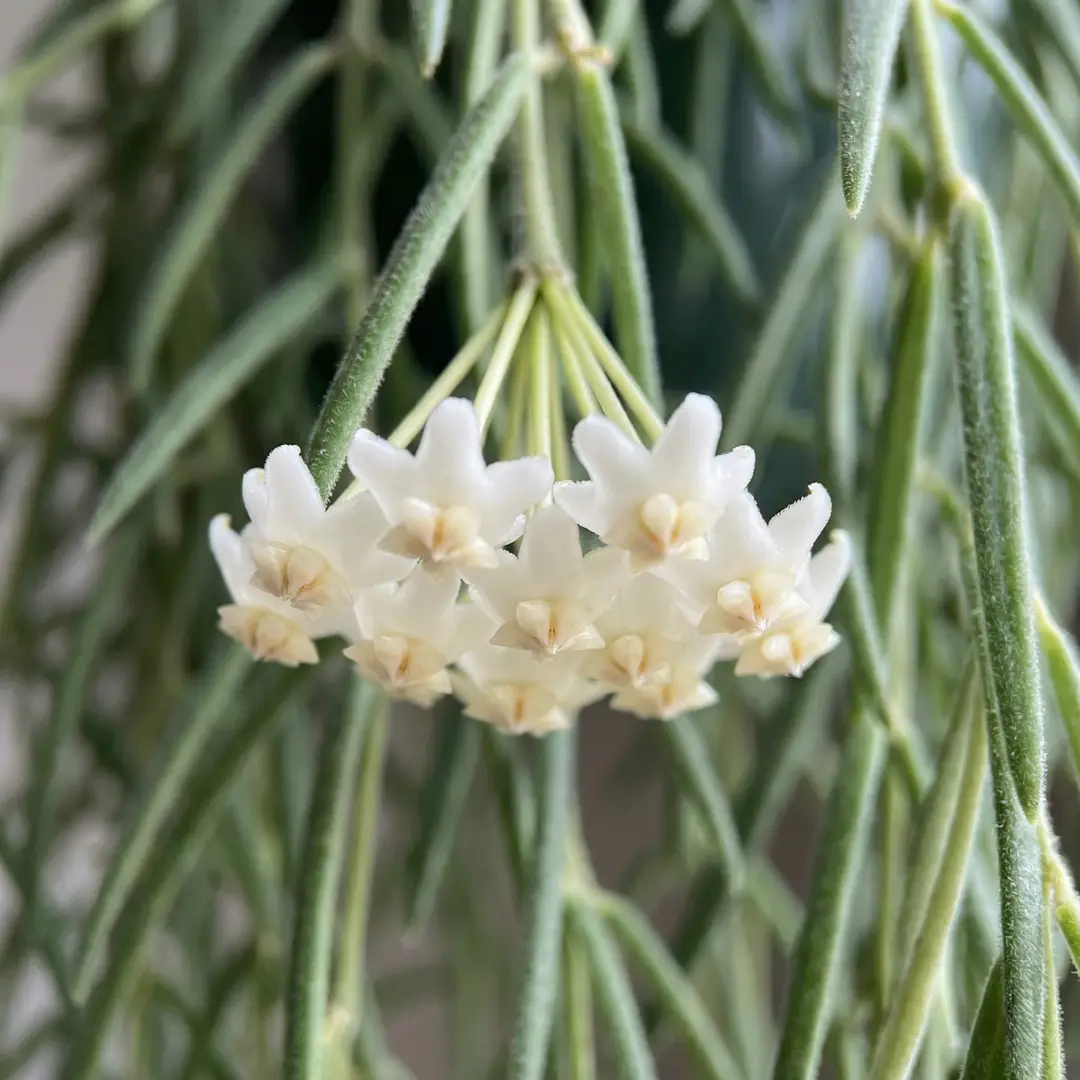
Hoya linearis produces pendant clusters of small, white, star-shaped flowers with pale yellow to cream center coronas. Each umbel hangs downward on a short peduncle spur, matching the overall pendulous character of the plant. The flowers are smaller and more delicate than those of obovata or australis, but the fragrance is one of the most distinctive in the genus: fresh, light, and lemony rather than the heavy sweetness common in other hoyas.
Conditions for Blooming
Hoya linearis needs bright indirect light, at least one to two growing seasons of establishment, and a cool winter rest to bloom consistently. The light requirement is as important here as with any hoya: plants in medium or low light will grow but rarely flower. Moving the plant to a brighter window, closer to an existing window, or under a grow light is the first adjustment to make if a healthy, multi-year plant is not blooming.
The winter rest period is particularly effective for linearis because cool winters are native to its Himalayan habitat. Temperatures in the 50-60°F range for two to three months before the expected spring bloom window almost always produce a flowering response in plants that previously did not bloom or bloomed poorly.
Flower Spurs and Reblooming
Like all hoyas, Hoya linearis blooms from peduncle spurs that form at stem nodes. These spurs rebloom from the exact same point each season indefinitely, making them permanent flower locations on the plant. After each bloom cycle ends, leave the spent spur in place. A spur that looks like a bare, short stub after flowering has finished is dormant and will produce new buds the next season, not dead growth to be removed.
When pruning the cascade for shape, examine every node carefully before cutting. The slender spurs of linearis can be particularly easy to overlook among the narrow, closely spaced leaves.
Fragrance Placement and Timing
The lemon-fresh scent of Hoya linearis flowers is subtle but distinctive and different from the heavy sweetness of hoyas like australis or obovata. Because the fragrance is lighter, placing the blooming plant in a room where you spend time sitting quietly, such as a reading area, bedroom, or study, allows you to appreciate it at close range. The scent is strongest when multiple umbels are open simultaneously during peak bloom.
Unlike some hoyas that release fragrance primarily in the evening, Hoya linearis flowers tend to be lightly fragrant throughout the day. The scent is most noticeable in still air: if the plant is near an open window with a strong cross-breeze, the fragrance disperses before it registers. On calm days or in rooms with minimal air movement, the lemon notes become pleasantly persistent. Individual umbels remain open and fragrant for approximately one to two weeks before the flowers begin to drop.
🌿 Hoya Linearis Forms and Related Hoyas
Standard Hoya Linearis
There is essentially one form of Hoya linearis in widespread cultivation: the standard species, with its pendant strings of narrow, linear, softly hairy green needles. Individual plants vary somewhat in needle length and fullness, but these differences are minor and related to growing conditions rather than distinct cultivar selection.
A small number of rare variegated forms of Hoya linearis exist in specialist collections, with cream or pale yellow markings on individual needles, but these are not in general trade and unlikely to be encountered at nurseries or plant shops. If you see a plant labeled “Hoya linearis variegata,” verify its provenance carefully before purchasing, as the label is often applied loosely to unusual specimens of uncertain origin.
Hoya Linearis vs. Similar Species
Hoya linearis is occasionally confused with a handful of other hoya and Apocynaceae species with pendulous or narrow-leaved growth habits. The most common lookalike in the trade is Hoya bella, which also produces pendant clusters of white flowers and grows with a somewhat pendant habit, but has small, oval, flat leaves rather than needle-like ones. Side by side, the two are easy to distinguish: linearis needles are clearly cylindrical or semi-cylindrical and fuzzy; bella leaves are flat and smooth.
Some sellers also confuse Hoya linearis with certain Dischidia species, which share the pendulous trailing habit, or with Rhipsalis (a cactus genus), which can produce needle-like stems. None of these are true hoyas, and all are easy to distinguish on closer inspection by their stem and leaf structure.
Hoya Linearis in the Context of the Genus
Within the Hoya genus, linearis occupies a unique ecological and aesthetic niche. Where most commonly grown hoyas evolved in lowland tropical forests and developed thick, waxy, water-storing leaves as a survival adaptation, linearis evolved in cool, misty highland environments and took a different path. The result is a plant that belongs firmly in the genus by taxonomy and flower structure, but looks and behaves differently enough to represent a distinct experience from any other hoya in a typical collection.
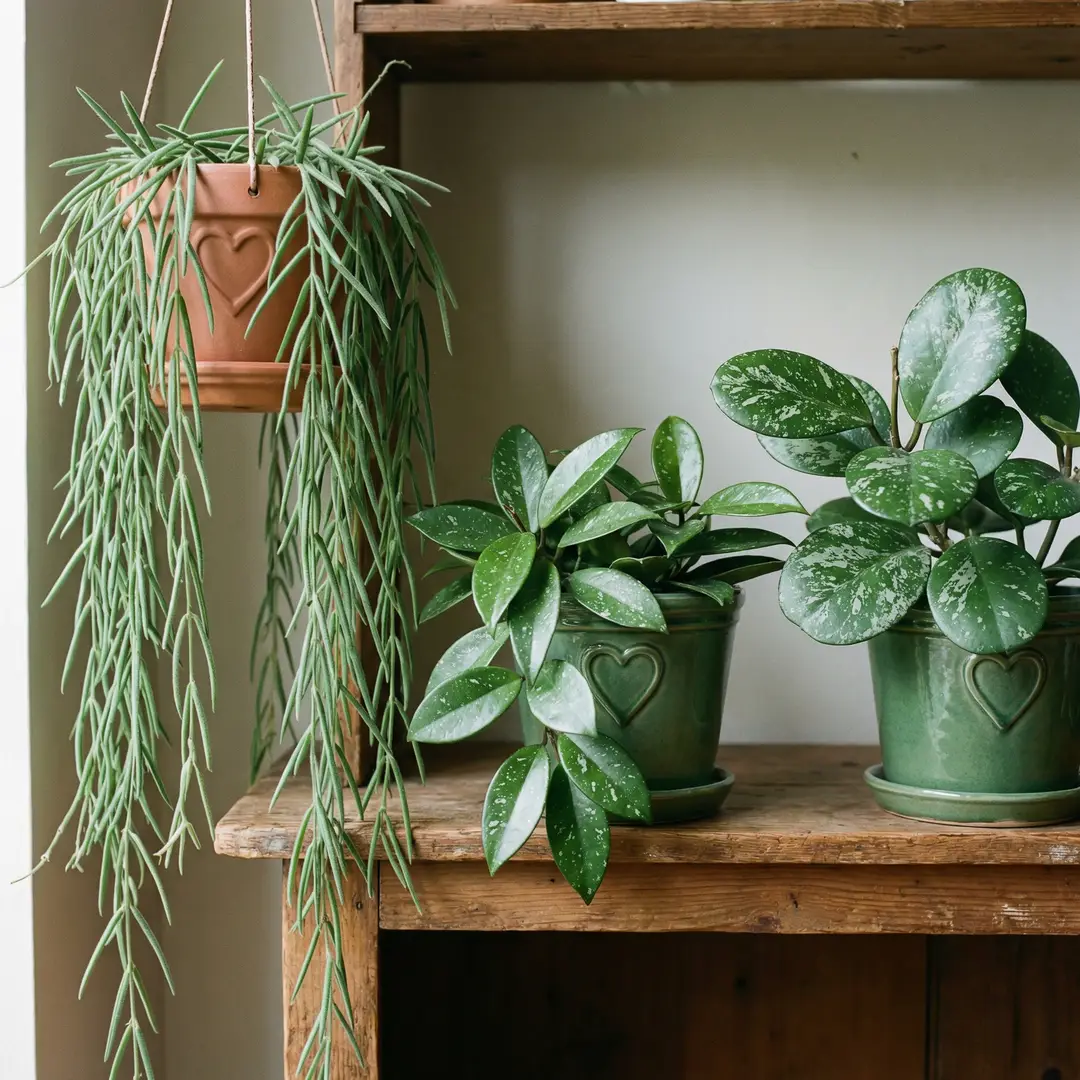
Adding linearis to a shelf or hanging display that already includes obovata, carnosa, and wayetii creates an immediate textural conversation between four very different interpretations of the same basic plant family. The contrast makes each plant more interesting rather than less.
Related Hoyas to Consider
- Hoya Carnosa (Hoya carnosa): The classic hoya with thick, oval, waxy leaves. The most dramatic foliage contrast to linearis’s soft needles. Both are long-lived, easy-care plants from very different habitats.
- Hoya Obovata (Hoya obovata): Large, rounded, silver-splashed leaves. Another strong visual contrast to linearis. Together on the same shelf, the two plants illustrate the range of leaf form in the genus.
- Hoya Australis (Hoya australis): Rounded glossy leaves and intensely fragrant flowers. Shares the easy-care profile and reliable blooming characteristic, with complementary fragrance: australis has a heavy sweet scent while linearis offers lemon-fresh notes.
- Hoya Wayetii (Hoya wayetii): Narrow leaves with dark red margins. Shares the narrow-leaf theme with linearis but in a very different texture (waxy vs. soft) and growth direction (trailing vs. pendulous strings).
- Hoya Pubicalyx (Hoya pubicalyx): Fast-growing with silver-splashed narrow leaves and dramatic dark flowers. A vigorous companion with a very different character from the delicate linearis.
🪴 Potting and Repotting Hoya Linearis
Hoya linearis grows well slightly pot-bound, like most hoyas, but its smaller, more delicate root system means it is more vulnerable to the extremes of both too small and too large a pot than thick-leaved relatives. Too small a pot dries out too fast for the thin leaves to compensate; too large a pot stays wet too long and increases root rot risk.
When and How to Repot
Repot every two to three years, or when roots are emerging from drainage holes in volume. Move up only one pot size at a time, 1-2 inches wider in diameter. Spring is the best repotting time, when the plant is entering active growth and can quickly fill the new root space.
When unpotting, handle the root system gently. Linearis roots are finer and more delicate than the robust roots of obovata or carnosa. Shake or rinse off old mix carefully, inspect the roots, and trim any brown or mushy ones cleanly with sterilized scissors. Settle the plant into fresh mix at the same depth as before and water lightly until new growth confirms recovery.
Choosing the Right Pot
Hanging baskets suit Hoya linearis perfectly. The naturally pendulous cascade looks most natural in a hanging position, with the strings falling freely rather than tangling on a shelf surface. Terracotta hanging pots provide the additional benefit of breathability, which helps the slightly more moisture-retentive mix dry at an appropriate rate without becoming waterlogged.
If you prefer a shelf or tabletop display, a tall narrow pot allows the strings to cascade over the edge before they would tangle on the surface. A pot height of 6-8 inches gives the early cascades room to develop elegantly before reaching the shelf level below.
Wire or open-sided hanging baskets are another option worth considering for Hoya linearis. The open structure maximizes air circulation around the root zone, which benefits the slightly humidity-sensitive roots, and allows the strings to emerge from multiple angles rather than only over the rim, creating a more spherical, full cascade. Line the basket with a layer of coco coir to retain the mix while still allowing air exchange.
✨ Cleaning Hoya Linearis
Cleaning Hoya linearis requires a different approach than broad-leaved hoyas. The needle-like leaves cannot be wiped with a damp cloth the way you would clean a Hoya obovata or carnosa leaf. Attempting to wipe the tiny, hairy needles is impractical and risks damaging the fine stems.
Instead, use a soft-bristle brush, such as a clean makeup brush or watercolor brush, to gently sweep dust from the needle surfaces. Work in the direction of the leaf tips, not against the grain, to avoid dislodging leaves. Alternatively, a gentle puff of air from a can of compressed air or a bulb duster lifts dust from the needle clusters without contact.
The stem nodes remain the most important inspection point. Check each node visible in the cascade for early signs of mealybug infestation, which appears as small white cottony patches at these junctions. A cotton swab moistened with 70% isopropyl alcohol can treat individual nodes without needing to wet the foliage.
Cleaning every three to four weeks during the growing season keeps the plant healthy, maintains the visual freshness of the matte-textured needles, and provides a structured opportunity to catch any pest or disease issue before it spreads.
When you bring Hoya linearis in from an outdoor summer position, do a thorough cleaning inspection before reintroducing it to your indoor collection. Outdoor plants can harbor spider mites, aphids, or fungal spores that are not visible at a casual glance. A careful node inspection and a preventive spray of dilute neem oil on all surfaces before bringing the plant inside protects both linearis and any neighboring indoor plants from hitchhiking pests.
✂️ Pruning Hoya Linearis
Hoya linearis rarely needs heavy pruning. The naturally pendant cascade looks best when the strings are allowed to grow to their full length, creating a lush, flowing display. Pruning is most useful for removing dead or damaged sections, shaping an uneven cascade, and encouraging denser growth at the top of the plant where it sometimes becomes bare as the strings lengthen.
How to Prune
Use clean, sharp scissors. Trim individual strings to the desired length, cutting just above a leaf node. Each cut typically encourages the stem to push new growth from the node below the cut, gradually building a fuller cascade over time. Avoid cutting every string to the same length, which creates an unnaturally uniform effect. A slight variation in string lengths gives the cascade a more natural, organic appearance.
Prune in spring or early summer when the plant is actively growing and will recover the fastest. Avoid heavy pruning in winter when growth is slow.
Protecting Spurs and Managing Dead Sections
As with all hoyas, never remove the peduncle spurs. These are permanent bloom sites that reuse the same point each season. A spur among the needle strings looks like a very short, bare, slightly thicker stub at a node. It can easily be mistaken for a dead section when dormant between flowering cycles.
Remove completely dead or desiccated string sections by cutting them at their base, close to the vine from which they emerge. Dead sections that stay on the plant can become pathways for fungal issues if the plant is in a humid environment.
🌱 Propagating Hoya Linearis
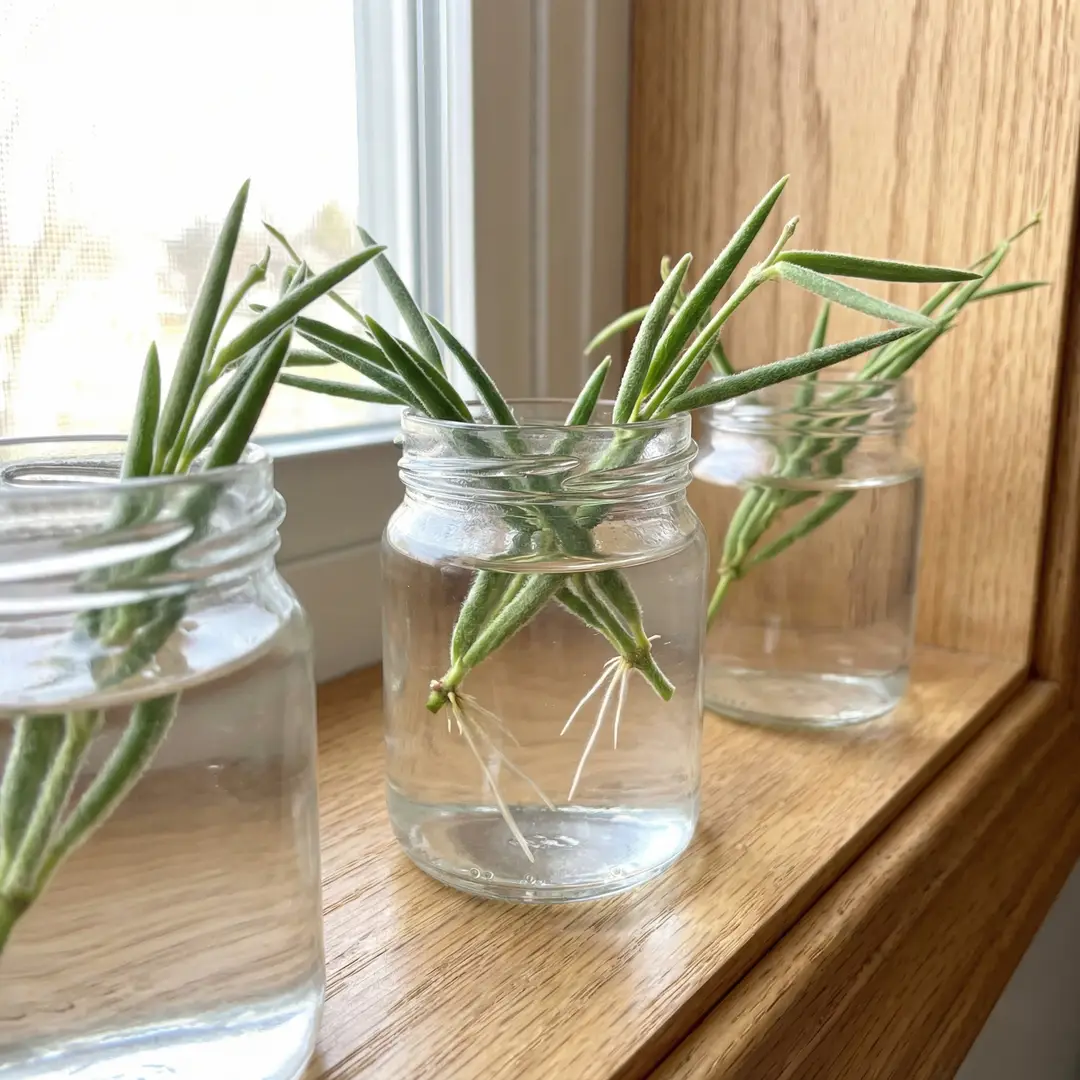
Hoya linearis is propagatable from stem cuttings, following the same basic approach as other hoyas. The key requirement is that each cutting includes at least one node. The main difference from thick-leaved hoyas is that linearis cuttings are more delicate and benefit from gentler handling and a slightly warmer, more humid rooting environment.
Taking Cuttings
Use clean, sharp scissors. Select a healthy stem section with at least one node and a small cluster of needle leaves. Remove the leaves immediately below the node to expose it cleanly for rooting. A cutting with two to four nodes and multiple leaf clusters is more reliable than a single-node cutting, because if one node fails to root, another may succeed.
Take cuttings in spring or early summer for the fastest rooting. The warm conditions and active growth hormones present in the plant during this period give cuttings the best chance of establishing roots before the onset of winter slow-down.
Rooting Methods
Water rooting works reliably for Hoya linearis. Place the cutting in a small jar with the node submerged and the leaf clusters above the waterline. Set the jar in a warm, bright location with good humidity and no direct sun. Roots typically appear within three to six weeks. Change the water weekly to keep it fresh.
Sphagnum moss is also an excellent rooting medium for linearis, providing the combination of moisture and air that the delicate roots develop best in. Keep the moss consistently moist but not waterlogged, and enclose the cutting in a clear bag or small propagation dome to maintain high humidity around the cutting. Remove the cover for an hour each day to prevent fungal buildup.
Transitioning to Soil
Water-rooted cuttings of Hoya linearis can be more sensitive to the soil transition than thick-leaved hoyas, because the fine, water-adapted roots are less robust. Pot the cutting into the standard linearis mix (equal parts orchid bark, perlite, and potting mix) and keep the mix consistently lightly moist for the first two to three weeks while the roots adapt. After the cutting begins pushing new growth, transition to the normal watering cycle of allowing the top half of the mix to dry before watering again.Growth Timeline After Propagation
New Hoya linearis plants from cuttings are slow to establish compared to thick-leaved hoyas. After rooting and transitioning to soil, the cutting may show minimal visible top growth for four to eight weeks while the root system consolidates. This is normal and not a sign of failure. The first new needle cluster to emerge is the confirmation that the plant has established successfully and can be gradually transitioned to normal care conditions.
A new linearis from a cutting should not be expected to bloom in the first year. Patience across at least one full growing season, and usually two, is typical before the plant has enough established growth to support flower production.
🐛 Hoya Linearis Pests and Diseases


Hoya linearis shares common hoya pests but is slightly more susceptible to certain issues due to the soft leaf texture and hairy surface. Regular inspection and good cultural practices are the most effective prevention.
Mealybugs are the most common pest, finding shelter in the needle clusters and stem nodes where the dense, hairy foliage provides ideal hiding spots. Look for small white cottony patches at nodes and at the base of leaf clusters. Treat with a cotton swab moistened with 70% isopropyl alcohol targeted at each colony, followed by a preventive spray of insecticidal soap or neem oil on the entire plant.
Spider mites thrive in hot, dry conditions and can establish in the dense needle clusters before becoming visible. Fine webbing strung between the needles is the easiest sign to spot. Increase humidity around the plant and treat with insecticidal soap or neem oil, taking care to work the solution into the dense leaf clusters where mites hide.
Aphids occasionally target soft, new growth and the tender tips of emerging needle clusters. Remove them with a gentle stream of water or a neem oil spray.
Fungal issues are more of a concern for Hoya linearis than for thick-leaved hoyas, because the hairy leaf surface retains moisture and the dense needle clusters can trap humid air. Ensure good air circulation around the plant. If you notice dark spots or gray fuzzy patches developing on the needles or stems, improve ventilation and reduce watering frequency immediately. Treat with a dilute fungicide if the problem persists.
🩺 Common Hoya Linearis Problems


Yellowing and dropping needles are the most common problem and almost always indicate overwatering or root rot. The thin leaves show water stress quickly. Check soil moisture: if the mix has been consistently moist for more than ten days, let it dry and reduce future watering frequency. See our yellowing leaves guide for detailed steps.
Leaf drop without yellowing often follows a sudden environmental change: relocation, cold draft, or a dramatic shift in light level. If the plant drops needles after being moved, give it stable conditions and minimal interference while it adjusts. See our leaf drop guide for more context.
Leggy, sparse needle growth with long bare sections between clusters indicates insufficient light. Move the plant to a brighter position. New growth in better light will be denser and more compact. See our leggy growth guide for guidance.
Wilting despite moist soil is a strong warning sign of root rot in Hoya linearis. Unlike thick-leaved hoyas that may resist wilting even with compromised roots, the thin leaves lose turgor quickly when root function is impaired. Unpot and inspect the roots immediately if the plant looks limp but the soil is wet. See our wilting and drooping guide for diagnostic steps.
Failure to bloom over multiple growing seasons is most often a light or winter-rest problem. Improve light levels and allow a genuine cool, dry winter rest. See our failure to bloom guide if the plant remains unresponsive after two improved seasons.
Root rot in Hoya linearis can advance quickly due to the thinner root system. Prevention through a well-draining mix, correct watering timing, and a pot sized appropriately to the root mass is essential. See our root rot guide for rescue steps if rot has already established.
🏡 Displaying Hoya Linearis
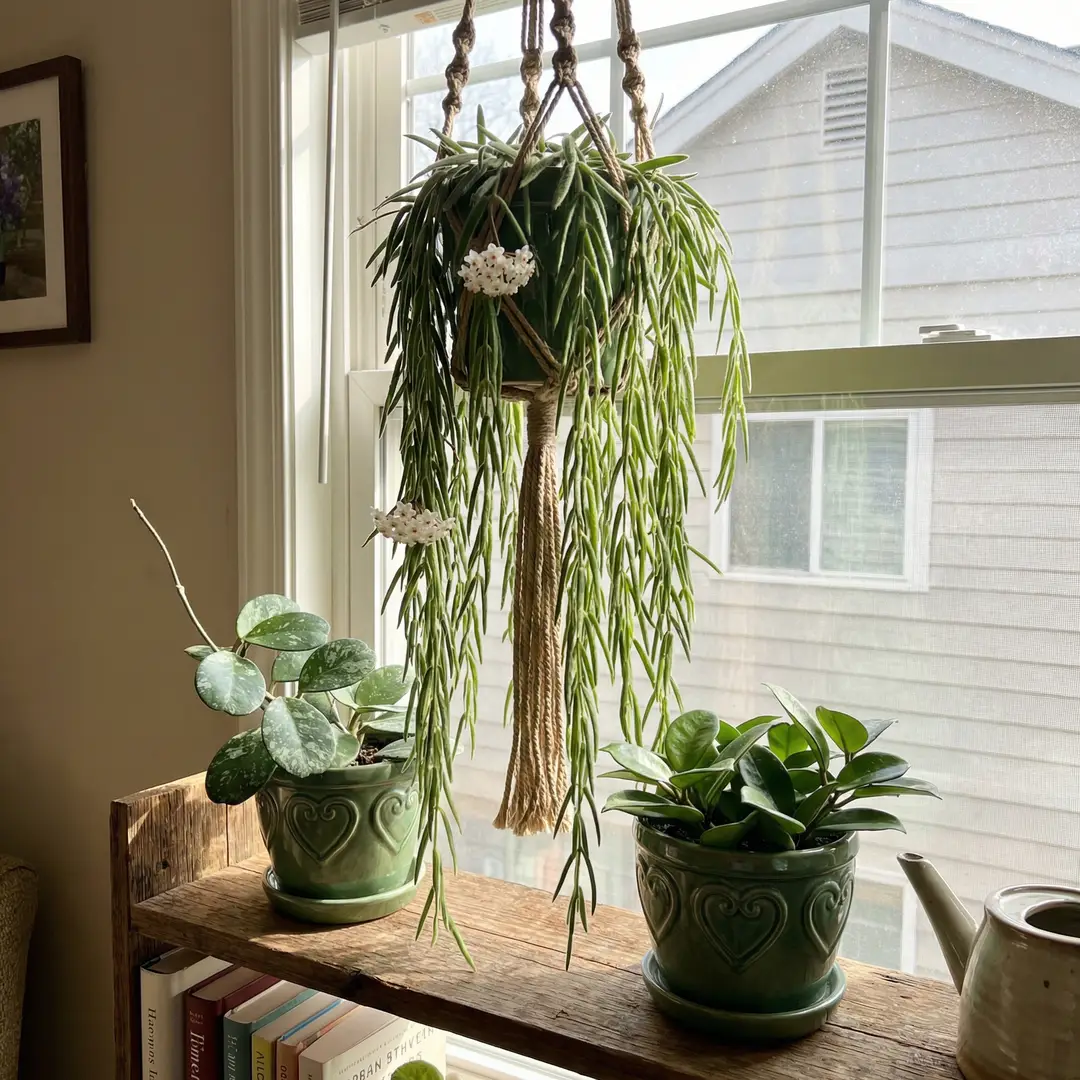
Hoya linearis is at its best in a hanging position. The naturally pendant strings look most graceful when allowed to hang freely, and the elevated position typically provides better light access than a shelf near floor level. A macrame hanger, ceiling hook, or curtain rod bracket near a bright window are all ideal mounting solutions.
Display Height and Length
The strings of Hoya linearis can grow to several feet in length. A mature plant displayed from a ceiling hook at 7-8 feet can develop cascades 3-4 feet long, creating a dramatic living curtain effect. If ceiling height is limited, a high shelf or bookcase top allows the strings to cascade down the side for 2-3 feet before reaching the shelf below.
Position the display location before the strings grow long enough to tangle on nearby surfaces. Once the needle clusters begin catching on furniture or other plants, untangling them without damage becomes difficult.
Texture Contrast Displays
Hoya linearis creates the most striking visual impact when displayed alongside hoyas with very different leaf textures. A grouping of linearis with Hoya Obovata and Hoya Carnosa on a bright shelf or in a plant corner shows the full range of leaf form in the genus. The soft, matte, needle-like texture of linearis looks most dramatic against the broad, glossy, silver-marked leaves of obovata or the classic oval foliage of carnosa. A grouping like this requires no additional styling: the plants provide their own contrast.💡 Top Tips for Growing Hoya Linearis
- Adjust your watering expectations. Unlike the classic hoya advice to wait until bone dry, linearis needs water when the top half of the mix is dry. The thin leaves have no significant water reserves. Going completely dry for extended periods stresses the plant in a way that does not apply to carnosa or australis.
- Never cut the spurs. The peduncle spurs that form at stem nodes are permanent bloom sites. They rebloom each season from the same point. A bare stub at a node is dormant, not dead. Protect every spur during pruning.
- Give it a cool winter. Temperatures in the 50-60°F range from November through February are native to this plant’s mountain habitat and reliably trigger spring flowering. This is the single most effective step for improving blooming in plants that have not flowered.
- Ensure air circulation. The hairy leaf surface and dense needle clusters can trap humid air. A gentle air movement around the plant prevents fungal issues and keeps the foliage in good condition. Do not place it in a sealed, stagnant corner.
- Avoid misting. The hairy surface retains water droplets, which can create spots for fungal growth in lower-light or low-airflow conditions. If you want to boost humidity, use a humidifier or pebble tray instead.
- Display it hanging. The pendulous cascade looks most natural and most impressive when allowed to hang freely from a ceiling hook or macrame hanger. A hanging position also tends to give better light access than a low shelf placement.
- Pair it with broad-leaved hoyas. Linearis creates its most striking visual impact when displayed next to hoyas with very different leaf textures. The contrast between soft needles and broad, waxy leaves makes both plants look more interesting than either does alone.
- Use a soft brush for cleaning. You cannot wipe the needle leaves with a cloth. A soft brush or gentle air stream is the right tool. The stem nodes still need regular inspection for mealybugs.
- Handle cuttings gently. The soft stems of linearis are more delicate than other hoyas during propagation. Avoid rough handling when taking or planting cuttings, and provide a humid rooting environment to support the more fragile cutting structure.
- Inspect before bringing indoors. If you summer the plant outdoors, do a full cleaning and preventive neem oil spray before returning it to your indoor collection. Outdoor plants can carry pests invisible at a glance.
- Think in seasons. Hoya linearis responds to seasonal rhythms more than most indoor plants: cooler and drier in winter, warmer and fed in summer. Working with those rhythms rather than fighting them produces a healthier plant and more reliable blooming than trying to maintain year-round stable conditions.
- Be patient with new cuttings. Linearis cuttings take longer to establish than those of thick-leaved hoyas. Four to eight weeks of minimal visible growth after rooting is normal. The first new needle cluster confirms success and signals that normal care can begin.
- Let the cascade develop. It is tempting to trim the strings when they reach the shelf below or start looking long. Resist for as long as practical. Long, flowing cascades are what makes Hoya linearis impressive. Once trimmed, each string takes a full season to regrow to that length.
- Source from specialists. General garden centers often keep linearis in conditions that are too wet or too dark. Buying from a specialist hoya grower or a reputable online seller dramatically improves the odds of getting a plant that is already accustomed to appropriate care.
❓ Frequently Asked Questions
Why does Hoya linearis look so different from other hoyas?
Hoya linearis originates from the Himalayan foothills rather than the tropical lowlands where most hoyas live. The needle-thin, soft, hairy leaves are an adaptation to that cooler, more exposed environment. Most common hoyas evolved in humid tropical forests where broad, waxy leaves with water-storage capacity make sense. Hoya linearis evolved in a different context and looks completely different as a result.Do I water Hoya linearis the same way as other hoyas?
Almost, but not quite. The thin leaves hold far less water than the succulent-style leaves of hoyas like carnosa or australis. With those plants you can wait until the mix is completely bone dry. With linearis, allow the top half of the mix to dry out, but water before the entire root zone goes dry and stays that way for an extended period. The plant is still susceptible to root rot, so drainage and a free-draining mix remain essential, but the drought tolerance is more limited.Is Hoya linearis toxic to pets?
No. Hoya linearis is non-toxic to cats, dogs, and people, like other members of the Hoya genus. The milky sap produced when the plant is cut can irritate sensitive skin, but it is not a poisoning risk.When will Hoya linearis bloom?
Established plants in bright indirect light typically bloom in spring or summer. The flowers appear as pendant clusters of small white star-shaped blooms with a fresh lemon fragrance. As with all hoyas, the peduncle spurs that produce the flowers rebloom from the same point each season, so do not remove them after blooming is finished.How cold can Hoya linearis tolerate?
Significantly more cold than most hoyas. It can handle brief temperatures near 40°F without damage, and it actively benefits from cool winter nights in the 50-60°F range, which helps trigger spring blooming. This cold tolerance reflects its origin in the Himalayan foothills rather than tropical lowlands. However, it should still be protected from frost, which will damage or kill it.Why are my Hoya linearis leaves yellowing or dropping?
Yellowing in Hoya linearis most often indicates overwatering or root rot. Unlike thick-leaved hoyas that can mask early overwatering stress, the needle-thin leaves yellow quickly when the root zone stays wet too long. Check the soil moisture. If the mix has been consistently moist for more than 10-14 days, reduce watering frequency. Cold drafts and sudden relocation can also trigger leaf drop.Can I grow Hoya linearis in a bathroom or high-humidity space?
A bright bathroom with good ventilation is actually well-suited to Hoya linearis. The moderate to high humidity benefits the soft leaves, and bright indirect light from a window supports growth and blooming. Avoid enclosed spaces with poor air circulation, which can lead to fungal issues on the hairy leaf surface. Good light and air movement are more important than any specific humidity target.ℹ️ Hoya Linearis Info
Care and Maintenance
🪴 Soil Type and pH: Chunky Epiphytic Mix with Moderate Moisture Retention
💧 Humidity and Misting: Prefers moderate humidity of 50-60%. The soft leaves are more sensitive to dry air than waxy-leaved hoyas. A pebble tray or nearby humidifier helps in dry climates.
✂️ Pruning: Trim individual strings to shape or remove dead sections. Never cut flower spurs, which rebloom from the same point each season.
🧼 Cleaning: Blow away dust with a gentle air stream or use a soft brush. The fuzzy, narrow leaves cannot be wiped with a cloth like broad-leaved hoyas. Check stem nodes for pests during cleaning.
🌱 Repotting: Every 2-3 years or when roots emerge from drainage holes. Prefers being slightly pot-bound. Spring is the best time to repot.
🔄 Repotting Frequency: Every 2-3 years
❄️ Seasonal Changes in Care: Reduce watering in fall and winter, but do not allow the root zone to stay completely dry for extended periods. Stop fertilizing from October through February. The plant benefits from cooler winter temperatures, which suits its Himalayan origin.
Growing Characteristics
💥 Growth Speed: Moderate
🔄 Life Cycle: Perennial Epiphyte
💥 Bloom Time: Spring through summer on established plants in bright light
🌡️ Hardiness Zones: 9-11 (more cold-tolerant than most hoyas; handles brief temperatures near 40°F)
🗺️ Native Area: Himalayan foothills: northern India, Nepal, Pakistan, and Yunnan province of China
🚘 Hibernation: Semi-dormant in winter, though less dramatically than tropical hoyas
Propagation and Health
📍 Suitable Locations: Hanging baskets, high shelves, macrame hangers, cascading from tall planters
🪴 Propagation Methods: Stem cuttings with at least one node, rooted in water, perlite, or sphagnum moss. Handle with care as the soft stems are more delicate than other hoyas.
🐛 Common Pests: mealybugs, spider-mites, aphids, and fungal-bacterial-disease
🦠 Possible Diseases: Root rot is the primary risk. Fungal issues on the soft leaves can occur in stagnant, humid conditions.
Plant Details
🌿 Plant Type: Vine / Epiphyte
🍃 Foliage Type: Evergreen
🎨 Color of Leaves: Medium to dark green; soft and covered with fine, short hairs giving a matte, textured appearance
🌸 Flower Color: White with a pale yellow or cream center corona
🌼 Blooming: Yes, on established plants; small pendant clusters of white flowers with a fresh lemon fragrance
🍽️ Edibility: Not edible.
📏 Mature Size: Up to 6-10 feet as a pendulous trailing plant with support
Additional Info
🌻 General Benefits: Non-toxic to pets and people. The uniquely soft, needle-like foliage sets it apart from any other common hoya. More cold-tolerant than tropical relatives, making it suitable for cooler rooms and even mild outdoor conditions. The lemon-scented white flowers are among the most freshly fragrant in the genus.
💊 Medical Properties: None known.
🧿 Feng Shui: Cascading needle-like leaves represent flowing, gentle energy. The white flowers are associated with purity and clarity. In feng shui, pendant plants near windows are considered to soften and regulate incoming energy.
⭐ Zodiac Sign Compatibility: Virgo
🌈 Symbolism or Folklore: Delicacy, resilience, quiet strength
📝 Interesting Facts: Hoya linearis is native to the Himalayan foothills at elevations where temperatures are significantly cooler than the tropical lowlands where most hoyas originate. This has given it an unusual cold-tolerance for the genus: it can handle brief near-frost temperatures that would kill most other hoyas. The soft, hairy leaves are an adaptation to the misty, somewhat exposed Himalayan environment, where the fine hairs may help with moisture absorption and temperature buffering.
Buying and Usage
🛒 What to Look for When Buying: Hoya linearis is available from specialist hoya sellers and online plant shops, though less commonly stocked than carnosa or australis at general garden centers. Look for plants with healthy green, firmly attached needle-like leaves and no yellowing or browning sections. Avoid plants with moist, heavy potting mix at the time of purchase, as these may have been kept too wet. Linearis is worth seeking out from specialist growers who understand its specific care needs.
🪴 Other Uses: Suitable for outdoor growing in zones 9-11 in a sheltered position with protection from frost. Can be displayed in a conservatory, cool greenhouse, or on a sheltered north-facing porch in mild temperate climates.
Decoration and Styling
🖼️ Display Ideas: Hanging basket where the pendant strings can cascade freely, draped from a high shelf, planted in a tall pot to cascade over the edge, or grouped with other hoyas to contrast the needle foliage against broad-leaved relatives.
🧵 Styling Tips: The needle-like texture and cascading habit make Hoya linearis look best in organic, natural settings: macrame hangers, woven rattan baskets, driftwood-mounted displays. The soft matte green foliage creates a gentle, romantic aesthetic very different from the bold, shiny leaves of most hoyas. It pairs beautifully with Hoya obovata or Hoya carnosa, where the contrast in leaf texture is dramatic.
📚 References ▼
- 📘 Kloppenburg, D. (2016). A Checklist of Hoya Species. Hoya Forum.
- 📘 Kumar, A. & Singh, P. (2020). Hoya Species of the Indian Himalayan Region. Journal of Economic Botany.
🪴 See also 🪴

Complete Guide to Hoya Wayetii Care and Growth

Complete Guide to Hoya Crimson Queen Care and Growth

Complete Guide to Hoya Obovata Care and Growth

Complete Guide to Hoya Pubicalyx Care and Growth

Complete Guide to Hoya Crimson Princess Care and Growth

