

Hoya Crimson Queen
Hoya carnosa 'Tricolor'
Krimson Queen, Hoya Tricolor, Variegated Wax Plant


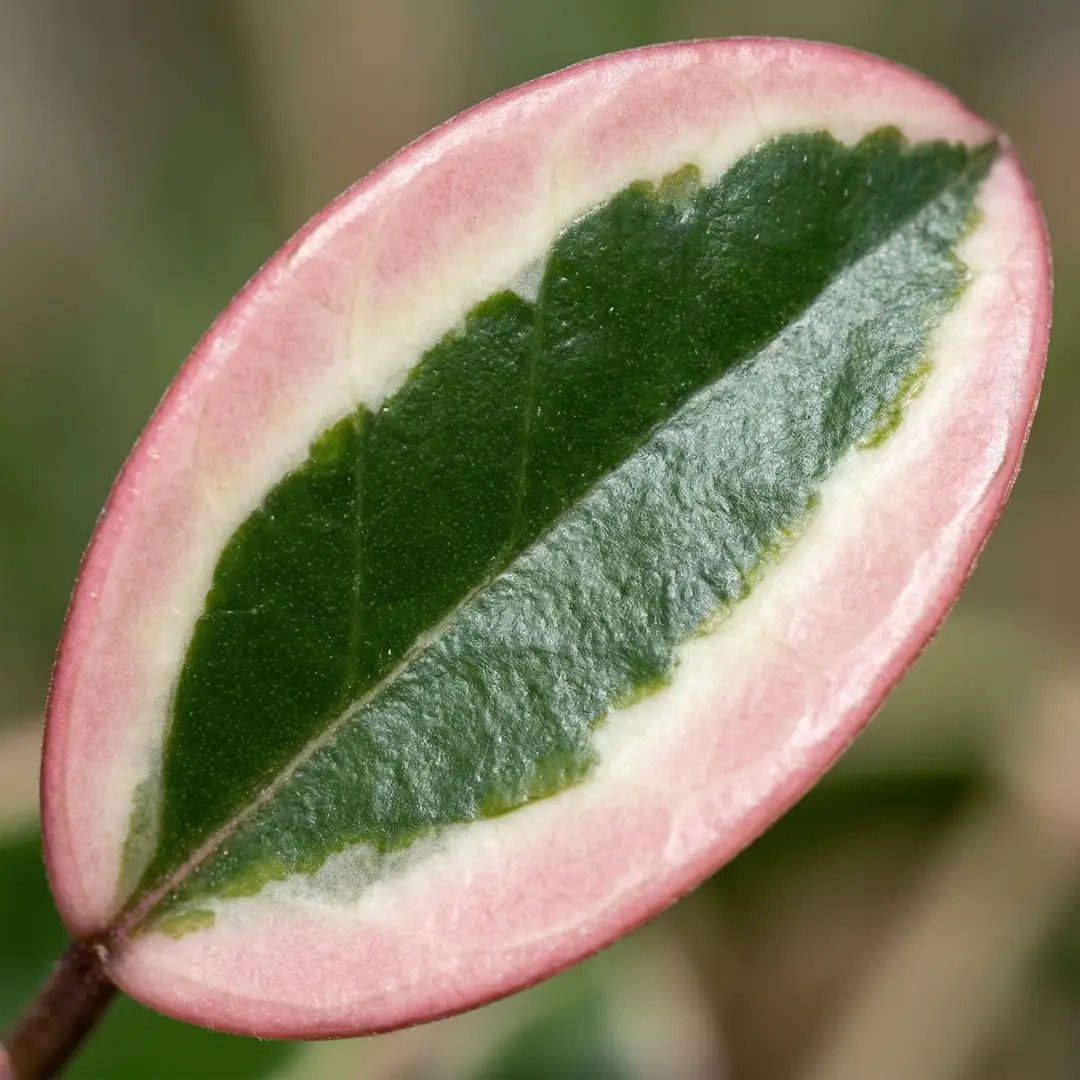
Hoya Crimson Queen is a variegated cultivar of Hoya carnosa with creamy white and pink leaf margins enclosing a deep green center. It blooms the same fragrant porcelain flower clusters as the straight species, but the three-toned leaves are the real draw.
📝 Hoya Crimson Queen Care Notes
🌿 Care Instructions
⚠️ Common Pests
📊 Growth Information
🪴 In This Guide 🪴

☀️ Hoya Crimson Queen Light Requirements
More Light Than the Green Version Needs
Standard Hoya carnosa is famously flexible about light. Crimson Queen is less so. The white and cream portions of the leaf contain almost no chlorophyll, which means every photon is more critical for energy production. A regular carnosa in a north-facing room might just grow slowly. A Crimson Queen in the same spot will limp along, push out mostly green reverted leaves, and likely never bloom.
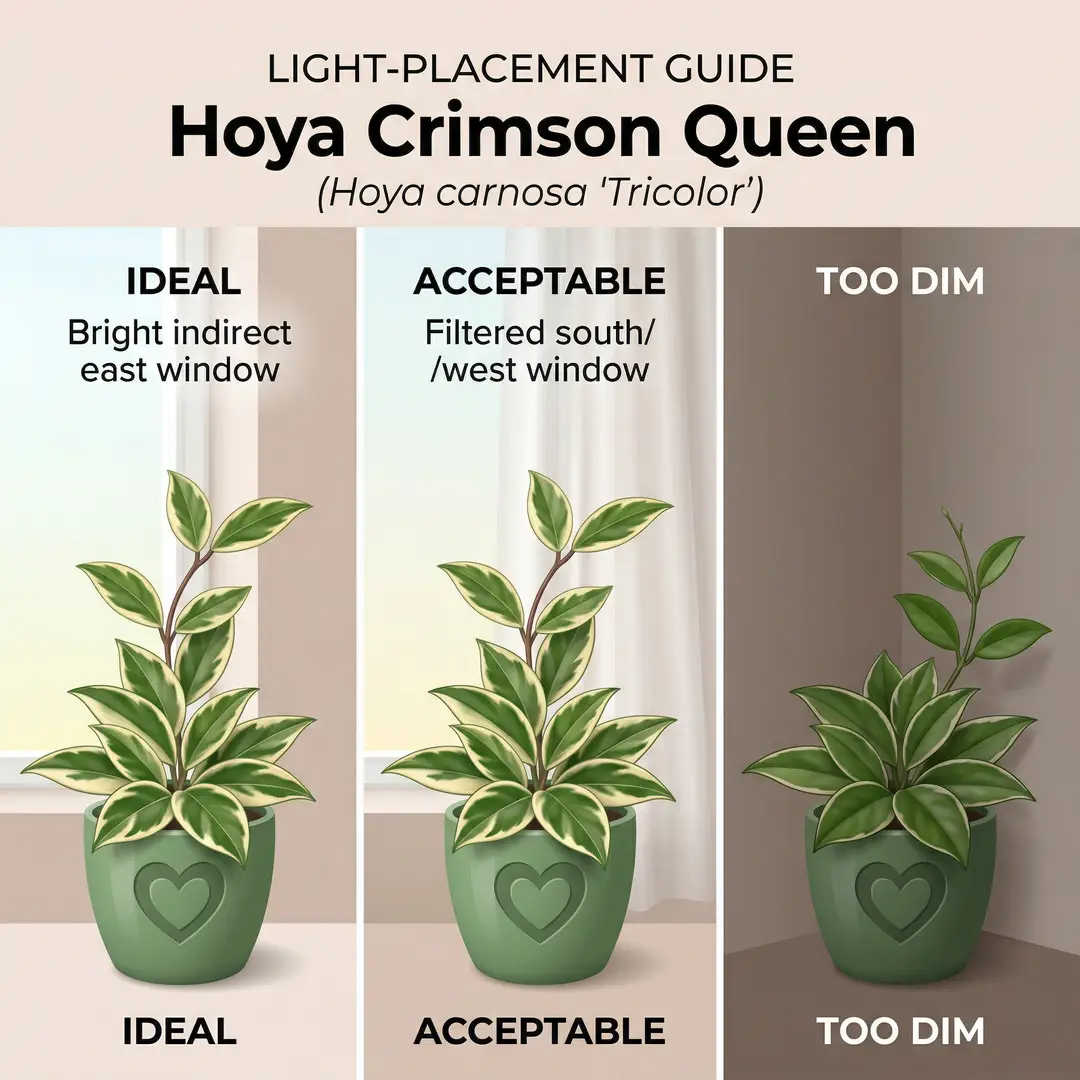
The sweet spot is bright indirect light for most of the day with some gentle direct sun, ideally in the morning.
- East-facing window: The best choice. Cool morning sun is plenty of direct light without the leaf-scorching intensity of the afternoon.
- West or south-facing window: Excellent energy, but use a sheer curtain or keep at least 2-3 feet of distance from the glass. The white margins burn faster than green tissue.
- North-facing window: Generally not enough. The plant will survive but gradually lose its variegation and push out mostly green reversion leaves.
- Grow lights: A solid option in low-light homes. Keep them on for 12-14 hours at medium intensity, positioned about 12 inches above the foliage. Full-spectrum LED grow lights work well for Hoyas.
For a practical room-by-room walkthrough of how to evaluate light in your home, see the Indoor Plant Light Guide.
Reversion: When the Plant Gives Up on Variegation
Reversion is when new growth comes in mostly green instead of the expected tricolor pattern. It is the plant adapting to low light by producing more chlorophyll-rich green tissue. It is not a disease, and it is not permanent, but it is a signal worth paying attention to.
If you start seeing reversion leaves, move the plant to a brighter spot. New growth after the move should return to the full tricolor pattern within a few leaf cycles. You can prune off reverted stems if you want to keep the aesthetic consistent, but that is entirely optional. The reverted stems photosynthesize more efficiently and actually help the plant overall.
On the flip side, very high light can push new leaves out almost entirely pink or white with almost no green. These leaves are fragile and can sunburn easily, especially the pale tips. Keep them out of harsh direct afternoon sun until the green center develops.
💧 Hoya Crimson Queen Watering Guide
Treat It Like the Succulent It Is
Hoya Crimson Queen is an epiphyte. In the wild it grows on tree trunks, where the roots dry out quickly between rains. Those thick, semi-succulent leaves are water storage tanks. The plant is genuinely built to handle drought better than it handles soggy soil.
The single most common way people kill this plant is overwatering. Roots rot quickly in wet, dense soil, and the plant gives very little warning before it is too far gone to save.
The rule: water deeply when the soil is completely dry, then leave it alone until it is dry again.
- In summer with good light, this might mean watering every 10-14 days.
- In winter or lower light, this can stretch to 4-6 weeks between waterings.
- Lift the pot. If it feels light as a feather, it is time. If it still feels heavy, wait another few days.
Bottom watering works particularly well for Hoyas. Set the pot in a tray of water for 20-30 minutes, let the chunky soil absorb from below, then drain thoroughly. This encourages roots to grow deeper and prevents the top layer of bark from sitting perpetually damp, which can invite fungus gnats.
For a deeper look at timing and technique, the Watering Guide covers how to adjust frequency by season and pot material.
The Taco Test
If you are not sure whether to water, ask the leaves. Pick a mature, fully developed leaf and gently try to fold it lengthwise like a taco shell.
- Firm and springs back: The plant still has water in reserve. Do not water.
- Pliable, slightly wrinkled, bends easily: Time to water.
This tactile check prevents almost all overwatering mistakes and works regardless of season or light level.
Water Quality
Hoya carnosa cultivars can occasionally show tip burn or spotting when watered with very cold or very mineral-heavy water. Room-temperature water is ideal. If your tap water is heavily chlorinated, letting it sit overnight before use can help. That said, most healthy Crimson Queens handle standard tap water without issue.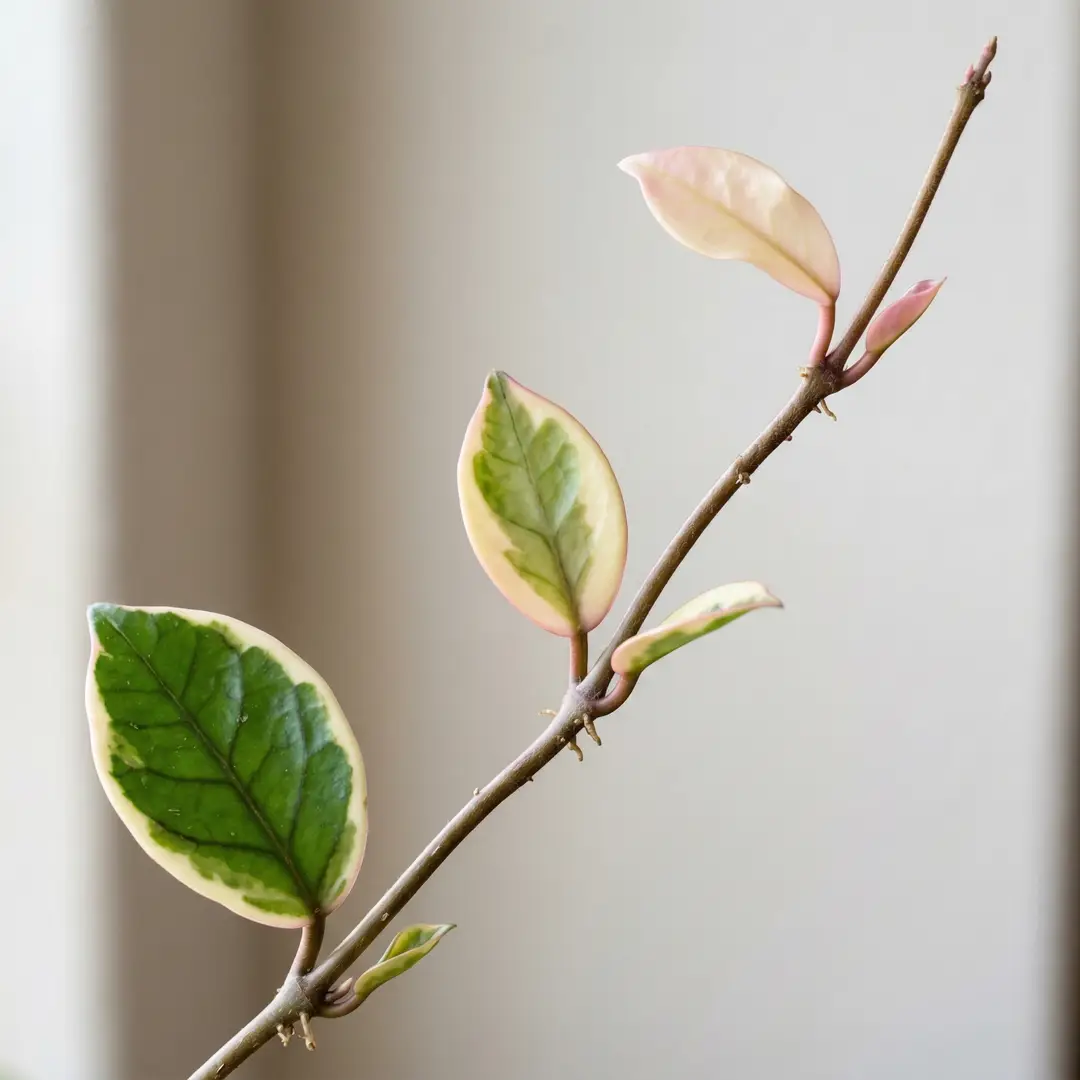
🪴 Best Soil for Hoya Crimson Queen
Chunky and Airy Beats Standard Potting Mix
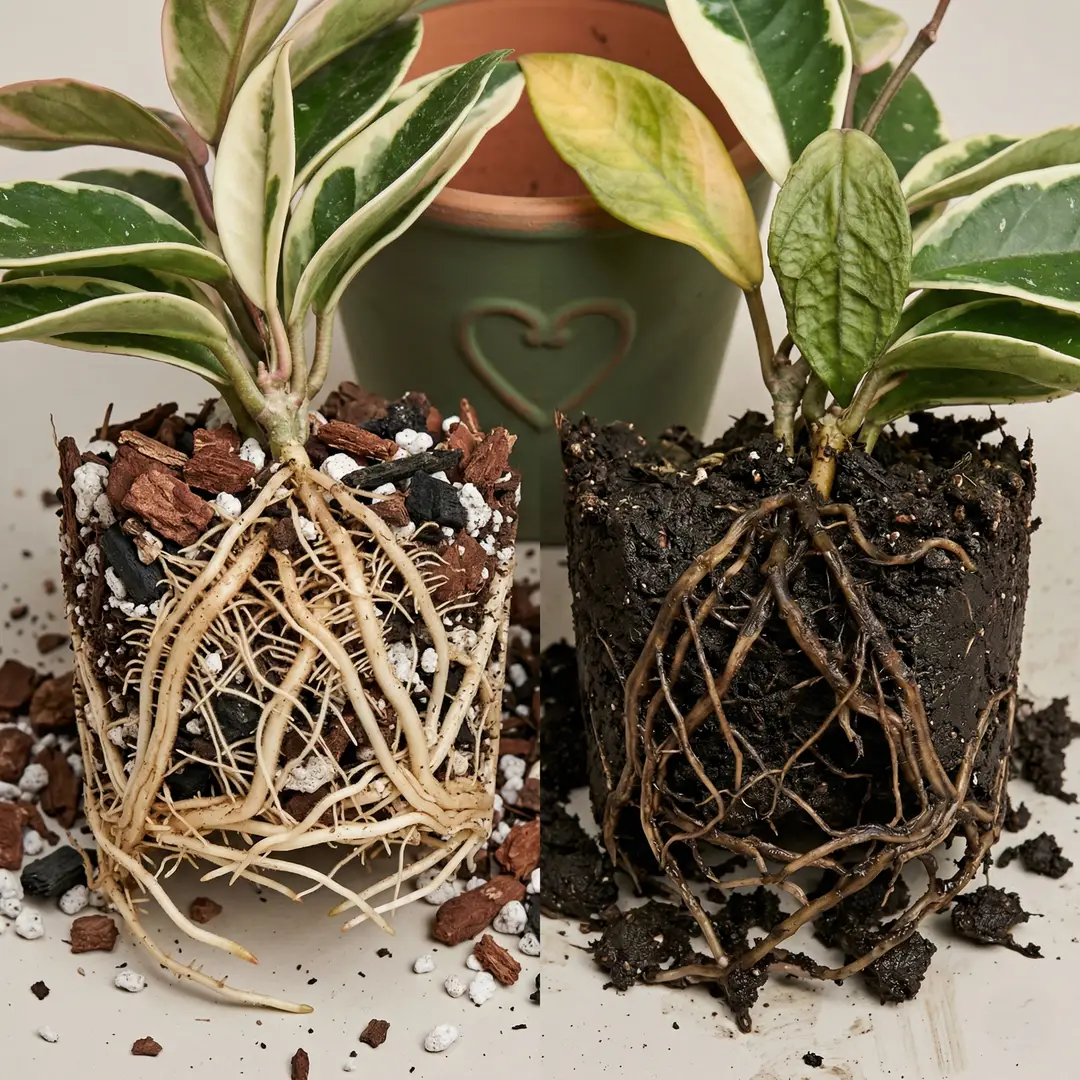
Standard all-purpose potting soil is too dense and water-retentive for this plant. It holds moisture around the roots far longer than an epiphyte can tolerate, and root rot follows. You want a mix with air gaps and fast drainage.
The standard Hoya soil recipe:
- 1 part orchid bark (fine or medium grade): creates drainage channels and mimics the rough tree-bark surfaces these plants grow on naturally.
- 1 part perlite or pumice: prevents the mix from compacting and speeds drainage.
- 1 part potting soil: adds enough organic matter to hold nutrients and a small amount of moisture.
If you do not want to mix your own, a commercial orchid or cactus mix with a large handful of extra perlite stirred in is a reasonable shortcut. The goal is a mix that drains within a few seconds of watering, feels light and crumbly, and does not smell musty. For the reasoning behind each component, the Houseplant Soil Guide goes into detail.
Pot Material and Drainage
Terra cotta is the best pot material for Hoya Crimson Queen. It is porous, lets the soil breathe, and wicks excess moisture away from the roots. Plastic pots hold water longer, which can be risky if you water on a fixed schedule rather than checking soil moisture.
Drainage holes are non-negotiable. A beautiful planter with no drainage hole will slowly drown the roots. If you love a solid decorative planter, drop the terra cotta pot inside it as a liner and empty any standing water 30 minutes after watering.
🍼 Fertilizing Hoya Crimson Queen
Feed for Growth First, Blooms Second
Hoya Crimson Queen is a moderate feeder. The variegated leaves generate less energy per leaf than an all-green plant would, so regular fertilizing during the growing season helps compensate.
- Spring and summer: Use a balanced formula (10-10-10 or similar) diluted to half strength, once a month. This supports steady vining growth without salt buildup.
- Approaching bloom season: Switch to a bloom booster with a higher middle number, such as 5-10-5. Higher phosphorus encourages both root development and flower production.
- Fall and winter: Stop fertilizing entirely. The plant is semi-dormant, its roots are less active, and fertilizer salts accumulate in soil that is not being actively processed by the plant.
Always water before applying liquid fertilizer. Applying to dry soil concentrates salts against the roots and can cause tip burn, especially on the delicate white and pink leaf margins. For more on fertilizer types and schedules, see the Fertilizing Guide.
Signs of Nutrient Issues
Hoya Crimson Queen gives clear visual feedback when fertilizing is off.
- Pale, washed-out green centers: Often a nitrogen deficiency in a plant that has been in the same soil for years without feeding. A balanced fertilizer applied once or twice usually brings the green back within a few weeks of new growth.
- Yellowing older leaves with green veins: Can signal iron or magnesium deficiency, though overwatering is more commonly the cause of this pattern. Repot into fresh mix first before concluding it is a nutrient issue.
- Brown leaf tips or margins: More often fertilizer salt buildup than a deficiency. Flush the soil thoroughly by watering heavily until water runs freely from the drainage holes, then hold off fertilizing for 4-6 weeks. If the brown tips persist on newer leaves, check whether you are fertilizing too often or at too high a concentration.
The most reliable safeguard is to stick to half-strength applications on a monthly schedule. Hoyas grown as epiphytes get relatively little nutrition in the wild, so they do not need or want heavy feeding.
🌡️ Hoya Crimson Queen Temperature Range
Warm Conditions, Cooler Winters
As a tropical epiphyte, Hoya Crimson Queen does best in typical indoor temperatures: 65-80°F (18-27°C) year-round is ideal. It is not a cold-tolerant plant. Below 50°F (10°C) growth stops completely, and anything close to freezing causes tissue damage. Keep it away from drafty windows in winter and never move it outdoors unless nighttime temperatures are reliably above 55°F.
One useful trick: a cooler winter rest at around 60°F (15°C) at night can signal the plant to initiate flower buds for spring. If you live somewhere with mild winters and a naturally cooler indoor temperature after dark, you may find the plant blooms reliably every spring without any deliberate management.
The white portions of the variegated leaf are particularly sensitive to sudden temperature swings. Cold damage on pale margins shows up as translucent or brown patches. Keep the plant away from AC vents in summer and cold window glass in winter.
Seasonal Temperature Adjustments
Managing temperature through the year is simpler than it sounds. In spring and summer, most homes stay comfortably within the 65-80°F range, and no special adjustments are needed. Growth is active, watering frequency increases, and the plant may push new leaves regularly.
In fall, when outdoor temperatures start dropping, indoor temperatures can swing more than people expect, especially at night near windows. If you keep your Crimson Queen on a windowsill, check that the glass is not significantly colder than the room air. A thermometer placed near the plant overnight can be surprisingly revealing. A thin window mat or a few inches of distance between the pot and the glass is usually enough protection.
In summer, forced-air cooling can dry out the air around the plant significantly and, if the plant is near a vent, can expose it to direct blasts of cold air that stress the pale leaf margins. If you notice the white edges going translucent in summer, an AC vent is often the culprit.
💦 Hoya Crimson Queen Humidity Needs
Flexible but Not Indifferent
Like the straight species, Hoya Crimson Queen is reasonably tolerant of average household humidity. Most homes run at 40-50% relative humidity, and the plant will grow there without issue. The waxy, thick leaves prevent the plant from losing water the way thinner-leaved tropicals do.
That said, you will see visibly faster growth, larger leaves, and more reliable blooming at 60% or above. In homes with forced-air heating in winter, humidity can drop below 35%, and the pale margins may develop tip burn over time.
Practical options for boosting humidity:
- Humidifier: The most reliable method. A small humidifier near the plant is more effective than any other approach.
- Pebble tray: Fill a tray with pebbles and water, rest the pot on the pebbles above the waterline. It adds a small amount of ambient humidity right around the plant.
- Group plants together: Clustering your Hoyas raises the local humidity slightly through natural transpiration.
Misting the leaves is not recommended. It raises humidity for about ten minutes, then evaporates. Repeated misting on dense Hoya foliage can encourage fungal spotting if airflow is poor. For broader strategies, see the Humidity Guide.
🌸 How to Get Hoya Crimson Queen to Bloom
The Peduncle Rule
Hoya Crimson Queen blooms the same way as all Hoya carnosa cultivars: clusters of star-shaped, waxy flowers (umbels), typically pink or white with red centers, with a sweet scent that is strongest at night. The fragrance is often described as vanilla, honey, or light chocolate.
The single most important rule: never cut the flower spurs. These are called peduncles, and they look like small, bare, woody nubs sticking out from the vine. The plant blooms from the same peduncle year after year. Every peduncle you preserve is a future bloom site. Accidentally prune one and the plant has to grow a new one from scratch, which can take two or more growing seasons.
Once a peduncle has developing bud clusters, do not move the plant. Hoyas orient their buds toward the light source, and rotating the pot while buds are forming causes bud blast, where the plant drops the buds before they open.
Conditions That Trigger Blooming
Hoya Crimson Queen is not as eager a bloomer as Hoya Australis, which blooms comparatively freely. Getting flowers requires patience and the right setup:
- Age and maturity: Plants under two years old rarely bloom. This is normal and not a sign anything is wrong.
- Bright light: Consistent, high-quality light is the biggest factor. A plant sitting in a dim spot will not bloom.
- Tight pot: Hoyas bloom more reliably when slightly root-bound. A plant recently moved to a large pot will spend its energy on roots before it considers flowers.
- Cool winter rest: A gradual nighttime temperature drop to around 60°F from late fall through early spring can trigger bud formation.
- Consistent moisture during budding: While the plant tolerates drought, letting it dry out completely and repeatedly during bud development can cause bud blast. Once buds are visible, maintain slightly more consistent moisture.
🏷️ Hoya Crimson Queen vs Crimson Princess and Related Cultivars
Queen vs Princess: The One Everyone Confuses
These two cultivars are sold interchangeably at so many nurseries that finding the right one requires knowing exactly what to look for.
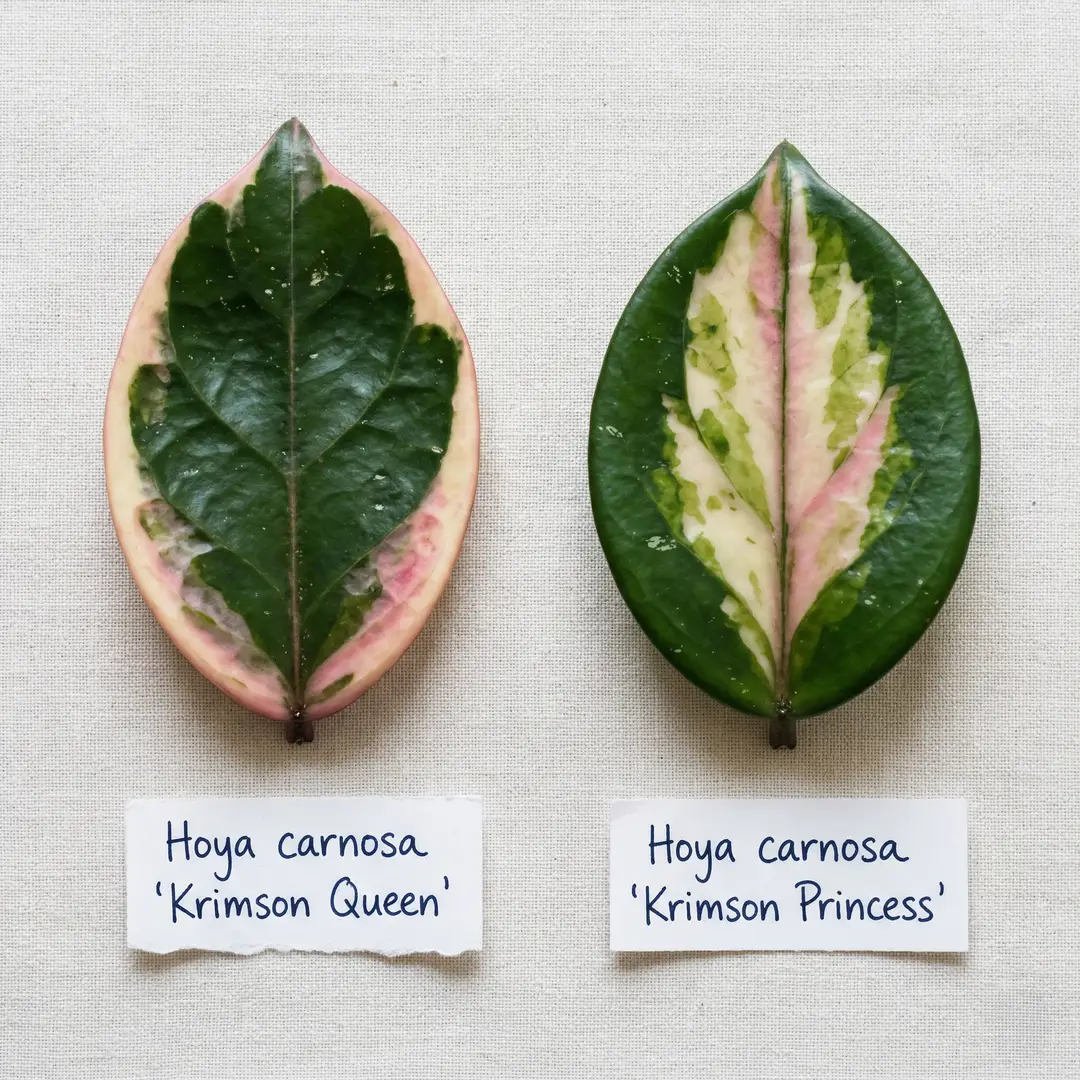
Hoya carnosa ‘Krimson Queen’ / Tricolor (this plant):
- Variegation is on the outer edges (margins) of the leaf.
- The leaf center is deep green. The margins are cream, white, or pink.
- Memory trick: the Queen wears her crown on the outside.
Hoya Crimson Princess (Hoya carnosa ‘Rubra’):
- Variegation is in the center of the leaf.
- The leaf edges stay green. The center is cream, white, or pink.
- Memory trick: the Princess wears her gown in the middle.
Both share the same care requirements. Crimson Princess tends to grow slightly faster because the green margins around the leaf perimeter provide more chlorophyll. Crimson Queen’s fully white or pink edges are the weaker photosynthesizing parts of the leaf. Both are worth growing.
Other Hoya carnosa Cultivars Worth Knowing
- Hoya carnosa (straight species): The all-green original. More vigorous, blooms more readily, and more forgiving of lower light. A great companion plant or starting point if you are new to Hoyas.
- Hoya carnosa ‘Compacta’ (Hindu Rope): Leaves are tightly curled and twisted along the stem. Extremely slow growing and famously prone to mealybugs hiding inside the curls. Stunning in a hanging basket.
- Hoya carnosa ‘Chelsea’: Slightly heart-shaped, cupped leaves with a lush, almost inflated texture.
- Hoya carnosa ‘Krinkle 8’: Features leaves with 8 distinct dimples across the surface, giving a corrugated, rippled appearance.
Other Hoya Species Worth Growing Alongside
- Hoya Pubicalyx: Faster growing with silver-splashed leaves and richly colored flowers. A good choice for growers who want quicker results.
- Hoya Obovata: Round, chunky leaves with silver flecks. The ‘Splash’ form with heavy silver coverage is highly collectible.
- Hoya Wayetii: Narrow leaves with dark red or purple margins that deepen with more light. Compact and easy to place on a small shelf.
- Hoya Linearis: Completely different texture, with soft needle-like leaves that cascade in hanging strings. From the Himalayan foothills and more cold-tolerant than most relatives.
- Sweetheart Hoya: Heart-shaped leaves, slow growing, and instantly recognizable. The most popular gift Hoya.
🪴 Potting and Repotting Hoya Crimson Queen
Small Pot, Happy Plant
Hoya Crimson Queen has a relatively small root system for how much foliage it can produce. It blooms more reliably when the roots are snug in their container. A plant recently moved to an oversized pot will spend a full growing season filling that pot with roots before it considers pushing new vines, let alone flowers.
Repot only when genuinely necessary:
- Roots are growing out of the drainage holes and tightly circling the root ball.
- The potting mix has broken down and no longer drains well, typically after 3-4 years.
- The plant is not taking up water at all, suggesting roots so compacted that water runs past rather than through them.
When you do repot, go up only one pot size (about 1-2 inches wider). Use fresh chunky epiphytic mix, water lightly, and hold off on fertilizing for 4-6 weeks to let the roots settle into the new environment. For step-by-step guidance on the process itself, see the Repotting Guide.
Seasonal Repotting Timing
Spring is the best time to repot. The plant is entering its active growth phase, new roots form quickly to anchor into the fresh mix, and there is plenty of growing season ahead for recovery. Repotting in fall or winter puts a stressed root system into cold, slow conditions and delays recovery significantly.
If you notice the plant declining in winter and suspect root rot, you may need to repot as an emergency intervention regardless of season. In that case, remove all damaged roots, let the root ball dry briefly before repotting into fresh mix, and keep the plant warm and in moderate light until it stabilizes.
✂️ Pruning Hoya Crimson Queen
When and How to Trim
This plant does not need regular pruning for health. You trim a Crimson Queen when the vines get too long for your space, when you want a bushier shape, or when you are harvesting cuttings to propagate.
- Best time: Early spring, just before the growing season.
- Where to cut: Just above a node, the small bump along the vine where leaves and roots originate. Every stem below the cut will eventually push out a new branch.
- Reversion stems: Fully green reverted vines can be pruned first if you want to keep the variegated aesthetic consistent. Leaving them is not harmful, and they actually help the plant photosynthesize more efficiently.
- The latex: Like all Hoya carnosa types, Crimson Queen bleeds a sticky, milky sap when cut. Dab it with a paper towel immediately. It can irritate skin and stains fabric if left to dry.
- The non-negotiable: Never cut a peduncle (flower spur). They look like bare, woody nubs along the vine, not regular leafed stems. Identify them before you start cutting.
🌱 How to Propagate Hoya Crimson Queen
Stem Cuttings: The Reliable Method
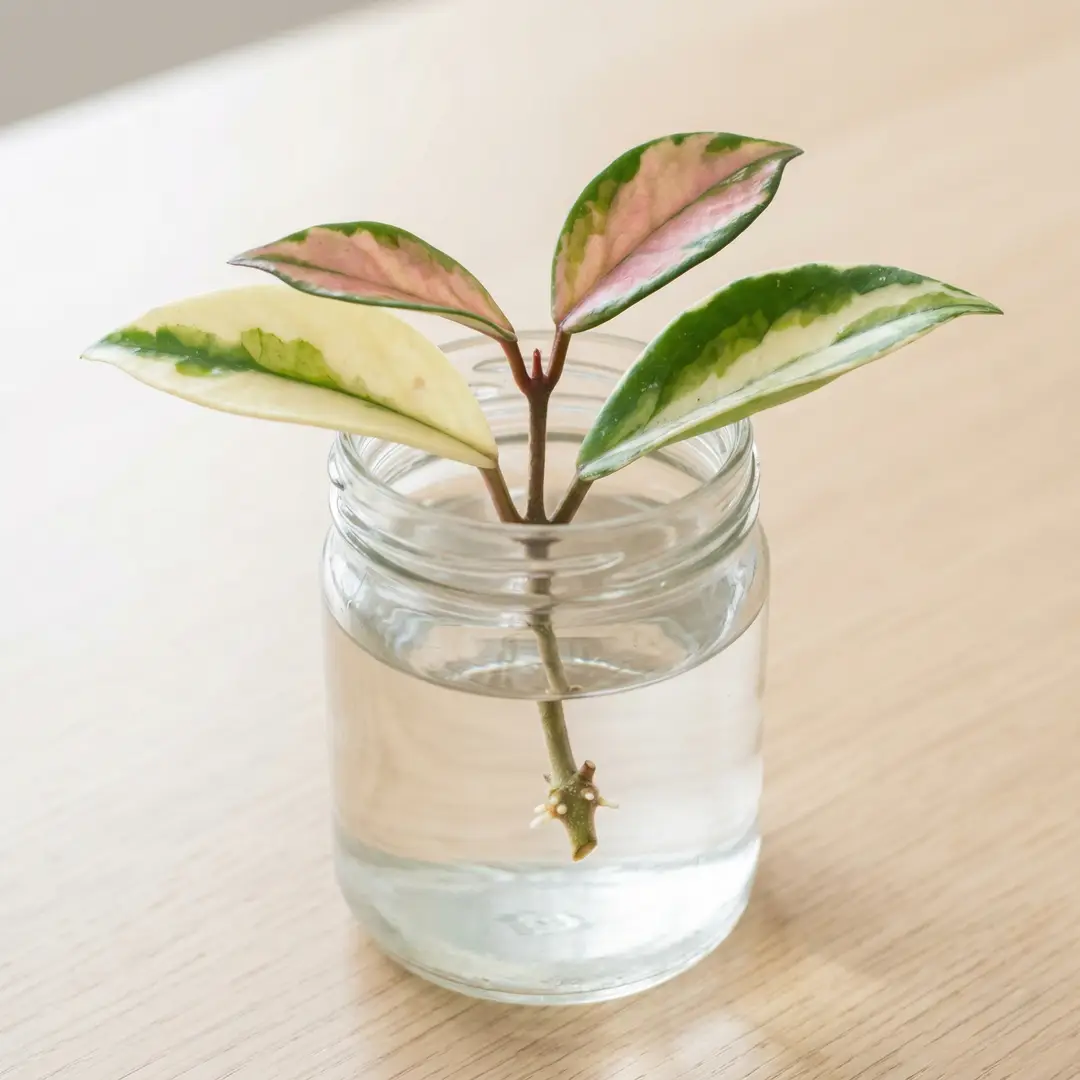
Hoya Crimson Queen propagates from stem cuttings exactly like the straight species. One difference worth noting: cuttings with heavy white or pink variegation root more slowly than cuttings from a greener stem, because they have less chlorophyll to power the rooting process. This is normal. Just allow more time.
How to take a cutting:
- Choose a healthy stem with at least 2-3 nodes. A node is the small bump where leaves attach.
- Cut cleanly just below the lowest node using clean scissors or pruning shears.
- Remove the leaf from the bottom node. The roots will emerge from here.
- Let the cut end callous for 30-60 minutes before placing it in your rooting medium.
Rooting options:
- Water: Place the cutting in a jar with the bottom node submerged. Change the water weekly. Roots typically appear in 3-5 weeks. Once secondary root threads form off the main roots, pot it up. See the Water Propagation Guide for detailed steps.
- Sphagnum moss: Dampen moss, squeeze out excess water, wrap the bottom node in the damp moss, and keep it in a warm spot. Arguably the best method for Hoyas: it keeps the cutting humid while the roots breathe. Roots form in 3-4 weeks.
- Perlite: Fill a small cup with perlite and add water to the lower third. Place the cutting with the bottom node in perlite. Similar timing to water but better aeration.
- Direct soil: Root straight into the chunky Hoya mix. Takes 4-6 weeks but produces roots already adapted to soil conditions. Cover with a humidity dome or a clear bag to maintain moisture. See the Soil Propagation Guide for more on this approach.
Choosing Cuttings for Good Variegation
All cuttings from Hoya carnosa ‘Tricolor’ carry the variegated genetics, so you are not selecting a trait, just selecting for root vigor. For best results, pick stems with a healthy mix of green and cream tissue rather than fully white stems. A cutting with some green has more chlorophyll available to drive the rooting process and will establish faster.After Rooting: Transitioning to Soil
Rooted cuttings need a gentle transition, especially those rooted in water. Water roots and soil roots are structurally different. A cutting pulled from a jar and dropped into dry potting mix will often show wilting for a few days while the roots adapt.
A few things that make the transition easier:
- Keep the mix slightly moist for the first 2-3 weeks after potting a water-rooted cutting. More moist than you would normally keep a mature Hoya. Then gradually let it dry out more between waterings until it is on the standard schedule.
- Pot size: Start in a small container, roughly the size of a large drinking cup, with drainage holes. A tiny root system in a large pot means most of the soil stays wet for too long.
- Light: Keep the newly potted cutting out of direct sun for the first 2 weeks. Bright indirect light is fine. The plant is spending its energy on root establishment, and harsh light adds stress.
- Hold fertilizer: Wait until you see new leaves growing before feeding. New leaves are the signal that the root system is active and ready to absorb nutrients.
🐛 Hoya Crimson Queen Pests and Treatment
Mealybugs: The Main Threat
Mealybugs are the most common pest on all Hoya carnosa cultivars. They love the warm, sheltered crevices where leaves meet the vine and can go unnoticed for weeks under the thick, waxy foliage.
- Signs: White cottony fluff at leaf axils, sticky residue (honeydew) on leaves and surrounding surfaces, and ants clustering around the plant (ants farm mealybugs for their honeydew).
- Treatment: Dip a cotton swab in 70% isopropyl alcohol and touch each visible mealybug. The alcohol dissolves their waxy coating instantly. For larger infestations, mix a spray with water, a few drops of dish soap, and 30% isopropyl and apply all over the plant. Repeat every 5-7 days for 3-4 weeks to catch newly hatched eggs.
- Prevention: Inspect the leaf axils specifically at every watering, not just the leaf surfaces.
Spider Mites, Aphids, and Scale
Spider mites appear in dry conditions. Look for faint yellow stippling on the leaves and extremely fine webbing on leaf undersides. They hate humidity, so a thorough shower followed by raised ambient humidity and a neem oil or miticide treatment is the standard response.
Aphids occasionally cluster on new growth, especially during bud formation. A strong stream of water knocks them off cleanly. Scale insects look like small brown bumps along the stems and can be scraped off manually, then treated with neem or horticultural oil.


🩺 Hoya Crimson Queen Problems and Diseases
Troubleshooting the Common Issues
Browning white or pink margins: Almost always sunburn or very low humidity. The white margins have no protective chlorophyll and burn faster than green tissue. Move the plant back from direct sun and check humidity. For more context on variegation-specific browning, see the Browning Variegation guide.
Leaves reverting to solid green: Not enough light. The plant is prioritizing energy production. Move it to a brighter spot and the next flush of new growth should return to the tricolor pattern.
Wrinkled or pliable leaves: Dehydration. Water thoroughly. If the soil is already wet when leaves are wrinkling, suspect root rot: roots that cannot take up water. Check the roots immediately.
Yellow leaves: Usually overwatering or natural shedding of old base leaves. If multiple leaves are yellowing at once, check soil moisture and inspect roots.
Buds falling off before opening (bud blast): Happens when the plant dries out during bud development, gets moved to a different location, or experiences a sudden temperature or humidity drop. Do not move a blooming Hoya. Maintain consistent moisture and stable conditions once buds are visible.
Long bare stems with no leaves (tendrils): The plant is searching for something to climb. These are not dead growth. Give them a bamboo hoop or trellis and they will fill in with leaves once attached.
Root Rot: Catching It Early
Root rot is the most serious problem Hoya Crimson Queen faces, and it always starts the same way: too much water in soil that does not drain well enough.
Early signs are easy to miss. The plant may look fine on the surface while the roots are failing below. By the time you see yellowing, wilting, or leaves that remain wrinkled despite a moist soil, the damage may already be significant.
If you suspect root rot, unpot the plant and inspect the roots directly. Healthy roots are firm and white to tan. Rotted roots are brown, black, mushy, and may smell slightly off. Cut away all affected roots with clean scissors. Let the root ball air out for an hour, then repot in fresh dry chunky mix. Hold off on watering for 5-7 days to encourage any remaining healthy roots to seek moisture rather than sitting in a wet environment.
Prevention is simple: use well-draining epiphytic mix, only water when the soil is completely dry, and ensure the pot has drainage holes.


🖼️ Hoya Crimson Queen Display Ideas
Showing Off the Tricolor Leaves
The whole appeal of Hoya Crimson Queen is the leaf color, so your display goal should be maximizing visibility and keeping those leaves bright.
- Hanging basket or macrame hanger: The classic Hoya display. Trail the vines down and the cream and pink margins catch the light beautifully. Position near an east or south window so the plant gets enough light to maintain the variegation.
- Bamboo hoop: Training the vines around a circular bamboo hoop creates a full, wreath-like structure. As the plant fills in, the layers of tricolor leaves have a genuinely stunning effect.
- High shelf: Letting vines spill down from a high shelf makes a dramatic visual. The tricolor foliage cascading down a bookcase or cabinet pairs well with other trailing plants.
For pot color, terra cotta in warm orange-red tones makes the cream and pink margins pop. Matte white or sage green ceramics give a softer, contemporary look. The pale leaf edges practically glow against dark backgrounds.
For interesting plant pairings, Hoya Callistophylla with its bold parallel venation makes a strong visual contrast on the same shelf, and Hoya Wayetii with its dark-edged narrow leaves complements the broad, cream-margined Crimson Queen leaves nicely.
One often-overlooked display idea: a bright bathroom is close to ideal placement. The elevated humidity from showers benefits the plant, the light from a frosted window is usually good indirect light, and the cream-and-pink leaves look especially striking against white tile. Just make sure the bathroom has a window and is not in constant darkness.
👍 Hoya Crimson Queen Care Tips (Pro Advice)
- Never cut a peduncle. That woody nub that looks like dead growth is a future bloom site. Leave it.
- More light means more color. The only way to keep the tricolor pattern vivid is consistent bright light. Dim rooms produce dull, mostly-green leaves.
- New pink leaves are fragile. If a leaf emerges almost entirely white or pink, avoid touching it and keep it out of direct sun until the green center develops.
- Do not repot unless necessary. A snug pot is a blooming Hoya. Repotting too early delays flower production by months.
- Shower it monthly. Wipe down the leaves and let them dry before night to prevent fungal spotting. Check the leaf axils for mealybugs every single time.
- Do not fertilize dry soil. Always water first, then apply liquid fertilizer. The epiphytic roots are sensitive to salt burn, especially the delicate pale leaf margins.
- Watch the peduncles in late spring. Once you see small, rounded bud clusters forming on a spur, stop moving the plant and keep moisture consistent.
- Reversion stems are still healthy. A reverted all-green stem does not harm the plant. Leave it, propagate it, or remove it. Your choice.
- Terra cotta helps. Terracotta pots dry out faster than plastic, which suits this plant’s preference for dry roots between waterings.
- It is a long game. Hoya Crimson Queen does not change dramatically week to week. Given the right conditions, it will be alive and getting better-looking in a decade.
❓ Frequently Asked Questions
Why are the white parts of my Hoya Crimson Queen turning brown?
Browning at the cream or pink margins is almost always sunburn or very low humidity. The white portions of the leaf contain no protective chlorophyll, so they burn more quickly than green tissue. Move the plant back from direct afternoon sun and check that ambient humidity is above 40%.Is Hoya Crimson Queen the same as Krimson Queen?
Yes. Krimson Queen is the original cultivar spelling often seen in older references, while Crimson Queen is the common modern usage. Both names refer to the same plant: Hoya carnosa ‘Tricolor’, identifiable by its cream or white outer leaf margins and deep green center.Why does my Hoya Crimson Queen keep producing all-green leaves?
Reversion to all-green leaves is the plant adapting to low light. Green tissue produces chlorophyll more efficiently, so under low light the plant favors green. Move it to a brighter spot and new growth should return to the full tricolor pattern within a few leaf cycles.How do I tell Crimson Queen and Crimson Princess apart?
Crimson Queen has the variegation on the outer edges: the center is green, and the margins are cream or pink. Crimson Princess is the reverse: the edges are green and the center is cream or pink. Think of it as the Queen wearing her crown on the outside and the Princess wearing her gown in the middle.Is Hoya Crimson Queen toxic to cats or dogs?
No. Hoya carnosa and all its cultivars, including Crimson Queen, are non-toxic to cats and dogs. It is a genuinely safe choice for pet owners who want a fragrant, trailing plant.Why are new leaves growing out white and droopy?
Fully white or pink new growth is completely normal for this cultivar. These leaves lack mature chlorophyll and are temporarily fragile. Given enough bright indirect light, the green center will develop over the next few weeks. Handle them carefully and keep them out of direct harsh sun until they mature.ℹ️ Hoya Crimson Queen Info
Care and Maintenance
🪴 Soil Type and pH: Chunky Epiphytic Mix (orchid bark, perlite, potting soil)
💧 Humidity and Misting: Tolerates average household humidity of 40-60%. Higher humidity of 60%+ encourages faster growth and stronger bud set.
✂️ Pruning: Trim only for size. Never remove flower spurs (peduncles), which re-bloom from the same spot each year.
🧼 Cleaning: Wipe leaves gently with a damp cloth. Inspect leaf axils and stem joints for mealybugs at every cleaning.
🌱 Repotting: Every 3-5 years, or when roots crowd out of the drainage holes. Prefers being slightly pot-bound.
🔄 Repotting Frequency: Every 3-5 years
❄️ Seasonal Changes in Care: Reduce watering in winter and stop fertilizing. A cooler night temperature around 60°F from fall through early spring can trigger spring bloom production.
Growing Characteristics
💥 Growth Speed: Slow to moderate (slower than the all-green species)
🔄 Life Cycle: Perennial Epiphyte
💥 Bloom Time: Spring through summer (fragrant star-shaped umbel clusters)
🌡️ Hardiness Zones: 10-12
🗺️ Native Area: East Asia and Australia (cultivar of the wild-collected species)
🚘 Hibernation: Semi-dormant in winter
Propagation and Health
📍 Suitable Locations: Hanging baskets, bamboo hoops, trellises, high shelves, macrame hangers
🪴 Propagation Methods: Stem cuttings with at least one node, rooted in water, perlite, or sphagnum moss. Variegated cuttings root slightly slower than all-green ones.
🐛 Common Pests: mealybugs, aphids, spider-mites, and scale-insects
🦠 Possible Diseases: Root rot is the primary risk.
Plant Details
🌿 Plant Type: Vine / Epiphyte
🍃 Foliage Type: Evergreen, semi-succulent
🎨 Color of Leaves: Tricolor: deep green center, cream to white margins, new growth often entirely pink
🌸 Flower Color: Pink or white with red centers
🌼 Blooming: Yes, fragrant star-shaped clusters (umbels), same as H. carnosa.
🍽️ Edibility: Nectar is sweet and edible. Plant is non-toxic.
📏 Mature Size: Vines up to 8-15 feet indoors with support
Additional Info
🌻 General Benefits: Pet safe, extremely long-lived, beautiful variegation, fragrant seasonal blooms.
💊 Medical Properties: None.
🧿 Feng Shui: East sector (Family/Health). The pink and green tones are associated with warmth and protection.
⭐ Zodiac Sign Compatibility: Taurus (patient, sensual, long-lived, slow but steady).
🌈 Symbolism or Folklore: Protection and longevity.
📝 Interesting Facts: New leaves often emerge entirely pink or white, with almost no green at all. With enough light, the green center develops over the following weeks. Without enough light, these leaves stay nearly white and remain fragile indefinitely.
Buying and Usage
🛒 What to Look for When Buying: Look for a plant with multiple vines rather than a single strand. Avoid pots where every leaf is fully white with no green tissue at all, as heavily etiolated plants recover slowly.
🪴 Other Uses: Privacy screen on a bright trellis. Looks outstanding in a bright bathroom with high humidity.
Decoration and Styling
🖼️ Display Ideas: Train onto a bamboo hoop or let cascade from a macrame hanger in an east-facing window.
🧵 Styling Tips: The cream and pink margins contrast beautifully with terracotta. Pairs well with other variegated climbers or deep-green hoyas on the same shelf.
📚 References ▼
- 📘 Hoya: The Complete Guide (Gardening Indoors Series)
- 📘 Royal Horticultural Society: Hoya carnosa cultivar notes
🪴 See also 🪴

Complete Guide to Hoya Wayetii Care and Growth

Complete Guide to Hoya Obovata Care and Growth

Complete Guide to Hoya Pubicalyx Care and Growth

Complete Guide to Hoya Linearis Care and Growth

Complete Guide to Hoya Crimson Princess Care and Growth

