

Hindu Rope
Hoya carnosa 'Compacta'
Hindu Rope Plant, Compacta Hoya, Krinkle Kurl, Curly Wax Plant


Hindu Rope is the tightly curled, rope-like form of Hoya carnosa, grown for its sculptural vines and fragrant clusters of waxy flowers. Learn how to keep the curls clean, the roots dry, and the plant bright enough to bloom without inviting rot or mealybugs.
📝 Hindu Rope Care Notes
🌿 Care Instructions
⚠️ Common Pests
📊 Growth Information
🪴 In This Guide 🪴

☀️ Hindu Rope Light Requirements
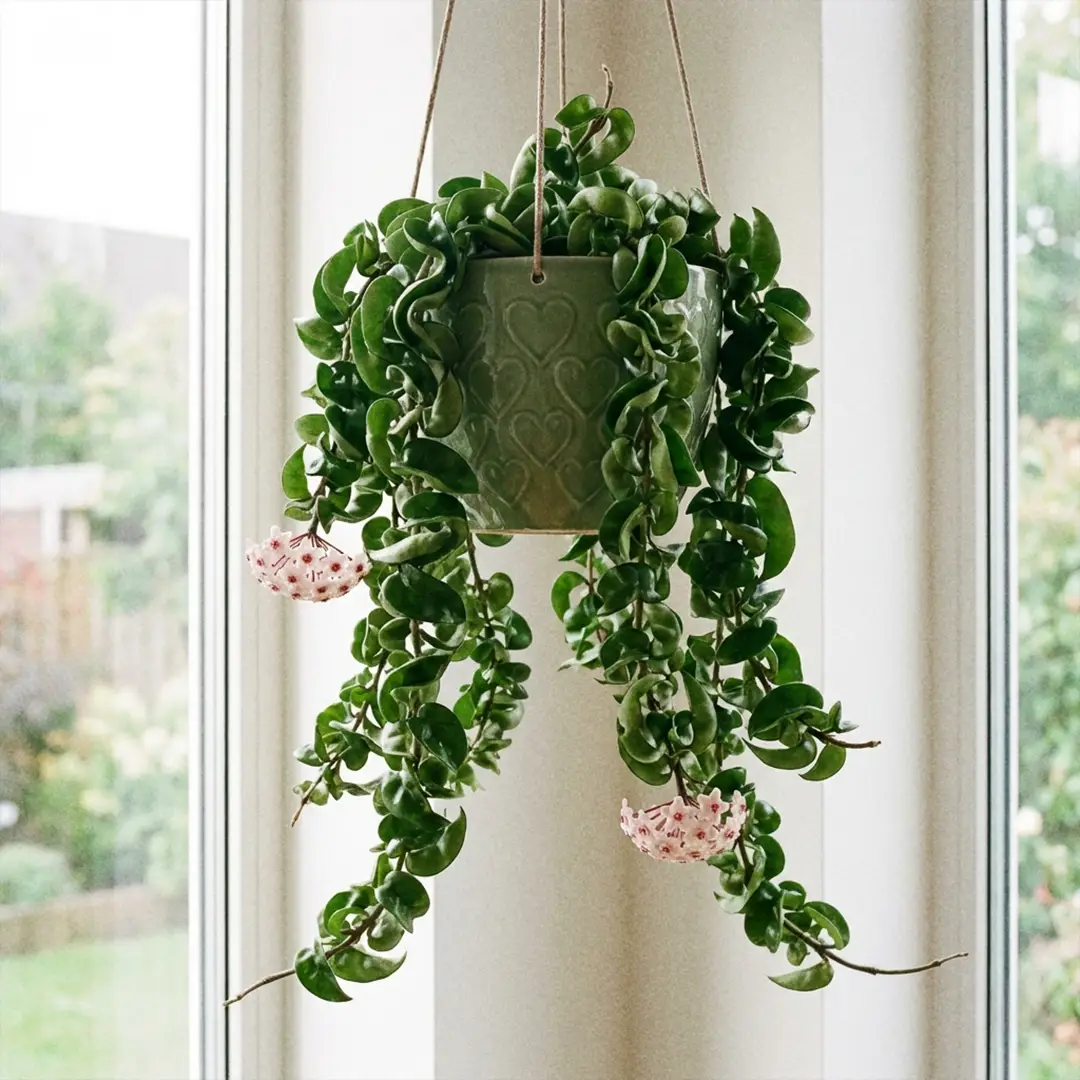
Best Indoor Light for Hindu Rope
Hindu Rope wants bright indirect light for most of the day, with gentle morning sun if you can provide it. An east-facing window is almost ideal. The plant gets enough energy to grow compactly and eventually bloom, but the leaves are not forced to sit in harsh afternoon heat.
South and west windows also work well, especially in climates with dull winters, but place the plant a little back from the glass or soften the light with a sheer curtain. The leaves are thick and waxy, yet the tight folds can still scorch where heat builds up at the window. Morning sun is useful. Baked afternoon glare is less useful.
This is one place people underestimate Hindu Rope. Because it grows slowly, many assume it tolerates low light. It does tolerate it in the sense that it will sit there for a long time without dying. But low light turns it into a stagnant plant that rarely flowers, barely grows, and slowly loses the crisp heavy look that makes it special. Our Indoor Light Guide is helpful if you are not sure how bright your brightest spot actually is.
What Low Light Looks Like on Hindu Rope
Low-light symptoms on Hindu Rope are subtler than on flatter hoyas because the leaf curls hide the spacing between nodes. The plant does not always look obviously leggy at first. Instead, growth becomes sparse, new vines stay thin, and the leaves sit less densely on the stem. The overall rope effect looks looser and less sculptural.
Another common sign is a plant that stays alive for years and never even hints at a bloom spur. Hindu Rope is slow, yes, but a mature plant in good light eventually tells you it is happy. One in weak light simply preserves itself.
If your plant is producing long bare searching stems, keeping old leaves but adding almost no new mass, or gradually looking duller than the photos that convinced you to buy it, more light is usually the answer. Compare it mentally with a strong Hoya Pubicalyx or Hoya Australis. Hindu Rope will never be that vigorous, but it should still look purposeful rather than stalled.
Grow Lights for Hindu Rope
Grow lights work very well for Hindu Rope because the plant is compact and easy to position under a fixture. A full-spectrum LED light placed roughly 10-14 inches above the top of the plant for 12-14 hours per day gives reliable results. If natural light is weak in winter, a grow light often makes the difference between a plant that merely survives and one that actually blooms later.
Because the plant is dense and curled, top-down light can leave the lower interior in shadow. If your grow light setup is very directional, rotate the plant occasionally during active growth so all sides get time near the strongest light. Do not rotate a plant that is carrying visible buds or fresh peduncles, since hoyas can drop buds when moved during blooming.

💧 Hindu Rope Watering Guide

Why Hindu Rope Must Dry Out Fully
Hindu Rope is a semi-succulent epiphyte. That combination tells you almost everything about watering. The leaves store water, and the roots are adapted to fast drainage and plenty of air. The plant can handle being a little thirsty. It does not handle sitting wet.
The thick curled foliage sometimes tricks people into thinking the plant is thirstier than it is because the pot looks full and lush. It is not a thirsty hanging basket. It is still a hoya, and the same rule applies here as with Hoya Obovata or Hoya Crimson Queen: water deeply, then let the mix dry out completely before watering again.
In a bright warm room that may mean every 10-14 days during peak growing season. In winter it can easily stretch to three or four weeks, sometimes longer. If you keep watering on a fixed summer schedule all year, root rot arrives quietly.
How to Water Hindu Rope Properly
When the mix is fully dry, water thoroughly until water runs out of the drainage holes. Then let the pot drain completely. Do not leave it sitting in a saucer of water.
Bottom watering can be especially useful for Hindu Rope because it wets the root zone without splashing water into the curls. Place the pot in a shallow basin of water for 15-20 minutes, let the mix wick moisture upward, then drain it well. If you tend to overwater from the top or if the plant lives in a decorative hanger that is awkward to water cleanly, see our Bottom Watering Guide.
Top watering still works perfectly well. Just keep the stream low and controlled so you are soaking the mix, not flooding the foliage. Water trapped in the curled leaves is not always fatal, but in stagnant rooms it can become a problem, especially if old petals or dust are already caught in the folds.
Reading the Leaves and Pot Weight
Hindu Rope gives two good hydration signals: the weight of the pot and the feel of the leaves. A freshly watered plant feels noticeably heavier. Once the pot feels light and airy again, the mix is often ready for another soak.
The leaves help confirm it. Fully hydrated Hindu Rope leaves feel firm and resistant when pressed gently. As the plant uses up stored moisture, the leaves lose a little of that pressure and become slightly softer. If they actually wrinkle, the plant is past ready for water. For many growers a moisture meter is useful during the first few months, just to learn how long the center of the pot stays damp.
One important nuance: wrinkled leaves do not always mean underwatering. Wrinkling in a dry pot means water it. Wrinkling in a wet pot means the roots may be damaged and unable to drink. That is a very different problem, and we will cover it again in the problems section.
Seasonal Watering for Hindu Rope
Season matters more than people expect with this plant.
- In spring, growth restarts and the plant gradually uses more water.
- In summer, bright light and warmth mean the mix dries more quickly, especially in terracotta or hanging baskets.
- In fall, shorten the interval between moisture checks but lengthen the interval between actual waterings.
- In winter, keep the plant brighter than ever but significantly drier.
The best habit is not setting a schedule. It is checking the mix and the pot regularly while accepting that the answer changes with the seasons. Our broader Watering Guide covers the logic in more detail, but Hindu Rope rewards cautious watering more than almost any beginner-friendly hoya.
🪴 Best Soil for Hindu Rope
Use a Chunky Epiphytic Mix for Hindu Rope
Standard potting soil alone is too dense for Hindu Rope. The roots need oxygen around them, not a wet heavy mass that stays cool and damp in the middle for two weeks. A bark-based epiphytic mix is the right direction.
A reliable homemade mix is:
- 1 part orchid bark or fine coco chips
- 1 part perlite or pumice
- 1 part potting mix
That gives you structure, drainage, and enough moisture retention for the roots to take a proper drink before the pot dries back down. If you want a deeper explanation of why these ingredients work, our Soil Guide breaks down air space, drainage, and organic content.
Why Dense Soil Fails Faster on Hindu Rope
Hindu Rope is especially unforgiving of dense mix because the plant is naturally slow. A fast grower can sometimes power through mediocre soil for a while by using water quickly and replacing roots aggressively. Hindu Rope does not do that. It sits in whatever environment you give it and reacts slowly, which means bad mix stays bad for a long time.
If the center of the pot remains wet for 10 days or more after watering, or if the mix smells sour instead of earthy, the problem is usually not the plant. It is the medium. Even a healthy root system cannot stay alive in stale, compacted potting soil forever.
Best Pot Type for Hindu Rope
Terracotta is often the safest choice because the porous walls help moisture escape. Plastic works too, but it stays wet longer, so your watering discipline has to be better. Drainage holes are non-negotiable.
Hanging baskets can be excellent for Hindu Rope, especially if they use an airy pot rather than a sealed decorative container. A small basket with a breathable potting setup dries more evenly and gives the vines room to fall naturally. That display habit also keeps the foliage off damp surfaces and improves airflow around the curls.
When the Mix Has Broken Down
Even a good mix degrades over time. Bark softens, fine particles settle downward, and what began as a light airy medium slowly becomes a tighter sponge. If your Hindu Rope used to dry in a week and now stays wet for two weeks under the same conditions, the mix has likely broken down and needs replacing.
This matters even if the plant is not obviously root-bound. Repotting is sometimes more about restoring air space than giving the roots more room.
🍼 Fertilizing Hindu Rope
Feeding Schedule for Hindu Rope
Hindu Rope is not a hungry plant, but steady low-dose feeding during active growth helps. From spring through late summer, use a balanced liquid fertilizer at half strength once a month. That is enough to support new leaves and vine growth without building up salts in the pot.
Because this plant grows slowly, overfeeding is easy to do by accident. People get impatient, the plant does not move much for a month, and they assume it wants more food. Usually it wants more light, not more fertilizer. Our Fertilizing Guide covers the same pattern across many epiphytes and slow growers.
Balanced Feed vs Bloom Booster on Hindu Rope
If your plant is still young or recently rooted, stay with balanced feed. You are building roots and foliage first. Once the plant is mature, settled, and has a history of producing peduncles, a bloom-booster formula in late spring can help support flowering.
That does not mean bloom fertilizer forces flowers on an immature plant. Hindu Rope blooms because it is mature, bright enough, and slightly snug in its pot. Fertilizer only helps a plant that is already positioned to bloom.
Signs of Too Much Fertilizer
White crust on the rim of the pot, crispy leaf edges, or a mix that seems to repel water after repeated feedings all suggest salt buildup. Flush the pot thoroughly with plain water and hold off fertilizing for a month.
Since Hindu Rope is often grown in hanging containers or decorative pots, salt buildup can go unnoticed longer than with tabletop plants. A slow plant in a small pot does not need constant feeding. Half strength and patience is the safer strategy.
🌡️ Hindu Rope Temperature Range
Best Temperature Range for Hindu Rope
Hindu Rope is happiest in the same temperatures most homes maintain anyway: roughly 65-80 F. Warm, steady conditions support gradual growth and keep the roots active enough to recover quickly after watering.
It is not a cold-tolerant plant. Once temperatures drop near 50 F, growth slows hard and leaf damage becomes more likely. Keep the plant away from freezing windows, drafty doors, and HVAC vents that blast either hot dry air or cold air directly onto the curled foliage.
Cooler Nights Can Help Hindu Rope Bloom
Like many hoyas, Hindu Rope often responds well to a slightly cooler winter period. Night temperatures around 58-62 F, paired with brighter winter light and reduced watering, can help mature plants set buds for the following season.
This is a gentle shift, not a stress test. You are not trying to chill the plant. You are giving it a small seasonal cue. If your indoor temperatures naturally fall a little at night in winter, that is usually enough. Do not push it colder just because someone online said cool stress makes flowers.
Outdoor Summering for Hindu Rope
In warm climates you can move Hindu Rope outside for summer once nights stay consistently above 60 F. Put it in bright shade or a place with a little morning sun only. Outdoor air movement often improves growth and can help harden the plant up for better blooming later.
Bring it back indoors well before cool nights return. The plant handles outdoor brightness much less safely if it goes from indoor shade straight into exposed patio sun, so acclimate it gradually either way.
💦 Hindu Rope Humidity Needs
Does Hindu Rope Need High Humidity
Hindu Rope is more flexible than delicate tropical vines, but it still appreciates moderate humidity. Average home humidity around 40-50% is usually enough to keep it alive and stable. Closer to 50-70% can support cleaner new growth, less bud drop, and faster rooting on cuttings.
That said, humidity is not the main lever with this plant. Light and watering matter more. A dim wet plant in a humid room is headed toward trouble. A bright plant with a dry airy root zone does fine in ordinary household humidity. If you want a broader overview, our Humidity Guide explains when humidity helps and when it is a distraction.
Airflow Matters More Than People Expect
The tight curled leaves make Hindu Rope different from most hoyas here. Moisture, dust, dead flower bits, and pests can all collect in spaces where the air barely moves. That means airflow matters just as much as humidity.
A bright bathroom can be a great place for Hindu Rope if it also has a window and some regular airflow. A steamy closed bathroom with stale air is much less useful. The goal is gentle circulation, not a damp enclosed pocket around the plant.
Should You Mist Hindu Rope
Misting is usually not worth it. It does very little for ambient humidity, and on a tightly curled plant it can leave droplets lodged in the folds where they stay longer than expected. If you want more humidity, a room humidifier is more effective than surface moisture.
If the plant is dusty, wipe or rinse it intentionally. Do not treat misting as care in itself.
🌸 How to Make Hindu Rope Bloom
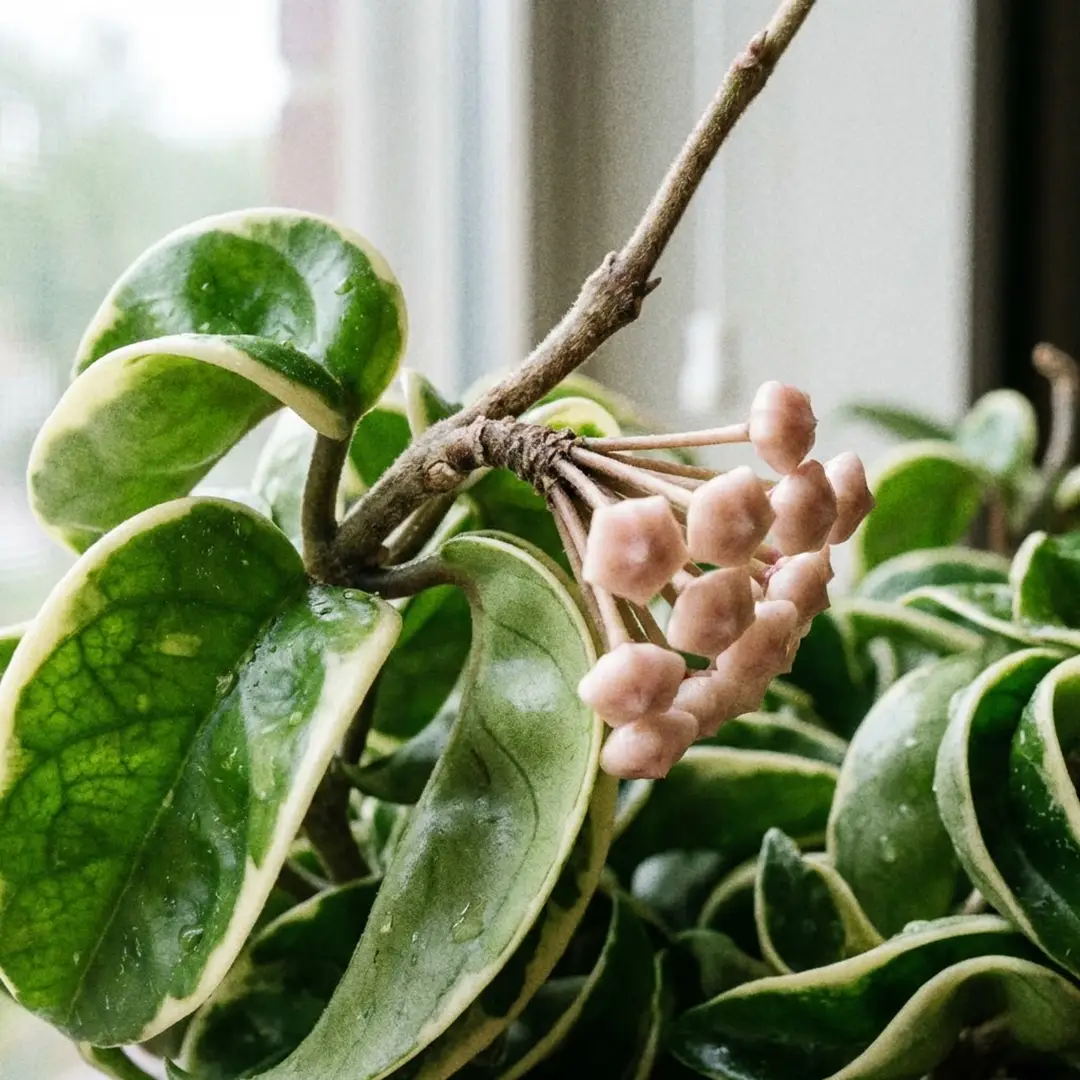
What Hindu Rope Flowers Look and Smell Like
Hindu Rope flowers are classic Hoya carnosa flowers: waxy, star-shaped, and clustered in rounded umbels that look almost too perfect to be real. The color is usually pale pink to white with a darker rosy center, and the flowers often produce a sweet evening fragrance that becomes stronger after sunset.
On this plant the contrast is especially good. The blossoms emerge from a mass of dark twisted foliage, so the flower cluster looks suspended in front of something much heavier and stranger than the bloom itself. If you like fragrant houseplants, mature Hindu Rope earns its shelf space.
The Peduncle Rule for Hindu Rope
Never remove the old flower spurs. On hoyas these spurs are called peduncles, and they rebloom from the same points year after year. They can look dry, stubby, and inactive after the flowers fall, which is exactly why people cut them off.
Do not. A plant that already has peduncles has done a lot of work. If you preserve them, you usually get blooms again from the same locations. If you remove them, the plant has to start over. That can cost you a year or more.
How to Encourage Hindu Rope to Bloom
There are four consistent bloom triggers:
- strong bright light
- a mature plant
- a slightly snug pot
- a drier, cooler winter rest
That is the foundation. On top of that, keep the plant stable once buds form. Do not rotate it, repot it, or let it swing wildly between bone dry and soaked. If buds form and then drop, read our bud blast guide, because the cause is often movement or abrupt moisture swings.
Compared with Hoya Pubicalyx, Hindu Rope is slower and more stubborn about blooming. Compared with standard Hoya carnosa, it asks for a little more patience. But once it decides to flower, the routine becomes easier to repeat in future seasons.
What Stops Hindu Rope from Blooming
The biggest reasons are simple: not enough light, too much potting space, or a plant that is still juvenile. Endless fertilizing does not fix any of those.
If you have had the plant for years and it still does nothing, start by increasing light. Then check whether it is sitting in an oversized pot full of mix that stays wet too long. A root-bound, bright plant is far more likely to flower than one that has lots of extra soil and mediocre light.
🏷️ Hindu Rope Types and Related Hoyas

Hindu Rope vs Standard Hoya Carnosa
Hindu Rope is a cultivar of Hoya carnosa, not a separate species. The core care is similar: bright light, airy mix, full dry-down between waterings, and preserved peduncles. The differences are growth rate and maintenance.
Standard Hoya carnosa grows more openly, more quickly, and is easier to inspect. Hindu Rope is denser, slower, and better at hiding problems. If you want a first hoya, the straight species is easier. If you want the most sculptural member of the group, Hindu Rope is the standout.
Green Hindu Rope vs Variegated Hindu Rope
The classic Hindu Rope is solid green. Variegated forms also exist and usually carry cream, yellow, or pale green sections mixed through the curled leaves. They are beautiful, but they are slower and usually need brighter light because less of the leaf surface is producing chlorophyll.
If you are choosing between them, the green form is easier and usually sturdier. The variegated form is more collector-focused and less forgiving of weak light or rough handling. The same rule that separates Hoya Crimson Princess from Hoya Crimson Queen applies here too: less green tissue means less margin for error.
Related Hoyas Worth Growing Alongside Hindu Rope
- Hoya Carnosa: the straightforward flat-leaved species, quicker and easier, useful as a reference point for what Hindu Rope is doing differently.
- Hoya Obovata: broad round leaves with silver splash, bold and heavy in a different way.
- Hoya Pubicalyx: faster, longer, and far less compact, with darker flowers and a more vigorous habit.
- Hoya Linearis: almost the opposite texture, with soft needle-like foliage and pendant strings.
- Sweetheart Hoya: another slow-growing hoya prized more for leaf character than speed.
Hindu Rope stands out in this group because it is the one people want to touch. That is also why it often gets damaged or overwatered. Treat it more like a specimen than a filler plant.
🪴 Potting and Repotting Hindu Rope
Why Hindu Rope Likes a Tight Pot
Hindu Rope blooms and roots best when slightly pot-bound. A snug pot dries more predictably, keeps the root zone airy, and discourages the overwatering problems that come with excess soil volume.
This is one of the biggest practical differences between healthy long-term hoya care and generic houseplant advice. Bigger is not better here. Moving a slow plant into a much larger container mostly gives wet soil more time to sit around the roots.
How to Repot Hindu Rope
Repot every 3-5 years, or sooner if the mix has broken down or the plant dries so quickly that roots have clearly filled the pot. Spring is the best time because the plant is just entering active growth.
Go up only one pot size. Gently remove the old mix from the outside of the root ball, trim any brown mushy roots, and reset the plant into fresh chunky mix at the same depth as before. After repotting, wait a few days before watering so disturbed roots can settle. Our Repotting Guide is worth reviewing if you have never repotted an epiphytic houseplant before.
Hanging Basket, Hoop, or Small Trellis for Hindu Rope
Most people display Hindu Rope as a hanging plant, and that makes sense. The vines are heavy, curved, and best appreciated when they can fall naturally. A hanging basket also keeps the foliage away from clutter and gives you easier visual access to the curls.
You can also guide younger vines around a bamboo hoop or compact trellis. That creates a dense sculptural ring that works especially well on tables or shelves. Just do it while the growth is still flexible. Older vines stiffen and do not appreciate being forced.
✂️ Pruning Hindu Rope
When to Prune Hindu Rope
Hindu Rope does not need heavy routine pruning. You prune it to shape the plant, shorten a rope that has outgrown the space, or take cuttings for propagation. Early spring is the safest time because fresh growth is about to start and the plant can recover faster.
This is not a plant you shear for fullness every few months. Slow hoyas resent constant interference. A single clean pruning session once in a while is better than repeated little trims.
Cleaning While You Prune
Pruning sessions are a good time to clean the plant because you are already handling it carefully. As you work, look deep into the folds for old dried blooms, dust, or white cottony patches. A soft brush, dry cotton swab, or lightly damp cloth helps remove debris without bruising the leaves.
You do not need to polish Hindu Rope. You need to inspect it. That difference matters. This is one of the few houseplants where inspection is part of basic maintenance, not an occasional extra.
What Not to Cut on Hindu Rope
Do not cut peduncles. Do not automatically cut every bare searching stem either. Hoyas often send out leafless tendrils before they decide how they want to grow. Those stems can later fill in with leaves or become future support points.
If you are unsure whether a stub is dead or a bloom spur, leave it. The plant loses nothing from you being conservative. It loses a future flower site if you are careless.
🌱 How to Propagate Hindu Rope
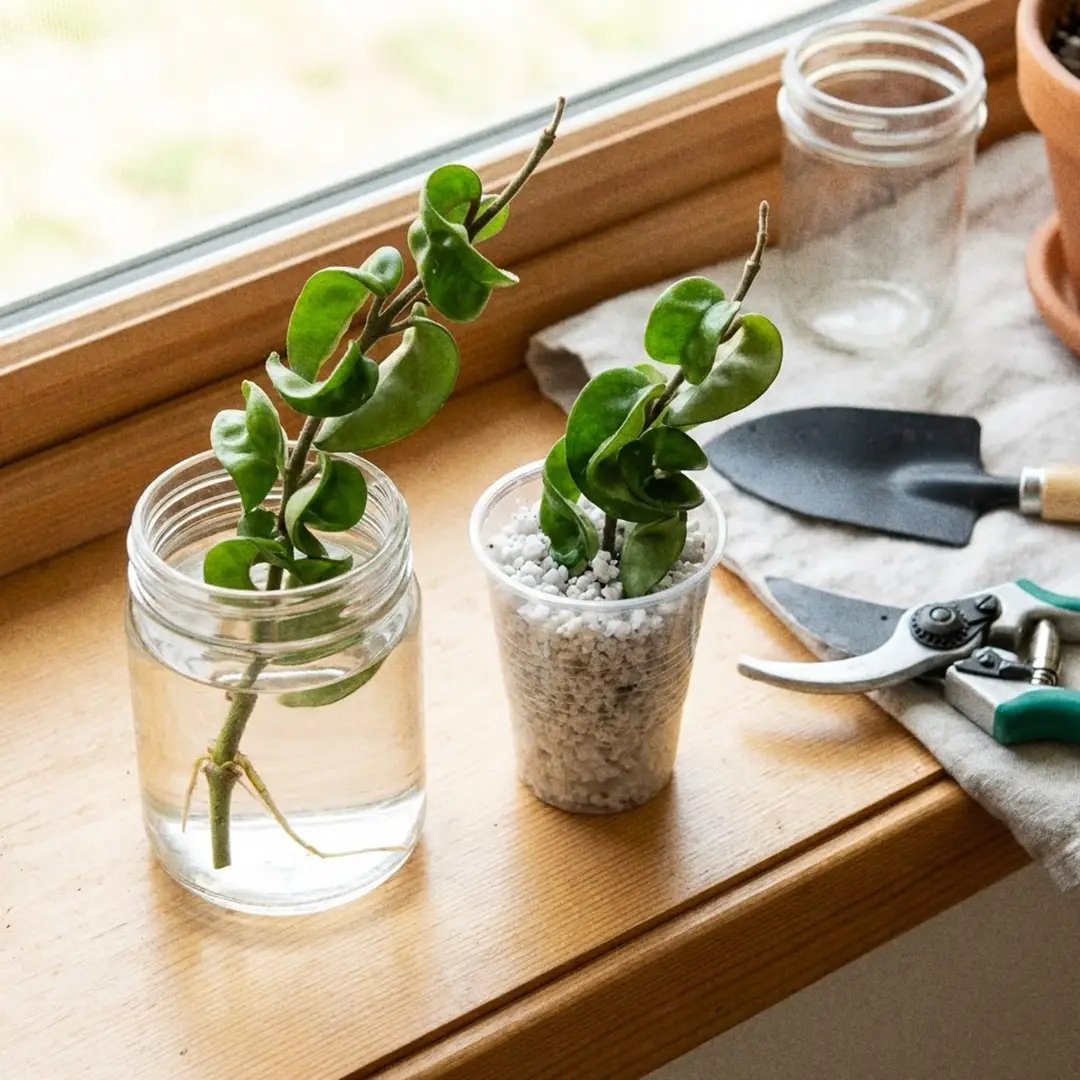
Can You Propagate Hindu Rope from a Leaf
No, not into a full plant. A detached leaf can stay alive for a surprisingly long time, but without a node it has no growing point. Hindu Rope must be propagated from a piece of stem that includes at least one node.
This matters because people often assume a curled leaf is a compact cutting on its own. It is not. If you are buying or trading cuttings, make sure there is real stem material attached.
Water Propagation for Hindu Rope Cuttings
Take a cutting with one or two nodes and at least a few healthy leaves. Remove any leaf that would sit below the waterline, then place the node in water and keep the cutting in bright indirect light. Change the water every week.
Roots usually appear in a few weeks, but Hindu Rope is slower than open-growing hoyas, so do not panic if it sits quietly at first. Once the roots are a couple of inches long and branching, you can pot the cutting into the same airy mix used for mature plants. Our Water Propagation Guide explains the full sequence.
Perlite, Moss, and Soil Propagation for Hindu Rope
Many growers prefer perlite or damp sphagnum moss because the roots transition into potting mix more smoothly than roots grown in water alone. Perlite gives excellent air around the cutting, while moss holds humidity around the node without drowning it.
Direct soil propagation also works. Use a very small pot, insert the node into slightly moist airy mix, and keep the cutting warm and bright but not sunny. The Soil Propagation Guide is useful if you want to skip the water step entirely.
How Long Hindu Rope Cuttings Take
Longer than you want, usually. That is normal. Hindu Rope is slower than standard Hoya carnosa because the plant is slower in general. Good warmth, bright light, and a healthy node matter more than trying multiple complicated rooting tricks.
The best time to propagate is spring or early summer when the mother plant is active. Winter cuttings can root, but they do it reluctantly.
🐛 Hindu Rope Pests and Treatment

Mealybugs Are the Main Threat to Hindu Rope
If Hindu Rope has an enemy, it is mealybugs. The tight curls are almost designed for them. They can hide deep in the leaf folds where normal leaf wiping never reaches, and by the time you notice sticky residue or distorted growth they may already be well established.
Treat individual clusters with a cotton swab dipped in 70% isopropyl alcohol. For heavier infestations, spray the entire plant with an insecticidal soap or diluted alcohol-and-soap mix, then repeat weekly until no new bugs appear. Rotate the curls gently as you inspect. Surface treatment alone is not enough if the bugs are sitting deep inside the plant.
Root Mealybugs, Scale, and Spider Mites on Hindu Rope
Root mealybugs are less common but worth knowing about because the first sign is often a plant that declines despite seemingly correct watering. If the top growth is weak, sticky, and never perks up, unpot the plant and inspect the roots and the inner wall of the pot.
Scale insects can settle along stems, especially older woody sections. Spider mites show up more often in hot dry air and reveal themselves through fine webbing or stippled pale damage on exposed leaves. Hindu Rope is less notorious for mites than for mealybugs, but no slow stressed houseplant is immune.
A Real Inspection Routine for Hindu Rope
The best pest prevention is a real routine, not vague vigilance. Every time you water:
- look into the curls from at least two sides
- check for white fluff, sticky shine, or distorted new growth
- remove dried bloom pieces trapped inside the foliage
- isolate the plant immediately if you find anything suspicious
This sounds fussy, but it becomes quick once you are used to it. Hindu Rope punishes neglect less than it punishes inattention.


🩺 Hindu Rope Problems and Diseases

Root Rot and Yellow Leaves on Hindu Rope
Root rot is the main serious problem. It usually starts with a mix that stays wet too long or a pot that is too large for the root system. The earliest signs are often yellowing leaves, especially near the base, combined with a pot that never seems to dry.
If several leaves yellow at once and the stems near the crown feel soft, unpot the plant and check the roots. Healthy roots are firm and pale. Rotted roots are brown, mushy, and often smell unpleasant. Trim the damage, repot into fresh airy mix, and hold off watering for a short recovery period.
Wrinkled Leaves, Leaf Drop, and Soft Growth on Hindu Rope
Wrinkling leaves usually means the plant has used up its stored moisture, but it can also mean the roots are too damaged to take up water. Always pair the leaf symptom with the soil condition. Dry pot plus wrinkled leaves equals thirst. Wet pot plus wrinkled leaves equals trouble.
Leaf drop can follow a sudden move, a cold draft, major underwatering, or root damage. Hindu Rope does not drop leaves as dramatically as some thin-leaved vines, so if it is doing so in noticeable numbers, pay attention.
Soft mushy growth is almost always an overwatering or rot issue rather than simple thirst.
Why Hindu Rope Does Not Bloom
Failure to bloom usually comes down to three things: not enough light, a plant that is still immature, or peduncles that were removed. If you have a healthy plant that grows slowly but never flowers, increase light before you change anything else.
Also check the pot size. A slow hoya sitting in too much mix spends energy stabilizing the root zone rather than building toward flowering. Hindu Rope blooms best when it is settled, not overpotted.
Bud Blast and Sun Stress on Hindu Rope
Bud blast happens when buds form and then fall before opening. The most common causes are moving the plant, letting it swing too dry during bud development, or exposing it to abrupt temperature shifts.
Sunburn is less common than rot, but it does happen. If leaves develop bleached or crispy patches after a move closer to the window, the light change was too abrupt. Treat Hindu Rope like a bright-light plant, not a full-sun desert succulent. If you need help distinguishing scorch from other pale damage, see the sunburn guide.


🖼️ Hindu Rope Display Ideas

Best Places to Display Hindu Rope
Hindu Rope looks best at eye level or slightly above, where you can actually appreciate the twist and density of the vines. A high shelf works if the plant hangs low enough to inspect easily. A hanging hook near a bright window is often the best compromise between light, airflow, and visibility.
This is not a plant I would hide in the back row of a plant corner. Its whole appeal is texture. Put it where the unusual foliage can be read clearly against a plain wall or bright background.
Plants That Pair Well with Hindu Rope
Hindu Rope pairs well with other hoyas that offer a different leaf shape:
- Hoya Linearis for a soft feathery contrast
- Hoya Obovata for broad round leaves and silver splash
- Hoya Pubicalyx for a faster, more open trailing habit
- Hoya Wayetii for narrow dark-edged leaves and a leaner silhouette
The best grouped displays contrast texture, not just color. Hindu Rope gives you the densest texture in the group, so it works especially well with flatter or finer-leaved companions.
Why Eye-Level Placement Works Best for Hindu Rope
Unlike many hanging plants, Hindu Rope needs regular inspection. Eye-level placement makes that easy. You can look into the curls without hauling the plant down, and you are more likely to notice early pests, old blooms, or soft growth before the problem expands.
That practicality is part of good styling here. A beautiful spot that prevents you from checking the plant is not actually a good spot.
👍 Hindu Rope Care Tips (Pro Advice)
- Let the mix dry fully. This plant forgives a late watering far more easily than an early one.
- Check inside the curls every time you water. Mealybugs win when inspections are casual.
- Do not remove peduncles. Old bloom spurs are future flowers, not dead clutter.
- A bright east window is often better than weak all-day light.
- Keep the pot snug. Oversized containers are the fastest route to slow hidden root rot.
- Bottom watering is useful if you tend to splash water into the curls.
- Do not expect fast visible growth. Hindu Rope rewards patience more than constant adjustment.
- Use a soft brush or cotton swab for cleaning, not heavy rubbing or leaf shine products.
- If the leaves wrinkle in wet soil, stop thinking underwatering and start checking roots.
- Mature plants bloom more reliably after a brighter summer and a cooler, drier winter.
- Propagate only from node cuttings. A leaf alone is a dead end.
- Display it where you can see and inspect it, not where it looks good from ten feet away.
❓ Frequently Asked Questions
Is Hindu Rope toxic to cats and dogs?
No. Hindu Rope, like other Hoya carnosa cultivars, is non-toxic to cats and dogs. It is a safe choice for homes with pets, though the sticky sap can irritate very sensitive skin.Why are my Hindu Rope leaves wrinkling?
Wrinkled leaves usually mean the plant is thirsty, but not always. If the potting mix is dry and the leaves feel softer than normal, give it a deep soak. If the soil is still wet and the leaves are wrinkling anyway, suspect root rot because damaged roots cannot absorb water.How do I make Hindu Rope bloom?
You need four things: bright light, maturity, a slightly snug pot, and patience. Mature plants bloom best after a brighter growing season followed by a slightly cooler, drier winter rest. Never remove the old flower spurs, because new umbels form from the same points.Can I propagate Hindu Rope from a single leaf?
No. A single leaf can sometimes stay alive for a very long time, but without a node it will not grow into a full plant. Hindu Rope must be propagated from a stem cutting that includes at least one node.Why is Hindu Rope so slow?
The tight curled growth is naturally slower than flat-leaved Hoya carnosa because the plant has a compact architecture and invests heavily in thick, folded leaves. That slower pace is normal. If the leaves are firm and the plant is not yellowing, slow growth alone is not a problem.Why are there white cottony bits deep in the curls?
That is usually mealybugs. Hindu Rope is one of the easiest hoyas for mealybugs to hide in because the leaf folds shelter them from light and casual inspections. Isolate the plant and treat every visible cluster with rubbing alcohol or an appropriate spray.Should I cut off the bare flower spurs after blooming?
No. Those bare little stems are peduncles, and hoyas rebloom from them year after year. Removing them resets the plant and can delay future flowers for a long time.ℹ️ Hindu Rope Info
Care and Maintenance
🪴 Soil Type and pH: Chunky Epiphytic Mix
💧 Humidity and Misting: Average home humidity works, though 50-70% supports cleaner growth and steadier bud development.
✂️ Pruning: Trim only for shape or propagation. Never remove the flower spurs, which rebloom from the same points.
🧼 Cleaning: Inspect deep inside the curls with a soft brush or cotton swab during each watering session. Dust and mealybugs hide where you cannot see at a glance.
🌱 Repotting: Every 3-5 years, or when roots are crowding the pot and the mix has broken down. Prefers being slightly pot-bound.
🔄 Repotting Frequency: Every 3-5 years
❄️ Seasonal Changes in Care: Reduce watering in fall and winter, stop fertilizing, and keep the plant in the brightest window you have. Slightly cooler nights help mature plants set buds.
Growing Characteristics
💥 Growth Speed: Slow
🔄 Life Cycle: Perennial Epiphyte
💥 Bloom Time: Late spring through summer on mature plants
🌡️ Hardiness Zones: 10-12
🗺️ Native Area: Cultivar of Hoya carnosa, a species native to Southeast Asia, Japan, and Taiwan
🚘 Hibernation: Semi-dormant in winter
Propagation and Health
📍 Suitable Locations: Hanging baskets, bright shelves, bamboo hoops, compact trellises, bright bathrooms with airflow
🪴 Propagation Methods: Stem cuttings with at least one node root in water, moss, or perlite, but more slowly than plain Hoya carnosa.
🐛 Common Pests: mealybugs, root-mealybugs, scale-insects, and spider-mites
🦠 Possible Diseases: Root rot is the main risk. Stagnant moisture trapped in the curls can also encourage fungal spotting in poor airflow.
Plant Details
🌿 Plant Type: Trailing Vine / Epiphyte
🍃 Foliage Type: Evergreen, semi-succulent
🎨 Color of Leaves: Deep green, waxy, tightly curled, sometimes lightly silver-flecked
🌸 Flower Color: Pale pink to white with a darker pink or red center
🌼 Blooming: Yes, on mature plants in bright light with preserved peduncles
🍽️ Edibility: Not edible. The nectar is sweet, but the plant itself is not grown as an edible crop.
📏 Mature Size: 3-6 feet trailing or climbing indoors
Additional Info
🌻 General Benefits: Non-toxic to pets, long-lived, sculptural, drought-tolerant for a flowering vine, and highly fragrant when mature.
💊 Medical Properties: None known.
🧿 Feng Shui: Trailing, looping vines are associated with gentle movement and continuity. The rounded curled leaves soften hard corners and are often used to bring a calmer visual rhythm to a room.
⭐ Zodiac Sign Compatibility: Taurus
🌈 Symbolism or Folklore: Patience, lasting affection, and endurance
📝 Interesting Facts: Hindu Rope is not a separate species. It is a mutation of Hoya carnosa in which the leaves curl inward and fold along the vine, creating the rope-like look. Those same folds are why it is slower and why mealybugs love it.
Buying and Usage
🛒 What to Look for When Buying: Check deep into the curls before buying. Any white cottony residue, sticky sap, or dull dusty centers are warning signs. Choose a plant with multiple ropes, firm leaves, and ideally at least one visible peduncle if you want flowers sooner.
🪴 Other Uses: Excellent for compact hanging displays where a standard hoya would look too loose or sprawling. Also works trained around a hoop for a sculptural centerpiece.
Decoration and Styling
🖼️ Display Ideas: Hang it at eye level, trail it from a narrow shelf, or wrap it around a bamboo hoop so the twisted foliage can be appreciated up close.
🧵 Styling Tips: The unusual texture does best in simple containers that do not compete with it. Matte green or terracotta pots work especially well, and eye-level placement matters more than with flatter-leaved hoyas.
🪴 See also 🪴

Complete Guide to Sweetheart Hoya Care and Growth

Complete Guide to Hoya Wayetii Care and Growth

Complete Guide to Hoya Crimson Queen Care and Growth

Complete Guide to Hoya Obovata Care and Growth

Complete Guide to Hoya Pubicalyx Care and Growth

Complete Guide to Hoya Linearis Care and Growth

Complete Guide to Hoya Crimson Princess Care and Growth

