

Beetle Peperomia
Peperomia angulata
Beetle Peperomia, Quadrangularis Peperomia, Angle Peperomia


Beetle Peperomia is a compact trailing peperomia with small oval leaves marked by four or five pale parallel stripes that run lengthwise, giving each leaf the look of an insect shell. It trails beautifully from shelves and hanging baskets, tolerates average indoor conditions, and roots from cuttings so easily that it is one of the best starter trailing plants in the genus.
📝 Beetle Peperomia Care Notes
🌿 Care Instructions
⚠️ Common Pests
📊 Growth Information
🪴 In This Guide 🪴

☀️ Beetle Peperomia Light Requirements
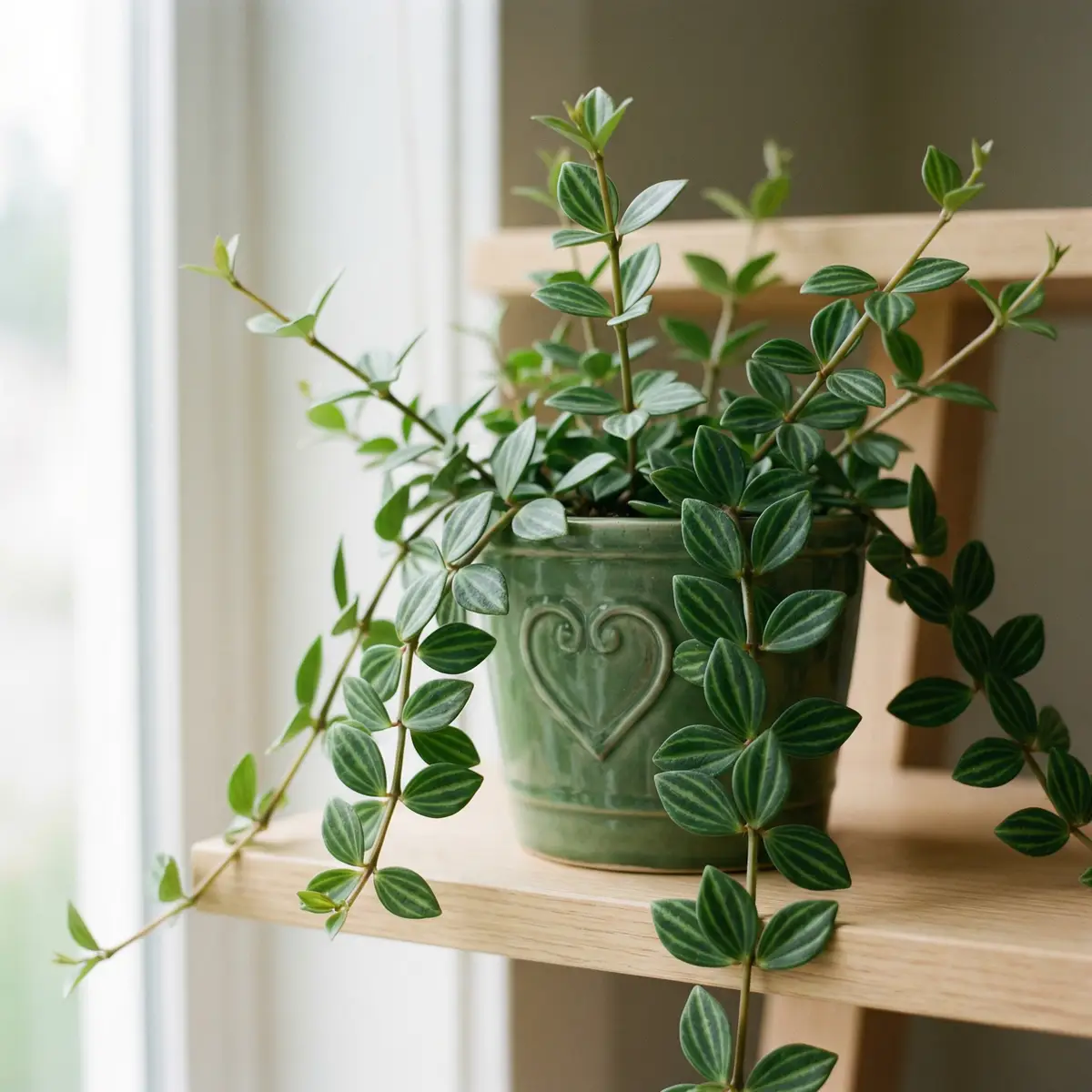
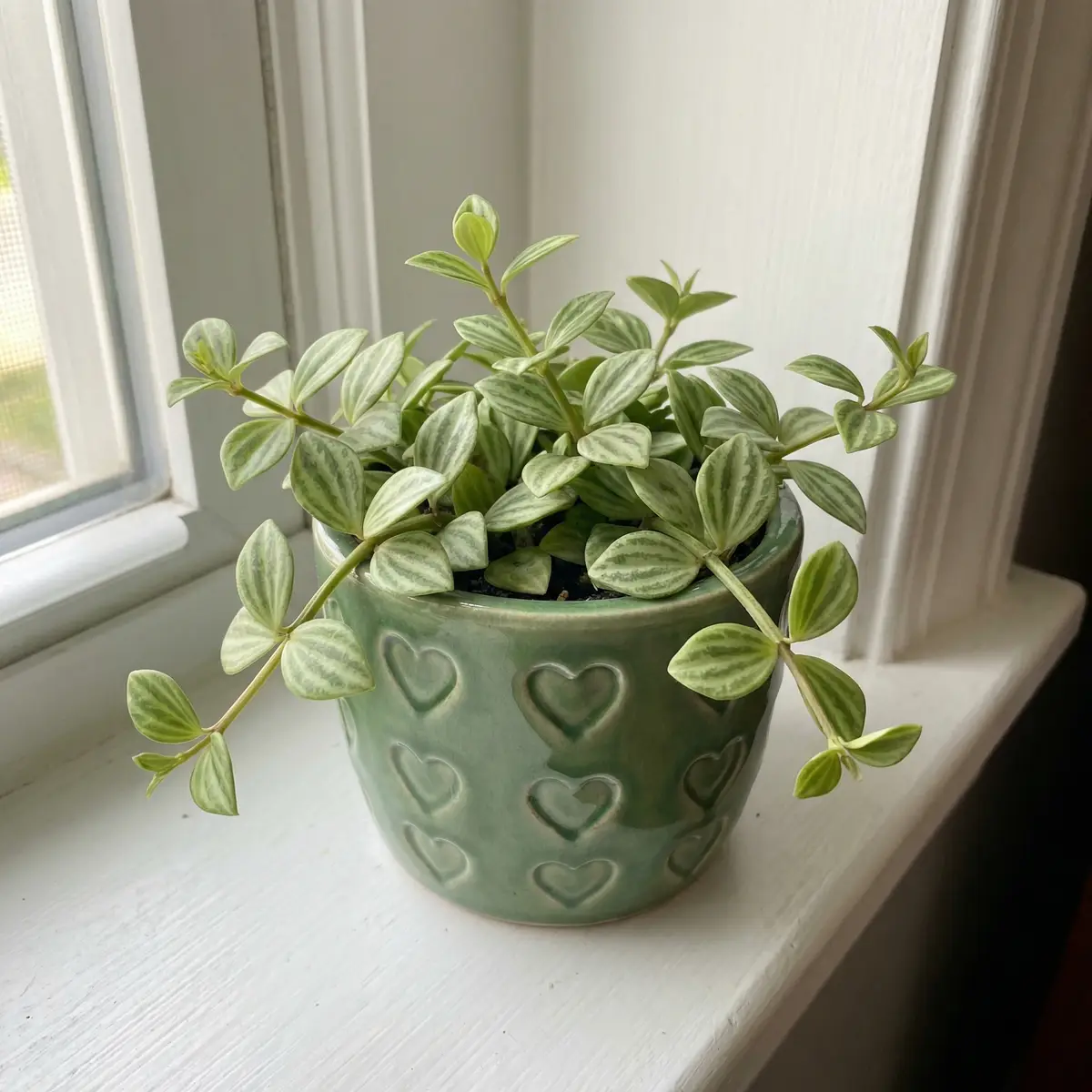
Best Light for Beetle Peperomia Indoors
Bright indirect to medium indirect light covers the full range this plant will thrive in. It is one of the more adaptable peperomias for indoor conditions, which is part of what makes it so reliable.
An east-facing window is a strong first choice. The soft morning light suits the plant perfectly and there is no risk of heat damage. A north-facing window with good ambient brightness also works well, especially in summer.
If you have a south or west exposure, keep the plant a few feet back or use a sheer curtain. The leaves are small and slightly waxy, but prolonged direct afternoon sun will bleach the stripes and stress the plant.
For spots farther from windows, Beetle Peperomia tolerates medium indirect light better than most striped plants. Our indoor lighting guide can help you measure and compare spots if you are uncertain which works best.
What Happens in Low Light
In genuinely low light, the plant does not die quickly, but the stripes fade, new leaves grow smaller, and the stems stretch toward any available source. That stretching is called leggy growth and it is one of the clearest signs the plant needs a better position.
If the plant looks pale and the stems are long with wide gaps between leaves, move it closer to a window. If a grow light is your only option, a full-spectrum LED positioned about 12 to 18 inches above the plant makes a reasonable substitute.
Signs of Too Much Direct Sun
Direct sun does not cause immediate drama, but over time you will see pale or bleached patches on the upper leaf surface, especially on the striped areas. The dark green between the stripes may also fade to a lighter, washed-out green.
If that happens, move the plant back from the glass or filter the light. New growth will come in with better color once the light is more appropriate.
💧 How to Water Beetle Peperomia
Watering Frequency and the Dry-Down Rule
The most important rule with Beetle Peperomia is to let the top inch of soil dry out before watering again. The leaves are slightly succulent, which means the plant can buffer a little drought. It cannot buffer sitting in wet soil.
In most homes during spring and summer, that interval lands somewhere between seven and ten days. In winter, or in a cooler north-facing room, it can stretch to fourteen days or more.
Do not water on a fixed calendar. Check the top inch of soil with your finger or a moisture meter before deciding. That one habit prevents the majority of problems people run into with this plant.
How to Water Properly
Water thoroughly when you do water. Add water until it runs freely from the drainage holes, then let the pot drain completely before returning it to its saucer or cachepot.
Never leave the pot sitting in standing water. Beetle Peperomia has a shallow, compact root system that saturates quickly, and roots left in pooled water rot faster than most people expect.
If you prefer to bottom water, set the pot in a shallow tray of water for ten to fifteen minutes, then lift it out and let it drain. Bottom watering keeps the foliage dry and encourages roots to grow downward.
Seasonal Watering Adjustments
- Spring: watering frequency increases as growth resumes. The soil starts drying faster again.
- Summer: check more often, especially in bright warm spots. The plant uses more water during active growth.
- Fall: gradually extend the interval as growth slows. Let the soil stay drier a bit longer between waterings.
- Winter: water less. Cold wet soil is a primary trigger for root rot in this plant.
Our watering guide covers how to adjust the rhythm as seasons and room conditions change.
Overwatering vs Underwatering
Both look like drooping, but the soil tells you which is happening. If the soil is soggy and the stems look soft, overwatering is the problem. If the soil is bone dry and the leaves feel slightly flat, the plant is thirsty.
Yellowing leaves and soft stems almost always point to too much water. Wilting or drooping in dry soil means it is time to water. Do not guess. Check the soil and respond to what you find.
🪴 Best Soil for Beetle Peperomia
What Kind of Mix to Use
Beetle Peperomia needs a well-draining mix that holds a little moisture but never becomes dense or waterlogged. A standard indoor potting mix on its own is usually too heavy and stays wet too long.
A reliable starting blend is two parts all-purpose potting mix to one part perlite. You can also add a small amount of coarse sand or fine orchid bark to open up the structure further. The goal is a mix that drains freely after watering and does not compact over time.
Our soil guide explains in detail why drainage matters so much for compact-rooted trailing plants like this one.
Pot Choice and Drainage
Drainage holes are not optional. Any pot without holes traps excess water and puts the roots at risk.
Terracotta pots work especially well for Beetle Peperomia because they allow moisture to evaporate through the walls, which gives the root zone extra buffering against overwatering. Plastic pots retain moisture longer, which is fine if you are careful, but less forgiving if you tend to water frequently.
For a decorative setup, a plastic nursery pot inside a cachepot gives you the best of both worlds. Our plant pots guide covers how to compare pot materials for different care habits.
When to Refresh the Mix
Potting mix breaks down over time. It compresses, loses air structure, and begins retaining water longer than it should. When you notice the soil staying wet for more than two weeks after watering, or when fungus gnats keep appearing despite good watering habits, the mix is often the culprit.
Refreshing the soil every one to two years at repotting time keeps the root zone healthy and makes watering easier to judge.
🍼 Fertilizing Beetle Peperomia
How and When to Feed
Beetle Peperomia is a light feeder. A balanced liquid fertilizer at half the recommended strength, applied once a month in spring and summer, gives the plant what it needs without overpowering the roots.
Stop feeding in fall and resume when you see active new growth return in spring. Fertilizing a slow or dormant plant in winter does nothing useful and can cause salt buildup in the soil.
What Overfertilizing Looks Like
Too much fertilizer shows up as brown leaf tips, pale or faded leaves, and a white or tan crust forming on the soil surface. If that happens, flush the pot with plain water to rinse out excess salts and scale back the feeding schedule.
Always water the plant before fertilizing. Applying fertilizer to a dry root ball concentrates the salts and burns the roots. Our fertilizing guide covers how to adjust the schedule based on season and growth rate.
🌡️ Beetle Peperomia Temperature and Cold Tolerance
Ideal Temperature Range
Beetle Peperomia is comfortable between 65 and 80 degrees Fahrenheit, which is 18 to 27 degrees Celsius. That range matches typical indoor living spaces very well.
Do not let the plant drop below 50 degrees Fahrenheit for any extended period. Brief cold exposure causes the leaves to lose firmness and the stems to soften. Prolonged cold, especially in combination with wet soil, is a reliable path to root rot.
Drafts, Vents, and Cold Glass
Cold air from open windows, exterior doors, or air conditioning vents can stress the plant even when the room temperature is otherwise fine. The sudden temperature drop is the problem, not just the average temperature.
Keep the plant away from cold glass in winter. The temperature at the glass surface can be significantly lower than the room temperature a foot or two away, and the roots feel that difference even if you do not.
Similarly, keep it away from heating vents. Hot dry air blasting the foliage dries the edges, causes brown crispy edges, and stresses the plant even if the temperature itself is within the acceptable range.
💦 Beetle Peperomia Humidity Requirements
How Much Humidity Does Beetle Peperomia Need?
This plant is one of the most humidity-tolerant peperomias. It manages perfectly well at average household humidity of 40 percent or above, which is within normal indoor range for most homes.
Higher humidity, in the 50 to 60 percent range, produces noticeably lusher and more vibrant growth. The leaves look deeper in color, the stems extend faster, and the trailing effect is more lush. But the plant does not suffer in dry air the way ferns or calatheas do.
Simple Ways to Raise Humidity
If your home runs dry, there are a few approaches that work well without creating a soggy environment:
- Group Beetle Peperomia with other plants. Transpiration from the group raises local humidity gently.
- Use a small humidifier near the plant if the air drops below 40 percent in winter.
- Place it in a kitchen or bathroom with a window if the light is adequate there.
Avoid misting this plant directly. Misting does not raise ambient humidity in any meaningful way, and water sitting on the leaves overnight can encourage mold or fungal spotting. Our humidity guide covers the smarter ways to manage air moisture around tropical foliage plants.
Terrarium Humidity
Inside an open terrarium, Beetle Peperomia benefits from the slightly elevated humidity while still getting the airflow it needs. This is one of the reasons it is often recommended as a terrarium plant.
In a closed terrarium, the humidity may be higher than the plant ideally wants, and poor air circulation becomes a genuine risk for rot. Open terrariums or those with vented lids are a better fit.
🌸 Beetle Peperomia Flowering
What the Flowers Look Like
Beetle Peperomia produces slim, greenish-yellow rat-tail flower spikes that emerge from the leaf axils during spring and summer. The flowers are typical for the peperomia genus: long, narrow, and not particularly decorative.
Most growers treat them as a sign that the plant is healthy and content rather than as a display feature. They do not have a significant fragrance and do not consume much plant energy.
Should You Remove the Flower Spikes?
This is a matter of preference. Leaving them causes no harm. Removing them once spent keeps the plant looking clean and may encourage more leaf growth on mature plants.
If you want to encourage blooming, the recipe is straightforward: consistent bright indirect light, regular watering without waterlogging, and monthly feeding in the growing season. The spikes appear most reliably on mature plants in good health.
🏷️ Beetle Peperomia Types and Similar Plants
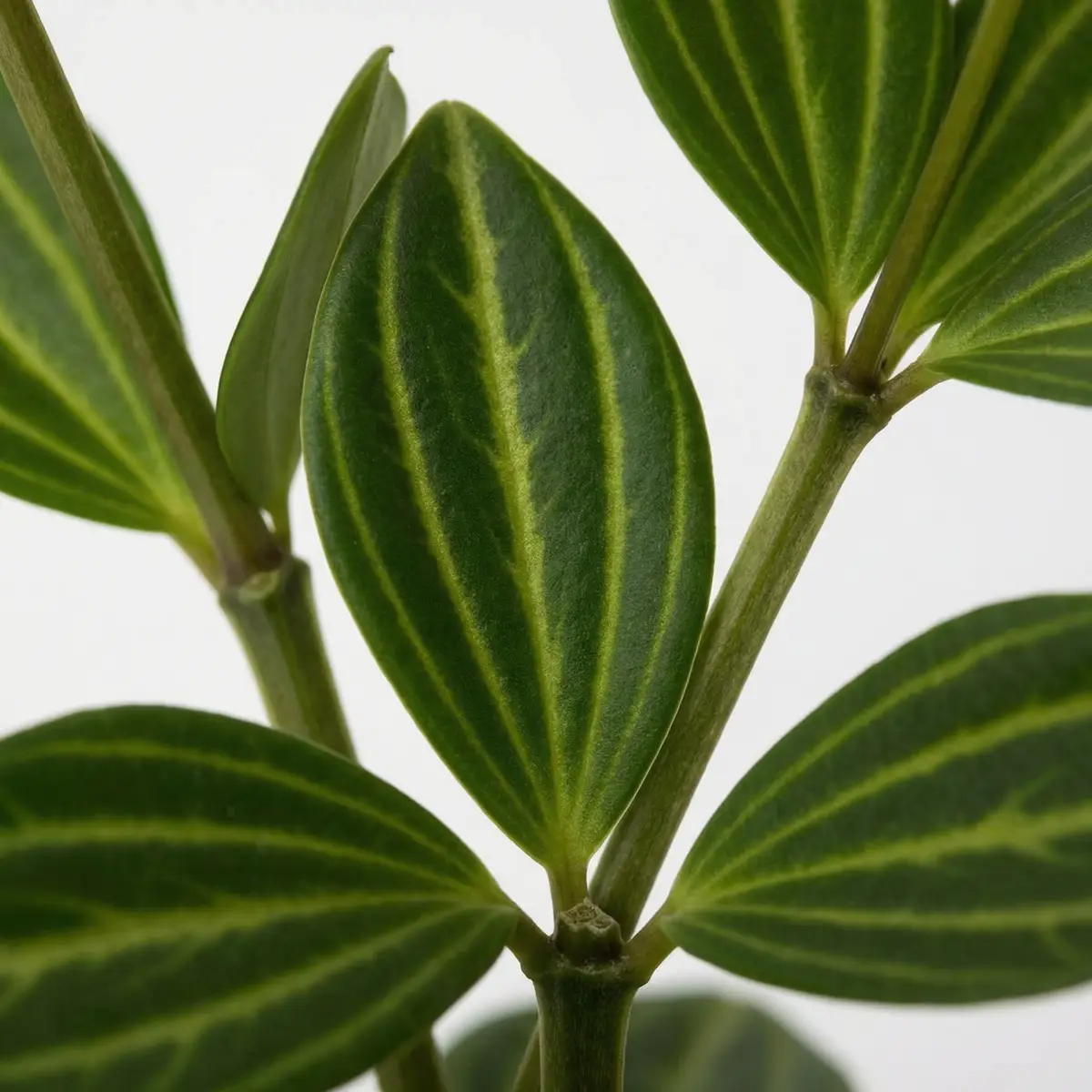
Peperomia angulata vs Peperomia puteolata
The plant most likely to be confused with Beetle Peperomia is Parallel Peperomia, which is Peperomia puteolata. Both are small trailing plants with striped leaves, and they are sold interchangeably at many nurseries.
The key differences:
- Leaf size and shape: Beetle Peperomia has smaller, more oval, and slightly stiffer leaves. Parallel Peperomia has larger, more elongated leaves that taper to a finer point.
- Stem shape: Beetle Peperomia stems are distinctly four-angled (square in cross-section). This is where the species name angulata comes from. Parallel Peperomia has round stems.
- Striping: Both have pale parallel stripes, but Parallel Peperomia tends to have slightly more prominent striping on larger leaf surfaces.
- Overall size: Parallel Peperomia trails more aggressively and can become a noticeably larger plant.
Care is nearly identical for both. If you have one, you can care for the other the same way.
Beetle Peperomia vs Watermelon Peperomia
Watermelon Peperomia is a frequent comparison because both have striped foliage within the same genus. But the two plants look quite different in person.
Watermelon Peperomia grows as a compact rosette with large rounded leaves marked by wide silver stripes on reddish petioles. It does not trail. Beetle Peperomia has much smaller dark green leaves with pale linear stripes and a true trailing habit.
Watermelon Peperomia is also more demanding about watering and crown moisture. Beetle Peperomia is more forgiving and better suited to hanging displays.
Beetle Peperomia vs String of Turtles
String of Turtles is another patterned trailing plant that sometimes appears alongside Beetle Peperomia in plant shops. Both trail, both have patterned leaves, and both work in terrariums.
String of Turtles has very small round leaves with a turtle-shell mosaic pattern rather than linear stripes. Its stems are wire-thin and more fragile. It is also more sensitive to overwatering and dryness than Beetle Peperomia, which makes Beetle Peperomia the easier choice for less experienced growers.
If you want both in a single arrangement, they pair beautifully because the patterning is complementary rather than repetitive.
🪴 Potting and Repotting Beetle Peperomia
How Often to Repot
Beetle Peperomia has a shallow, compact root system and does not need frequent repotting. Every one to two years is a reasonable schedule, though many plants are happy staying in the same pot for two years or more if the soil is still draining well.
The best time to repot is in spring, when the plant is beginning its active growing season and will recover quickly. Avoid repotting in winter unless the plant is in crisis.
Signs That Repotting Is Needed
- Roots are circling densely at the drainage holes.
- The soil dries out very fast after watering, suggesting the roots have taken up most of the space.
- The mix stays wet too long, indicating it has broken down and lost its structure.
- The plant looks disproportionately large and top-heavy for the pot.
If none of these apply, there is no reason to repot. An unnecessary repot in a pot too large will hold more soil moisture than the roots can use and may trigger the root rot you were trying to avoid.
How to Choose the New Pot
Go up only one pot size at a time, typically one to two inches in diameter larger than the current container. Too much extra soil volume stays wet too long.
Shallow pots suit the root architecture of this plant better than tall deep pots. Wide and shallow is a better shape than narrow and deep for Beetle Peperomia. Our repotting guide explains how to handle root inspection and potting mix selection during the process.
✂️ Pruning and Shaping Beetle Peperomia
Why Pruning Matters for Trailing Peperomias
Left unpruned, Beetle Peperomia will trail long stems with good leaf cover near the tips but increasingly bare sections closer to the base. Regular pinching prevents this and keeps the plant dense and full throughout its length.
This is not a plant that needs hard pruning. Light tip pinching is the main technique, and it doubles as a source of cuttings for propagation.
How to Prune Beetle Peperomia
Pinch or cut just above a leaf node using clean scissors or a clean fingernail pinch. Removing the tip signals the stem to branch, which gives you two growing points instead of one.
Do this regularly through spring and summer while the plant is actively growing. A plant that gets tip-pinched four or five times through the season looks dramatically fuller than one that was left to grow unchecked.
The pinched tips are ready-to-go cuttings. Rather than discarding them, place them directly into fresh moist mix or a glass of water.
Handling Leggy or Sparse Growth
If the stems have already stretched out and become bare, cut them back more firmly. Trim to just above a healthy node and the stem will typically regrow from that point.
Very sparse, leggy growth is almost always a light problem first and a pruning problem second. Fix the light conditions before doing a heavy trim, or you will be trimming again in a few months.
🌱 How to Propagate Beetle Peperomia
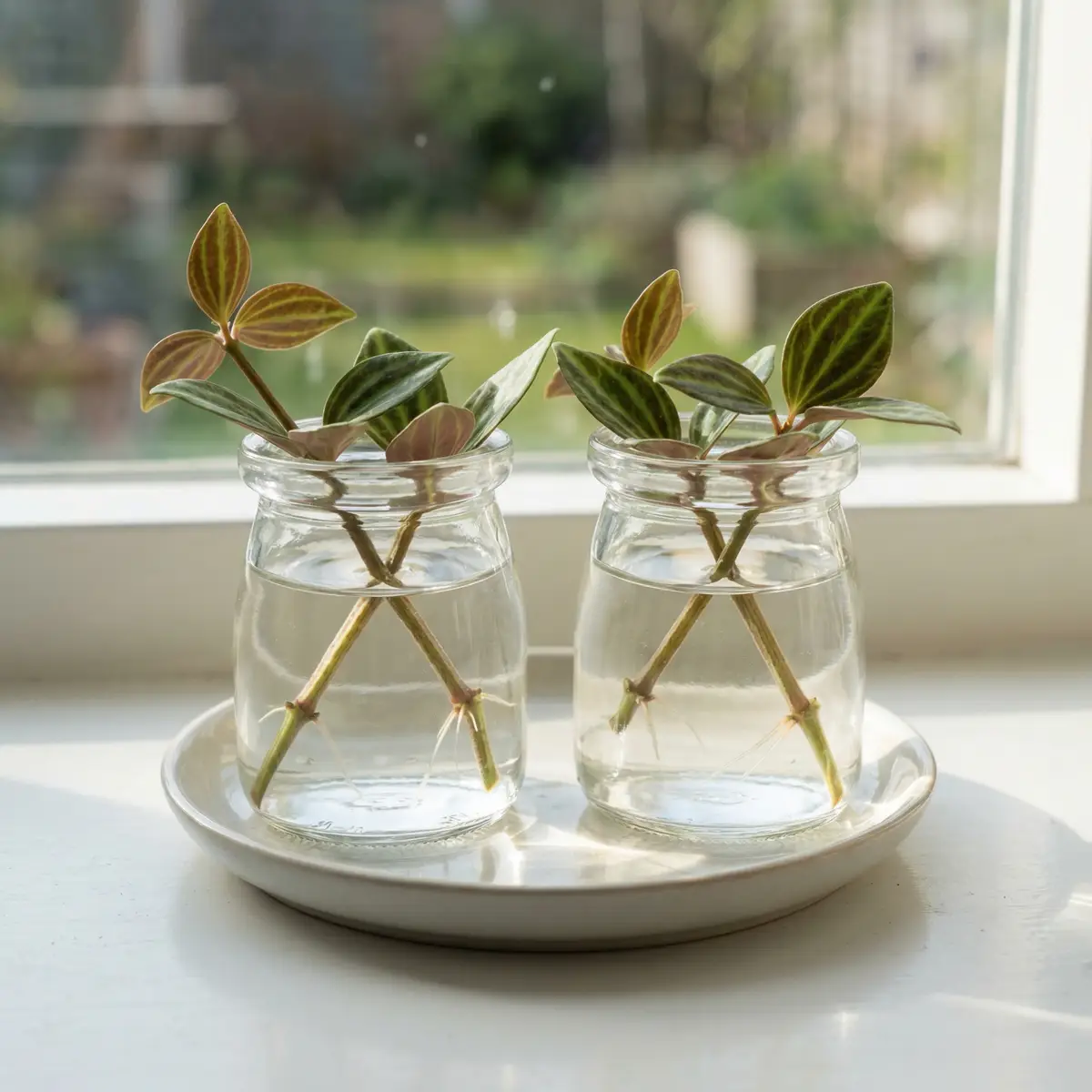
Why Stem Cuttings Work So Well Here
Beetle Peperomia is one of the easiest peperomias to propagate. The stems are stiff enough to handle without breaking, each cutting has clear nodes, and roots develop quickly in warm conditions.
This is the ideal plant to practice propagation with before attempting more delicate peperomias. You can take cuttings when you prune and have new rooted plants within three to four weeks.
Propagating in Water
- Take a stem cutting with at least two or three nodes and a few healthy leaves.
- Remove the leaves from the bottom one or two nodes so the submerged section is clean.
- Place the cutting in a small glass or jar of room-temperature water, with the bare nodes submerged and the top leaves above the waterline.
- Set it in bright indirect light.
- Change the water every three to five days to keep it fresh.
- Roots usually appear within two to four weeks. Once they are an inch or more long, pot the cutting into moist airy soil.
Our water propagation guide has full step-by-step detail if you want extra guidance.
Propagating in Soil
- Take a stem cutting as described above.
- Allow the cut end to callous for a few hours, or plant immediately into lightly moist mix.
- Insert the bottom nodes into the soil so at least one node is buried.
- Keep the soil consistently moist but not saturated.
- Place in warm bright indirect light.
- New growth emerging from the cutting is the sign that roots have taken.
Soil propagation results in a cutting that is already adjusted to growing in mix, which makes the transition easier. Our soil propagation guide covers the technique in full detail.
Terrarium Propagation
Beetle Peperomia also roots reliably when cuttings are placed directly into the growing medium of a terrarium. The slightly elevated humidity inside an open terrarium speeds up root formation.
Place the cutting at the edge or corner of the terrarium so it can trail naturally. Keep the medium moist but not wet and the cutting should root without any special treatment. This is one of the most satisfying ways to fill out a new terrarium quickly.
🐛 Beetle Peperomia Pests and Treatment
What Pests to Watch For
Beetle Peperomia is not particularly pest-prone when grown in good conditions, but no houseplant is completely immune. The most common pests are spider mites, mealybugs, fungus gnats, and scale insects.
Spider mites tend to appear when the air is very dry or the plant is stressed. Mealybugs cluster in the joints where leaves meet stems. Fungus gnats are a soil problem rather than a plant problem and appear when the mix stays too wet for too long. Scale insects can go unnoticed for weeks because they sit still and blend into the stems.
How to Treat Pests on Beetle Peperomia
Isolate the plant as soon as you spot a problem. For spider mites and mealybugs, wipe the affected areas with a cloth dampened in diluted insecticidal soap or rubbing alcohol. Repeat every five to seven days for three weeks to break the life cycle.
For scale insects, use a cotton swab dipped in rubbing alcohol to remove each one individually from the stem. Follow up with insecticidal soap to catch any missed crawlers.
For fungus gnats, the fix is in the watering habit. Let the soil surface dry out between waterings, which breaks the life cycle because the larvae cannot survive in dry conditions. Sticky yellow traps help monitor the population but do not eliminate the problem on their own.


🩺 Beetle Peperomia Problems and How to Fix Them
Root Rot from Overwatering
Root rot is the primary disease threat for Beetle Peperomia. It develops when the roots stay wet for too long, either from watering too frequently, using soil that does not drain well, or leaving the pot sitting in standing water.
Early signs include soft stems, yellowing lower leaves, and a sour smell from the soil. If you catch it early, unpot the plant, trim the affected roots, let the healthy roots air-dry briefly, and repot into fresh well-draining mix. Later-stage root rot may leave the plant with too few healthy roots to recover.
Yellowing Leaves
Yellowing leaves on Beetle Peperomia are most often caused by overwatering or cold wet soil. Occasional lower leaf yellowing on an otherwise healthy plant is normal as older leaves cycle out.
If yellowing is widespread and accompanied by soft stems, root rot is likely. If the plant looks otherwise firm but leaves are slowly turning yellow from the bottom up, check the watering frequency and soil drainage.
Pale, Faded, or Washed-Out Leaves
Pale or faded leaves and loss of stripe contrast are both light-related. Either the plant is not getting enough light, causing general pallor, or it is getting too much direct sun, which bleaches the leaf surface.
Move the plant to brighter indirect light for the first scenario. Filter or reduce direct sun exposure for the second. New growth will come in with better color once the light is corrected.
Brown Crispy Edges
Brown crispy leaf edges are usually caused by very low humidity, heat from a nearby vent, irregular watering, or salt buildup in the soil.
Check the location first. If the plant is near a heater vent or in very dry air, relocate it. If the soil surface shows a white crust, flush the pot with plain water to clear excess salts.
Wilting and Drooping
Wilting or drooping has two very different causes that require opposite responses. Check the soil moisture before doing anything else.
If the soil is dry, the plant needs water. If the soil is wet or the stems feel soft, overwatering or root rot is the cause and adding more water will make it worse. Unpot to inspect the roots if you are unsure.


🖼️ Beetle Peperomia Display Ideas and Styling
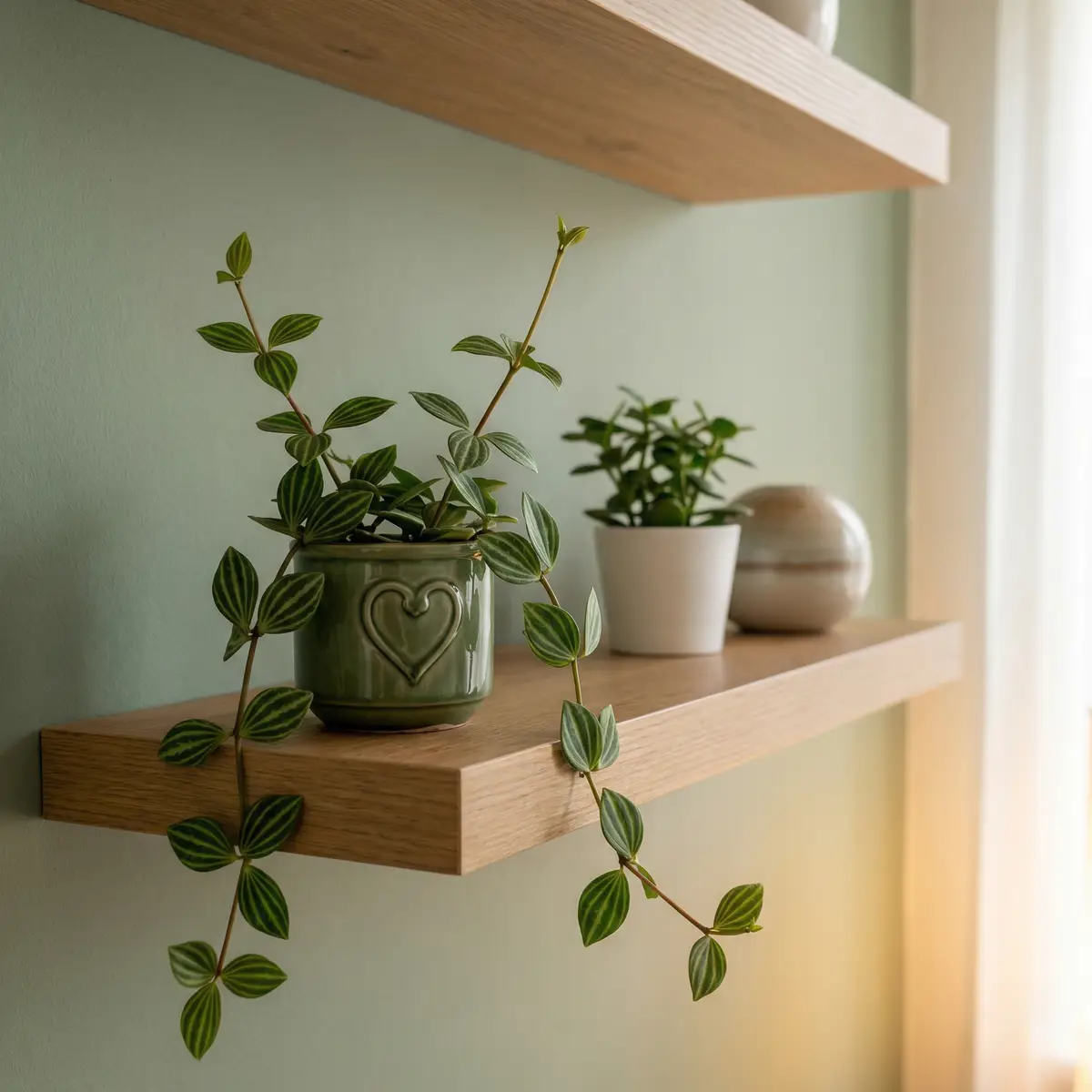
Where Beetle Peperomia Looks Best
The trailing habit is the defining feature to work with. A shelf edge, hanging basket, or elevated planter lets the stems spill naturally downward, which is when the plant looks its best.
Eye level or slightly above is ideal so you can see the striped leaves as they trail. A high shelf out of sightline wastes the visual appeal.
In terrariums, place it at the front or along one side so the trailing stems have somewhere to go and the striped leaves remain visible through the glass.
Companion Plants That Work Well
Beetle Peperomia pairs naturally with other peperomias because the care requirements align and the varied leaf forms create visual contrast without competing.
- Watermelon Peperomia provides a wide rosette shape that anchors the arrangement while the Beetle trails around it.
- Peperomia Napoli Nights offers deep silvery leaves for a tonal contrast.
- Baby Rubber Plant adds upright glossy greenery behind the trailing form.
- String of Turtles pairs well in terrariums where the turtle-shell and beetle-stripe patterns create a layered patterned landscape.
- Chinese Money Plant provides round flat coins of green at a different scale, which makes the small striped leaves of the Beetle Peperomia stand out even more.
Container and Styling Notes
Simple pots work best. The plant’s detail is in the leaf texture and patterning, so a busy or heavily decorated container competes with the foliage.
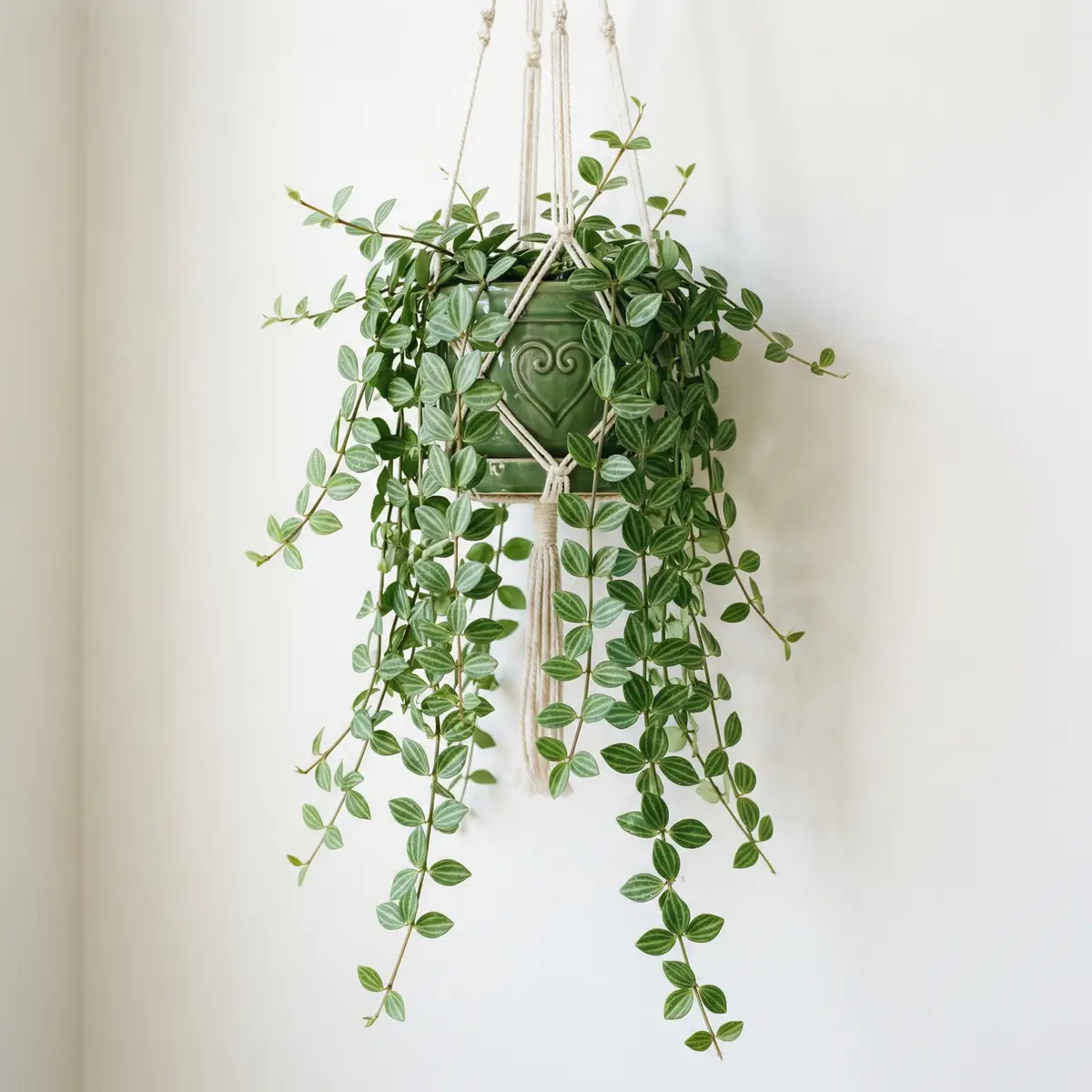
Terracotta, matte ceramic, and plain white or neutral pots all let the leaf pattern do the work. Hanging macrame or basket-style planters suit the trailing form well and give the stems room to fall freely.
🌟 Beetle Peperomia Care Tips
✅ Check the top inch of soil before every watering. The leaves are slightly succulent and can handle a missed day.
✅ Bright indirect light produces the best stripe contrast. Medium light is fine but the patterning will be subtler.
✅ Pinch the stem tips regularly to keep growth full rather than sparse and leggy.
✅ Use shallow pots with drainage holes. The root system is compact and wide, not deep.
✅ Propagate when you prune. The tip cuttings root without any special treatment.
✅ Place it in a terrarium at the front edge so the trailing stems have room to develop naturally.
✅ Avoid misting. It does not raise humidity meaningfully and water sitting on leaves overnight creates more problems than it solves.
✅ Keep it away from heating vents and cold drafts. Sudden temperature shifts cause more stress than steady cool temperatures.
✅ If you see leggy bare stems, fix the light first, then prune. Pruning without fixing the light just repeats the problem.
✅ Do not fertilize in winter unless the plant is actively pushing new growth in strong light conditions.
❓ Frequently Asked Questions
Is Beetle Peperomia toxic to pets?
No. Beetle Peperomia is considered non-toxic to cats, dogs, and people. It is one of the safer houseplants you can keep in a home with animals.What is the difference between Beetle Peperomia and Parallel Peperomia?
Both are small trailing peperomias with striped leaves, and they are often confused at the nursery. Beetle Peperomia (Peperomia angulata) has smaller, oval, slightly stiffer leaves and four-angled stems. Parallel Peperomia (Peperomia puteolata) has larger, more elongated leaves with more pronounced striping and rounder stems. The two have similar care needs, but Parallel Peperomia generally grows larger and trails more aggressively.Why are the stripes on my Beetle Peperomia fading?
Fading or washed-out stripes almost always point to light that is too low. Move the plant to a brighter spot with good indirect light and the new growth should emerge with stronger, crisper banding. Direct sun can also bleach the coloring, so bright filtered light is the goal.How do I propagate Beetle Peperomia?
Stem cuttings are the easiest method. Take a cutting with two or three nodes, remove the lower leaves, and place it in water or moist airy soil. Roots appear within two to four weeks in warm conditions. It is one of the most forgiving peperomias to propagate.Can Beetle Peperomia grow in a terrarium?
Yes. Its small leaf size, trailing habit, and tolerance for moderate humidity make it a natural fit for open terrariums and larger planted terrariums with good airflow. Avoid fully sealed setups where moisture has no exit, as soggy conditions will cause root rot.How often should I water Beetle Peperomia?
Wait until the top inch of soil is dry before watering again, then water thoroughly and let the pot drain. In most homes this works out to every seven to ten days in the growing season and less often in winter. The leaves are slightly succulent, which gives the plant some buffer if you run a little dry.ℹ️ Beetle Peperomia Info
Care and Maintenance
🪴 Soil Type and pH: Well-draining potting mix with perlite; avoid dense heavy soil
💧 Humidity and Misting: Tolerates average home humidity of 40 percent or higher. More humidity produces lusher growth.
✂️ Pruning: Pinch stem tips regularly to encourage dense, bushy trailing growth.
🧼 Cleaning: Wipe leaves gently with a damp cloth to remove dust from the textured surface
🌱 Repotting: Every 1-2 years. Shallow-rooted and content in small pots
🔄 Repotting Frequency: Every 1-2 years
❄️ Seasonal Changes in Care: Reduce watering in winter and keep away from cold drafts and heating vents
Growing Characteristics
💥 Growth Speed: Moderate
🔄 Life Cycle: Perennial
💥 Bloom Time: Spring and Summer
🌡️ Hardiness Zones: 10-12
🗺️ Native Area: Northern South America, including Colombia, Venezuela, Ecuador, and Peru
🚘 Hibernation: No true dormancy, but growth slows in winter
Propagation and Health
📍 Suitable Locations: Hanging baskets, shelf edges, terrariums, windowsills, and desks
🪴 Propagation Methods: Stem cuttings root very easily in water or moist soil. One of the easiest peperomias to propagate.
🐛 Common Pests: spider-mites, mealybugs, fungus-gnats, and scale-insects
🦠 Possible Diseases: Root rot is the main concern when the soil stays too wet for too long
Plant Details
🌿 Plant Type: Trailing tropical perennial with angular four-sided stems
🍃 Foliage Type: Evergreen
🎨 Color of Leaves: Dark green with 4-5 parallel lighter green or yellow-green stripes
🌸 Flower Color: Greenish-yellow
🌼 Blooming: Produces slim greenish-yellow rat-tail flower spikes; mostly grown for foliage
🍽️ Edibility: Not edible
📏 Mature Size: 4-8 inches upright, trailing stems reach 12-24 inches
Additional Info
🌻 General Benefits: Distinctive striped foliage, pet-safe, easy propagation, excellent for trailing displays and terrariums
💊 Medical Properties: None known
🧿 Feng Shui: The striped leaves and trailing form are associated with steady energy and movement
⭐ Zodiac Sign Compatibility: Virgo
🌈 Symbolism or Folklore: Resilience, adaptability, and natural patterning
📝 Interesting Facts: The species name angulata refers to the four-angled stems. Each stem has a distinctly square cross-section, which is unusual in the peperomia genus and makes the plant easy to identify even when the leaves are not visible. The leaf stripes mimic the banding seen on certain beetle species, hence the common name.
Buying and Usage
🛒 What to Look for When Buying: Look for a plant with multiple trailing stems, firm dark green leaves with clearly defined pale stripes, and no yellowing or mushy growth at the base.
🪴 Other Uses: Ideal for terrariums, fairy gardens, and mixed trailing baskets. Also works as ground cover in tropical-style container combinations.
Decoration and Styling
🖼️ Display Ideas: Let it trail from a hanging basket, drape over a shelf edge, or use it as a trailing component inside an open terrarium
🧵 Styling Tips: Beetle Peperomia pairs naturally with other members of the family. Try it beside Watermelon Peperomia for a contrast in leaf shape, or alongside String of Turtles for a mixed trailing display with layered patterning.
🪴 See also 🪴

Complete Guide to Peperomia Hope Care and Growth

Complete Guide to Parallel Peperomia Care and Growth

Complete Guide to Watermelon Peperomia Care and Growth

Complete Guide to Raindrop Peperomia Care and Growth

Complete Guide to Baby Rubber Plant Care and Growth

Complete Guide to String of Turtles Care (Peperomia prostrata)

Complete Guide To Peperomia Orba Care and Growth

Complete Guide To Peperomia Green Bean Care and Growth

Complete Guide To Peperomia Rosso Care and Growth

Complete Guide To Red Ripple Peperomia Care and Growth

Complete Guide to Peperomia Napoli Nights Care and Growth

Complete Guide To Silver Ripple Peperomia Care and Growth

